
Navigating a layoff is one of the most challenging responsibilities a leader can face. It's a decision fraught with financial, legal, and emotional complexities. Getting it wrong can lead to costly legal disputes, damage your company's reputation, and demoralize your remaining team. Getting it right requires a process that is not only legally defensible but also fundamentally humane.
This guide provides a practical, actionable playbook for business owners and HR leaders. It moves beyond high-level advice to offer a structured framework for handling layoffs with clarity, compassion, and compliance. The goal is to protect your organization while treating every individual with the dignity they deserve.
The foundation of any reduction in force is a process built on objective, fair, and non-discriminatory criteria. Every decision must be documented, defensible, and executed with care. A strategic, structured approach is your most critical asset in these moments.
Many leaders partner with an HR risk advisor to navigate these high-stakes situations. This specialized guidance helps create clear termination protocols, ensure documentation is robust, and manage the complexities of state and federal laws. A well-defined process is designed to withstand scrutiny from the start. You can learn more about this advisory approach at paradigmie.com.
A well-executed layoff isn't a reactive crisis—it's a structured business process. When every action is deliberate, documented, and aligned with legal requirements, you minimize risk while upholding the dignity of everyone involved.
By adopting a methodical framework, you can achieve three critical outcomes:
This guide offers practical insights to help you manage this process effectively. If you are facing these difficult decisions, our team is available to provide the expert guidance you need. Reach out to us to discuss your specific situation.
A layoff that is both humane and defensible begins long before names are on a list. It starts with a clear, documented business case for the reduction in force (RIF). This is not a mere formality; it is the foundation of a process that shields your organization from legal challenges by proving the decision was strategic, not personal.
This business rationale must be objective and tied directly to operational needs. Common justifications include economic pressures, technological shifts that make certain roles obsolete, or a strategic pivot requiring a new organizational design. Documenting this business case is your first and most important step in demonstrating that decisions are driven by necessity, not bias.
Once the business reason is solidified, you must define the criteria for selecting which positions will be eliminated. The key here is objectivity. Your goal is to build a consistent, non-discriminatory framework that can be applied fairly across the entire organization.
Common and legally sound selection criteria include:
After setting your criteria and drafting a preliminary list of impacted roles, it is essential to conduct a disparate impact analysis. This critical risk-management step involves scrutinizing your selections to ensure they do not unintentionally discriminate against a protected class, such as employees of a certain age, race, or gender.
For example, if your layoff list disproportionately affects employees over the age of 40, it could raise a red flag for age discrimination under the Age Discrimination in Employment Act (ADEA), even if unintentional. The analysis involves reviewing the data to see if any group is impacted at a statistically higher rate. If a potential disparate impact is found, you must revisit your criteria or be prepared to demonstrate a compelling business necessity for your choices.
A thoughtful disparate impact analysis isn't about hitting quotas. It’s about stress-testing your objective criteria to find and fix unconscious bias, making your process as fair and legally sound as possible.
Juggling a layoff correctly means balancing a complex mix of legal, brand, and team-related factors. As this visual shows, you need to address risk from all three angles.
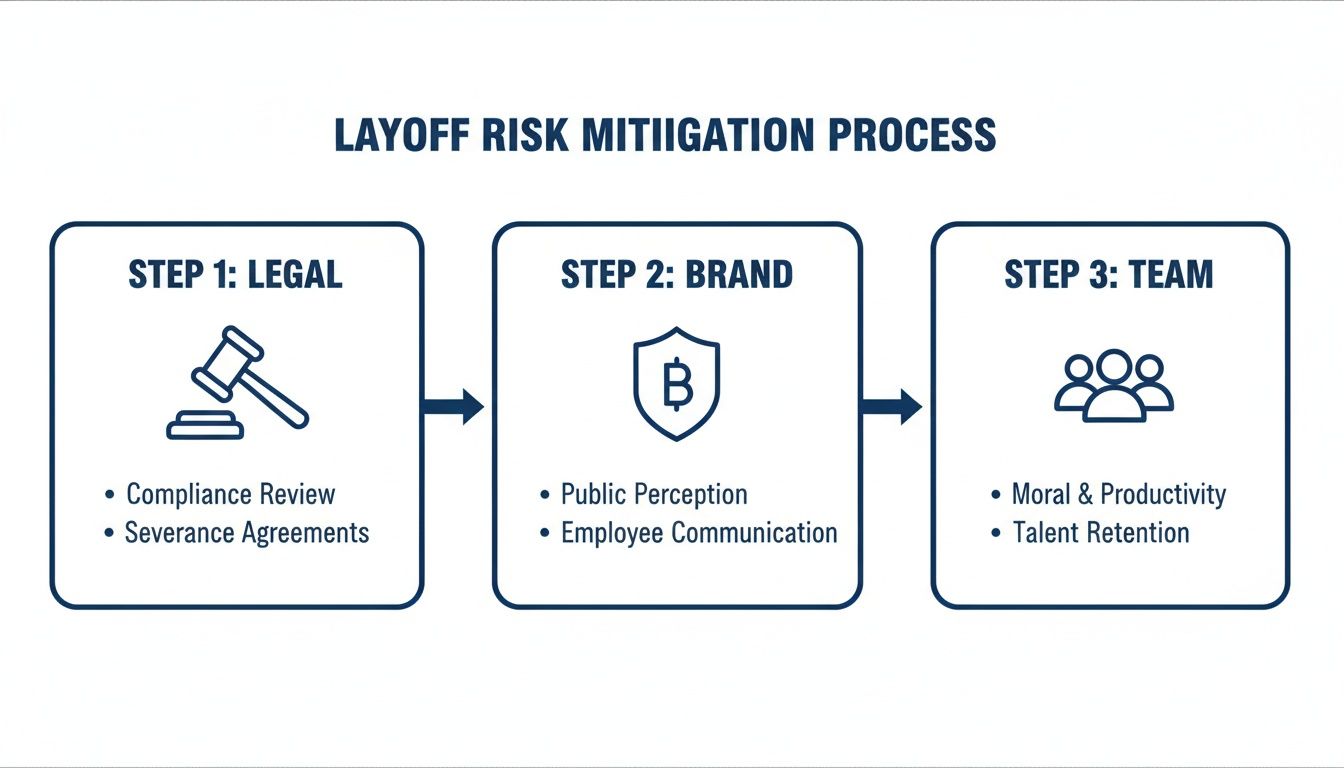
This infographic makes it clear: a truly defensible layoff strategy must manage legal compliance, protect brand reputation, and support the well-being of the remaining team. Neglecting any one of these areas can cause serious, long-term damage to your business.
Navigating the legal landscape is a non-negotiable part of handling layoffs. A web of federal and state laws governs the process, and a single misstep can lead to significant penalties. The table below outlines primary compliance areas for businesses, especially those operating in multiple states.
| Compliance Area | Key Consideration | Potential Risk of Non-Compliance |
|---|---|---|
| WARN Act (Federal) | Requires employers with 100+ employees to give 60 days' notice for mass layoffs or plant closings. | Significant financial penalties per employee, potential for class-action lawsuits. |
| State Mini-WARN Acts | Many states (e.g., CA, NY, IL) have their own laws, often with lower employee thresholds and longer notice periods. | State-level fines, penalties, and legal action separate from federal violations. |
| Final Paycheck Laws | Each state has strict deadlines for issuing final pay, often requiring faster payment for involuntary termination. | Unpaid wage claims, waiting time penalties, and potential for litigation. |
| Age Discrimination (ADEA) | Protects workers aged 40 and over. A disparate impact analysis is crucial to avoid unintentional age bias. | Wrongful termination lawsuits, EEOC investigations, and costly settlements. |
| Severance Agreements | If offered, agreements must include specific language (e.g., OWBPA waivers for employees 40+) to be legally binding. | Invalidated severance agreements, leaving the company open to future lawsuits. |
| COBRA & State Continuation | Federal COBRA (for firms with 20+ employees) and state laws mandate offering continued health coverage. | Excise tax penalties from the IRS and potential civil lawsuits from affected employees. |
The federal Worker Adjustment and Retraining Notification (WARN) Act is the most well-known regulation. It generally applies to employers with 100 or more employees and requires 60 days of advance notice for a mass layoff. To complicate matters, many states have their own "mini-WARN" acts with different rules. It is critical to know which laws apply to your business.
For more in-depth guidance on specific offboarding steps, a detailed termination checklist can be an invaluable tool to keep your process on track. Building a defensible strategy is a specialized process, and an experienced advisory partner can make all the difference. When you need clear, actionable guidance, our team is here to help. Contact us to learn how we can support your leadership.

This is the moment that defines the entire layoff process. The notification meeting is where strategic planning becomes intensely personal. How you deliver this news will be remembered by the departing employee for years to come. A conversation handled with compassion and clarity allows someone to leave with their dignity intact, while a rushed or cold delivery can create lasting resentment and increase legal risk.
Training your managers for these conversations is not optional; it is a crucial investment. They need a practical framework—not a rigid script—that empowers them to be both direct and empathetic.
The logistics of the notification meeting are just as important as the words you choose. Your primary goal is to create a private, respectful space where an employee can absorb difficult news without an audience. Rushing this step is a common and costly mistake.
Consider these details carefully:
This is not a performance review or a debate; it is the delivery of a business decision. The best conversations are brief, direct, and focused. While it feels uncomfortable, prolonging the discussion only makes it worse. It is helpful to structure the meeting in three distinct parts.
The most compassionate notification is a clear one. Ambiguity creates false hope and confusion. Be direct, be honest, and be prepared to guide them to the next step in the process without making promises you cannot keep.
The words you use in this meeting are critical. Every phrase carries weight and can either reduce or multiply your company's risk. Knowing what not to say is often more important than having a perfect script. A single offhand remark can be misinterpreted as an admission of wrongdoing or create an accidental legal promise. For more specific examples, you can review our guide on what to say when you fire someone.
When announcing these changes, careful thought must also go into how to professionally announce an employee is leaving to ensure every message is delivered with respect. This moment requires a delicate balance of humanity and precision. A well-managed notification process protects the individual's dignity and your company's reputation.
Navigating workforce reductions demands careful planning. If you're facing these difficult decisions, our team can provide the strategic support you need. Contact us to discuss how we can help you lead through this challenging process.
Once the notification meetings are complete, the focus shifts to structured, logistical follow-through. A seamless and compliant offboarding process is essential. This phase is less about emotion and more about precision. Getting the details right protects your company from future disputes and gives departing employees the clarity they need to move forward.
A comprehensive separation package is the cornerstone of a solid offboarding strategy. While not always legally required, offering severance is a powerful tool. It provides a financial cushion for the employee and, in return, allows the company to secure a release of legal claims. This step can dramatically reduce your risk of future litigation.
A severance agreement is a legally binding contract that must be drafted with extreme care. The goal is to provide consideration—typically severance pay—in exchange for the employee's promise not to pursue legal action. A poorly written agreement can be invalidated, leaving your organization exposed.
Key components of a defensible severance agreement include:
A severance agreement acts as a legal shield. By offering fair consideration in exchange for a release of claims, you are essentially closing the book on potential future disputes and creating a clean, definitive separation.
For employees aged 40 or older, the Older Workers Benefit Protection Act (OWBPA) adds strict requirements. The employee must be given at least 21 days to consider the agreement (or 45 days in a group layoff) and an additional 7 days to revoke their signature after signing. The agreement must also advise them in writing to consult with an attorney. You can find more details in our employment separation agreement template.
Beyond the legal paperwork, the logistical side of offboarding requires meticulous attention to detail. A standardized checklist ensures nothing falls through the cracks, especially when managing multiple exits at once.
Your checklist should cover several critical tasks:
As part of a compassionate offboarding process, it is also a good practice to provide resources like actionable steps for managing unemployment. Helping people navigate their next steps reinforces a positive final impression of your company. A well-organized offboarding provides a smoother transition for them and minimizes legal risks for you. If you need help structuring a defensible offboarding plan, our team is ready to assist. Contact us to ensure your process is managed with expertise.
The layoff is not over when the last person leaves. For the remaining team—your "survivors"—the most challenging period is just beginning. They may feel anxious, overworked, and uncertain about their own futures. How you lead in the coming days will determine if your company rebuilds or unravels.

Your remaining employees are watching every move you make. They need to see visible, decisive leadership, not executives hiding in their offices. This is the time to be transparent, even when it is uncomfortable. Your first move must be to address the team directly, acknowledge the human cost, and shift the narrative toward the future.
As soon as the last notification meeting is finished, gather your remaining employees. If you wait, you allow rumors and fear to fill the vacuum. This first meeting is about acknowledging the human impact and projecting stability. Keep your message direct, empathetic, and forward-looking. Acknowledge that it is a tough day and express gratitude for both the people who are leaving and those who are staying.
Layoff survivor syndrome is a real phenomenon. Your remaining employees may grapple with guilt, anxiety, and a hit to their morale. Your immediate job is to start rebuilding psychological safety with clear, consistent, and compassionate communication.
This initial address is just the start. A structured communication plan is necessary to manage the emotional fallout and keep your team informed. The framework below can help structure your communications in the following days and weeks.
| Audience | Key Message | Communication Channel | Timing |
|---|---|---|---|
| All Remaining Employees | Acknowledge the event, express gratitude, reiterate the "why," and commit to open communication. | All-hands meeting (in-person or virtual) | Day of the layoff |
| Departmental Teams | Discuss specific impacts, new role alignments, and immediate workload priorities. | Small group meetings with managers | Day after the layoff |
| Individual Employees | Check in on morale, clarify individual role expectations, and answer personal questions. | One-on-one meetings with managers | Within the first week |
| Entire Company | Provide a forward-looking vision, celebrate early wins, and reiterate the strategic direction. | Weekly or bi-weekly updates | Ongoing for the next 30-60 days |
Following a clear cadence like this demonstrates that you have a plan and are committed to keeping them informed, which is critical for rebuilding trust.
You cannot expect business as usual with fewer people. Dumping the work of departed colleagues onto your remaining team without a strategy is a fast way to cause burnout. This is a critical moment to recalibrate roles and reset expectations. Work with your managers to map out essential tasks. Some responsibilities may need to be paused or redistributed.
A few practical steps can help:
Your best employees may now be considering their options. To retain them, you must show they are valued and that there is a compelling future for them at the company. Now is the time to reinvest in your team's development and well-being. This could mean providing new training, offering mental health resources, or creating forums for employees to voice concerns.
Navigating the aftermath is a true test of leadership. It demands a balance of empathy, strategic clarity, and decisive action. If you need help developing a post-layoff leadership and communication strategy, our team has the expertise to guide you. Please contact us to learn how we can help you rebuild momentum. Leading through this period is an opportunity to reshape your culture and emerge as a more resilient and focused organization.
When planning a reduction in force, leaders often face tough, practical questions under immense pressure. Here, we address some of the most common challenges that arise.
There is no single magic number for severance pay. While no federal law requires it (unless a contract is in place), severance is an important strategic tool. A common starting point is one to two weeks of pay for every year of service, but this is just a baseline.
Several factors should inform your decision:
Yes, offering outplacement services is an investment that pays for itself in goodwill and risk reduction. These services provide departing team members with practical support like career coaching, resume assistance, and job search strategies. This act of goodwill shows you care about your people, and employees who feel supported are far less likely to pursue legal action.
An investment in outplacement is an investment in your company’s reputation. It shows both departing and remaining employees that you value people, which is a message that lasts long after the layoff is over.
This is a tempting but dangerous shortcut. A layoff is a business decision based on objective criteria, not a performance management tool. Using a layoff to avoid a difficult termination can undermine the integrity of your entire process and expose you to wrongful termination claims. If an employee with a documented history of poor performance also happens to hold a role being eliminated, that history can be a secondary factor, but it cannot be the primary reason.
An employee is never obligated to sign a severance agreement. If they refuse, they forfeit the severance pay but retain their right to take legal action. Do not pressure them or renegotiate. Simply move forward with the standard offboarding process, ensuring you pay their final wages on time and provide all legally required notices, like COBRA information. Document that the offer was made and declined while maintaining a professional tone.
If you plan to rehire, you must be careful and consistent. Establish clear, objective criteria for any new roles. Your hiring decision should be based on the specific skills needed now, not on past employment. Most importantly, do not make any promises or hint at the possibility of re-employment during the layoff notification, as this can create false hope and legal liability.
Navigating the complexities of a layoff requires sound judgment and expert guidance. At Paradigm International Inc., we act as a decision partner for leaders facing these high-stakes moments, helping you manage risk and lead with confidence.
A well-planned and compassionately executed layoff process protects your business, your brand, and your people. If you would like to learn more about how our advisory-first approach can support your organization, please contact us.