Dealing with an underperforming employee is one of the most challenging, yet necessary, responsibilities of a manager. The best path forward is always a fair, consistent, and well-documented process. This approach gives the employee a genuine opportunity to improve while protecting the organization. Following a clear framework transforms a high-risk situation into a manageable one, safeguarding both your team's morale and the business itself.

Letting poor performance continue is not a passive act; it actively damages your organization. The impact extends far beyond one person's missed deadlines. It creates a ripple effect that can demotivate your top talent, who may feel their high standards no longer matter.
Unaddressed performance issues are a major driver of employee disengagement, which costs the U.S. economy trillions each year in lost productivity. A structured process is not about being punitive. It’s about upholding standards, creating a culture of accountability, and ensuring every team member has the clarity and support they need to succeed. To navigate these conversations effectively, managers need a solid leadership toolset for managers.
This guide provides a clear, defensible framework for handling underperformance, focusing on:
Moving beyond theory helps you confidently manage underperforming employees, protect your business, and maintain a high-performing culture. If you need help building these defensible practices, connect with our team to learn more.
Before you can fix a performance problem, you must understand its source. Performance issues are rarely what they seem on the surface; they are often symptoms of deeper problems that require a careful approach. Jumping to conclusions risks applying the wrong solution, which wastes time and erodes trust.
Your role here is not to be an accuser, but a coach. The goal is to discover the "why" behind the dip in productivity by gathering objective facts. This diagnostic mindset helps you separate skill gaps from motivation problems and uncover external roadblocks that may be holding a good employee back.

The first critical step is determining if you are dealing with a capability issue (can't do) or a willingness issue (won't do). These are two different problems that demand entirely different strategies. Getting this diagnosis wrong can make things worse, like sending a disengaged employee to a training course they neither need nor want.
To gain clarity, consider these common scenarios:
A manager’s primary task is not to assign blame but to uncover the truth. Asking, "What is getting in your way?" is far more productive than asking, "Why aren't you performing?"
To make an accurate diagnosis, ground your assessment in concrete evidence, not just feelings or recent events. This means digging into past performance data before having a conversation. Collecting this information ahead of time ensures your discussion remains factual and constructive.
Here’s what you should look for:
Disengagement is a quiet but powerful driver of underperformance. Recent data reveals that U.S. employee engagement has hit a 10-year low. This apathy costs the economy an estimated $1.9 trillion annually in lost productivity. For workers under 35, the biggest causes are unclear expectations and feeling unrecognized.
When investigating performance issues, consider if underlying cognitive factors are at play. A deeper dive into understanding cognitive function tests can offer clues as to whether an employee is genuinely set up to succeed in their current role. Taking the time to properly diagnose the root cause is the most critical step in effectively handling an underperforming employee.
Once you have a clearer picture, you can create a targeted improvement plan. If you find an external blocker, you can fix it. If it's a skill gap, you can arrange for training. And if it's a motivation issue, you can finally start a real conversation to understand why. If you need help developing a structured process for these situations, contact our team today.
Once you have the facts, it is time for a direct and supportive conversation. This first coaching session is a pivotal moment that sets the tone for everything that follows. The goal is not to reprimand but to build a shared understanding of the performance gap and collaboratively map out a path forward.
Your mindset is crucial. This needs to be a private, two-way dialogue where the employee feels safe to share their perspective. Act as a guide, using specific, observable examples to shift the focus from blame to problem-solving.
The environment you create and your opening words can make or break the conversation. Do not ambush someone with serious feedback during a routine check-in. Instead, schedule a dedicated meeting in a private space and be upfront about its purpose so they are prepared.
A calm, professional demeanor is non-negotiable. Start by reaffirming the employee’s value to the team and expressing a genuine desire to see them succeed. This simple step can lower their defenses and pave the way for a more honest discussion about the performance issues.
Going into these talks without a plan is a common mistake. A clear framework keeps the focus on behavior and results, not personality. A structured discussion prevents the conversation from getting derailed by emotions or vague complaints.
Here’s a simple, effective structure:
Productive coaching conversations are built on specific examples. Vague feedback like "you need to be more proactive" is impossible to act on. Specific feedback like "I need you to provide a daily progress update on the Miller account" is clear and actionable.
The questions you ask are powerful tools for turning a top-down lecture into a true dialogue. The right questions help the employee take ownership of both the problem and the solution. For more ideas, our article on employee performance review questions has great examples you can adapt.
Here are a few effective questions:
These questions encourage self-reflection, not defensiveness, positioning you as a partner in their success. Always document the key takeaways from the conversation, including the agreed-upon goals and the follow-up date. This initial coaching is the foundational step in a fair and defensible performance management process.
When informal coaching and feedback do not produce results, it is time to introduce a formal Performance Improvement Plan (PIP). A PIP is a structured, time-bound document that details what needs to change, the support you will provide, and the consequences if performance does not improve.
Think of a PIP as a final, good-faith effort to help an employee succeed, not just a step before termination. This rehabilitative mindset is critical. It shows the employee you are invested in their success, which helps maintain team morale regardless of the outcome. A solid PIP must be clear, objective, and legally sound.
A defensible PIP is built on clarity. Vague goals and undefined timelines create confusion and set everyone up for failure. Every effective PIP must include a few non-negotiable elements that leave no room for misinterpretation.
These components ensure you and the employee share the same understanding of what success looks like and how it will be measured.
The quality of its goals is the foundation of any good PIP. Using the SMART framework—Specific, Measurable, Achievable, Relevant, and Time-bound—is the best way to turn subjective feedback into a concrete action plan.
Consider this example for a project manager missing deadlines.
Ineffective Goal: "The employee must get better at managing project timelines."
Effective (SMART) Goal: "For the next 60 days, the employee will ensure that all project milestones for the 'Alpha Project' are updated in the project management software by the end of each business day. No more than one deadline may be missed during this period without prior approval from their manager at least 48 hours in advance."
The second example provides a crystal-clear benchmark for success with no ambiguity.
A well-structured Performance Improvement Plan is your roadmap for addressing underperformance fairly and effectively. The table below outlines the critical components that make a PIP clear, actionable, and legally defensible.
By ensuring each of these components is thoughtfully addressed, you create a document that not only sets clear expectations for the employee but also provides robust documentation for the company.
The PIP is a critical legal document that creates a formal record of the company's fair efforts to help an employee improve. This is especially important when considering that poor performance is a major driver of employee separations.
Recent data shows poor performance accounts for 30.2% of terminations. However, companies that use PIPs effectively see 47% higher retention of salvageable talent. A structured 90-day PIP with weekly check-ins can slash litigation risks while uncovering fixable skills gaps. You can learn more by reading the full research about these workplace trends.
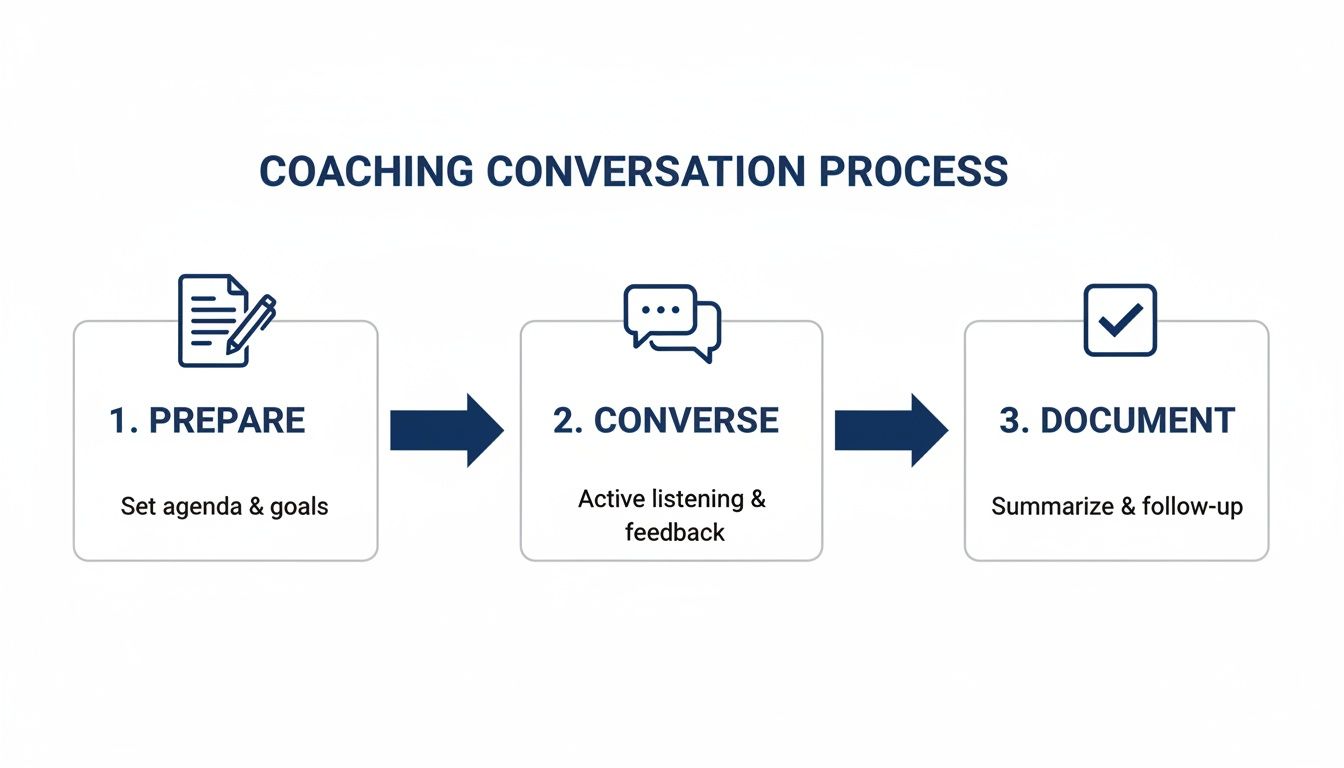
This Prepare, Converse, Document cycle ensures every interaction is purposeful, collaborative, and properly recorded. It is also crucial to avoid any language that could be interpreted as an employment contract, particularly in at-will states. Always have your PIP templates reviewed by HR or legal counsel to ensure compliance.
A well-structured PIP gives you a fair, clear path forward. It is a powerful tool for either improving performance or making a defensible separation decision. If you need expert guidance on developing compliant performance management documents, Contact us to learn more about our advisory services.
Consistent, objective documentation is the backbone of any defensible performance management process. It transforms subjective feelings into a factual record, creating a clear picture of an employee’s journey. This is not about building a case against someone; it is about demonstrating your company’s good-faith effort to help them succeed while protecting the organization.
Solid documentation brings clarity for everyone. It helps the employee see specific patterns that need to change and gives managers a concrete basis for follow-up conversations. Without it, you are relying on memory, which is often unreliable and biased.
Effective documentation is a learned skill that requires a disciplined focus on facts over feelings. The goal is to create a record that is specific, behavioral, and directly tied to business impact. This approach makes your notes useful for coaching and legally sound if matters escalate.
Here are the ground rules to follow:
A manager’s note that says, "Sarah was unprofessional in the team meeting," is just an opinion. A much stronger entry would be: "During today’s 10 AM team meeting, Sarah interrupted a colleague three times while they were presenting and referred to the project deadline as 'impossible'." By focusing on specific behaviors, you create a credible and defensible record.
The timeline for a Performance Improvement Plan is as critical as its content. A well-managed timeline creates structure and a sense of urgency, while regular check-ins provide opportunities to offer support and track progress. For most PIPs, which last between 30 to 90 days, weekly check-ins are the gold standard.
These meetings should be short and to the point—no more than 15-20 minutes. Keep the agenda for these check-ins simple and focused:
These meetings are not the time to introduce new criticisms. They are strictly for reviewing progress against the goals already set in the PIP. For more help on how to frame these discussions, our article on employee write-up examples is a great resource.
One of the trickiest situations is when an employee shows some, but not complete, improvement by the end of the PIP. This scenario requires careful judgment. First, ask yourself: were the goals they met the most critical ones? If they improved in minor areas but failed on core requirements, the PIP was likely unsuccessful.
If they showed significant, sustained improvement in the most important areas, you might consider extending the plan for a short period. Ultimately, the decision boils down to one question: has the employee demonstrated the ability and willingness to perform at the required level consistently? A clear, objective record will allow you to make a fair and defensible final call. If you need help building defensible documentation standards, Contact us for expert guidance.
When the Performance Improvement Plan (PIP) concludes, you reach a critical decision point. You must make an objective call on whether the employee has met the established goals. This decision sends a powerful message to your entire team about accountability, fairness, and the standards you uphold.
Your decision should be anchored in the documentation you have carefully maintained throughout the process. That record is what makes your final action—whether it is retaining the employee or letting them go—both fair and legally defensible.
First, conduct a straightforward, objective review. Did the employee meet the specific, measurable goals in the PIP? Vague assessments like "they tried hard" are not sufficient. You must compare their performance directly against the documented expectations.
Use this simple checklist for your assessment:
If the employee successfully met all expectations, the goal is to reintegrate them. Acknowledge their hard work, formally close the PIP, and continue regular check-ins to ensure momentum is maintained.
If the employee fell short, termination is not your only option. Sometimes, the issue is not the person but the role. A fundamental mismatch can hinder even the most dedicated employee. In these cases, redeployment to a different position can be a valuable alternative.
Redeployment is a good option when an employee has a strong work ethic, aligns with company values, and has skills that could be better used elsewhere. It turns a potential loss into a strategic internal transfer. Poor management of underperformance is a key reason people leave, with 51% of workers actively seeking new jobs because of it.
Redeployment and reskilling offer a powerful solution. Research shows that 82% of at-risk employees can be retained through these methods, which is a significant win for engagement and helps avoid the high costs of termination. You can read the full research on global workforce trends for more on this topic.
When improvement does not happen and another role is not a good fit, termination is the necessary next step. This conversation must be handled with professionalism, compassion, and respect. The goal is to preserve the employee's dignity while protecting the company from legal risk.
Before scheduling the meeting, have all documentation reviewed and approved by HR or legal counsel. The termination meeting itself should be brief and direct. Stick to the facts: the performance standards in the PIP were not met, and as a result, the employment relationship is ending. This is not the time for debate.
Getting these final steps right is a true test of leadership. A structured, fair, and well-documented process ensures every decision is handled correctly. If you need a partner to guide you through these high-stakes decisions, Contact our team for a consultation.
Effectively managing an underperforming employee is a true test of leadership. It is a high-risk scenario, but a structured, consistent process can transform that risk into a manageable situation. When you focus on clear communication, objective feedback, and a genuine opportunity for improvement, you are not just solving one person’s problem; you are building a stronger culture of accountability.
This proactive approach does more than minimize legal risks. It demonstrates a commitment to fairness that benefits the entire team. When your people see a clear and equitable process in action, it builds trust and reinforces the high standards you expect from everyone.
The ultimate goal is not to become an expert at writing PIPs. It is to create an environment where underperformance is addressed so early that formal PIPs become a rarity. This means building a culture where regular feedback and open dialogue are the norm, not the exception.
A proactive performance culture is built on a few key pillars:
Every action you take, from the first informal chat to the final decision, shapes your company's reputation as an employer. Handling these situations poorly can crush team morale and leave your top performers wondering why standards are not being upheld. A fair process, however, reinforces a culture of accountability.
A strong performance culture is your best defense against both declining productivity and legal risk. It is built not on punitive measures, but on a foundation of clarity, consistency, and a genuine commitment to employee development. This commitment shows you are willing to invest in your people.
Navigating complex employee situations can feel overwhelming, but you do not have to do it alone. The right partner can help you build the defensible HR practices that support your company's growth and protect you from unnecessary risk. To learn more about how our expert guidance can support your business, connect with our team.