
Watching your best people walk out the door is more than just frustrating—it is a significant financial drain that most businesses underestimate. Preventing employee turnover isn't about flashy perks or office game rooms. It's about building a proactive retention strategy that protects your bottom line and creates genuine stability for your organization. To succeed, you must stop treating retention as an HR problem and start seeing it as a core business advantage.
For any business leader, turnover is not just a metric on a spreadsheet; it is a critical operational risk. When a team member leaves, the costs of recruiting and training are only the beginning. The hidden costs—lost productivity, a dip in team morale, and potential disruption to customer service—do the real damage. This is especially true for small and mid-sized businesses where every person's contribution is magnified.
Let’s look at the numbers. Reliable estimates show that replacing an employee can cost anywhere from 50% to 200% of their annual salary. For a manager making $80,000 a year, you are looking at a potential loss of $40,000 to $160,000. That money comes directly from your bottom line, quietly draining resources and halting growth.
The direct costs of hiring—job ads, recruiter fees, and background checks—are easy to track. But the indirect costs are where your business truly feels the impact. A new hire needs significant time to get up to speed and match the productivity of the person they replaced. This process can easily take a full year or more.
During that ramp-up period, your existing team members are forced to pick up the slack. This often leads to burnout and increases the risk of even more employees leaving. High turnover creates a ripple effect, causing the rest of your team to question their own roles and the company's stability. That uncertainty can damage a great culture and disengage even your most loyal people.
If your only response to turnover is to post another job opening, you are stuck in an expensive and unsustainable cycle. This reactive approach does nothing to fix the underlying reasons people are leaving in the first place. A proactive retention strategy, on the other hand, creates an environment where employees want to stay and build their careers.
A proactive approach strengthens your organization with better management practices, fair compensation, and an onboarding process that sets people up for success. Ultimately, preventing employee turnover means shifting your mindset from reactive to strategic. It is about protecting the investment you've made in your people and building a more resilient organization.
If you are ready to build a structured approach to keeping your best talent, our team can provide the guidance you need. Learn more by contacting us today.
Before you can fix a turnover problem, you have to understand it. Too many leaders jump to conclusions, blaming compensation or a tough market without first looking inward. To make a real impact on retention, you need to move past assumptions and gather honest, defensible data about why your people are leaving. This diagnostic work is the foundation of any effective retention strategy.
Your most valuable insights will come directly from your team, but you have to ask the right questions in the right way. A simple "why are you leaving?" during an exit interview only scratches the surface. To get the full picture, you need to pull information from several sources to uncover otherwise invisible patterns.
A combination of the following methods provides the most complete picture:
This is not just about feelings; it's about connecting the dots between manager burnout, the financial hit of turnover, and the tangible benefits of a smart retention plan.
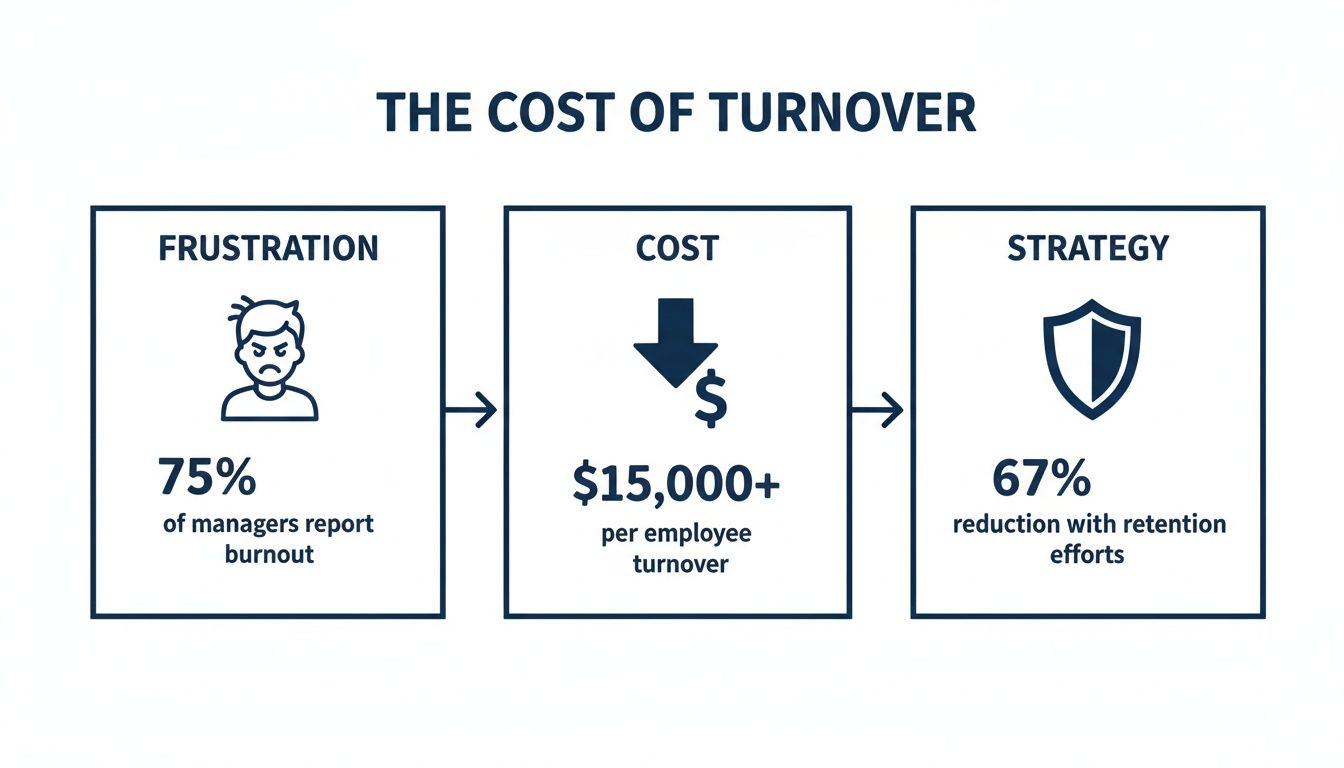
When you look at retention this way, it stops being a reactive HR task. It becomes a core operational priority that directly protects your bottom line.
Once you have gathered feedback, the real work begins: finding the patterns. Look for recurring themes. Are multiple departing employees mentioning the same manager? Is one department experiencing high turnover? Are top performers citing a lack of growth opportunities? By breaking down the problem this way, you can move from broad assumptions to targeted, data-backed insights.
The most effective way to tackle turnover is to quantify the problem by segment—by location, manager, or role—and then focus your resources where the financial exposure is highest. With U.S. voluntary turnover benchmarks sitting around 13.0–13.2% and the cost to replace a single senior manager ranging from $36,000 to $480,000, leaders who measure this gain a massive advantage. You can find more data by checking out the latest employee retention statistics from SecondTalent.com.
Your goal is not to find a single silver bullet. It is to identify the high-impact areas where a focused intervention can make a real difference. If data points to one manager struggling with their team, the answer is targeted coaching, not a company-wide pizza party.
Digging into the reasons for turnover is pointless if you do not act on what you find. Once you've identified the patterns, you can build a focused action plan. This might mean leadership training for specific managers, a compensation review for one department, or creating clearer career paths for high-potential employees.
It is also crucial to recognize when you are dealing with something more complex. If exit interviews consistently bring up complaints about unfair treatment or poor communication from a manager, you might have a deeper problem. For help navigating those situations, take a look at our guide on how to address common employee relations issues. This diagnostic phase sets the stage for everything else.
You have probably heard the saying: people don’t quit jobs, they quit bosses. While fair pay and solid benefits are important, the single biggest factor in retaining your best people is the quality of their direct manager. The day-to-day interactions, quality of feedback, and level of support an employee receives from their boss will make or break their commitment. This is about turning your managers into your greatest retention asset.

Preventing turnover today is less about pay and more about manager capability and trust in leadership. Data shows that roughly 50% of employees who look for a new job do so because of their direct manager. This makes your front-line leadership the most controllable predictor of who stays and who goes. A smart retention strategy is a disciplined effort to professionalize how your managers lead.
Compounding this is the fact that U.S. employee engagement has slumped to an 11-year low. This opens the door to "quiet quitting" and widespread disengagement, which has real compliance implications. A disengaged manager is more likely to cut corners on documentation or mishandle investigations, increasing your legal risk. You can learn more about why turnover is the top concern for business leaders.
The best retention strategies are built on strong leadership. When managers are trained, supported, and held accountable, they create the stability and trust that makes people want to stay.
To be retention assets, your managers need more than technical expertise; they need strong people skills. Your job is to define what good management looks like in your company and provide the training to get them there. Focus your efforts on these critical areas:
Training is just the starting point. To make a real impact, you must hold managers accountable for their team's engagement and retention. Start by making people leadership a formal part of your managers’ job descriptions and performance evaluations. Their success is not just about team output; it's also about their ability to develop and retain talent.
Here are practical ways to build accountability:
By arming managers with the right skills and holding them accountable, you build a powerful, proactive system for keeping your best people. If you need help developing your managers, feel free to contact us to discuss how we can support your leadership team.
While a great manager can make a significant difference, compensation and career growth are foundational pillars of any serious retention plan. Pay is a powerful signal of an employee's value to the organization. Building a pay strategy that is both competitive and legally defensible is essential for preventing your best talent from looking elsewhere. This process starts with a commitment to understanding your market and ensuring internal equity.
To know if your pay is competitive, you must first understand what the market is paying for similar roles. This process, known as salary benchmarking, is your starting point. The goal is to gather objective data that helps you set pay ranges that are both fair and realistic for your business.
You can get reliable data from several sources:
Once you have this data, you can establish salary bands for each role in your organization. A salary band defines the minimum, midpoint, and maximum pay for a position, giving you a structured framework for compensation decisions.
Benchmarking against the external market is only half the battle. You must also ensure internal pay equity, which means paying employees fairly for similar work, regardless of gender, race, or other protected characteristics. This is a critical compliance issue. An internal pay audit is the best way to spot and correct disparities before they become legal risks.
A defensible pay strategy is one where you can clearly articulate why someone is paid what they are. It should be based on objective factors like their role, experience, performance, and market data—not on subjective feelings. This is especially critical as pay transparency laws become more common, often requiring employers to disclose salary ranges in job postings.
Compensation is directly tied to career growth. An employee who feels stuck in a dead-end job will eventually leave, even if their pay is competitive. Creating clear, achievable career paths is a powerful tool for preventing employee turnover. In smaller organizations, growth can also mean expanding responsibilities, developing expertise, or mentorship opportunities.
The key is to show employees a tangible future within your company. Regular career conversations, where managers discuss an employee's goals and map out a path to achieve them, are essential. When people see that you are invested in their long-term success, they become far more invested in yours. It is also important to remember that compensation is just one part of the equation. You can learn more about maximizing employee retention with innovative benefits.
If you need a partner to help design a competitive and legally sound compensation strategy, our advisory services can provide the guidance you need. Please contact us to learn how we can help.
An employee's first 90 days are a powerful predictor of their long-term commitment. A disorganized, confusing start creates an unease that is difficult to overcome. To stop this before it starts, your onboarding must be an intentional, structured experience that goes beyond filling out paperwork. The goal is deep integration, helping new hires connect with your culture, understand their role, and build relationships with their team.

A successful onboarding program provides clarity and connection at every turn. It systematically introduces a new person to the people, processes, and performance benchmarks that will define their role. This structured approach shows them you are invested in their success from day one. For a deeper dive, these 10 Employee Onboarding Best Practices are a valuable resource.
A simple, repeatable checklist is the perfect starting point. Here are a few non-negotiables to include:
Consistent documentation is essential for building trust and clarity. When you clearly document expectations, feedback, and development goals, you create a transparent, objective record of an employee’s journey. Proper documentation protects your business and empowers your employees by showing them exactly where they stand.
Documentation is a tool for clarity, not just compliance. It transforms subjective conversations into objective, actionable records that build trust and align expectations. This consistency fosters a culture where employees feel supported and know that decisions are based on performance, not politics. Mastering this is a key part of the entire employee journey.
When you master both a welcoming onboarding experience and a disciplined approach to documentation, you set new hires up for success. This powerful combination significantly boosts long-term commitment and reduces the risk of preventable turnover. For guidance on creating structured onboarding and documentation standards, our team is here to help. Contact us to learn more.
Preventing employee turnover is not a one-time project; it is a strategic commitment that must be woven into your daily operations. This is about moving beyond reactive fixes and getting proactive about why people stay. The pillars of a strong retention plan are all connected. It starts with digging into the root causes of turnover, empowering your managers, creating fair compensation strategies, and mastering a structured onboarding experience.
The most effective way to get started is by looking at your current practices and measuring them against these pillars. Where are your biggest gaps? Are your managers equipped to lead, or are they unknowingly part of the problem? Does your compensation hold up in today's market? A focused, evidence-based approach ensures you are investing your time and money where it will have the biggest impact.
A successful retention strategy is built on deliberate, consistent action, not just good intentions. By focusing on manager quality, fair compensation, and a strong onboarding process, you create a powerful defense against preventable turnover. For organizations in specialized fields, sector-specific strategies are also invaluable. For example, exploring a comprehensive guide on how to reduce staff turnover in healthcare can offer critical insights.
Building a defensible retention strategy is a critical move to protect your business. If you need a trusted partner to navigate high-stakes people decisions and reduce employment risk, our team is ready to help. Contact us to learn more.
Business leaders and HR professionals often ask us where they should begin when tackling employee turnover. Here are a few of the most common questions we receive, along with practical answers to help you get focused.
If you can only focus on one area, make it improving manager quality. While factors like pay and benefits matter, an employee's relationship with their direct manager is the top reason they decide to stay or go. A bad manager can undermine even the best compensation package. The highest-return investment you can make is training your managers in communication, feedback, performance management, and documentation.
While you may not win a bidding war with a large corporation, small businesses can offer an employee experience that big companies often cannot replicate. Focus on your unique advantages:
When employees feel valued, trust their leaders, and see a real future for themselves, salary becomes just one piece of a much larger puzzle.
If your turnover rate is already high, the first step is to diagnose the root cause before you jump to solutions. Making assumptions will waste time and money. Start by implementing structured exit interviews for every departing employee. Just as important, conduct "stay interviews" with your current high-performers to learn what keeps them there. Once you have that feedback, look for patterns to ensure you are aiming your efforts at the real problems driving people away.
Building a defensible retention strategy is one of the most critical steps you can take to protect your business. If you need a trusted partner to help you navigate high-stakes people decisions and reduce employment risk, the team at Paradigm International Inc. is ready to help.