A senior employee misses another critical deadline. The manager has already held several difficult conversations, but the notes are inconsistent, the expectations were never written clearly, and the employee now says the treatment is unfair. At that point, a performance improvement plan can either create needed structure or become the document that exposes the employer's weaknesses.
Learning how to write a PIP requires more than filling in a template. A defensible plan connects documented facts to reasonable expectations, explains the support available, gives the employee a fair opportunity to improve, and preserves a reliable record of what happened. It must also survive review across different states, policies, and employment-risk scenarios.
A performance improvement plan, or PIP, is a formal written process for addressing a defined performance gap. It should identify what has fallen short, describe the standard the employee must meet, establish measurable outcomes, set a fixed review period, and explain the coaching or resources the employer will provide. Federal supervisor guidance describes a PIP as a formal corrective and developmental tool that should include measurable objectives, support, check-ins, and a documented closing decision. The federal PIP quick guide provides a useful model for that closed-loop process.
A PIP isn't a replacement for a verbal warning, a generic form copied from the internet, or a collection of personal impressions. It also shouldn't be a hidden termination script disguised as coaching. If leadership has already decided that termination is inevitable, issuing a plan that suggests otherwise creates an avoidable credibility problem.
The first job is coaching. The employee should be able to read the plan and understand what to change, how success will be measured, what help is available, and when progress will be reviewed. The second job is defensibility. If improvement doesn't occur, an HR reviewer, outside counsel, agency, or court should be able to understand the decision without relying on the manager's memory.
That means the plan should answer five questions plainly:
Formal performance systems are increasingly common in large organizations. A 2026 industry survey of more than 250 organizations reported that 91.6% had a formal performance-management process, while one U.S. estimate found formal performance procedures rose from 33.4 per 1,000 workers in 2020 to 43.6 per 1,000 workers in 2023, a gain of more than 30%, as reported in this review of PIP statistics. The practical lesson is straightforward. A PIP should fit the employer's broader performance process, not appear as an improvised response to one difficult employee.
For a useful process overview before drafting, review MyCulture.ai's PIP process advice. Use it to structure the workflow, then adapt the language to the employee's role, documentation history, and jurisdictional risk.
A PIP is appropriate when the employer can show a sustained, job-related performance problem and still has a reasonable basis to believe the employee can improve. Typical examples include repeated missed deadlines, declining work quality, incomplete core duties, or conduct that interferes with assigned responsibilities. The concern should already appear in performance reviews, one-on-one notes, written coaching, or corrective conversations.
A PIP isn't the right response to every difficult workplace event. Don't use one for a single bad week, a first minor mistake, or a personal conflict between a manager and employee. Serious misconduct may require immediate action under company policy rather than a performance process. A PIP also shouldn't be used to force an employee out because the manager dislikes their personality or communication style.
Before drafting, require the manager to complete an HR intake. The intake should confirm that the proposed action is based on legitimate performance concerns, not retaliation, discrimination, or an attempt to punish protected activity.
HR should review whether the employee recently:
Written documentation can help rebut a retaliation inference when performance concerns predate a complaint or protected activity. Employment-law guidance recommends documenting even verbal counseling and pairing each criticism with specific coaching and a deadline. The Amundsen Davis discussion of performance documentation also warns that written material may later be requested in litigation, so managers should write as though an outside reviewer will read every sentence.
Before approving the PIP, assemble:
If these materials don't exist, pause. Build the record prospectively, address the issue directly, and avoid creating a PIP that appears to manufacture justification after the decision has already been made.
The weakest PIPs describe impressions. The strongest PIPs describe work.
“Not pulling weight,” “poor attitude,” and “communication problems” don't tell an employee what to do differently. They also give a later reviewer no reliable way to distinguish actual failure from managerial opinion. Replace each label with a statement tied to a duty, output, timeframe, quality standard, or observable interaction.
A practical framework is SMART-plus. Each objective should be specific, measurable, attainable, relevant, and time-bound, with one additional requirement: the employee must control the outcome. A manager can require timely updates, complete deliverables, accurate records, or professional responses. A manager can't fairly require an employee to make clients “feel positive” or guarantee that every project receives approval.
Write each expectation with three parts:
For example, “Improve communication” is too broad. A defensible replacement is: “Respond to internal client emails requiring action within one business day, unless the sender agrees to another deadline. Send a status report every Friday by 4 p.m. using the approved reporting format.” The measurement comes from email timestamps and the submitted reports. The manager doesn't have to interpret attitude, effort, or intent.
Practical rule: If two reasonable managers could reach different conclusions from the same work, the expectation needs more detail.
| Vague Concern | Defensible PIP Expectation |
|---|---|
| “Improve communication” | Respond to action-required internal client emails within one business day and send the weekly status report every Friday by 4 p.m. |
| “Not meeting deadlines” | Submit each assigned deliverable by the deadline recorded in the project tracker, and notify the manager before the deadline if a documented obstacle threatens completion. |
| “Poor attention to detail” | Review each client deliverable against the approved quality checklist before submission, with no unresolved calculation or formatting errors identified during manager review. |
| “Not pulling weight” | Complete the assigned work items listed in the team tracker and update their status by the agreed reporting time on each scheduled workday. |
| “Attitude issues” | In team meetings, allow colleagues to finish speaking, respond to work-related questions without personal remarks, and raise disagreements through the designated escalation process. |
| “Not a team player” | Attend required project meetings, complete assigned handoffs by the recorded dates, and provide the next responsible person with the information identified in the handoff checklist. |
Avoid metrics that have no relationship to the job. A target isn't defensible merely because it looks precise. The standard must be tied to the employee's duties, applied consistently, and achievable with the support the employer promises.
A defensible PIP should read like a factual business record, not an argument. Keep the tone neutral, use dates, identify documents, and remove adjectives that describe character rather than conduct. Written material that isn't properly privileged may be subpoenaed by a plaintiff's attorney, as noted in this HR guidance on documentation risk, so managers should avoid speculation and editorial commentary.
Neutral opening paragraph
Sample language: “This plan addresses documented performance concerns relating to the essential duties of the Senior Account Manager role. The plan is intended to clarify performance expectations, identify available support, and provide a defined period for demonstrating sustained improvement.”
Specific gaps tied to prior records
Sample language: “On March 4, the client renewal summary was submitted after the recorded deadline. The same issue was discussed during the February 12 one-on-one meeting and documented in the manager's follow-up email dated February 13.”
Success criteria
Sample language: “Fully successful performance requires submission of each renewal summary by the deadline in the account tracker, with required fields complete and no unresolved calculation errors identified during review.”
Support and resources
Sample language: “The manager will provide the approved renewal-summary template, review the first two submissions, and meet with the employee to address questions about the workflow.”
Check-in cadence
Sample language: “The manager and employee will meet every other week to review each objective, discuss barriers, record support provided, and identify the next required actions.”
Review date
SHRM identifies 30 to 90 days as a typical PIP duration in its guidance on PIP timing. Breezy HR similarly describes total plan durations commonly set at 30, 60, or 90 days in its PIP guide. Choose the period based on the work, then include interim checkpoints and a firm closing date.
Consequences
Sample language: “Failure to demonstrate and sustain the required improvement may result in further corrective action, up to and including termination of employment. The company may also take action before the end of the plan if additional serious performance or conduct concerns arise.”
Receipt acknowledgment
Sample language: “The employee's signature confirms receipt and discussion of this plan. It does not necessarily indicate agreement with its contents.” If the employee refuses to sign, record the refusal and have a witness confirm that the plan was delivered.
| PIP Section | Weak Phrasing to Avoid | Defensible Replacement |
|---|---|---|
| Performance gap | “You have a bad attitude.” | “During the March 6 team meeting, you interrupted two colleagues and stated that their assigned work was pointless.” |
| Performance standard | “Show more ownership.” | “Review assigned tasks at the start of each workday, update the tracker, and escalate a material risk before the agreed deadline.” |
| Quality | “Your work is sloppy.” | “Submit reports with all required fields complete and correct the calculation errors identified in the attached review records.” |
| Collaboration | “You aren't a team player.” | “Complete assigned handoffs by the documented date and provide the receiving employee with the required files and status notes.” |
| Culture | “You aren't a cultural fit.” | “Follow the meeting conduct standard by allowing others to speak and raising disagreements through the stated escalation process.” |
Don't rely on “satisfactory” without defining it. That wording can create particular problems in states with stricter expectations around clear notice, including California and Washington. HR should also reconcile the plan with any active accommodation, FMLA, or workers' compensation matter before delivery.
For related disciplinary documentation, use this written warning guide for leaders to keep the PIP aligned with the organization's broader corrective-action process.
Delivery matters almost as much as drafting. Hold the opening meeting privately, give the employee the document, explain the process without theatrics, and allow a real opportunity to respond. HR should attend when the issue is high-risk or the organization's practice calls for a witness.
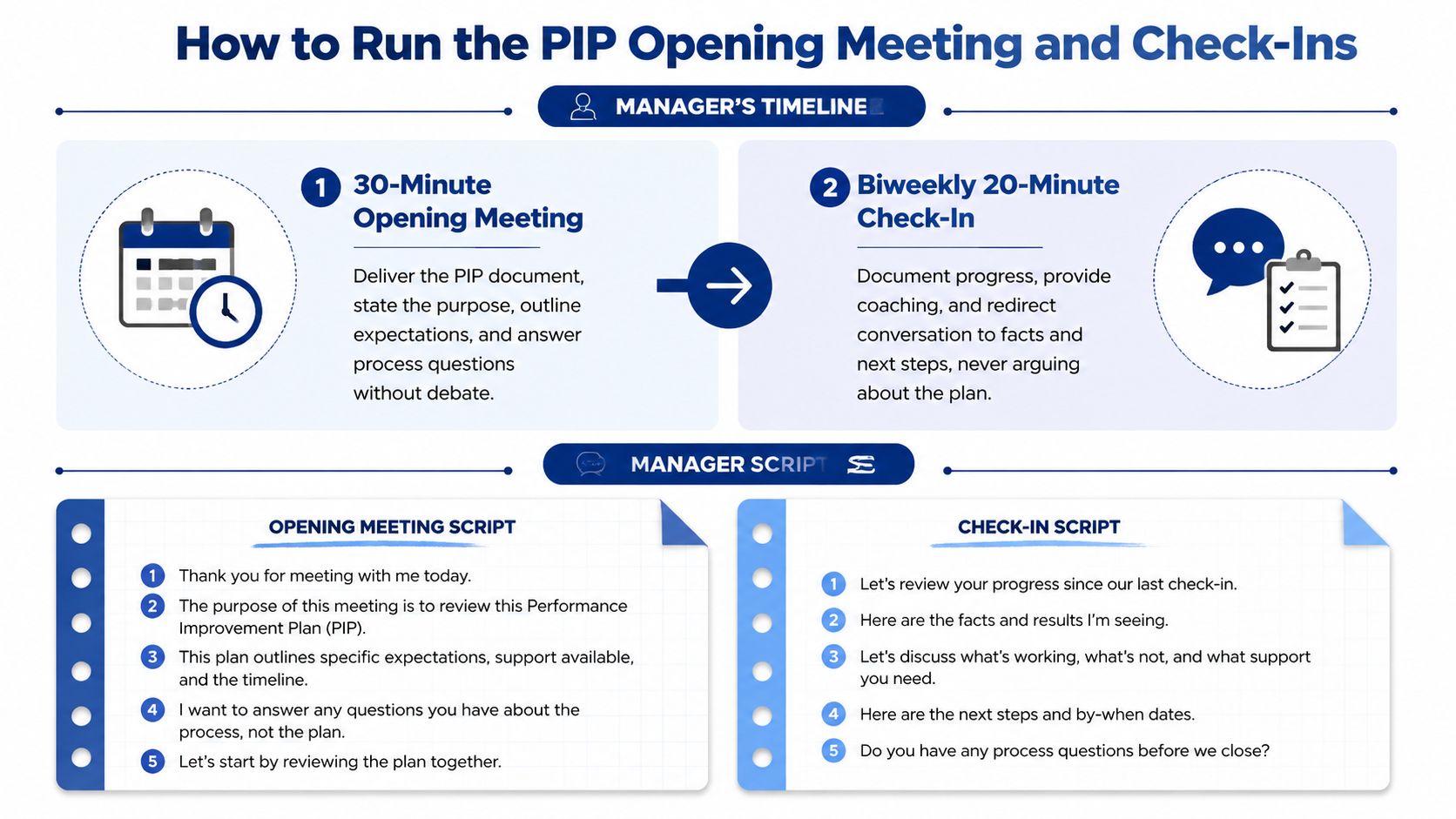
A manager can say:
“Thank you for meeting with us. We're addressing documented performance concerns and putting a structured plan in place to help you meet the requirements of your role. The plan identifies the specific gaps, the standard expected, the support we'll provide, and how progress will be reviewed. This process may affect your employment if the required improvement doesn't occur. I'll walk through each section, then I want to hear your questions and any facts or barriers we need to address.”
Then ask:
Don't debate every historical event in the meeting. Listen, document the response, correct factual errors when you can verify them, and explain what will be reviewed after the meeting.
A biweekly meeting should follow the same structure each time:
“We're reviewing progress against each objective, not reopening the entire plan. Let's record the evidence, discuss any barriers, identify the support provided, and confirm the next actions and dates.”
Document:
The manager should take notes, provide a factual follow-up summary, and place the approved record in the appropriate personnel file. Don't record meetings without checking applicable law and company policy. Some states require consent from all parties before a conversation may be recorded, and New York investigatory interviews may involve a right to representation in applicable circumstances. HR should determine the correct process before the meeting, not after a dispute arises.
Use the organization's 7 progressive discipline steps to keep the PIP connected to consistent corrective-action practices.
The closing decision should follow the evidence, not the manager's frustration. Compare the employee's documented performance against the written objectives, review the support provided, and confirm that the same standards were applied throughout the plan. The final memo should explain the decision without overstating what the record proves.
| Closure Path | Decision Criteria | Required Documentation | State-Specific Risk |
|---|---|---|---|
| Successful completion | Every required metric was met and improvement is sufficiently sustained for the role. | Closing memo, metric results, employee communication, and follow-up expectations. | Clarify whether the PIP is closed, what remains subject to normal performance management, and where the record is stored. |
| Extension | Meaningful progress exists, but a defined objective remains incomplete and more time could reasonably produce improvement. | Written rationale, unchanged metrics, new end date, and continued support plan. | Avoid moving the goalposts or extending indefinitely. Confirm any leave or accommodation impact. |
| Role change or demotion | Business needs and documented performance facts support a different role or level. | Business justification, new written agreement, duties, compensation terms, and effective date. | Review state wage-notice requirements and obtain required agreement before changing pay or duties. |
| Termination | Required improvement wasn't demonstrated, or serious additional concerns justify ending employment. | Final evaluation, prior records, PIP delivery and check-in notes, separation documents, benefits information, and decision approval. | Confirm final-pay timing, unemployment-response facts, protected activity, leave, accommodation, and state-specific termination rules. |
A successful completion memo might state: “The employee met the objectives relating to deadline compliance, report completeness, and required status updates during the review period. The PIP is closed as of the stated date. The employee remains responsible for meeting the role's ordinary performance requirements, which will be addressed through the regular performance process.”
A termination memo should stay equally controlled: “The employee did not demonstrate the required improvement identified in Objectives One and Two despite the support and review opportunities documented during the plan. Employment will end effective [date], subject to the company's separation procedures.”
Before the meeting, confirm who attends, who delivers the decision, and which documents the employee receives. Read the decision plainly, explain the effective date and next administrative steps, and avoid turning the meeting into a trial about every past disagreement.
Don't say the employee “failed because of attitude,” “was never going to succeed,” or “made the company terminate them.” Don't promise that a successful PIP guarantees continued employment, and don't introduce a new reason that wasn't evaluated during the process. For difficult separations, seek advice from Paradigm International Inc. before the final meeting.
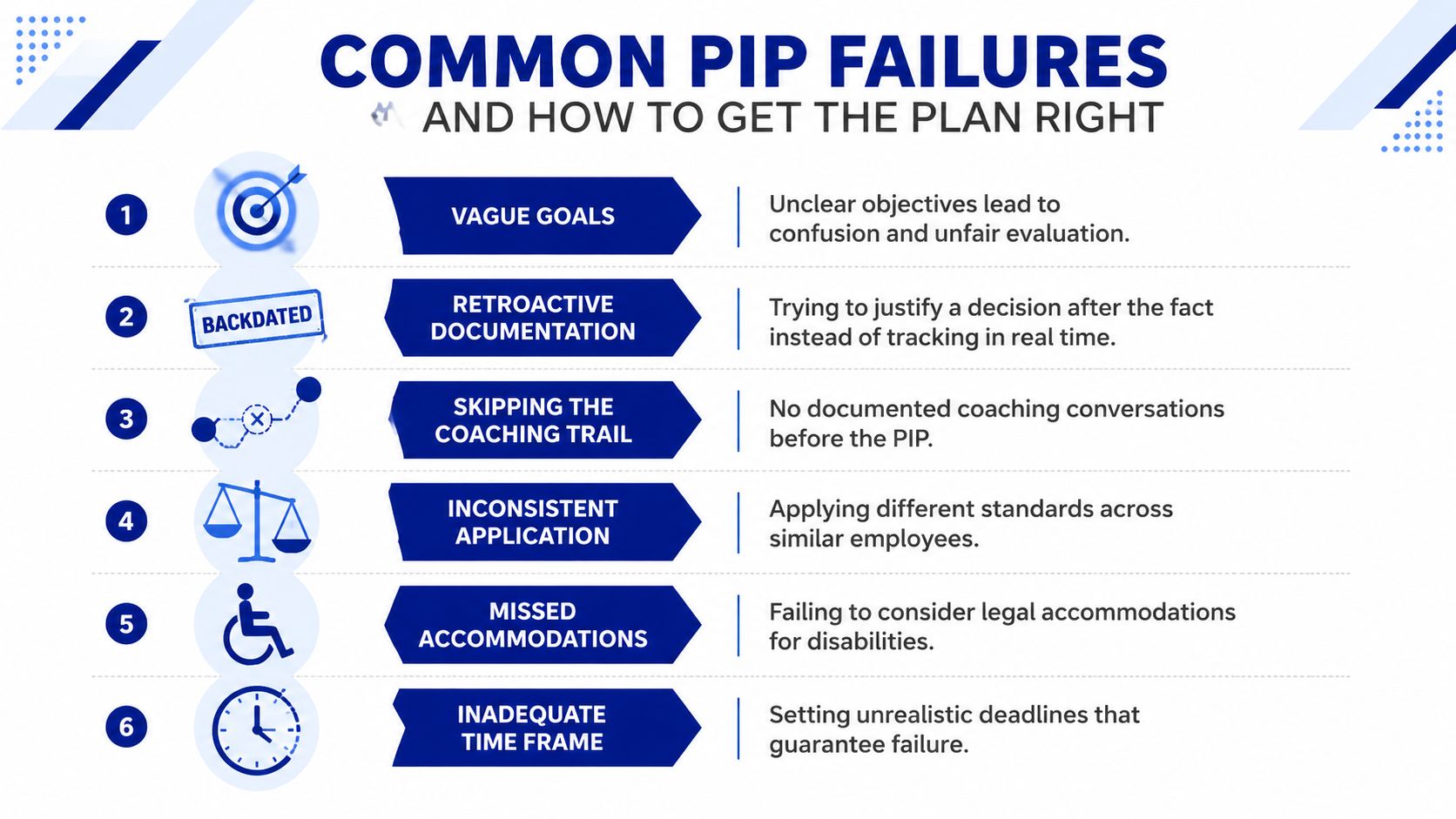
Multi-state SMBs repeat the same mistakes. Each one creates a predictable weakness in the record.
The defensibility test: Could an uninvolved HR professional identify the standard, the evidence, the support, the employee's response, and the reason for the final decision without asking the manager to fill in the gaps?
Before delivery, verify the pre-PIP record, measurable goals, support commitments, state-specific review, consistent treatment, and signature or refusal documentation. If the case involves a complaint, leave, accommodation, protected activity, inconsistent prior treatment, or a likely termination, escalate it to senior HR or outside counsel first. The PIP language will become part of the evidence record, so drafting it casually is a costly mistake.
Paradigm International Inc. helps owners, COOs, and HR leaders manage high-stakes performance decisions, documentation, investigations, terminations, and multi-state employment risk. Visit Paradigm International Inc. to discuss a PIP that needs to support both genuine coaching and a defensible business decision.