
Navigating a complex employee situation can be daunting, especially when the standard handbook doesn’t have the answer. This is the exact moment an HR advisory service proves its value. It steps in as a strategic partner to guide you through high-stakes decisions with confidence. Unlike traditional HR outsourcing that handles routine tasks, an advisory service provides the seasoned judgment you need to manage your toughest people-related challenges.

Many growing businesses manage day-to-day HR tasks like payroll and benefits administration without issue. However, significant operational risk rarely comes from these routine processes. It appears during critical moments that demand nuanced judgment and expertise. These are the situations where a simple checklist is not enough.
Consider a sensitive termination, an allegation of manager misconduct, or the complexities of multi-state compliance. These scenarios fall outside the scope of standard HR administration. They demand a partner who provides strategic guidance, helping leadership weigh risks and make defensible decisions. An HR advisory service is built for this purpose, focusing on risk mitigation, not just task management.
At its heart, an HR advisory service acts as a strategic partner to your leadership team. Think of it less like an outsourced department and more like an on-call expert focused on protecting your business. The goal is to bring clarity and confidence when the path forward is uncertain, shielding you from potential legal, financial, and reputational harm.
This strategic function is especially vital for organizations in a growth phase. As you hire more employees, expand into new states, or operate in regulated industries, your exposure to employment-related risk increases. Simply following a generic HR checklist is no longer sufficient to protect your organization.
The real value of an HR advisory service isn't just knowing the rules; it's understanding how to apply them in the context of your specific business challenges to achieve a defensible outcome.
A specialized advisory partner provides critical support in several high-risk areas that often overwhelm internal teams. Their guidance ensures that your actions are not only compliant but also applied consistently and fairly across the organization. This helps build a foundation of trust and stability.
Key areas where advisory services shine include:
By focusing on these pivotal areas, an HR advisory service helps you build a strong foundation for sustainable growth. This proactive approach to managing employment risk is a key part of a robust organizational strategy. To learn more, check out our guide on how to build an HR strategy for growth that aligns with your business objectives.
An effective partnership with an advisor gives your leadership team the confidence to act decisively. You can move forward knowing your decisions are supported by expert guidance and a clear, documented rationale. This allows you to focus on running your business, not just reacting to HR problems. If you are facing complex people decisions, a conversation with an expert can provide immediate clarity. Feel free to contact us to discuss your situation.
Business leaders often hear "HR advisory," "consulting," and "outsourcing" used interchangeably, which can create confusion. While all three models bring in outside HR expertise, they serve fundamentally different purposes. Picking the wrong one can mean paying for services you don't need or lacking strategic guidance when a high-stakes issue arises.
For leaders of growing businesses, understanding this distinction is critical. You need a partner focused on proactive risk mitigation and complex decision support—not just someone to offload routine paperwork. Getting clear on these roles ensures you invest in a service that truly protects and strengthens your organization.
HR outsourcing (HRO), often delivered through a Professional Employer Organization (PEO), focuses on transactions. Think of this model as an extension of your administrative team. It is designed to take on the recurring, time-consuming tasks of managing a workforce, such as payroll and benefits administration.
The primary focus is efficiency and execution. An HRO partner ensures routine processes run smoothly, which is a valuable service for any company looking to streamline operations. They handle the basic compliance tasks associated with day-to-day workforce management.
Key functions handled by HR outsourcing include:
The global human resource outsourcing market was valued at approximately USD 39.25 billion this year and is projected to grow. This growth highlights how many organizations rely on outside help to manage day-to-day employment tasks.
HR consulting is project-based and specialized. You bring in a consultant to solve a specific, defined problem or create a particular program within a set timeframe. They act as a subject matter expert who diagnoses an issue, develops a solution, and often helps implement it before their engagement ends.
Think of a consultant as a specialist you call for a targeted need. For example, if your compensation structure is outdated, a compensation consultant can analyze market data and design a new salary framework. To better understand this role, it helps to see where it fits within the broader world of business consulting services.
An HR consultant provides a specific deliverable for a specific need. Their relationship is typically short-term, ending once the project is complete.
Common projects for HR consultants include overhauling a performance management system, developing an employee handbook from scratch, or conducting a company-wide pay equity audit. Their work is focused and has a clear start and end point.
An HR advisory service provides ongoing, strategic guidance for high-stakes, complex, or ambiguous situations. Unlike outsourcing's transactional focus or consulting's project-based nature, an advisory relationship is built on partnership. Its goal is proactive risk management and long-term organizational health.
An advisor acts as a strategic confidant for your leadership team, especially during moments with serious consequences. They don't run your payroll, but they will guide you through a defensible process for a high-risk termination. They provide the consistent judgment needed to navigate a sensitive employee investigation or address difficult manager conduct.
This ongoing partnership is designed to build organizational resilience. It ensures your decisions are consistent, well-documented, and legally sound. For leaders navigating the complexities of a growing, multi-state workforce, this type of strategic support is indispensable.
To make these differences even clearer, the following table breaks down how each model operates in practice. This comparison should help you quickly identify which type of support aligns best with your current business needs.
Choosing the right model comes down to the problem you are trying to solve. If you need someone to manage daily administrative tasks, outsourcing is your answer. If you have a specific, one-time project, a consultant is perfect. But if you need a strategic partner to navigate the tough issues that keep you up at night, an advisory service is the ideal choice.
Understanding these differences is the first step toward finding the right partner. If you need a trusted advisor to help with high-stakes people decisions, we can help provide the clarity you need. Reach out to our team to learn how an advisory approach can protect your business.
Not all business challenges are created equal. While you likely have clear processes for day-to-day operations, certain situations carry a disproportionate amount of risk. These are the moments where a single misstep can spiral into significant legal, financial, or reputational damage.
This is precisely when an HR advisory service becomes indispensable. An advisor brings the strategic judgment needed to navigate these high-stakes events. They help leadership move from uncertainty to confidence, ensuring every action is deliberate, defensible, and thoroughly documented. Their guidance is most critical when emotions run high and the path forward is unclear.
Letting an employee go is one of the most difficult and legally perilous actions a leader can take. When a termination is handled poorly, it can easily escalate into a costly wrongful termination claim. An HR advisor is your expert guide in these moments, making sure the process is fair, consistent, and legally sound.
An advisor provides a structured framework for the entire process. This includes reviewing performance documentation, assessing risk factors, scripting the termination conversation, and preparing separation agreements. Their objective guidance removes emotion from the decision, grounding it in a defensible business rationale.
Example: A tech company needed to terminate a long-tenured employee for poor performance, but the employee was in a protected class and had recently made informal complaints. An HR advisor guided the leadership team to meticulously document performance discussions over several weeks, ensuring the termination was based purely on objective metrics. This careful process deterred a potential discrimination claim and saved the company from a costly legal fight.
With an HR advisory service, a high-risk termination transforms from a potential lawsuit into a managed, defensible business decision.
When an employee alleges harassment, discrimination, or other serious misconduct, your company’s response is immediately put under a microscope. A flawed or biased investigation can expose the business to immense liability. An HR advisor brings a neutral, third-party perspective to ensure the process is both thorough and impartial.
An advisor helps establish a clear protocol for gathering facts, interviewing witnesses, and evaluating evidence. This structured approach is crucial for reaching a credible conclusion and showing that the company took the complaint seriously.
An advisor helps manage key steps like these:
In these situations, advisors are critical. They provide guidance on complex matters like disciplining employees without risking legal consequences to protect the business.
Nothing poisons a team culture faster than a manager's poor behavior. It can lead to widespread disruption and serious legal claims, such as hostile work environment allegations. Addressing this conduct is incredibly sensitive, since managers are in positions of power and their actions reflect directly on the company.
An HR advisor helps leadership confront these issues head-on. They provide coaching on how to deliver difficult feedback, create a formal performance improvement plan, and document every step of the corrective action process. This approach gives the manager a fair chance to improve while protecting the business if termination becomes the only option.
The diagram below shows how different HR support models—Advisory, Consulting, and Outsourcing—fit together.
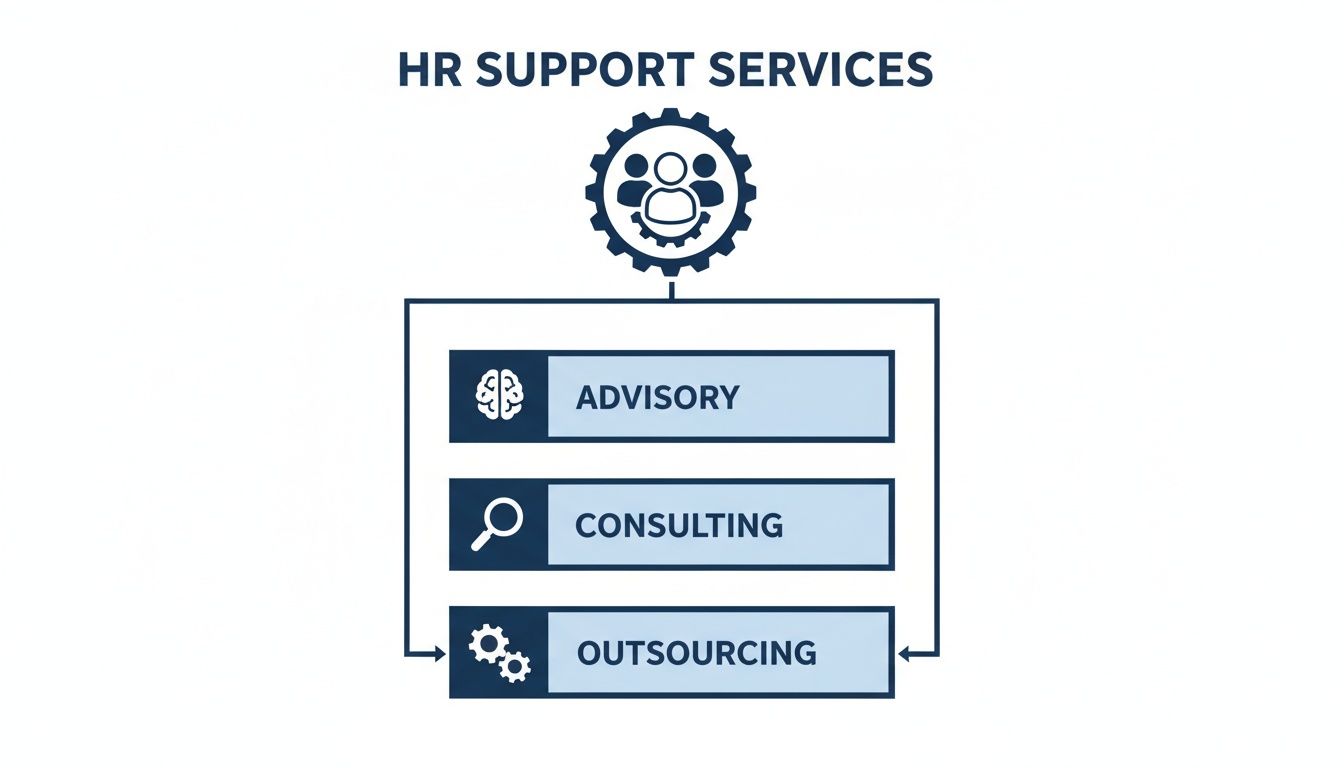
As you can see, advisory services are distinct from project-based consulting or administrative outsourcing, focusing squarely on strategic guidance for leadership.
For any business operating in more than one state, compliance is a minefield. Each state has its own unique rules for wages, leave, hiring practices, and terminations. Keeping up with this patchwork of regulations is a full-time job, and falling out of compliance can lead to steep fines and penalties.
An HR advisory service specializing in multi-state operations is essential for navigating this complexity. They will audit your current policies, identifying gaps between your procedures and the specific laws in each location where you have employees. This proactive approach prevents costly compliance mistakes before they happen.
These are not just theoretical risks; they are real challenges that growing businesses face every day. Partnering with an HR advisor gives your leadership team the expertise needed to handle them correctly and protect the business you have worked so hard to build.
Investing in an HR advisory service is a significant step, so it is important to understand how these partnerships work. Advisory services are structured to deliver specific expert support. Knowing the difference between a retainer and a project-based fee helps you match the service to what your business truly needs.
Getting this right ensures you form the right kind of partnership. Understanding the models and the factors driving cost will give you the confidence to select a partner who delivers real, measurable value for your organization.
When you partner with an HR advisor, the relationship is usually set up in one of a few ways. Each model is built for a different level of engagement, from continuous support to short-term projects. The right fit depends on your company's immediate challenges and long-term goals.
Here are the most common structures you will encounter:
The retainer model is built for proactive risk management. It allows an advisor to understand your operational patterns and help you address potential issues before they escalate, rather than just reacting to problems as they happen.
The cost of an HR advisory service is calculated based on your company’s unique risk profile and the complexity of support you need. A few key factors directly impact the price you can expect to pay for high-level guidance. Knowing what they are helps you understand the value behind the proposals you receive.
For a deeper dive, check out our complete guide on what multi-state SMBs should expect to pay for HR consulting.
Generally, pricing comes down to these four critical factors:
Understanding these service models and pricing factors is the first step toward making a smart investment in your company's protection. If you would like to discuss a model that works for your business, you can connect with our team to learn more.

Choosing the right HR advisory partner is one of the most critical decisions a leadership team can make. This isn’t about finding just another vendor; it’s about finding a true confidant for your most challenging moments. A mismatch in expertise, philosophy, or communication style can create more risk than it solves.
The goal is to move beyond a simple price comparison and find a firm that feels like an extension of your own team. You need a partner who provides the structured, defensible guidance required to navigate difficult situations with confidence.
Your first step is to confirm a potential partner has the right kind of experience. Not all HR expertise is created equal. You need to dig deep with specific questions about the scenarios that are most concerning for your business.
Focus your vetting process on these mission-critical areas:
Once you have confirmed their technical expertise, the next step is to assess their approach. An effective advisory relationship must align with your company’s values and leadership style. If your culture values nuance and employee-centric solutions, a firm with a rigid, "by the book" approach may be a poor fit.
The best advisory relationships are built on a shared philosophy of risk management. Your partner should feel like an extension of your leadership team, offering guidance that is not only compliant but also practical for your specific operational reality.
This alignment is what makes the advice you receive truly usable. A strategy that looks great on paper is worthless if it clashes with how your business operates day-to-day.
To keep your evaluation structured, prepare a consistent set of questions to ask every potential partner. This allows you to compare their responses objectively and make a sound decision. Treat this process like you're hiring a key executive—because, in many ways, you are.
Here is a practical checklist of questions to guide your conversations:
These questions will help you cut through the sales pitch and understand how a firm truly operates. To assist in this critical process, you might find it helpful to explore our detailed guide on how to select the right HR partner.
Taking the time to conduct a thorough vetting process is an investment that pays for itself many times over. It ensures you find a partner who not only protects your business but also empowers your leadership team to make sound, confident decisions.
Deciding to bring in an HR advisory service is a significant step toward protecting your business. As leaders explore this type of partnership, a few key questions almost always come up. Getting straight answers is the only way to make an informed decision and find a partner who understands your organization's needs.
Here, we will tackle the most frequent questions we hear from business owners and leadership teams. Our goal is to cut through the jargon and show you the real-world value an advisor brings, especially when situations get complicated.
There is no magic number for when to hire an HR advisor. The real trigger is complexity and risk, not just employee headcount. A company with just 30 employees spread across three states often faces more risk than a single-location business with 100 people.
It is time to start looking for an advisor when you see signs like these:
The focus should always be on your level of risk exposure, not just the number of employees on your payroll.
No, and it is a mistake to confuse the two roles. An HR advisor and an employment attorney play very different but equally important roles. Think of an advisor as proactive and operational, while an attorney is reactive and legal.
An HR advisor works with you to build defensible practices and provides operational guidance to minimize risks before a legal claim arises. An employment attorney is who you call for legal counsel and representation when a claim is imminent or has already been filed.
A great HR advisory service dramatically reduces how often you need to make urgent calls to your employment attorney. They ensure that if a legal challenge does occur, your documentation and processes are already in a strong, defensible position.
Your advisor helps you build a strong fence to keep problems out. Your attorney is there to represent you when someone tries to climb over it.
The return on investment for HR advisory is measured primarily in cost avoidance and risk mitigation. A single wrongful termination lawsuit can easily cost a business tens or even hundreds of thousands of dollars. That figure does not even account for the damage to team morale and your company's reputation.
An effective advisor helps you sidestep these massive costs by making sure your actions are consistent, well-documented, and compliant. The ROI also appears in better operational efficiency. When your leaders can make tough decisions with confidence, they get valuable time back to focus on growing the business.
A good HR advisor does not replace your existing resources—they elevate them. They integrate with your internal HR manager or PEO by focusing on a higher level of strategic guidance. This fills the gaps where those resources typically fall short.
For instance, your PEO or in-house team will continue to handle transactional tasks like payroll and benefits. The HR advisory service is the expert you bring in to guide leadership through high-stakes issues outside that administrative scope. They are your go-to for navigating a sensitive termination, conducting an internal investigation, or untangling a complex multi-state compliance challenge.
An HR advisory partnership gives you the structure and expert judgment needed to protect your business as it grows. At Paradigm International Inc., we act as a decision partner for leadership teams navigating complex employment challenges. If you need to build more defensible HR practices, we can help.
To discover how our advisory services can support your organization's unique needs, we invite you to learn more by connecting with our team.