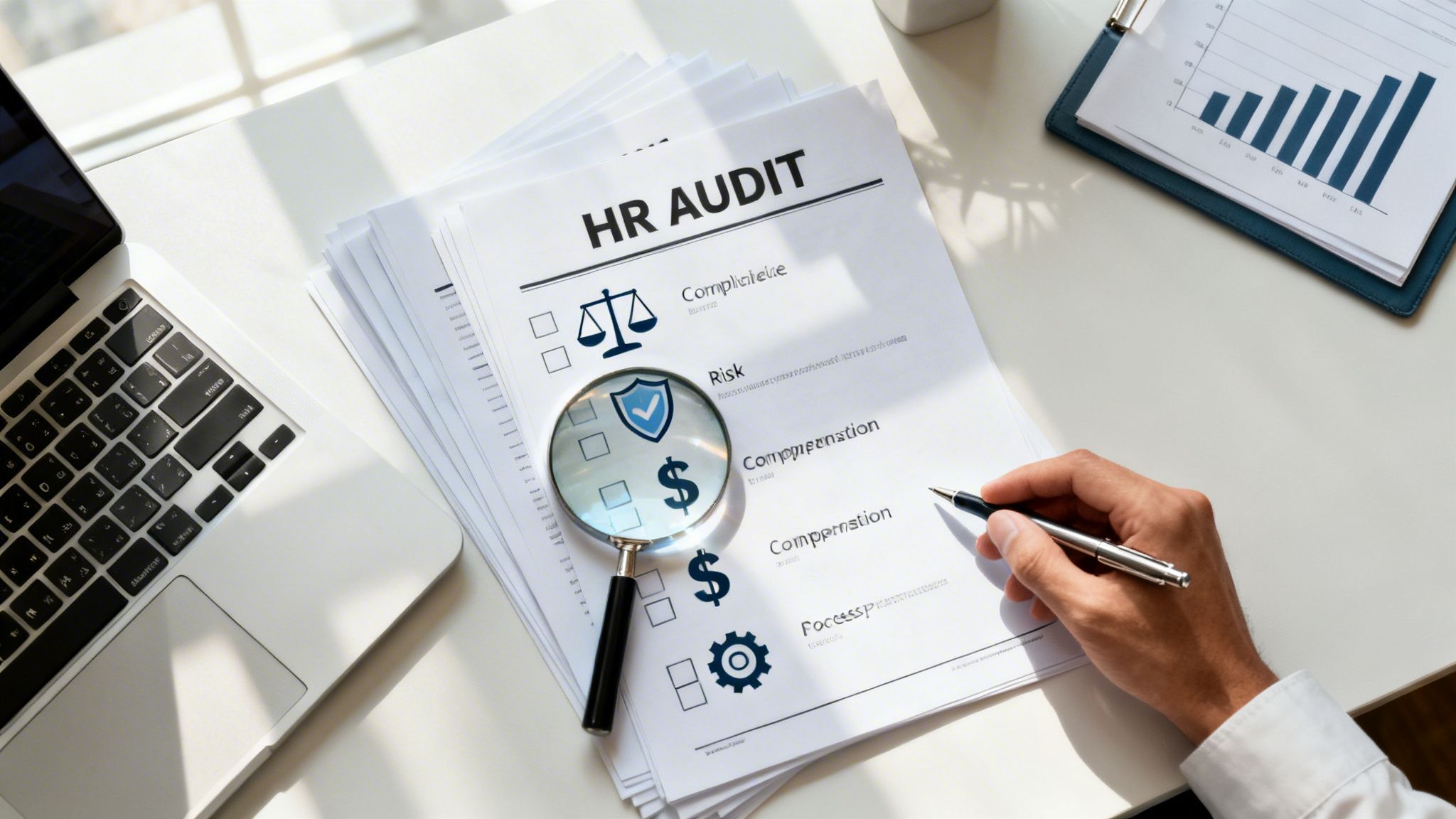
An HR audit is a comprehensive review of your company's human resources policies, procedures, and practices. Think of it as a strategic health check for your people operations, designed to identify potential risks before they become costly problems. This proactive process moves beyond simple box-checking to help you build a more resilient and efficient business.

At its core, an HR audit provides a clear, objective snapshot of your company's people operations. It is a systematic review of everything from hiring practices and employee handbooks to payroll classifications and termination procedures. The goal is simple: ensure your daily practices align with legal requirements and your own stated policies. This process is not about finding fault; it is about uncovering opportunities for improvement.
For most businesses, HR functions grow organically over time. This often leads to inconsistencies or outdated practices that create unnecessary risks. An audit brings much-needed structure to this critical area, ensuring every process is purposeful, fair, and legally sound. By identifying these gaps, you can take action before they lead to employee complaints, regulatory fines, or legal disputes. The U.S. Equal Employment Opportunity Commission (EEOC), for instance, secures hundreds of millions of dollars for victims of discrimination each year, highlighting the financial risks of non-compliance.
While legal compliance is a major driver, the benefits of a thorough HR audit go much deeper. It is a powerful tool for improving operational efficiency, boosting employee morale, and supporting your broader business goals. When leadership has confidence that their decisions are based on solid, defensible practices, the entire organization benefits.
This process helps you build a stronger, more equitable workplace. The key advantages are clear:
An HR audit is not an admission of weakness; it is a declaration of commitment. It signals to your team, stakeholders, and regulators that you are serious about building a fair, compliant, and well-run organization.
Ultimately, conducting a regular HR audit is simply good governance. It transforms HR from a reactive function into a proactive, strategic partner. By taking the time to review and refine your processes, you create a stable foundation that supports sustainable growth and protects your business from avoidable risks.
If you're ready to gain clarity on your HR practices, our team can help you design a process that fits your business needs. To learn more about how a strategic audit can strengthen your organization, schedule a consultation with our team.
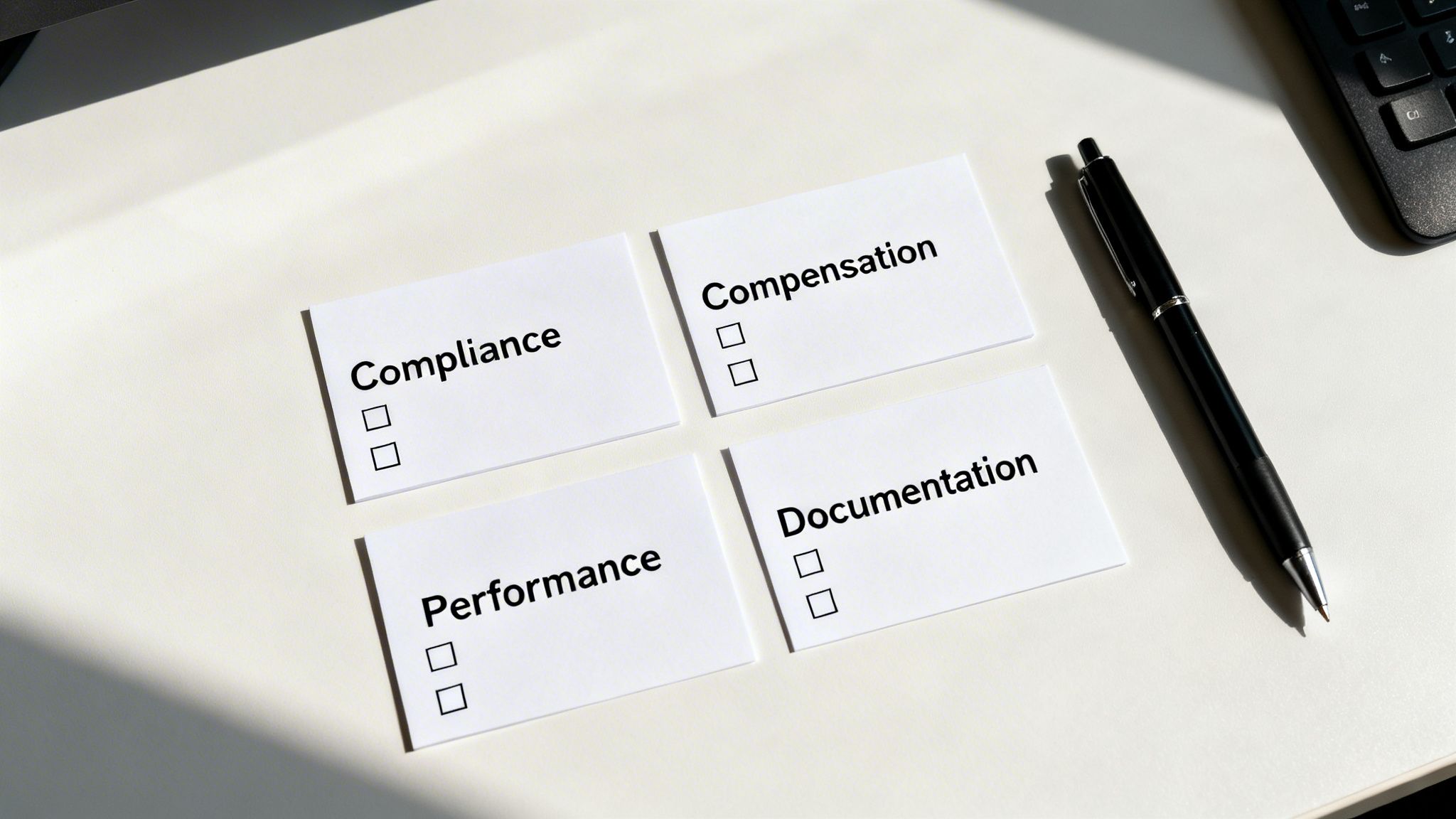
A thorough HR audit is not a single, massive task. It is more like a multi-point inspection for your people operations, broken down into several interconnected functions. By tackling an audit in focused stages, you can methodically review each area, address unique risks, and ensure no critical gaps are overlooked. This is the most effective way to get a complete picture of your HR health.
This area is the bedrock of any HR audit. It focuses on confirming that your business meets its legal obligations, as mistakes here can lead to serious fines and lawsuits. The scope is broad, covering some of the most critical paperwork your company handles. For businesses operating in multiple states, this is an especially high-stakes area. In fact, over half of HR professionals report that navigating different state and local regulations is a major operational challenge.
Your review here should cover essentials like:
How you pay your people is under constant scrutiny from both regulators and your own team. Auditing this area is about ensuring fairness, equity, and compliance with complex wage and hour laws. It is your chance to find and fix pay disparities before they become major liabilities. A crucial part of this is verifying that every employee is correctly classified under the Fair Labor Standards Act (FLSA). Misclassifying an employee as exempt from overtime is one of the most common and costly mistakes a business can make.
An audit focused on compensation is not just about compliance; it's about validating that your pay philosophy is both fair and competitive. It confirms that your most significant investment—your people—is managed with intention and equity.
This review should also examine your benefits administration to ensure it aligns with the Affordable Care Act (ACA) and other regulations. Additionally, you will need to analyze your pay structures to identify any potential inequities across gender, race, or other protected classes.
This is where the audit shifts from paperwork to practice. It is one thing to have policies on the books; it is another to apply them consistently day-to-day. This part of the audit examines how you manage performance, handle discipline, and address employee concerns. Consistency is critical. When managers apply standards unevenly, it creates a perception of favoritism and dramatically increases your risk of discrimination claims.
Your audit should confirm that performance reviews and disciplinary actions are handled uniformly across all teams. A key area to cover is a meticulous employment agreement review to ensure your terms are clear, legally sound, and applied the same way for everyone. It is also the perfect time to review your termination procedures to ensure they are well-documented and defensible.
Sooner or later, every business faces a situation that requires a formal internal investigation, such as a harassment claim or safety incident. Your ability to respond effectively and fairly is crucial. An audit of your investigations readiness ensures you have a clear, defensible process in place before a crisis hits.
This review confirms that you have:
Without a solid protocol, investigations can fall apart, leading to flawed conclusions and additional legal risk. A proactive audit builds the capability you need to handle sensitive issues with confidence and integrity. To help structure this process, we have outlined the key components that form a strategic and comprehensive HR audit.
Each of these areas represents a pillar of your people operations. A weakness in one can easily compromise the others, which is why a holistic audit is so important for building a resilient business. If you are ready to gain this level of clarity, our team can guide you. Reach out to Paradigm to discuss how a structured audit can protect and strengthen your business.
Knowing what an HR audit covers is one thing, but knowing when you need one is another. For most businesses, an audit is not just a calendar event; it is a direct response to specific growth challenges. These are not signs of failure. Instead, think of them as clear signals that your business is evolving and your people practices need to keep pace. Spotting these warning signs early allows you to manage change and build a stable foundation.
One of the most common triggers is rapid growth. When you are hiring quickly or expanding into new markets, the HR systems that once worked well can start to break down. The informal processes that suited a team of 20 often become inconsistent and non-compliant by the time you reach 50 or 100 employees. This is especially true when your growth crosses state lines. Every new state adds a fresh layer of employment laws, from unique paid leave mandates to different payroll requirements.
Major events like a merger, acquisition, or funding round put your internal operations under a microscope. During these due diligence phases, investors and potential partners will scrutinize your business, including your people practices. They are looking for clean records, consistent processes, and minimal legal exposure. Conducting an HR audit before these events allows you to find and fix any potential red flags on your own terms. It is a powerful way to demonstrate that your organization is well-managed and a low-risk investment.
Sometimes, the clearest signals that you need an audit come from within your own organization. These internal warning signs are often leading indicators of deeper issues that can harm morale, drive up turnover, and create serious legal risks if ignored.
Pay close attention to trends like these:
When you start noticing a pattern of employee relations issues, it's a clear sign your policies and your day-to-day practices have drifted apart. An HR audit gives you an objective lens to diagnose that disconnect and map out a path back to alignment.
These signals are not problems to be swept under the rug; they are opportunities. By using an HR audit to address them head-on, you reinforce your company’s commitment to fairness and consistency. This reduces your immediate risk and strengthens your culture for the long term. If any of these warning signs feel familiar, it may be time to get a clear picture of your HR health.
Our team is here to help you understand your risks and build a stronger foundation. To learn more about how a strategic audit can support your business, connect with us at Paradigm.
Starting your first HR audit can feel like a major undertaking, but it does not have to be overwhelming. By breaking it down into a structured framework, a complex project becomes a series of clear, achievable steps. The goal is not perfection overnight; it is about making steady progress and setting a solid baseline for continuous improvement. This framework will help you conduct a meaningful review of your people practices and build a stronger, more compliant organization.
Before you begin reviewing files, the most important step is to decide what you want to accomplish. A successful HR audit is a focused one. Trying to audit everything at once can lead to burnout and incomplete work. Instead, start by identifying your highest-risk areas. Are you concerned about wage and hour compliance? Have you recently expanded into a new state? Your answers will help you define a clear, manageable scope.
To help you get started, here are a few common events that often trigger an HR audit and can help you narrow your focus.
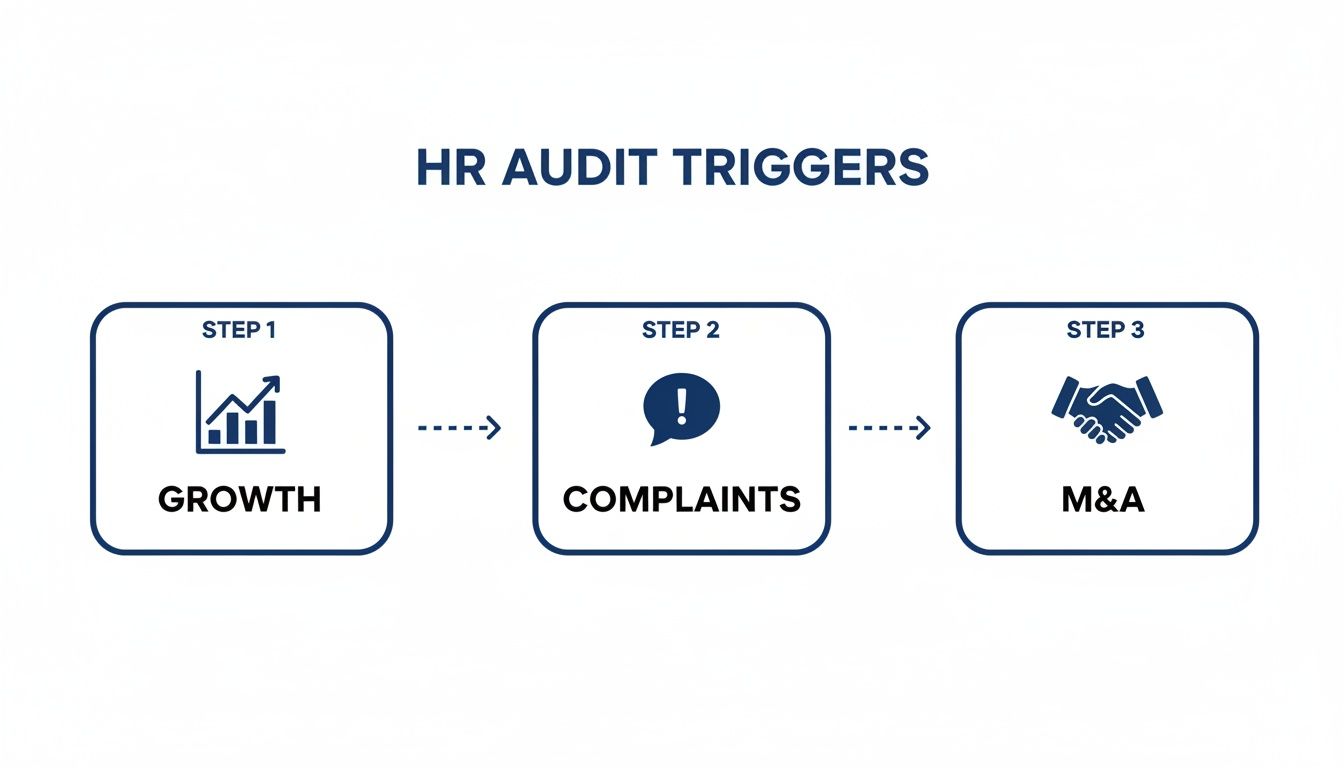
As you can see, triggers like rapid growth, a pattern of employee complaints, or M&A activity are clear signals that it’s time to take a hard look at your HR practices.
Once your scope is set, it is time to gather the necessary documents. Think of this as the evidence-collection stage of your audit. You are trying to get a complete picture of your current HR practices as they exist on paper. Create a simple checklist of all the documents you need to review based on your audit’s scope. This step is crucial for staying organized.
Your documentation checklist might include items like:
This phase is all about creating an objective record. The goal is to collect the raw data that will allow you to compare your documented policies against what’s actually happening day-to-day.
With your documents in hand, the analysis can begin. This is where you compare what you found against legal requirements, industry best practices, and your own internal policies. The central question you are asking here is: “Are we doing what we say we are doing, and does it meet legal standards?” For example, your employee handbook might outline a clear progressive discipline policy, but a review of personnel files might show that managers are applying it inconsistently.
Document every single finding, both good and bad. Note where your practices are strong and compliant, and be specific about where you see discrepancies or risks. For a deeper dive into this part of the process, you can explore our detailed guide on how to conduct an HR compliance audit. This detailed review gives you the insights needed for the final and most important phase.
The last phase is where you turn your findings into a concrete roadmap for improvement. Identifying problems is not enough; you need a prioritized plan to fix them. Not all findings carry the same level of risk, so it is essential to categorize them based on urgency. Start by sorting your findings into high, medium, and low-priority categories. A high-priority issue might be a significant wage and hour violation, while a low-priority item could be a minor policy update.
For each finding, create a specific, actionable step for remediation. Assign an owner responsible for seeing the fix through and set a realistic timeline for completion. This transforms your audit from a simple report into a living document that drives meaningful change. Below is a simple template you can adapt to track your audit results.
This table provides a clear, organized way to document your findings, assess the associated risks, and assign concrete actions to the right people.
By creating and maintaining a plan like this, you ensure that your audit leads to real, lasting improvements that protect and strengthen your business.
While an internal HR audit is a great step toward building a stronger organization, some situations call for the objectivity and specialized knowledge that only an outside expert can provide. This is not a sign of failure; it is a strategic move to get an impartial perspective when the stakes are high. An external advisor’s only job is to provide an unbiased assessment, free from internal politics or the "that's how we've always done it" mindset.
Certain business challenges carry serious legal and financial weight. These are the moments when you need an expert who has navigated similar situations before and knows every potential pitfall. An external advisor provides critical support here, ensuring your decisions are not just compliant, but completely defensible.
Consider partnering with an expert in situations like these:
A great external expert does more than just spot problems. They provide crucial context by benchmarking your practices against current industry standards and legal trends. This helps you understand not just if you are compliant, but if your practices are competitive and effective. For business leaders, this validation provides the confidence needed to make tough decisions, knowing they are backed by sound logic.
By engaging an external auditor, you are investing in defensibility. Their objective findings and recommendations create a clear record of due diligence, demonstrating a proactive commitment to fair and lawful employment practices.
The role of data in HR is growing. Organizations that use workforce analytics and regular audits often see significant improvements in employee retention and engagement. An external expert brings this data-driven approach to your HR audit, ensuring your strategies are built on solid evidence. You can learn more about evolving global HR strategies and key trends. Our guide on when to hire an HR consultant for your small business also offers more detailed insights.
If you are facing a high-stakes HR challenge and need an objective, expert perspective, our team is here to help. Connect with Paradigm to discuss how our advisory services can support your business.
An HR audit should never feel like a final exam that you pass and then forget. Think of it less as a one-time test and more as an annual check-up. It is the starting point for a healthy, ongoing cycle of organizational improvement. The real value of an audit lies in how you use its insights to build a stronger, more resilient business for the long term. This is your chance to shift from a reactive compliance mindset to a culture of continuous improvement.
To turn your audit from a one-off project into a sustainable process, set a regular schedule for these reviews. Your HR practices deserve the same consistent attention as your financials. Committing to a predictable schedule—whether it is a deep-dive annual audit or smaller quarterly reviews—keeps your practices sharp and prevents new compliance gaps from emerging as your business and regulations change.
The best companies do not just patch the holes an audit uncovers; they weave the lessons learned directly into their strategic planning. Your audit findings provide a clear, data-backed snapshot of your operational strengths and weaknesses. This invaluable information should inform everything from workforce planning and leadership development to your overall risk management strategy. For example, if your audit reveals inconsistent policy application, the strategic response is to invest in better manager training to ensure fairness across the board.
The goal is to stop seeing HR audits as a chore and start seeing them as a strategic tool. Consistent, well-documented HR practices do more than just manage risk—they create the stable, trustworthy foundation your business needs to grow with confidence.
Building this cycle of review and improvement does more than just keep you out of legal trouble. It sends a powerful message to your entire team that fairness and consistency are core to how you operate. When employees see that leadership is genuinely committed to getting it right, it builds trust and psychological safety—essential ingredients for a high-performing culture.
This commitment creates a powerful feedback loop:
This process ensures your organization is not just prepared for today’s challenges but is also building the resilience to adapt to whatever comes next. If you are ready to turn your audit findings into a lasting strategic advantage, our team can help you build the framework. Connect with us at Paradigm to learn more.
It is normal to have questions when considering an HR audit. Business leaders often focus on the practical side of things, such as the time, cost, and ultimate value. Here are straightforward answers to the most common questions, designed to provide clarity as you prepare to strengthen your people operations.
There is no one-size-fits-all answer, as the timeline depends on your company’s size and the audit's scope. A focused review of a single area, like I-9 documentation, might only take a few days. However, a comprehensive audit covering all major HR functions could easily take several weeks to a month or longer to complete properly.
Several factors influence the timeline:
The best way to get a realistic timeline is to clearly define the scope from the very beginning. This keeps the process focused and manageable for everyone involved.
While both have their place, they serve different purposes. A self-assessment is like a quick internal pulse check. It is usually informal, run by your own team with a simple checklist to spot known issues. The limitation is that it relies on what you already know and can easily miss blind spots. An HR audit, on the other hand, is a formal, systematic process that provides an objective, evidence-based analysis of your practices against legal standards and industry best practices.
An audit isn't about confirming what you assume to be true; it's about uncovering the unknown risks you didn't even know you had.
This is a critical distinction. If your audit is conducted by an HR professional or a non-attorney consultant, the findings are typically not protected by attorney-client privilege. This means that in the event of a lawsuit, your audit report could potentially be discoverable, providing the other side with a roadmap to your weaknesses. However, if the audit is conducted at the direction of your legal counsel for the purpose of providing legal advice, the findings may be protected.
An HR audit delivers the clarity you need to lead with confidence. By addressing potential issues before they become real problems, you are building a more resilient, defensible organization that is ready for growth. If you are exploring how an audit can support your business, understanding these practical details is an important first step.
At Paradigm, we specialize in helping leadership teams navigate complex employment challenges with structured, defensible HR practices. If you are ready to gain a clear, objective view of your HR risks and opportunities, our advisory team is here to support you.
Learn more about how we can help by scheduling a consultation.