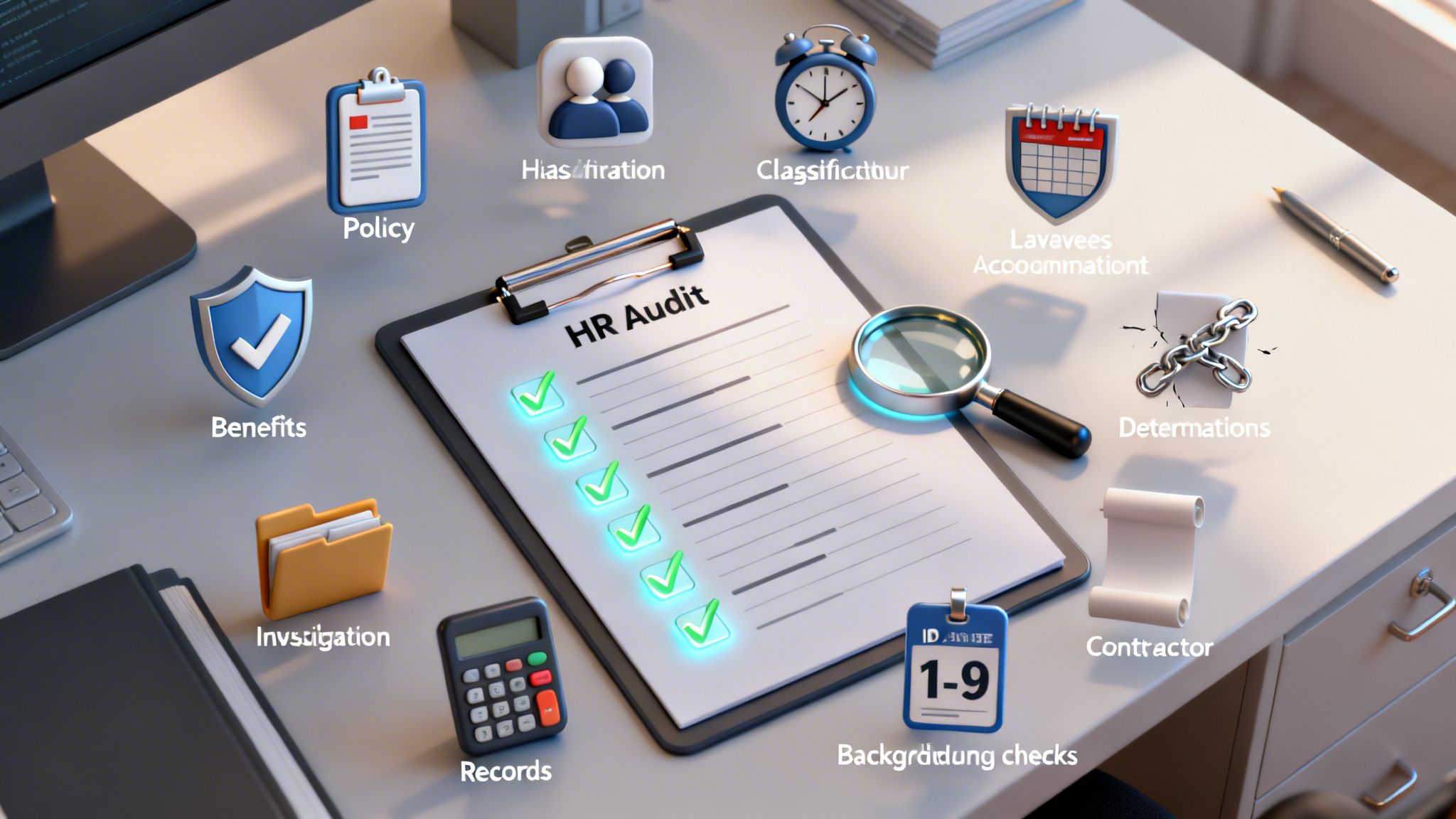
For business owners and leaders, navigating the complexities of employment law is a constant challenge. As an organization grows or expands, the risk of a simple mistake leading to significant legal and financial consequences increases. An HR audit is not just about checking boxes; it is a strategic process for uncovering hidden liabilities, strengthening decision-making, and building a resilient operational framework. This proactive approach ensures your people practices are not only compliant but also defensible.
This guide provides a detailed and prioritized hr audit checklist designed for leadership. It moves beyond generic advice to offer actionable steps for identifying and correcting specific areas of risk before they become costly problems. We will break down ten critical areas of HR compliance, from pay equity and employee classification to separation procedures and multi-state regulations. For each item, you will find a clear explanation of what to look for, the evidence you need to collect, and the red flags that demand immediate attention.
An audit of compensation and pay equity is a systematic review of how your organization pays its employees. It goes beyond simple payroll verification to analyze wage structures, pay scales, and compensation practices across different jobs and departments. The goal is to ensure your pay practices are fair, defensible, and compliant with a growing web of federal, state, and local laws. This part of your HR audit checklist is critical for mitigating legal and financial risks.
Laws like the federal Equal Pay Act (EPA) and various state mandates place the burden of proof on employers to justify pay differences. Without a clear, documented compensation philosophy and consistent practices, an organization can be exposed to costly litigation and regulatory penalties. A thorough audit identifies discriminatory patterns—even unintentional ones—and confirms that all pay decisions are based on legitimate, non-discriminatory business factors like skill, effort, and responsibility.
An effective pay equity audit is not a one-time event but an ongoing process. It provides leadership with the defensible documentation needed to justify compensation decisions and demonstrate a good-faith commitment to fairness.
To conduct this audit, you must analyze compensation data to spot disparities and ensure your internal logic holds up to scrutiny. Collect payroll records, job descriptions, and performance reviews.
Identifying inconsistent pay for similar work without clear, documented justification is a major red flag. Another is the absence of a formal compensation philosophy that guides managers in making equitable pay decisions.
A misclassification audit reviews one of the most fundamental aspects of your workforce: whether a worker is correctly identified as an employee versus an independent contractor. It also checks if an employee is properly designated as exempt or non-exempt from overtime pay. This analysis scrutinizes job roles against federal and state-specific legal tests to prevent costly penalties. This part of your HR audit checklist is essential for avoiding wage and hour liabilities.

The Department of Labor (DOL) and state agencies aggressively pursue misclassification claims. The federal Fair Labor Standards Act (FLSA) sets the rules for overtime exemptions, while states like California have implemented strict "ABC tests" that make it harder to classify workers as independent contractors. The legal landscape is constantly shifting. An audit confirms your classifications are defensible and aligned with current regulations.
A proactive classification audit is a critical defense against wage and hour claims. It creates a documented, good-faith effort to comply with complex rules, which can substantially reduce liability in a legal dispute.
To properly audit classifications, gather detailed job descriptions, contractor agreements, and records of actual duties performed. You must evaluate each role against the specific legal tests applicable in the jurisdictions where you operate.
A significant red flag is having independent contractors who perform the same core functions as your employees. Another is using "exempt" status to avoid paying overtime to employees whose duties don't meet legal requirements.
An EEO practices audit is a critical examination of every stage of the employee lifecycle, from hiring and promotion to discipline and termination. This review ensures your personnel decisions are based on objective, merit-based criteria and are free from unlawful bias. It involves a deep dive into compliance with federal laws like Title VII of the Civil Rights Act and the Americans with Disabilities Act (ADA), as well as various state and local ordinances. This part of an HR audit checklist is fundamental to building a fair workplace.
Regulatory scrutiny and litigation risk in this area are consistently high. The Equal Employment Opportunity Commission (EEOC) has shown increased focus on specific discrimination types, while high-profile settlements underscore the financial consequences of non-compliance. An EEO audit helps identify and correct systemic issues before they lead to formal complaints or lawsuits. It confirms your standards are applied consistently and that you have the documentation to support every personnel decision.
A well-documented EEO audit provides a defensible foundation for all employment actions. It proves that decisions are rooted in legitimate business reasons, not discriminatory factors, which is your primary defense in any legal challenge.
To perform this audit, you must gather and analyze documentation related to all significant personnel actions. This includes hiring records, performance reviews, disciplinary actions, accommodation requests, and termination files. The goal is to verify that processes are standardized and applied uniformly.
A major red flag is the absence of clear, objective criteria for hiring and promotions, leaving decisions vulnerable to claims of bias. Inconsistent application of disciplinary policies or a lack of thorough documentation for terminations also presents a significant risk.
An audit of termination standards is a systematic review of how your organization manages employee departures. This process examines everything from the termination decision and final paycheck practices to severance agreements. The goal is to ensure every step is handled consistently, fairly, and in compliance with federal and state laws, including WARN Act requirements and final wage payment rules. This part of your HR audit checklist is essential for minimizing wrongful termination claims.
Inconsistent or poorly documented terminations create significant legal risks. Courts often look for evidence that a firing was retaliatory or discriminatory, and the absence of clear business reasons can weaken an employer's defense. For example, failing to pay out all accrued PTO in a state like California can lead to immediate penalties. A thorough audit ensures your procedures are defensible and applied uniformly to every departing employee.
Proper termination documentation is your best defense against wrongful termination litigation. It transforms a subjective decision into an objective, evidence-based business action, protecting the organization from claims that can cost upwards of $50,000 to resolve.
To conduct this audit, you will need to review personnel files of terminated employees, separation agreements, and final pay stubs. The objective is to verify that your documentation supports the stated reason for termination and that all legal obligations were met. For a complete guide, review this detailed employee termination checklist.
A major red flag is the lack of a "termination summary" written before the employee is notified. Another is discovering that managers are not following progressive discipline procedures, making terminations appear sudden and unsupported.
An audit of your investigation procedures is a methodical review of how your organization responds to employee complaints, from initial report to final resolution. This process assesses whether your handling of issues like harassment or misconduct is prompt, impartial, and thoroughly documented. The objective is to ensure your internal protocols are effective and compliant with laws like Title VII and various whistleblower statutes. This component of your HR audit checklist is fundamental to maintaining a fair workplace.

Regulatory bodies like the EEOC place a significant burden on employers to act swiftly and appropriately once they are aware of potential harassment or discrimination. A failure to investigate, or a poorly executed one, can be as damaging as the initial complaint itself. Having a non-retaliation policy on paper is insufficient if the investigation response is weak. A proper audit confirms you have a defensible process that protects both employees and the organization.
A well-documented, unbiased investigation process is your organization's first line of defense. It demonstrates a good-faith effort to uphold the law and company policy, which is a critical factor in mitigating liability and penalties.
To complete this audit, you will need to gather your formal complaint and investigation policies, past investigation files, and manager training logs. Examine these materials for consistency, timeliness, and impartiality. For a deeper look, explore our guide on employee complaint investigation best practices.
A major red flag is the absence of a standardized, written procedure that guides managers and HR on how to handle complaints. Another is inconsistent documentation or a pattern of inconclusive findings without clear rationale.
An audit of your policy documentation is a thorough review of your employee handbook and related procedures. This process confirms that your written policies are legally compliant and accurately reflect your organization's actual day-to-day practices. The audit scrutinizes essential policies—like at-will employment, anti-harassment, and leave—to ensure they are clear and consistently applied. This part of your HR audit checklist is fundamental to establishing a defensible employment framework.

Your employee handbook is more than a guide; it can be interpreted as a contract. Courts have found that vague or overly rigid language can erode at-will employment protections and create an implied contract. Furthermore, with multi-state and remote workforces, failing to include state-specific notices for wages, leave, and accommodations can lead to significant penalties. A careful audit ensures your handbook minimizes legal risk while clearly communicating workplace standards.
A well-drafted employee handbook is a critical risk management tool. It should serve as a clear, flexible guide for managers and employees, not an inflexible set of rules that could be used against the organization in court.
To perform this audit, collect all versions of your employee handbook, individual policy documents, and employee acknowledgment forms. You will compare these documents against both legal requirements and your actual operational procedures to identify any gaps.
A major red flag is a "one-size-fits-all" handbook used for a multi-state workforce. Another is the absence of a signed acknowledgment form from every employee for the current version of the handbook.
An audit of leave administration is a detailed review of how your organization manages all types of employee absences, from vacation and sick time to federally protected leaves like FMLA. This process scrutinizes your procedures for calculating leave entitlements, tracking usage, and communicating rights to employees. It is particularly important for multi-state employers, as it ensures compliance with an intricate web of federal, state, and local laws. This part of your HR audit checklist is essential for avoiding costly administrative errors.
Mismanaging employee leave is one of the fastest ways to incur legal liability. Federal laws like the Family and Medical Leave Act (FMLA) and the Americans with Disabilities Act (ADA) have strict requirements for notice and job protection. Additionally, many states and cities have enacted their own paid sick and family leave laws. An audit identifies gaps in compliance, ensuring you correctly run different leaves concurrently and meet all notification and tracking duties.
Effective leave administration requires more than just a policy; it demands a documented, consistent process. A thorough audit confirms that your practices align with your written policies and protects the organization from claims of interference or discrimination.
To conduct this audit, you will need to gather leave policies, employee leave request forms, FMLA notices, and records of leave accrual and usage. For a holistic view, using a detailed employee benefits compliance checklist can help ensure all related federal and state requirements are being met.
A major red flag is the failure to provide required FMLA notices or incorrectly calculating an employee's available leave entitlement. Applying leave policies inconsistently can also open the door to discrimination claims.
An audit of multi-state compliance involves a comprehensive review of your obligations in every state where you have employees. This goes beyond federal law, touching on state-specific tax accounts, required workplace postings, and unique wage and hour rules. The goal is to verify that your organization is properly registered and operating in full compliance with the distinct legal framework of each jurisdiction. This part of your HR audit checklist is fundamental for any business expanding beyond a single state.
Operating in multiple states means navigating a complex patchwork of employment laws where one-size-fits-all policies fail. States like California have intricate regulations covering everything from meal periods to contractor classifications, while cities like New York have their own pay transparency laws. Non-compliance can lead to substantial financial penalties and legal challenges. A multi-state audit ensures you have a clear, state-by-state inventory of your obligations.
Failing to properly register or comply with state-specific employment laws can invalidate your policies and expose the business to significant unforeseen liabilities. A proactive audit is the only way to manage this risk effectively as you grow.
To conduct this audit, you will need to create a state-by-state compliance matrix. Collect evidence of state registrations, copies of all workplace postings, payroll tax records, and state-specific policy addendums.
A major red flag is discovering you have employees in a state where you are not registered to do business or pay unemployment taxes. Another is using a generic employee handbook without any state-specific provisions.
An audit of your screening and hiring practices is a detailed examination of how your organization vets and selects candidates. This review analyzes the entire process, including when you ask about criminal history, the use of credit reports, and the consistency of your selection criteria. The objective is to ensure your screening methods are fair, job-related, and compliant with federal and local laws. This part of your HR audit checklist is essential for maintaining a fair hiring process.
Laws like the Fair Credit Reporting Act (FCRA), EEOC guidance on criminal history, and various "ban-the-box" laws create a complex compliance web. The FCRA dictates strict procedures for consent and adverse action notices. Meanwhile, the EEOC scrutinizes screening policies that have a disparate impact on protected groups, pushing employers to conduct individualized assessments. Failing to navigate these rules can lead to costly settlements and regulatory fines.
A compliant screening process is not about finding perfect candidates; it's about using job-related information fairly and consistently to make defensible hiring decisions. Proper documentation of this process is your best defense against claims of discrimination.
To perform this audit, you need to gather your background check policies, consent forms, adverse action notices, and a sample of applicant files. Scrutinize these documents for procedural consistency and legal compliance.
A major red flag is having no standardized process, allowing managers to apply screening criteria inconsistently. Using outdated consent or notice forms that don't meet current FCRA requirements also exposes the organization to significant legal risk.
An audit of health, safety, and workers' compensation is a critical review of your commitment to providing a safe working environment. It examines everything from adherence to Occupational Safety and Health Administration (OSHA) standards to the proper management of workplace injury claims. This process verifies that you are proactively protecting your most valuable asset: your employees. A thorough review in this area is a fundamental part of any complete HR audit checklist.
Maintaining a safe workplace is a non-negotiable legal and ethical obligation. Failures can lead to severe consequences, including significant OSHA fines, increased workers' compensation insurance premiums, and costly litigation. A systematic audit ensures your safety protocols are effective, your incident reporting is accurate, and your handling of claims is compliant. For a guide to regulatory requirements, see this resource on Workplace Health and Safety compliance.
A proactive safety and workers' compensation audit shifts the focus from reactive damage control to preventive risk management. It creates a defensible record demonstrating your due diligence in protecting employee well-being.
To perform this audit, you'll need to gather and review safety policies, OSHA logs, workers' compensation claim files, incident reports, and training records. The objective is to confirm that your procedures are documented and consistently followed.
A major red flag is a pattern of similar injuries occurring over time, suggesting a failure to address root causes. Other warning signs include incomplete OSHA logs, inconsistent incident reporting, and the lack of a formal return-to-work program.
Completing a comprehensive HR audit is a significant achievement. The true value of this process lies not in the checklist itself, but in the focused actions you take in response to its findings. You now have a clear, data-informed perspective on your organization's operational health, identifying strengths and pinpointing vulnerabilities before they escalate into costly liabilities. This audit provides your leadership team with a prioritized roadmap for meaningful improvement.
The immediate task is to translate your audit results into a tangible action plan. Avoid trying to address every finding at once. Instead, apply a risk-based approach to prioritize your efforts.
Once prioritized, assign clear ownership for each remediation task. Every action item should have a designated leader and a realistic deadline. This accountability is crucial for ensuring the momentum from the HR audit checklist translates into lasting organizational change.
Ultimately, the audit is a tool to foster a culture where compliance and best practices are integrated into daily operations. Use the findings as a catalyst for training. If the audit revealed inconsistencies in how managers handle leave requests, that is a clear signal to schedule targeted training for your leadership team. By documenting your findings and remediation plan, you create a defensible record of your good-faith efforts.
This journey from audit to action reinforces your commitment to operational excellence and provides the structure needed to scale your business with confidence.
The team at Paradigm International Inc. specializes in helping multi-state and regulated businesses implement the structured systems needed to move from compliance checklists to confident, proactive operations. If you need an expert partner to help you build a defensible and scalable HR function, we invite you to get in touch. To learn more about how our advisory-first approach can support your leadership team, visit us at Paradigm International Inc..