
If you're running a growing business across more than one state, you've probably felt this tension already. A manager brings you a conduct issue, a weak performer, or a termination request, and the question isn't just what to do. It's how to do it in a way that protects the business, supports the manager, and holds up if the decision is challenged later.
That's where an HR Business Partner matters. Not as an extra layer of HR process, but as a decision partner who helps leadership move with more structure, better judgment, and less avoidable risk.
Many leaders hear HR Business Partner and assume it means a more senior HR generalist. In practice, that framing misses the point. A true HR Business Partner isn't there to primarily process paperwork, answer routine employee questions, or serve as a catch-all for administrative HR work.
The role is closer to an internal consultant embedded in business decisions. An HRBP helps leadership translate business goals into workforce actions, and simultaneously helps managers make people decisions that are practical, consistent, and defensible.
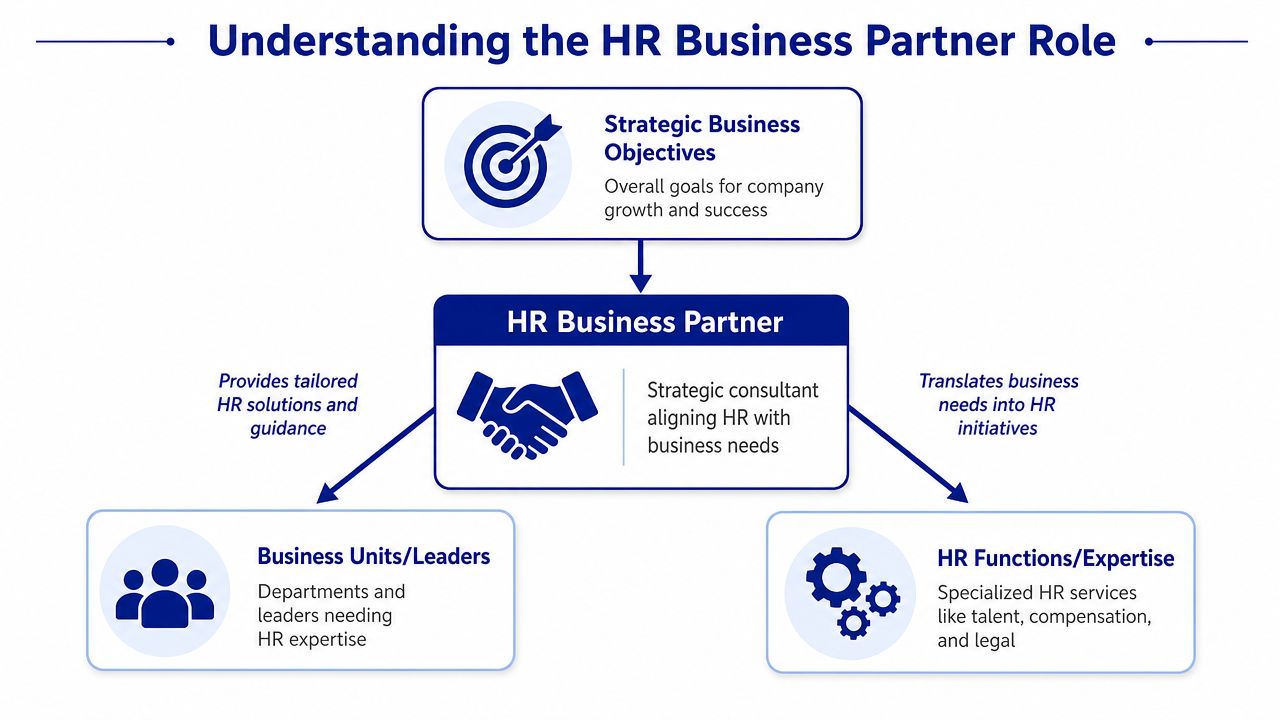
A traditional HR administrator or generalist often focuses on execution. That may include onboarding coordination, policy distribution, benefits administration, and routine employee record management. Those functions matter, but they don't define an HRBP.
The i4cp HRBP model describes six competency domains that make the role strategic rather than clerical: business acumen, HR expertise, relationship skills, consulting and influencing, talent planning and risk management, and people analytics, as outlined in i4cp's HR Business Partner competency framework.
That framework becomes more useful when you translate it into operating terms:
Practical rule: If your "HRBP" spends most of the week chasing forms, managing inbox traffic, and solving basic admin issues, you likely don't have an HR Business Partner. You have a mislabeled operations role.
For a COO, the value of an HRBP is simple. You should expect someone who can sit with a business leader, understand the operational problem behind the people issue, and recommend a path that balances speed, fairness, and risk.
That means asking questions such as:
When the role is structured well, the HRBP becomes the link between leadership intent and disciplined people execution. That's very different from an HR generalist who merely keeps the system moving.
Growth exposes weak management systems fast. The same informal decision-making that worked when you had one location and a small leadership team starts to break down when performance issues multiply, teams spread across states, and managers apply different standards.
An HR Business Partner helps move the company from reactive HR to operational discipline. That shift matters because people decisions affect output, retention, manager credibility, and legal exposure all at once.
The strongest case for an HRBP isn't that they make HR more polished. It's that they improve business outcomes. According to Gartner data cited by Northeastern, high-performing HR business partners can improve employee performance by up to 22% and employee retention by up to 24%, and 75% of respondents in CIPD research said HRBPs hold the relationship with business leaders, reinforcing that the role sits at the center of business-facing HR work, as summarized in Northeastern's overview of HR Business Partner impact.
For a growing company, those aren't abstract HR metrics. Better performance affects execution. Better retention reduces disruption, hiring strain, and manager time spent refilling the same roles.
Without an HRBP, many companies drift into one of two bad patterns. Either managers make inconsistent calls on employee issues with little structure, or every difficult decision gets pushed upward until the executive team becomes the bottleneck.
An HRBP changes that operating model by helping leaders:
HR works best in a growing company when it isn't just servicing requests. It should improve the quality of management decisions.
The bigger your footprint, the less room you have for casual people management. A manager in one state may think they're handling a situation sensibly while creating inconsistency with another location, another policy interpretation, or another employment requirement.
That's why a strategic HR partner matters most when the business is scaling unevenly. The role brings a repeatable way to assess issues, coach managers, and document decisions before they become larger operational or legal problems.
The most useful way to understand an HR Business Partner is to look at when leadership needs one. Not for routine approvals. For moments when a manager's judgment, the facts, and the business risk don't line up neatly.

Industry guidance consistently points to the same pressure points. In multi-state organizations, HRBPs are often pulled into employee relations matters, policy interpretation, performance management, investigations, and monitoring employment law changes across locations, as described in this overview of HRBP priorities in complex organizations.
A regional manager wants to terminate an employee who has performance issues and works remotely from another state. The manager insists the case is straightforward. But the file is uneven. Coaching happened verbally. Prior expectations weren't documented clearly. Similar conduct by another employee was handled more lightly.
An HRBP earns their seat not by deciding whether the business can ever terminate, but by assessing whether the current path is coherent, documented, and consistent enough to proceed defensibly.
A strong HRBP will usually step in to:
The point isn't delay. It's to reduce the chance that a rushed decision creates unnecessary exposure.
A complaint comes in about a high-performing manager. The allegations may involve favoritism, retaliation, or conduct that undermines team trust. Operations wants speed. Legal risk may be present. The reporting employees may already believe leadership protects strong performers.
An HRBP helps impose structure when emotions and business pressure are high. They define scope, identify what facts need to be gathered, help sequence interviews, and keep leadership from jumping to conclusions too early.
The fastest way to damage an investigation is to let urgency replace process.
This is also where line-manager boundaries matter. The HRBP shouldn't become the emotional absorber for everyone involved while management disappears. Leaders still need to own communication, accountability, and the business response.
A company expands hiring into a new state because the talent is there. Soon after, managers start asking whether existing attendance rules, leave practices, and discipline standards still apply the same way. Usually, that's the point where leaders realize they don't just need HR administration. They need policy interpretation and operating discipline.
An HRBP can align the business on what needs to change, what needs to stay consistent, and where managers need clearer direction. That work often overlaps with workforce planning too. If the business is entering new markets or changing role expectations, a structured review of capability gaps becomes useful. A practical primer like this complete guide to skills gap analysis can help leaders think through whether the issue is performance, role design, or missing capability.
In each of these scenarios, the HRBP is doing more than advising in theory. They're helping leadership make choices that are organized, supportable, and less likely to unravel later.
The biggest hiring mistake leaders make with this role is screening for broad HR exposure instead of judgment. Plenty of candidates can describe onboarding, policy work, and employee relations. Fewer can sit with a COO, understand the business stakes, and guide a high-risk decision without either overreacting or becoming passive.
That's why the selection process should focus less on whether someone has touched many HR functions and more on how they think. The role is established as a senior one. Zippia reports 105,963 employed HR Business Partners in the United States, with an average age of 46, which supports the view that this is a mid-career advisory role rather than an entry-level HR job, according to Zippia's HRBP demographics profile.
A capable HRBP should be able to move comfortably between business discussion and people risk. They should also know when to slow a leader down, when to escalate concerns, and when a manager needs coaching instead of rescue.
Use questions that surface judgment under pressure, not just technical familiarity.
| Evaluation Area | Key Question to Ask |
|---|---|
| Business judgment | How do you evaluate a people issue when the operational need is urgent but the documentation is weak? |
| Manager coaching | Tell me about a time you had to guide a manager who wanted HR to take over a difficult employee conversation. |
| Risk assessment | How do you identify when a termination or disciplinary action needs more review before moving forward? |
| Multi-state awareness | How have you handled situations where one policy had to be applied across employees in different states or locations? |
| Influencing skill | Describe a time you had to push back on a senior leader's preferred approach. What did you do? |
| Investigation discipline | How do you scope and manage a sensitive employee relations investigation without losing objectivity? |
| Documentation standards | What does good manager documentation look like to you before a final corrective action or termination? |
| Prioritization | When several leaders bring urgent issues at once, how do you decide what gets attention first? |
Good candidates don't hide behind jargon. They talk in specifics. They explain trade-offs, show they understand line-manager accountability, and can describe how they create structure around messy decisions.
Look for signs they can do the following:
If you need a practical comparison point while evaluating options, this guide on how to select an HR partner is a useful companion to the interview process.
A strong HRBP should make your managers more capable over time. If the candidate's examples always end with HR taking over, that's a warning sign.
Even a skilled HRBP can fail in the wrong operating model. The most common breakdown isn't lack of effort. It's lack of boundaries. Managers start handing off ownership of performance issues. HR gets pulled into every difficult conversation. Soon the business has more HR involvement, but not better management.
Cornell's CAHRS discussion of the role is useful here because it frames HRBP work around judgment, prioritization, thought partnership, change management, administration, crisis management, and the need to push back when needed, as discussed in Cornell's CAHRS HRBP research. That's the right lens for a COO. The question isn't just whether HR is involved. It's whether the engagement model builds stronger decision-making.
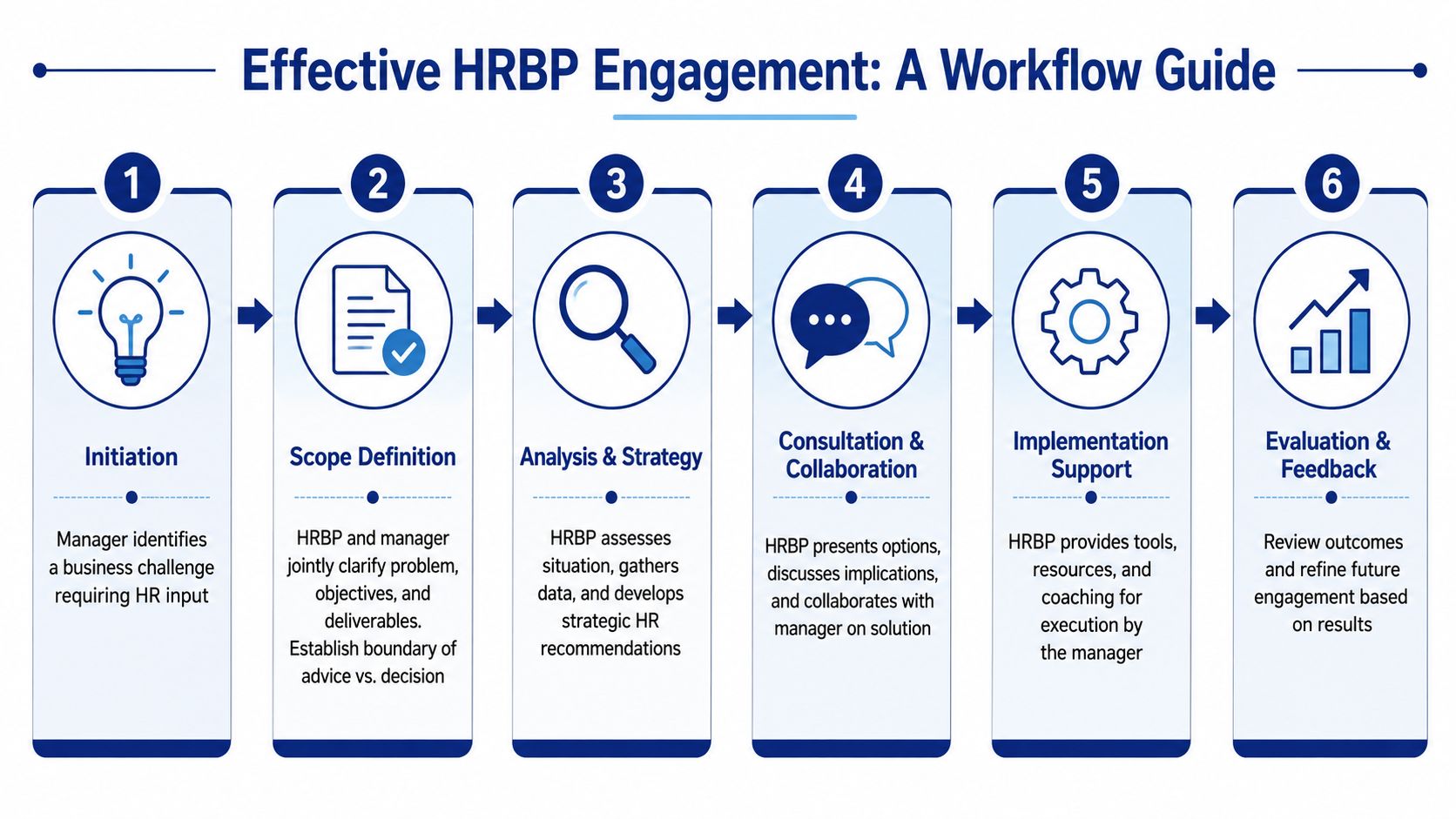
The cleanest structure is an advisory-first workflow. The manager identifies the issue. The HRBP helps define the problem, assess options, flag risk, and shape the process. The manager then executes with support rather than transferring ownership to HR.
That sounds simple, but it changes behavior in important ways:
A firm like Paradigm International's growth-focused HR strategy advisory can fit into this model when leadership needs structured support around high-stakes decisions, manager standards, and scalable HR governance.
The HRBP should advise on process, risk, documentation, and consistency. The manager should own expectations, performance conversations, and operational follow-through. When those lines blur, two problems show up fast. Managers get weaker, and HR inherits decisions it doesn't fully control.
Use this split as a working standard:
Operating principle: If a manager can't explain the rationale for their employment decision without HR speaking for them, the process isn't ready.
An overinvolved HRBP can accidentally train managers to escalate too early and think less carefully. A disengaged HRBP creates the opposite problem, where managers improvise in high-risk situations. The right model sits between those extremes.
Three habits help:
This workflow also makes prioritization easier. Not every issue deserves the same level of HRBP involvement. Some need quick coaching. Others need deep review because the legal, reputational, or operational risk is higher. That's one of the role's most valuable contributions.
A strong HR Business Partner doesn't exist to make HR sound more strategic. The role exists to help leadership make better people decisions under pressure. In a growing multi-state business, that means bringing structure to terminations, investigations, policy interpretation, manager coaching, and workforce decisions that can affect both performance and exposure.
The key is using the role correctly. An HRBP should strengthen management accountability, not replace it. They should help the business move faster where it can, slow down where it should, and document decisions in a way that stands up over time.
If you're trying to assess where your current HR practices are vulnerable, a practical HR audit checklist for growing organizations can help you spot gaps before they become bigger problems.
When that foundation is in place, HR stops being a reactive service function and becomes part of how the business protects itself while it grows.
If your leadership team is dealing with difficult terminations, inconsistent manager practices, investigations, or multi-state employment complexity, Paradigm International Inc. offers HR risk and advisory support designed for those high-stakes moments. The work is focused on helping businesses make clearer decisions, document them well, and build a more defensible operating model as they grow.