A lot of Tampa leaders don't start looking for HR compliance help when things are calm. They start looking after a former employee files a complaint, outside counsel asks for documentation that doesn't exist, and a manager says, “I thought HR had that covered.” If you're evaluating an HR compliance agency in Tampa, FL, that's the wrong moment to discover your process was informal, your records were fragmented, and your policies didn't match how the business operates.
Tampa isn't a casual employment market. One legal directory reports 2,563 employment-law attorney listings across 331 different law firms serving Tampa, Florida and another lists 480 employment lawyers in the city through Avvo's Tampa employment-law directory. My view is simple. In a market with that much legal concentration, you don't buy HR compliance for paperwork. You buy it for defensibility.
A manager fires an employee on Friday. By Tuesday, an EEOC inquiry asks for the policy, prior coaching records, comparator treatment, pay history, and proof that the manager was trained. Your outside counsel is not looking for a prettier handbook. Counsel is looking for a record that holds up before a charge matures into a larger dispute.
That is the job of an HR compliance agency. It builds the evidence trail before someone forces you to produce it.
In Tampa, that work has to be defensible under pressure, not just technically current on paper. As of March 2025, Martindale-Hubbell's Tampa employment law directory listed 2,563 employment-law attorney listings across 331 different law firms serving Tampa, Florida. As of March 2025, Avvo's Tampa employment-law directory listed 480 employment lawyers in the city. In a market with that much plaintiff and defense capacity, informal HR practices do not stay informal for long.
A credible firm should leave you with work product you can hand to counsel, an investigator, or a regulator without scrambling:
Ask for redacted samples. If the firm cannot show you an audit memo, investigation file, or manager training record set, walk away.
The wrong buyers still overpay for low-value deliverables. A handbook alone does not protect you in a pre-litigation inquiry. Template policies without training logs, acknowledgment records, and audit notes are administrative clutter. If you want broader context on the category, you can view HR compliance resources, but your selection criteria should stay narrow. Buy documentation discipline, decision support, and records that survive scrutiny.
Tampa employers need more than a generic federal checklist. Florida wage rules, E-Verify obligations, and local discrimination enforcement create a multi-layer compliance problem, especially for companies with remote staff in other states. A useful starting point is this Florida and Tampa HR compliance review, but the better question is whether the agency uses that Florida layer inside a repeatable multi-state audit method.
That means the agency should test policy language against actual practice, trace pay rules from handbook to payroll setup, verify onboarding controls by entity and location, and flag where Florida-specific requirements conflict with legacy processes built for another state.
If the firm produces policies but cannot map risk by jurisdiction, preserve evidence fast, and support a response before a complaint turns into a formal case, it is selling HR administration under a compliance label. Tampa businesses should expect more.
It is 4:40 p.m. on a Thursday. An EEOC inquiry lands first. The charge may never come, but the pressure starts now. Your COO wants records by Monday. Your HR lead has policy files, scattered manager notes, inconsistent acknowledgments, and no clean audit trail showing who knew what, when, and why a decision was made.
That is the moment outside help starts paying for itself.
External support makes sense when the business has real exposure and cannot produce a defensible record fast. In Tampa, that exposure often starts with Florida rules that change operating risk before anyone files a formal claim. Private employers with 25 or more employees must use E-Verify for new hires under Florida law. Florida's minimum wage reached $13.00 per hour on September 30, 2024, and the constitutional schedule is projected to reach $15.00 per hour on September 30, 2026. Tampa employers also need to account for local anti-discrimination enforcement, not just federal standards. The issue is not whether you have a handbook. The issue is whether your documents, payroll settings, onboarding controls, and manager practices line up well enough to survive scrutiny.
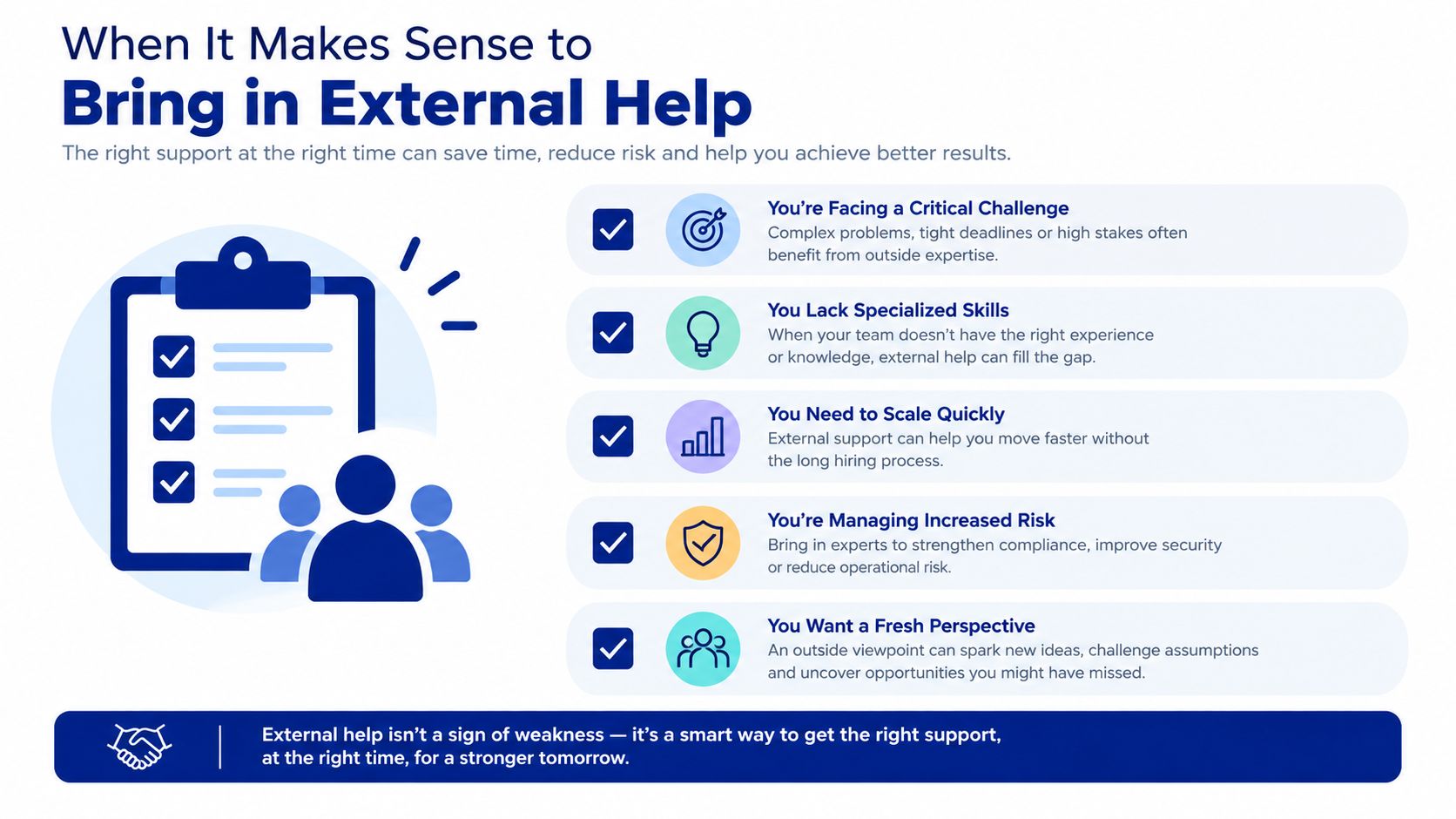
Bring in an external advisor when one or more of these conditions exists:
The strongest reason to hire help is usually pre-litigation pressure. EEOC inquiries and internal complaints often outpace formal charges. They force the same immediate test. Can the company collect the facts, preserve evidence, explain its process, and show consistent treatment across employees and locations?
If the answer is no, do not ask an outside firm for generic compliance support. Ask for an audit that ties policy to actual practice, checks Florida wage and E-Verify controls, and maps the same review method across every state where you employ people.
The best time to engage is before a dispute hardens into a record problem.
Use outside help before opening a new location, before rolling out a compensation change, before integrating an acquisition, or after an internal spot check shows missing acknowledgments, weak supervisor documentation, or inconsistent onboarding files. Those are controllable moments. They let an advisor fix process, assign ownership, and build a record before opposing counsel or an investigator starts asking for one.
Buy outside help when you need defensibility, not reassurance.
If your internal team cannot produce a clear timeline, a jurisdiction-by-jurisdiction risk map, and supporting records without scrambling, the company has outgrown informal HR compliance.
An EEOC inquiry lands on Monday. By Wednesday, leadership wants a timeline, manager notes, policy versions, pay records, and a clear explanation for why the same issue was handled differently in Tampa and Georgia. Your engagement model decides whether the vendor can produce a defensible record or just send you a checklist.
That is the decision. Buy for pressure handling, not for convenience.
| Model | Best Fit | Typical Deliverables | Cost Posture |
|---|---|---|---|
| Project audit | Company with a defined exposure or a specific audit target | Wage and hour review, I-9 and E-Verify audit, handbook and state addenda review, remediation roadmap | Fixed fee if scope is precise |
| Fractional advisory | Growing employer with recurring judgment calls across locations | Ongoing issue spotting, investigation guidance, manager documentation standards, multi-state compliance review | Monthly retainer with clear limits |
| Full-service HR support | Employer that needs administrative HR coverage plus compliance oversight | Onboarding support, policy administration, employee relations support, process management | Recurring spend with wider scope and more variation |
A project audit works when the problem is already clear. Use it for a Florida wage review, an I-9 and E-Verify cleanup, a classification check, or a pre-acquisition file audit. Insist on written findings, ranked risks, named owners, and deadlines. If the vendor offers verbal advice without a remediation document, walk away.
Fractional advisory fits companies that keep facing the same hard calls. Terminations, complaint handling, manager inconsistency, remote hiring, and state-by-state policy drift all create pre-litigation exposure before any formal charge appears. This model works only if the advisor sets rules for escalation, documentation, and decision logs across every state where you employ people.
Full-service HR support is the most misunderstood option.
Many Tampa employers buy it because it feels safer. Often it just buys administrative relief. The vendor can answer routine employee questions and keep onboarding moving, yet still fail when an investigator asks for chronology, comparators, and proof that Florida-specific controls matched the company's multi-state process. Administrative coverage has value. It is not the same as defensibility.
Use a simple selection rule. Match the model to the failure point.
Some buyers also compare adjacent support options such as virtual legal assistants companies to help with document flow and legal workflow. That support can reduce administrative drag. It does not replace senior HR compliance judgment.
Paradigm International Inc. is one example of an advisory-focused firm. Its relevance here is straightforward. A vendor built around investigations, terminations, documentation standards, and multi-state compliance is usually a better fit for risk-sensitive work than a general HR help desk.
An EEOC inquiry lands before any formal charge. Plaintiff's counsel sends a preservation letter two days later. Your COO asks the vendor for the investigation file, handbook history, wage classification support, and Florida hiring records. If the answer is a scramble across inboxes, shared drives, and manager memory, the engagement already failed.
That is the standard. Judge the firm by what it can defend under pressure, not by how polished the sales call felt.
Ask for work product, not promises. A serious agency should show redacted examples, templates, or system screenshots that prove it builds records a reviewer can follow months later.
Use this checklist:
Weak vendors reveal themselves quickly. They talk about support. Strong vendors talk about files, logs, controls, and escalation.
| Deliverable Area | What you should hear | What should end the conversation |
|---|---|---|
| Investigations | “We maintain a separate investigation file with notes, evidence, findings, and action records.” | “We usually keep everything in the personnel file.” |
| Handbooks | “We track versions and acknowledgments by date and state.” | “We send updates by email and trust managers to handle it.” |
| I-9 and E-Verify | “We can show an audit process and exception handling log.” | “Payroll or ops handles that somewhere.” |
| Wage mapping | “We document classification rationale by role.” | “We review jobs informally as questions come up.” |
| Training | “We maintain completion records and topic coverage.” | “Managers know the expectations.” |
| Multi-state mapping | “We tie obligations to employee work location.” | “Our base handbook covers everyone.” |
One more test matters. Ask how the firm handles pre-litigation pressure before a lawsuit exists. EEOC inquiries, attorney demand letters, and internal complaints often move faster than formal claims. The vendor should have a clear intake protocol, preservation standard, chronology format, and attorney-coordination process. If it gives legal-adjacent advice with no handoff method to counsel, walk away.
Do not ask generic Florida questions. Ask where the record breaks.
Start with wage practices and hiring controls. How does the agency test Florida pay rules against stricter rules in other states where your people work? How does it audit E-Verify responsibility, timing, and correction steps when hiring is split between field managers, HR, and operations? If it cannot explain the audit method, it is selling coverage, not control.
Then ask for document governance. How are Florida-specific policies issued, acknowledged, and retired? How are Tampa location practices checked against the company's broader multi-state method? For policy architecture, state addenda, and handbook structure, I would expect working familiarity with Paradigm International state requirements.
Decision test: Buy the vendor that can produce record architecture, audit logic, and escalation rules on command. Leave the one that sells confidence but cannot show how the file would read to an investigator.
A Tampa COO usually finds out the multi-state method is weak when an EEOC inquiry, wage complaint, or hiring record request hits before anyone can assemble a clean file. By then, the problem is not the handbook. The problem is whether your records, workflows, and state logic hold up under pressure.
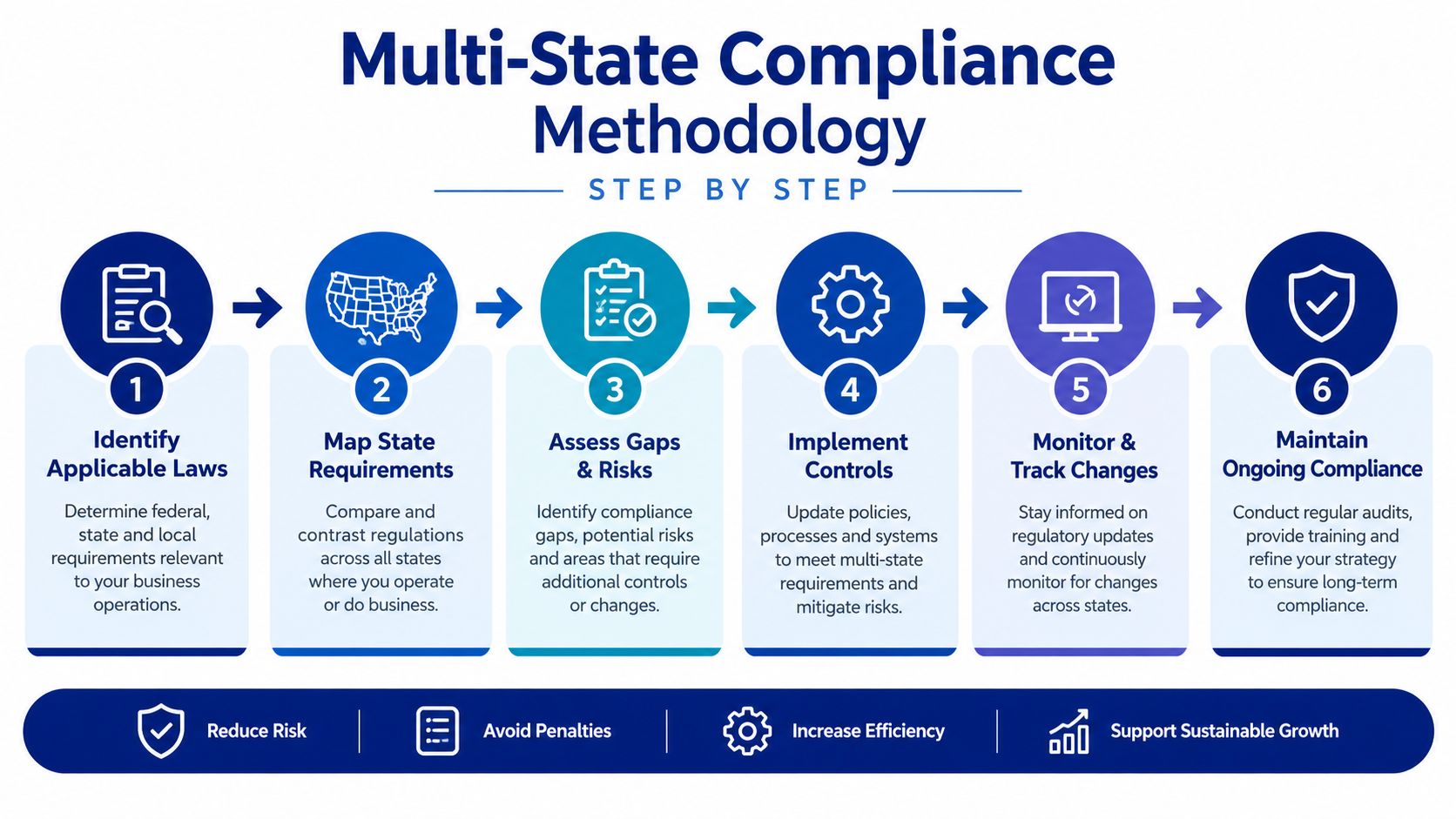
Start with a jurisdiction inventory. Pull work location data from payroll, HRIS, timekeeping, and remote-work records, then reconcile conflicts. Manager recollection is not evidence. If the work-state data is wrong, your wage, leave, notice, and termination rules are wrong too.
Then build an obligation map by state and topic. Match each employee to the rules that apply where the work is performed. That means wage payment timing, exemption tests, meal and rest rules where applicable, leave, accommodations, postings, and termination documents. For Tampa employers, Florida has to be tested against stricter states, not treated as the default for everyone on payroll.
The third step is a document and workflow audit. Review handbook language, offer letters, state addenda, pay practices, I-9 processes, classification memos, acknowledgments, complaint intake records, and manager training logs. You are testing proof, not intent.
That distinction matters. In the 2025 compliance benchmark report, analysts found that 23% of organizations had audit findings that exposed previously unknown compliance gaps, with missing I-9s, FLSA misclassification problems, and outdated handbook policies among the recurring issues. A serious agency uses that reality to drive file testing and workflow testing, especially in companies juggling Florida hiring rules, E-Verify responsibility, and out-of-state wage obligations at the same time.
Next comes risk ranking and remediation sequencing. Fix the issues that create the worst record first. Misclassification, missing hiring documents, broken pay practices, and inconsistent complaint records belong at the top because they become expensive fast once a regulator, plaintiff's lawyer, or investigator asks for support.
Some parts of this work should be attorney-supervised. Put high-risk classification reviews, investigations tied to protected complaints, and remediation analysis connected to known exposure under counsel direction. If the vendor cannot say where HR operations ends and privileged legal review begins, do not give them this engagement.
Use a 90-day build:
The failure point is usually simple. Records sit across inboxes, shared drives, payroll notes, and local folders, so nobody can produce a defensible chronology without rebuilding it by hand. Under pre-litigation pressure, that delay reads as poor control, and poor control attracts more scrutiny.
A Tampa employer usually does not feel Florida risk during a routine payroll run. It feels it when an EEOC inquiry, wage complaint, or document request hits the inbox and leadership cannot produce a clean, state-specific record set within days.
That is why I would judge an HR compliance agency on Florida execution, not generic handbook language. A vendor that cannot connect Florida wage rules, E-Verify workflow, local discrimination coverage, and multi-state recordkeeping into one audit method will fail you under pressure.
Florida's minimum wage is scheduled to be $14.00 per hour through September 29, 2026, and is scheduled to rise to $15.00 per hour on September 30, 2026, according to this Florida minimum wage coverage. The tipped minimum cash wage is scheduled to move from $10.98 to $11.98 on September 30, 2026. Employers may count a fixed $3.02 tip credit toward the full minimum wage.
Treat that as an operating control issue, not a payroll footnote. If your agency reviews wage tables but does not test offer letters, tipped job coding, service charge treatment, regular-rate calculations, and manager scheduling assumptions, the review is too shallow.
Florida hiring rules also get missed when companies expand across state lines. Private employers with 25 or more employees must use E-Verify for new hires. That sounds simple until a multi-state employer runs different onboarding paths by location, assigns I-9 completion to local managers, and never tests whether Florida hires are flowing through the right process.
Pre-litigation pressure often arrives before a formal charge. An intake question, agency inquiry, demand letter, or internal complaint can force you to defend pay decisions, hiring steps, and complaint handling long before a case is filed.
In Florida, a worker generally has 300 days from the discriminatory act to file a charge with the EEOC, while Florida state discrimination claims are commonly described as having a 365-day filing window, according to this Florida EEOC complaint process overview. Track both. A vendor that tracks only the formal charge deadline is thinking like a form processor, not a risk advisor.
Tampa employers also miss the local layer. The city's ordinance broadens the exposure analysis beyond federal categories, which should change manager training, complaint intake forms, investigation templates, and posting review. National policy language will not cover that gap by itself.
| Compliance Area | Florida/Tampa Threshold | Common Tampa SMB Mistake |
|---|---|---|
| Minimum wage | State wage rate changes on a scheduled timeline | Updating payroll late and leaving outdated offers, postings, and manager guidance in circulation |
| Tipped pay | Cash wage and fixed tip credit must align with state rules | Reviewing tip credit math once and never testing actual pay practices |
| E-Verify | Private employers with 25 or more employees must use it for new hires | Hitting the threshold without assigning ownership or auditing completion records |
| Discrimination claims | Separate EEOC and state filing windows apply | Logging the complaint but failing to calendar both external exposure windows |
| Local protected classes | Tampa ordinance adds local risk points | Using a national handbook and generic training deck without local revision |
Keep these records current and easy to produce:
If your agency cannot show you how those records are indexed by work location, legal entity, and issue type, keep looking. In Tampa, the test is not whether the vendor can list Florida rules. The test is whether it can help you answer fast, accurately, and defensibly when the questions start before litigation does.
A Tampa COO usually gets pressured to sign after the first scare event. An EEOC inquiry lands, a wage complaint surfaces, or counsel asks for records across two states by Friday. That is the wrong moment to discover your vendor sold advice but not evidence.
Price the engagement around exposure, response speed, and proof.
Three pricing models show up again and again, but they are not equal from a risk standpoint.
The cost problem is not hourly rate. It is ambiguity. Vendors hide margin in undefined review rounds, open-ended investigation support, vague policy rewrite language, and soft promises on turnaround time. Fix that before signature. Require a scope that states what is included, what triggers extra fees, who answers urgent questions, and what written work product you receive after each major issue.
If you need a fee benchmark before final negotiations, review this defensible HR practices guide.
| Selection Criterion | Weight | Vendor A Score (1-5) | Vendor B Score (1-5) |
|---|---|---|---|
| Defensibility artifacts | 30% | ||
| Multi-state methodology | 25% | ||
| Florida-specific expertise | 20% | ||
| Pricing transparency | 15% | ||
| Cultural fit | 10% |
Keep the weighting strict. A polished sales process should not outrank document quality.
Defensibility artifacts belong at the top because pre-litigation pressure now starts earlier. Employers are often answering agency questions, employee complaints, and counsel demands before any formal charge is filed. Your vendor should be able to show exactly what it produces in that phase: investigation templates, decision logs, policy crosswalks, location-level audit findings, and remediation trackers.
Multi-state methodology belongs second. Tampa employers with even one out-of-state worker need a repeatable audit method that tests Florida wage rules and E-Verify obligations alongside state-by-state differences in leave, pay notices, posting, and complaint handling. If a firm only talks about handbooks, it is too shallow.
Before you sign, get these three items in writing:
Walk away from any firm that will not provide those materials. You are not buying reassurance. You are buying a record that holds up under scrutiny.
Paradigm International Inc. supports owners, COOs, and HR leaders who need structure around investigations, documentation, manager conduct, and multi-state compliance decisions. If you're evaluating an HR compliance agency in Tampa, FL and want a more defensible approach before the next complaint or audit arrives, visit Paradigm International Inc. or contact the team to continue the conversation.