
Managing HR compliance in employment can feel like navigating a minefield of confusing rules and administrative tasks. It's easy to view it as just another cost of doing business. But this perspective overlooks a significant opportunity. A strong compliance strategy is more than a defense against penalties; it's a powerful asset that protects your company, supports your team, and fuels sustainable growth.

Think of your company’s HR compliance as the foundation of a house. When you first started, a simple slab was probably enough. But as you add more stories—more employees, new locations, greater complexity—that original foundation comes under serious strain. Without reinforcement, cracks start to form.
In the business world, these cracks appear as unexpected legal battles, audits, and fines. A single misstep in HR compliance employment can cause serious financial and reputational harm. That's why being proactive is not just a good idea—it's essential for survival and growth.
Pushing compliance obligations to the back burner creates risks that go far beyond a government fine. The consequences are real and can disrupt your entire operation.
The first step toward building a more resilient organization is to stop seeing compliance as a cost center and start treating it as a strategic investment. It’s about shifting from a vulnerable, reactive stance to a strong, defensible one.
This guide is a practical roadmap for business leaders. We will break down the "why" behind critical labor laws so you can make confident, defensible decisions in high-stakes moments. These include employee terminations, internal investigations, or navigating multi-state employment. By mastering these fundamentals, you can build a system that minimizes risk and makes your organization stronger.

To manage risk effectively, business leaders do not need to memorize dense legal statutes. Instead, you need a clear map of your core obligations and their real-world impact on your daily operations.
Think of HR compliance employment as being built on three foundational pillars. When these pillars are strong, your business is far more secure against legal threats. They are not abstract concepts; they govern every interaction you have with your team, from paychecks to time off.
Understanding these pillars lets you operate with confidence, knowing your decisions are grounded in solid, defensible business practices. Let’s break them down one by one.
Before diving into the pillars, it's helpful to see how these legal categories connect directly to common business risks. The following table outlines the main compliance areas and the challenges leaders often face.
This table serves as a quick reference, but understanding the "why" behind each pillar is what truly builds a resilient organization.
The first and most frequently litigated pillar involves how you pay your people. These rules, governed primarily by the Fair Labor Standards Act (FLSA), set the standards for minimum wage, overtime pay, and recordkeeping. For example, under the FLSA, non-exempt employees must be paid overtime at 1.5 times their regular rate for all hours worked over 40 in a workweek.
But the biggest tripwire for most employers is correctly classifying employees. A costly and common error is misclassifying someone as exempt (salaried and not eligible for overtime) when they should be non-exempt (typically hourly and owed overtime).
This single mistake can trigger devastating class-action lawsuits for back wages. Getting this right from day one with legally sound employment agreements is not just good practice; it's critical risk management. An employee’s duties, not their job title or how they are paid, determine their exemption status. Simply paying someone a salary does not automatically make them exempt from overtime.
The second pillar protects your employees from unfair treatment. Federal laws like Title VII of the Civil Rights Act and the Americans with Disabilities Act (ADA) prohibit making employment decisions based on protected characteristics. These include race, gender, religion, age, or disability.
These laws touch every part of the employee journey, from hiring and promotions to daily management and even termination. For instance, asking candidates inconsistent interview questions or promoting someone based on a "gut feeling" rather than objective metrics can create significant legal exposure.
Every employment decision must be tied to legitimate, job-related reasons. Essential HR compliance employment in this area demands:
The third pillar governs how you handle employee leave and workplace accommodations, primarily under the Family and Medical Leave Act (FMLA) and the ADA. FMLA provides eligible employees with job-protected, unpaid leave for specific family and medical needs. Managing these requests requires meticulous tracking and clear communication.
Similarly, the ADA requires you to provide reasonable accommodations for employees with disabilities, as long as it does not cause an "undue hardship" on the business. This kicks off an "interactive process"—a dialogue between you and the employee to find a workable solution.
Properly managing leave and accommodations shows you support your employees while protecting the business. It requires a clear process, consistent application, and thorough documentation. Ignoring or fumbling these requests can quickly escalate into claims of retaliation or discrimination.
Compliance failures rarely happen in a vacuum. They tend to surface during the most stressful moments a business can face, such as a difficult employee termination or a sensitive internal complaint. These are the moments that put your HR practices to the ultimate test, and where mistakes carry the heaviest price.
Leaders who navigate these situations with a clear, defensible process are actively shielding their organizations from serious legal and financial damage. It’s not about being a lawyer; it’s about having a consistent, fair, and well-documented framework to guide your actions when the pressure is on. Let's walk through common high-risk scenarios and the steps you can take to manage them.
Terminating an employee is one of the most legally hazardous actions you can take. A poorly handled separation can quickly spiral into a wrongful termination lawsuit, which is expensive to defend regardless of the outcome. The key to a defensible termination is being able to prove your decision with clear, consistent documentation.
Your defense begins long before that final meeting. It is built on a foundation of objective, business-related reasoning. A termination decision should never come as a surprise to the employee. It should be the logical conclusion of a well-documented performance management process where the employee was given clear feedback and an opportunity to improve.
Follow these steps to make sure your termination process is structured and defensible:
When an employee comes to you with a complaint—whether it’s about harassment, discrimination, or another broken policy—how you respond is critical. Launching a swift, thorough, and impartial investigation is a legal necessity. Ignoring a complaint or fumbling the response can create far more liability than the original issue.
Think of an internal investigation as a fact-finding mission, not a trial. Your goal is to gather information, assess credibility, and determine whether company policy was violated. A fair process shows your team you take their concerns seriously. This proactive stance is a cornerstone of effective HR compliance employment.
Your frontline managers are either your first line of defense or your greatest liability. They make daily decisions about work assignments, feedback, and schedules that directly impact your employees. An untrained manager can inadvertently create massive risk through inconsistent actions or off-the-cuff comments.
For example, a manager who casually promises an employee they'll "always have a job here" might accidentally create an implied contract. A supervisor who dismisses a harassment complaint as "just drama" could expose the company to a major lawsuit. These mistakes usually stem from a lack of training on fundamental employment laws.
To mitigate this risk, focus on providing targeted training to anyone who manages people. This training should cover:
By equipping your managers with this core knowledge, you empower them to lead effectively while protecting the business from preventable and costly mistakes.
Handling HR compliance in one location is tough enough. But the moment you hire employees across state lines, the game changes completely. What used to be a single rulebook explodes into a complicated patchwork of local, state, and federal laws.
Do not mistake these for minor differences. State and city governments often have rules that are far more demanding than federal law. These variations can touch everything from minimum wage and paid sick leave to meal break requirements and when you have to issue a final paycheck.
To understand this, just look at the different approaches to paid sick leave. In Texas, for instance, private employers generally have no statewide requirement to offer paid sick time. In contrast, California dictates specific accrual rates, usage rules, and carryover provisions that employers must follow precisely.
This example highlights a crucial point for any multi-state employer: applying a single, federally-based policy everywhere is a direct path to non-compliance. What is perfectly fine in one state could lead to fines and lawsuits in another. For a growing business, compliance stops being a simple checklist and becomes a dynamic puzzle of managing conflicting legal requirements.
When faced with this puzzle, most businesses adopt one of two strategies for their employee handbooks and internal policies. Each comes with its own trade-offs.
No matter which path you choose, having a consistent process for handling employee issues is non-negotiable. The workflow below outlines the core steps that form the bedrock of defensible HR.
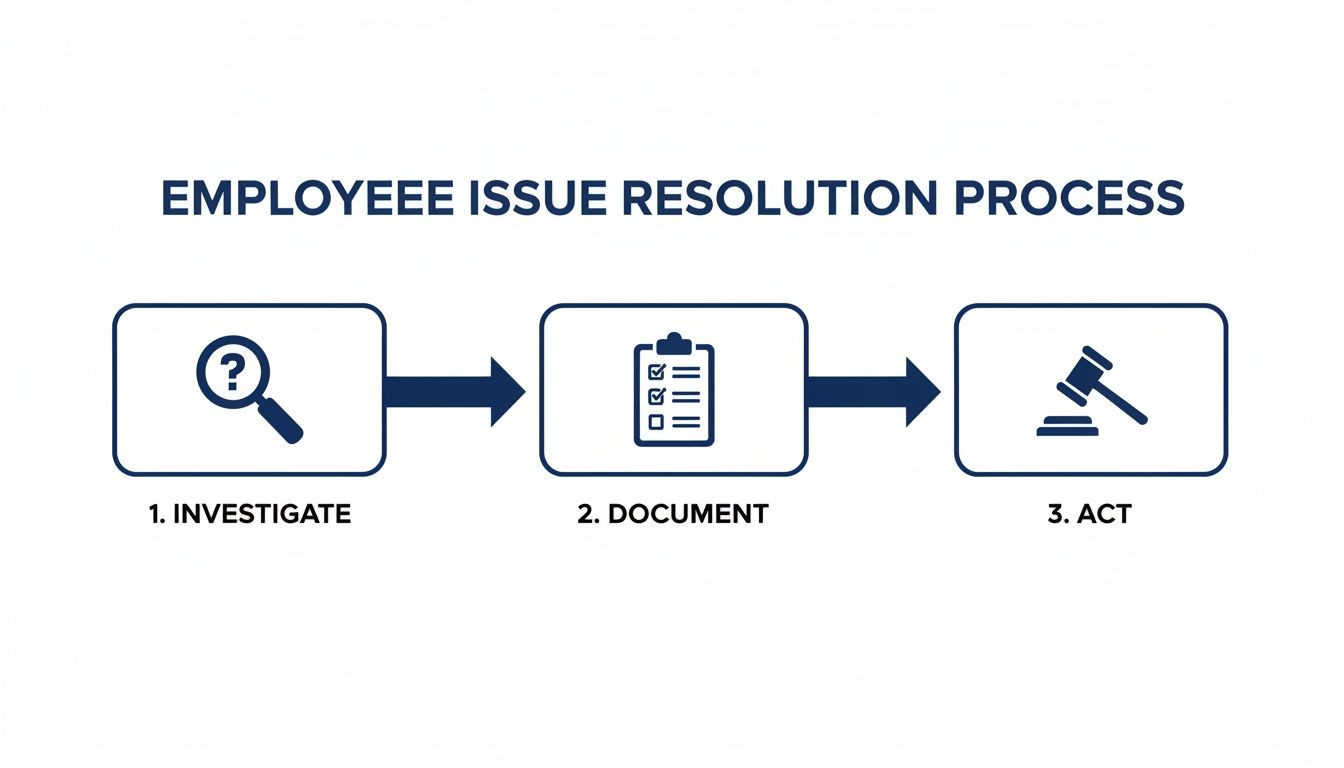
This Investigate, Document, and Act framework is your foundation for ensuring fairness and consistency, no matter where an employee is based.
The rise of remote work has pushed multi-state compliance from a "big company problem" to an everyday reality for businesses of all sizes. To stay on top of it, you need a proactive system. This means monitoring legislative changes, scheduling policy updates, and communicating new requirements as they roll out. In today's distributed workforce, understanding the nuances of remote worker compliance is absolutely critical.
Successfully managing HR compliance employment across different states requires constant vigilance and a highly structured approach. It's a massive undertaking where one misstep can have a ripple effect across your entire organization.
When it comes to employment law, there’s a simple truth: if it wasn't documented, it didn't happen. Many leaders view documentation as a tedious chore, but this is a shortsighted perspective. Consistent, objective records are one of the most powerful defense strategies you can have. Think of good documentation as your company's insurance policy against claims of unfair treatment, discrimination, or wrongful termination.

When a legal challenge arises, the question is not just what happened, but what you can prove happened. Strong records create a factual, real-time narrative of performance issues and the steps you took to address them. Weak notes—or no notes at all—leave you relying on memory, which simply will not hold up under legal scrutiny.
The goal is to move away from recording subjective opinions and start documenting objective, behavioral facts. This is the bedrock of defensible HR compliance employment. Subjective notes are easily portrayed as biased, while facts provide a clear, neutral account.
Let’s look at two ways to document a missed project deadline:
Strong documentation focuses on the "what," not the "why." It records observable actions and ties them directly to clear job expectations or company policies.
Your frontline managers create these records every day. They handle performance check-ins, address policy violations, and have conversations that will either protect your company or expose it to risk. To effectively manage performance and ensure legal defensibility, it is vital for managers to understand how to write up an employee correctly.
Your training needs to reinforce these core principles:
This documentation culture must be built and reinforced intentionally. Knowing what to document is only half the battle; you also have to know how long to keep it. It's vital to understand employment records retention requirements to stay compliant. Building this muscle across your leadership team turns HR compliance from a reactive scramble into a proactive strategy.
An effective HR compliance strategy is not a dusty binder on a shelf—it’s woven into your daily operations. The goal is to shift from a reactive, fire-fighting mode to a proactive one. This means building a sustainable system where compliance is routine, not an emergency response.
This approach turns your compliance efforts from a defensive necessity into a strategic advantage. It protects the business from costly, preventable mistakes.
A strong compliance program is built on a few key pillars that work together to minimize your risk. They create clarity, set expectations, and provide a structured way to handle issues before they escalate.
Every forward-looking program should include these key elements:
One of the most powerful things you can do is look for compliance issues yourself. Conducting periodic self-audits in high-risk areas lets you spot and fix vulnerabilities before they attract outside attention. These internal reviews do not have to be overwhelming. Just focus on the areas where mistakes are most common and expensive.
A proactive self-audit is like a preventative health screening for your business. It helps you identify hidden risks and address them on your own terms. For a structured approach, our comprehensive HR audit checklist provides an invaluable starting point.
A simple self-audit schedule might focus on:
Even the most well-designed internal program has its limits. A critical part of a proactive strategy is knowing when a situation requires specialized guidance from an expert. Recognizing these triggers helps you engage a partner before a manageable issue becomes a crisis.
Be ready to seek outside advisory support when you face:
Building this robust framework is where a strategic partner can make a significant difference. They can help you design a system that not only meets today’s requirements but is also prepared for future challenges.
As you navigate HR compliance, a few practical questions almost always come up. This section tackles some of the most common questions we hear, clearing up misconceptions and reinforcing the core principles of a solid compliance program.
The compliance trap that most consistently snares growing businesses is employee misclassification. This usually means labeling an employee as “exempt” (salaried and not eligible for overtime) when their actual job duties legally make them “non-exempt” (requiring overtime pay).
This mistake is common because many leaders assume that paying a salary automatically makes an employee exempt. But the law cares about specific job duties, not pay structure. One wrong classification can snowball into a class-action lawsuit for back wages and heavy penalties, making this a critical area of HR compliance employment to master.
Think of your handbook as a living document, not a project you finish once. You should review it thoroughly at least once a year to ensure it reflects how you operate and includes any new legal updates.
However, an annual review is just the minimum. You must update it anytime a new federal, state, or local law passes that impacts your business. This is especially true if you operate in multiple states, where rules on paid leave and final paychecks can be very different. An outdated handbook is not just unhelpful—it creates real legal risk.
The goal is not to write up every minor issue, but to document significant performance issues and policy violations consistently and objectively. That consistency is non-negotiable. It creates a factual, time-stamped record that shows a clear, business-related reason for any disciplinary action or termination.
This paper trail is your single best defense against claims of discrimination or unfair treatment. When a decision is challenged, you won’t be scrambling to recall details from memory. Instead, you’ll have a clear, factual story showing the employee was treated fairly. In the eyes of the law, what is not documented often did not happen.
Knowing when to call for backup is an important leadership skill. You should seek expert guidance whenever you face a high-risk situation that is outside your day-to-day comfort zone.
Consider bringing in a specialist for scenarios like these:
Getting proactive advice is almost always cheaper and less stressful than paying for a reactive legal defense after a mistake has been made. If you want to learn more about how to strengthen your company’s compliance framework, you can get in touch with our advisory team to learn how we can help.