For a growing business, the line between a simple management decision and a costly legal mistake is dangerously thin. HR compliance training isn't just another corporate chore; it's the strategic shield that protects your bottom line, your reputation, and the very culture you've worked hard to build. It’s what gives your leaders the know-how to make defensible people decisions, every single time.

As your company scales, the informal practices that worked for a small team can quietly become major liabilities. Casual hiring, inconsistent discipline, or off-the-cuff termination talks are common weak spots. What worked for a team of ten can create serious legal exposure with fifty, especially if you operate in different states with their own employment laws.
This is where structured training comes in. It transforms your managers from potential risks into your most effective line of defense. It gives them a consistent playbook for handling sensitive situations, ensuring every people-related decision aligns with federal, state, and local rules.
Good HR compliance training is about more than just dodging lawsuits—it's about building a resilient, healthy organization. When your managers know the rules of the road, they act with more confidence and fairness. This has a direct, positive impact on employee morale and retention.
A well-trained leadership team creates a workplace where issues are handled correctly and consistently from the start. This approach stops small internal complaints from snowballing into messy legal challenges.
This proactive approach delivers real benefits:
Think of it as preventative maintenance for your business. You wouldn't wait for a critical piece of machinery to break down before servicing it. Proactive training addresses potential people-management issues before they become expensive, time-consuming problems.
Ultimately, investing in HR compliance training empowers your team to protect the business as it grows. If you're ready to build a more resilient operational framework, our team is here to help. To learn more, Contact us.
Think of HR compliance as the essential operating system for your workforce. When it runs smoothly in the background, you barely notice it. But a single glitch—a poorly handled termination, an unintentional hiring bias, or an overlooked wage and hour rule—can disrupt your entire organization.
It’s easy to dismiss these as abstract risks, but they are real-world problems that divert critical resources from growth to defense. A misstep can quickly escalate into a government audit or a lawsuit, draining both your budget and your leadership team’s focus. Viewing HR compliance training as just another expense is a critical mistake; it's an investment in protecting your business.
Ignoring compliance is like gambling with your company's future. The penalties for getting it wrong are steep and can come from federal agencies, state regulators, and civil litigation. Every misstep carries a direct financial cost that can easily destabilize a growing business.
The numbers paint a stark picture. For small and mid-sized businesses, the financial fallout can be devastating. Globally, penalties for non-compliance average $14.82 million, and 27% of firms report weekly breaches. These figures underscore why a reactive approach is no longer a viable option. You can find more details on how these stats impact training needs at Teachfloor.com.
Here are a few common hotspots for financial penalties:
The rules governing employment are legally binding mandates, not suggestions. Federal laws establish a baseline of protection for employees across the country, while state and city laws often add more layers of complexity. Understanding this legal framework is the first step toward building a defensible HR practice.
Think of federal law as the main highway and state laws as the local roads. You have to follow the rules of both to get where you're going safely. A manager who only knows federal rules might unknowingly violate a stricter state law, putting the entire company at risk.
This is why effective HR compliance training is so important. It gives your leaders the map they need to navigate this multi-layered legal environment. For a deeper dive into organizing these requirements, you might find our guide on creating a comprehensive HR compliance checklist helpful.
While the full scope of employment law is vast, a few foundational federal statutes drive most compliance requirements. Your managers do not need to be lawyers, but they must understand the core principles of these laws to avoid common pitfalls.
Understanding these laws is about building a fair, ethical, and legally sound foundation for your business. To learn more about fortifying your company against these risks, contact us for a consultation.
A strong HR compliance training program is built on essential topics that directly tackle your company's biggest risks. This isn't about checking off a generic list; it's about identifying your vulnerabilities and creating targeted training to address them. Understanding the "why" behind each module connects the training to real-world business outcomes.
A great first step is figuring out your specific compliance gaps. Using a detailed Training Needs Assessment Template can provide the structure needed to pinpoint weaknesses before they become liabilities. This ensures your training resources are aimed where they matter most.
Before diving into specifics, it's helpful to see how these essential training topics connect directly to mitigating business risk. The table below outlines the core modules of any robust HR compliance program and the primary threats they help manage.
This framework shows that compliance training is a strategic defense for your business. Let's explore each of these critical areas.
This is the absolute cornerstone of any HR compliance curriculum. Harassment and discrimination claims are not just expensive and damaging to your brand; they poison your company culture and destroy trust from the inside out.
Effective training moves beyond just defining legal terms. It must equip every manager and employee to recognize misconduct, from obvious offenses to subtle interactions that create a hostile environment. The goal is to shift from a reactive "damage control" stance to a truly preventive one.
Training must cover legally protected classes under federal law—like race, religion, sex, and disability—and any additional protections provided by your state or city. Critically, it also needs to teach leaders how to respond correctly and decisively when a complaint is made. For a deeper look, learn more about effective workplace harassment training for managers in our dedicated guide.
Pay-related mistakes are among the most common and costly compliance failures for businesses of all sizes. The Fair Labor Standards Act (FLSA) sets federal ground rules for minimum wage and overtime, but many states have stricter requirements. This is a high-risk area where even small, unintentional errors can snowball into a class-action lawsuit.
Your training must provide clear, actionable guidance on several key topics:
A classic mistake is assuming that paying someone a salary automatically makes them exempt from overtime. A manager might misclassify an administrative assistant as exempt, failing to pay overtime for years. That single error could trigger a Department of Labor audit and a demand for back wages and other damages.
Navigating employee leave requests under laws like the Family and Medical Leave Act (FMLA) and the Americans with Disabilities Act (ADA) requires a careful, consistent touch. Managerial missteps in this area are a frequent source of litigation.
The focus of this training should be on equipping leaders to recognize a potential need for leave or an accommodation and to properly initiate the required interactive process.
Managers don't need to be legal experts. They do need to know how to spot trigger situations. For instance, if an employee mentions needing time off for a "serious health condition," a trained manager knows this is a cue to involve HR immediately, not to make an uninformed decision on their own. This simple step prevents premature denials or inconsistent policy application.
The training should clearly define the manager's role: to identify the need and escalate it, not to make the final legal call. This creates a defensible, consistent process that protects both the employee and the business. Building a robust curriculum around these core pillars is the first step toward creating that protective layer.
Having a training program is a great start, but its real value is tested when it has to stand up to legal scrutiny. A legally defensible program is not a one-off event; it’s an ongoing, documented system that proves your good-faith effort to follow the law. This shifts the focus from just teaching the material to implementing a consistent, tracked, and tailored process.
Building this kind of program requires a structured approach. It is a deliberate process designed for maximum impact and legal protection.
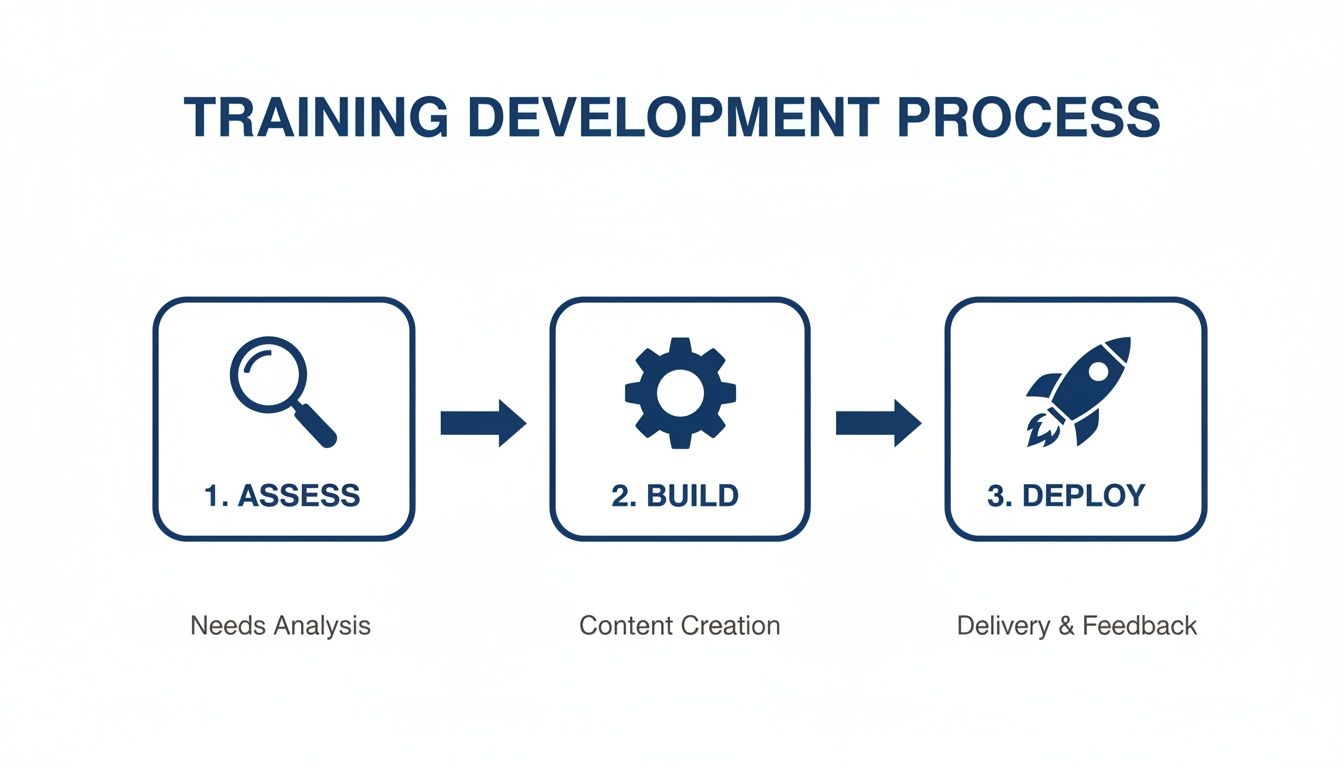
This model shows that effective training starts with understanding your specific risks before you create a single slide or schedule a meeting.
One of the most common mistakes is rolling out a one-size-fits-all training program. To be truly effective and defensible, your program must differentiate between employee groups based on their roles and responsibilities. What a frontline employee needs to know is fundamentally different from what a senior manager requires.
Start by segmenting your workforce into logical training groups:
Frequency is just as important as the audience. An annual "check-the-box" training is not enough. A legally sound schedule includes multiple touchpoints throughout an employee's time with your company.
A strong training cadence isn't just about meeting a legal minimum; it's about keeping compliance top-of-mind. Regular, relevant training reinforces a culture where doing the right thing is the standard, not the exception.
Consider this layered approach to your training schedule:
The way you deliver HR compliance training directly impacts its effectiveness and how well you can defend it later. Passive, boring methods do little to change behavior or prove a genuine commitment to compliance. The best approach often blends different formats to keep the content fresh and engaging.
Live, interactive sessions are the gold standard, especially for sensitive topics like anti-harassment. This format allows for real-time questions, role-playing scenarios, and nuanced discussions that a pre-recorded online module cannot replicate. For managers, these live sessions are critical for building confidence.
At the same time, online learning platforms are fantastic for delivering consistent information, especially with a distributed or remote workforce. They are ideal for foundational topics, policy acknowledgments, and efficiently tracking completion records.
If one of your employment practices is ever legally challenged, your ability to defend your company will hinge on your records. Documentation is the hard evidence that proves you took your compliance obligations seriously. Without it, even the best training program is just your word against someone else's.
Your training records must be meticulous and easy to access. For every training session, you should document:
This paper trail serves as your proof of a good-faith effort. It demonstrates that you not only provided the necessary HR compliance training but also took concrete steps to ensure your team received and understood it. This proactive recordkeeping is an indispensable part of risk management.
The investment in these programs is growing for a reason. The global corporate compliance training market is set to more than double from USD 4,800.29 million in 2025 to USD 9,617.33 million by 2033. You can read the full research about these market trends to understand the shifting landscape.
Building a defensible program requires careful planning and execution. If you need guidance on strengthening your training and documentation practices, our team is here to help. To learn more, reach out to us for a consultation.

As your business grows, manually managing HR compliance training becomes an administrative nightmare. Juggling spreadsheets to track who needs what training, whether they’ve completed it, and how to pull a report is a logistical mess. This is where technology transforms a major headache into a scalable, efficient system.
This isn’t just a nice-to-have; it's the standard. A recent global survey revealed that 82% of companies use technology for compliance training. With nearly half of businesses using tech for 11 or more compliance functions, it's clear that going digital is essential for managing risk. You can dig into more of these findings in PwC's 2025 Global Compliance Survey.
At the core of a tech-forward training strategy is a Learning Management System (LMS). Think of it as the central command center for your entire training program. An LMS automates tedious administrative tasks, freeing your HR team to focus on more strategic work.
With an LMS, you can manage the whole training lifecycle from one place. You can assign courses, send automated reminders, and track everyone's progress in real time. It creates a smooth, consistent workflow that ensures no one falls through the cracks.
The real beauty of an LMS is that it creates a single source of truth for all your training records. When you need to prove compliance, you can instantly pull reports showing who was trained on what, and when. That's the kind of defensible documentation you need.
If you're starting to explore these systems, our guide providing an HR compliance software comparison is a great place to start.
Automation is where the real magic happens. Imagine you hire a new manager for your California office. A good LMS can automatically enroll them in the state-mandated anti-harassment training and notify them of the deadline—all without you lifting a finger.
This level of automation drives consistency and slashes the risk of human error. It also means you can deliver more targeted training exactly when it's needed.
Here is what technology brings to the table:
To truly scale your efforts, many businesses are turning to specialized platforms and employee training tracking software. These tools are built to handle the complexities of modern training programs.
Putting the right technology in place is a game-changer for any growing business. If you need help figuring out your options, contact us to discuss a strategy.
The ultimate goal of HR compliance training is not just checking a box or avoiding lawsuits. It's about shaping a stable, ethical, and high-performing workplace where people feel safe and empowered to do their best work. When you approach training as a strategic pillar, you build a foundation of trust that becomes a genuine competitive advantage.
A truly compliant culture takes root when leaders actively champion its principles, managers consistently model the right behaviors, and every employee understands the critical role they play.
Real compliance isn't about memorizing rules from a slide deck. It's about seeing those rules applied with confidence in everyday decisions. It’s the manager who spots a potential ADA accommodation issue and immediately involves HR, or the employee who feels safe reporting misconduct without fear of retaliation.
That shift—from passive knowledge to active practice—is where your investment in training truly pays off. But to get there, your program must be reinforced by clear accountability from the top down.
Compliance becomes a core value only when leaders not only promote the training but also model the behavior and hold everyone, including themselves, to the same high standards. Without that unwavering commitment, even the best-designed program will fail to create meaningful, lasting change.
This commitment ripples through the entire organization and strengthens it in key ways:
Evaluating and refining your HR compliance training program is not a one-time project; it’s an ongoing process. The legal landscape is always shifting, and your business risks will evolve as you grow. Regular, thoughtful reviews ensure your training stays relevant, effective, and aligned with your company’s goals.
Navigating these complexities can be a challenge, and having a trusted partner can make all the difference in ensuring your practices are not just current but also legally defensible.
A strong compliance culture is your organization's ultimate safeguard. If you are ready to take the next confident steps in evaluating and strengthening your HR compliance framework, our team can provide the expert guidance you need. Learn how we can help by contacting us today.
When it comes to HR compliance training, business leaders often have practical questions. Getting straight answers is the first step toward building a program that meets legal standards and shields your company from risk. Here, we tackle some of the most common questions we hear from owners and executives.
The idea is to give you actionable insights you can use to make smarter decisions about your training strategy.
There’s no magic number here—the right frequency depends on the topic, your industry, and specific state laws. Trying to find a one-size-fits-all schedule is a mistake. The best approach is layered and continuous, ensuring training is always timely and relevant.
A solid training calendar usually includes a few key rhythms:
The single biggest mistake is treating HR compliance training like a chore to be checked off a list. Forcing employees to passively click through a generic online module does almost nothing to change behavior or build a real legal defense. Regulators and courts see right through that kind of performative compliance.
Another massive error is failing to keep meticulous training records.
Without detailed documentation—who was trained, on what topics, and when—your training program is legally invisible. In the event of a claim, these records are your first and best evidence of a good-faith effort to comply with the law.
Effective training isn't a one-and-done event; it's an ongoing process. It demands active participation, relevant scenarios, and clear proof that the company takes its duties seriously. A passive, check-the-box approach signals that compliance isn't a priority, which is a dangerous message to send.
Online platforms, often called Learning Management Systems (LMS), are fantastic tools. They are incredibly useful for delivering training consistently across a multi-state workforce and for tracking who has completed what. For foundational topics like data privacy or your code of conduct, they work perfectly.
But for more sensitive and nuanced issues—like anti-harassment or reasonable accommodations—a blended approach is far stronger. The gold standard is supplementing online modules with live, interactive sessions led by a skilled facilitator. This format allows for role-playing, tough Q&A, and real discussion about complex scenarios that a pre-recorded video simply cannot handle.
At Paradigm International Inc., we help leadership teams build defensible HR practices that protect their organizations as they grow. If you need expert guidance on strengthening your HR compliance framework, we invite you to learn more. You can contact us to learn how we can help.