
For many founders and leaders, managing human resources in a small business can feel like just one more task on an endless to-do list. However, viewing HR as a strategic partner—not just an administrative burden—is essential for sustainable growth. Strong HR practices act as a safety net, protecting your business from compliance risks while nurturing the culture that drives your success.

Think of HR as the shock absorbers on a vehicle. When the road is smooth, you might not notice them. But the moment you hit an unexpected bump—like a difficult termination, a compliance issue, or an internal conflict—a solid HR system absorbs the impact. This prevents serious damage and keeps your business moving forward safely.
Without that system, every minor issue can send a jolt through the entire organization. It pulls leaders away from core responsibilities and exposes the company to legal and financial risks. Ignoring HR is not a cost-saving measure; it is a gamble that can threaten the stability you have worked so hard to build. The importance of HR services for small business success is clear, as they provide the structure needed to grow responsibly.
This guide serves as a roadmap to building a resilient HR framework. We will walk through the essential functions that form the foundation of your people operations. Our goal is to provide actionable insights for managing your team and navigating high-stakes situations with confidence.
This guide offers practical tools you can implement immediately. We will cover several key areas to help you build an effective and defensible HR practice for your small business.
By focusing on these areas, you can transform HR from a reactive function into a proactive tool for growth. Let's begin by exploring the core functions that every small business leader needs to master.
For a small business owner, "HR" can sound like a mountain of confusing and time-consuming tasks. In reality, it boils down to a few core systems that support your people and protect your organization. Each function serves a distinct purpose, but they all connect to create a stable structure for your company.
Neglecting one of these areas is like leaving a vulnerability in your foundation—it is bound to cause bigger problems later. When these systems are strong, they not only keep you compliant but also give your team the support they need to do their best work.
Attracting and hiring the right people is the starting point. A weak hiring process can lead to costly mistakes and compromises everything else you build. This process begins the moment you decide to hire, starting with a clear definition of the role and how it contributes to your business goals.
A disorganized hiring process is a recipe for error. Vague job descriptions attract unsuitable candidates, while unstructured interviews can introduce bias. To get it right, focus on these fundamentals:
Once you have made a great hire, onboarding provides the structure a new employee needs to integrate into your team. A poor onboarding experience can leave people feeling lost and disconnected, which is a leading cause of early turnover. Effective onboarding is more than just completing paperwork.
It is a structured introduction to your company’s culture, processes, and expectations. In today's hybrid work environment, having solid remote employee onboarding strategies is essential to ensure everyone feels included. The goal is simple: make every new team member feel welcomed, prepared, and confident from day one.
Think of payroll and benefits as the essential utilities that keep your HR operations running. When they work flawlessly, they are invisible. But the moment they fail, everything grinds to a halt. Payroll mistakes can trigger serious compliance penalties and erode employee trust faster than almost anything else.
Administering payroll and benefits is not just a back-office task; it is a fundamental promise to your team. Paying them accurately and on time, and managing their benefits correctly, is the bedrock of a stable work environment. This administrative work can also be incredibly time-consuming, with some studies showing that small businesses can spend hundreds of hours per year on these tasks alone.
Finally, performance management is how you maintain and improve your organization over time. It is the ongoing rhythm of setting clear expectations, providing regular feedback, and helping your people grow. Without it, even your best employees can stagnate, and unresolved performance issues can damage team morale. This process connects individual effort to your company's broader goals. For more detail, read our guide on enhancing employee lifecycle management.
These four pillars form the backbone of HR in a small business. Mastering them creates a system that not only protects your company but also helps it—and your people—thrive.
While day-to-day HR functions keep your business running smoothly, certain high-stakes situations can put everything at risk. If handled poorly, these moments can quickly spiral into legal challenges, steep financial penalties, and serious damage to your company culture. These are the areas where the margin for error is razor-thin.
We are talking about employee terminations, internal investigations, manager conduct, and documentation. For a small business, getting these right is not just good practice—it is essential for survival. Each scenario demands a careful mix of empathy, consistency, and legal awareness. Without a clear plan, leaders often improvise under pressure, leading to inconsistent decisions and heightened risk.
Letting an employee go is one of the most difficult and legally sensitive actions a leader can take. A poorly handled termination can lead to a wrongful termination claim, damage team morale, and tarnish your company's reputation. The only way to navigate this is with a structured, consistent, and respectful process every single time.
The termination meeting should be brief and direct, and it should never be a surprise. This conversation should be the final, predictable step in a process that has already included direct feedback, performance warnings, and a genuine opportunity for the employee to improve.
To ensure every termination is both defensible and humane, follow a clear checklist:
When an employee brings a complaint—whether it concerns harassment, discrimination, or other misconduct—you have a legal and ethical duty to take it seriously. This means launching a prompt, thorough, and impartial investigation. Your goal is to conduct a fact-finding mission to determine what happened so you can take appropriate corrective action.
An effective investigation protects not only the individuals involved but also the integrity of your organization. Failing to investigate, or conducting a biased one, can be as damaging as the initial complaint itself. A credible investigation requires a consistent process, including appointing a neutral investigator, interviewing all relevant parties, and documenting every step objectively.
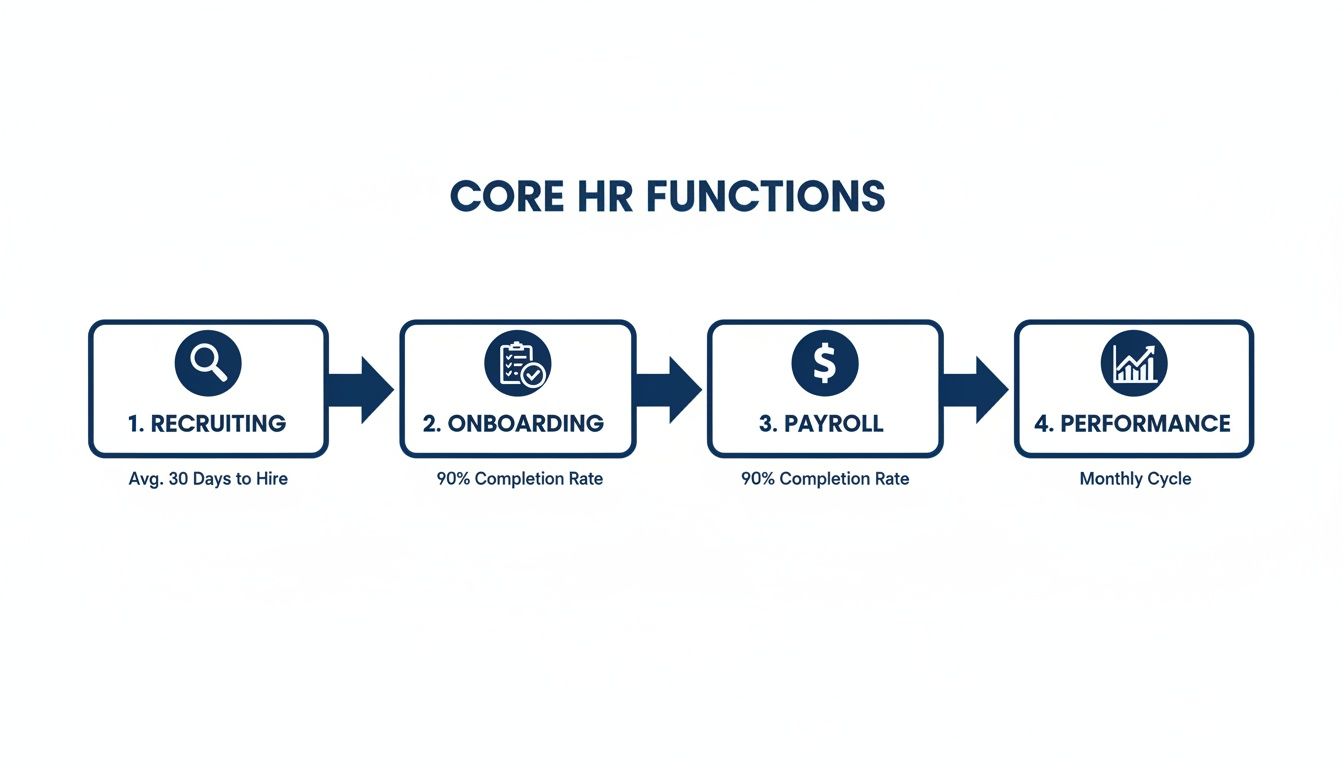
Understanding the entire employee lifecycle helps you see where risks are most likely to appear. The flow from recruiting to performance management shows how interconnected everything is, as a breakdown in one area often creates risk in another.
Your managers are your first line of defense in managing HR risk, but without proper training, they can become your biggest liability. Inconsistent policy enforcement and a failure to document performance issues can undermine your HR strategy. Training managers on how to give constructive feedback and when to escalate concerns is a critical investment.
Equally important is creating defensible documentation. This is not about building a case against an employee; it is about creating a factual, objective, and consistent business record. Good documentation is your best protection in a dispute. This includes performance improvement plans (PIPs) with measurable goals, written warnings that state the issue clearly, and email recaps of verbal conversations.
This becomes even more crucial for businesses operating in more than one state. By building a foundation of solid documentation, you can support strategic goals and create a more resilient team. To better understand these trends, you can review pivotal HR statistics for 2025.
Managing these high-stakes scenarios is a core part of effective HR in a small business. By turning potential crises into structured processes, you protect your company and build a culture of fairness and respect. If you need assistance building these defensible practices, feel free to get in touch with us.

Expanding your business across state lines is an exciting milestone, but it also introduces a labyrinth of employment laws. What is perfectly legal in your home state might be a compliance violation just one state over. A common and costly mistake is assuming a single HR policy can cover all locations.
This patchwork of regulations is a critical risk area. Each state, and sometimes individual cities, has its own rules for everything from how you pay your team to the leave they are entitled to take. A one-size-fits-all employee handbook is a recipe for a compliance disaster. You must shift your mindset to a state-by-state approach, adapting to the key differences wherever you have staff.
Navigating multi-state compliance starts with knowing where the biggest risks lie. While countless differences exist, a few key areas consistently create the most significant legal exposure for employers.
Focus your energy on these four critical areas first:
Ignoring these differences can lead to steep penalties and expensive lawsuits. For example, failing to provide a compliant meal break in California can trigger a penalty of one hour of pay for each day the break was missed. For a team of employees, those costs add up quickly.
Consider a common scenario: a company headquartered in Texas, where meal break laws are lenient, opens an office in California. The business continues using its standard policy, which does not mandate paid rest breaks or specify meal period timing. In this situation, the business is unknowingly breaking California law every day for every employee in that office, creating a compounding liability.
The same problem arises with final pay. In some states, you can provide the final paycheck on the next regular payday. In a state like California, however, a terminated employee is generally owed their final wages immediately. A delay of even one day can result in "waiting time" penalties that continue to accrue.
Here’s a quick look at how just one area—the final paycheck deadline for a terminated employee—differs:
This table makes it clear why a single offboarding process will not work. Each state demands its own specific procedure, and your HR systems must be flexible enough to handle them all. Managing multi-state hr in a small business means building a system to track these requirements and ensuring your policies are state-specific. If you are expanding, feel free to contact us to discuss your multi-state compliance strategy.

Managing HR risk is not about reacting to problems; it is about building systems that prevent them. The most effective way to protect your business is to create defensible, repeatable processes that ensure every situation is handled with consistency. This approach separates good intentions from concrete, protective actions.
Think of it like a pilot's pre-flight checklist. Pilots follow a precise procedure before every takeoff to ensure no critical step is missed, regardless of stress or distraction. Your HR processes should function in the same way. Documented systems take the guesswork out of high-stakes decisions, ensure fairness, and provide a strong defense if a decision is ever questioned.
Creating standardized processes means developing templates and clear protocols for common HR scenarios. This is not about adding red tape; it is about establishing a baseline for quality and fairness. To get started, you can reference an ultimate small business compliance checklist for critical items.
Begin by building your "checklist" for these core areas:
These tools are the bedrock of a defensible hr in a small business framework. They ensure every manager operates from the same playbook, which is critical for fair and equitable treatment.
Documented processes are only as good as the people who use them. A perfect template is useless if one manager uses it diligently while another improvises. This inconsistency is a massive source of risk. Effective manager training must be practical and ongoing, not just a one-time event.
A documented process that is not followed consistently is often worse than having no process at all. It signals that the rules are optional, undermining the system's integrity and creating significant legal risk. Your training should focus on real-world application, using role-playing and clear examples of proper documentation.
Once your processes are established and your managers are trained, you need a way to ensure standards are maintained. This is where periodic, informal audits come in. On a quarterly basis, review a random sample of recent HR actions, such as new hire files, performance warnings, or termination paperwork, to spot inconsistencies.
This proactive check-in is especially vital for growing companies, as structured HR can fuel expansion. By building these defensible systems now, you create a scalable framework that protects your business and supports your team as you grow. If you need guidance on creating or auditing your HR checklists, you can contact us to learn more.
Handling human resources on your own can work well, especially when you are just starting out. But as your company grows and challenges become more complex, managing everything in-house can become a strategic risk. Knowing when to call in an expert can be the difference between navigating a tough situation successfully and making a costly mistake.
The decision to seek outside help often comes at a clear tipping point. These are moments where the stakes are unusually high and the margin for error is thin. An advisory partner provides specialized judgment that goes beyond what HR software or a standard PEO can offer, focusing on strategic guidance.
Certain events should trigger a conversation about external HR support. If your business is in one of these scenarios, it is likely time to engage an advisory firm.
An HR advisory firm plays a different role than a PEO or HR software. While technology is excellent for managing payroll and routine tasks, an advisory firm acts as an extension of your leadership team. They provide strategic counsel during your most critical moments, helping you make defensible decisions under pressure.
Small business HR teams are often stretched thin. An advisor closes that gap by providing focused expertise right when it is needed most. You can discover more insights on pivotal HR statistics for 2025 to understand the strain on internal capacity.
Partnering with a firm like Paradigm lets you handle the complexities of hr in a small business with confidence. It ensures your high-stakes decisions are deliberate and aligned with best practices for mitigating risk. You can learn more about the benefits in our guide to HR consulting services for small business.
If you are facing a period of growth or navigating a complex employee situation, it might be the perfect time to explore a strategic partnership. To learn how our advisory services can support your leadership team, please contact us to start a conversation.
Juggling HR on top of everything else it takes to run a business can feel overwhelming. This section provides direct, practical answers to some of the most common questions we hear from leaders like you.
Start small and tackle your highest-risk areas first. Instead of trying to write a massive employee handbook, begin with a simple, one-page checklist for a critical process like employee terminations or a standardized template for performance warnings. Once you have a solid, repeatable process for one area, move on to the next.
Fairness in terminations comes from consistency and documentation. The decision should never be a surprise to the employee; it should be the final step in a well-documented process that included clear warnings and an opportunity to improve. During the meeting, be direct, professional, and respectful, and always have a witness present.
A structured approach is not just about fairness—it is your single best defense against wrongful termination claims. A consistent process acts as your legal armor.
Staying on top of compliance is a significant challenge, especially as you grow. A good first step is to designate one person on your team to own it, monitoring updates from the Department of Labor and state agencies. An even better strategy is to partner with an advisory firm that specializes in multi-state compliance and can provide timely alerts.
With a high number of employees actively looking for new jobs, you cannot afford to have poor HR practices drive away your best people. As you can learn in this analysis of small business HR challenges, a strong people strategy is non-negotiable for retention.
Building a resilient HR framework is a continuous effort, but it is one of the smartest investments you can make in your company's long-term stability. As you continue to grow, refining these processes will become even more important.
If you are looking for a strategic partner to help you build defensible HR practices and make confident decisions, we are here to help. You can learn more about how our advisory services can support your business by getting in touch.
Ready to strengthen your HR foundation? Get in touch with us.