


Scaling a business requires intense focus on sales, operations, and market expansion. These are the engines of growth, and they rightly demand your attention. But in this push for growth, HR management can often be overlooked, treated more as an administrative task than a strategic pillar. This common oversight can quickly create serious legal, financial, and reputational risks that threaten the very growth you are working so hard to achieve.
Small inconsistencies in how you manage your people can snowball into major problems. A manager in one state handling a termination differently than a manager in another can open the door to a lawsuit. An employee complaint that isn't properly investigated can erode morale, lower productivity, and damage your reputation as a great place to work. These are not isolated incidents; they are symptoms of a weak HR risk management strategy.
Ignoring HR risks doesn't make them disappear. It simply means you will deal with them later, when the cost is significantly higher. The consequences of inaction typically appear in three key areas, impacting your bottom line and your ability to operate effectively.
When HR risks are not managed proactively, the costs can be staggering. These expenses go far beyond simple legal fees and can disrupt your entire business.
The greatest danger in HR risk isn't a single catastrophic event, but the slow erosion of standards that makes a crisis inevitable. It’s the small, undocumented warnings and inconsistent decisions that accumulate over time.
This isn’t about creating more red tape. Proactive HR risk management is a core business strategy that builds a more resilient company. It ensures that as you grow, especially across state lines, your internal processes are strong enough to handle the pressure. By establishing clear protocols and training managers effectively, you create a defensible foundation that protects your bottom line and lets you focus on growth.
Shifting from reactive problem-solving to proactive protection requires a structured approach. A defensible HR risk framework is a clear, repeatable system for handling people-related challenges before they become crises. This framework is your roadmap for making sound decisions that protect both your employees and your business. The process comes down to three core pillars: identifying risks, assessing their impact, and implementing strategies to mitigate them.
The first step is to gain an honest understanding of where your company is vulnerable. HR risks often hide within day-to-day processes and interactions. A thorough audit is essential to uncover these hidden liabilities across the entire employee lifecycle. Start by reviewing current practices and paperwork to spot inconsistencies or dangerous gaps. To get started, you can conduct a targeted assessment to better understand and prioritize your company's most significant legal risks.
Key areas to put under the microscope include:
The flow chart below shows how quickly a minor oversight can escalate without a proper framework in place.
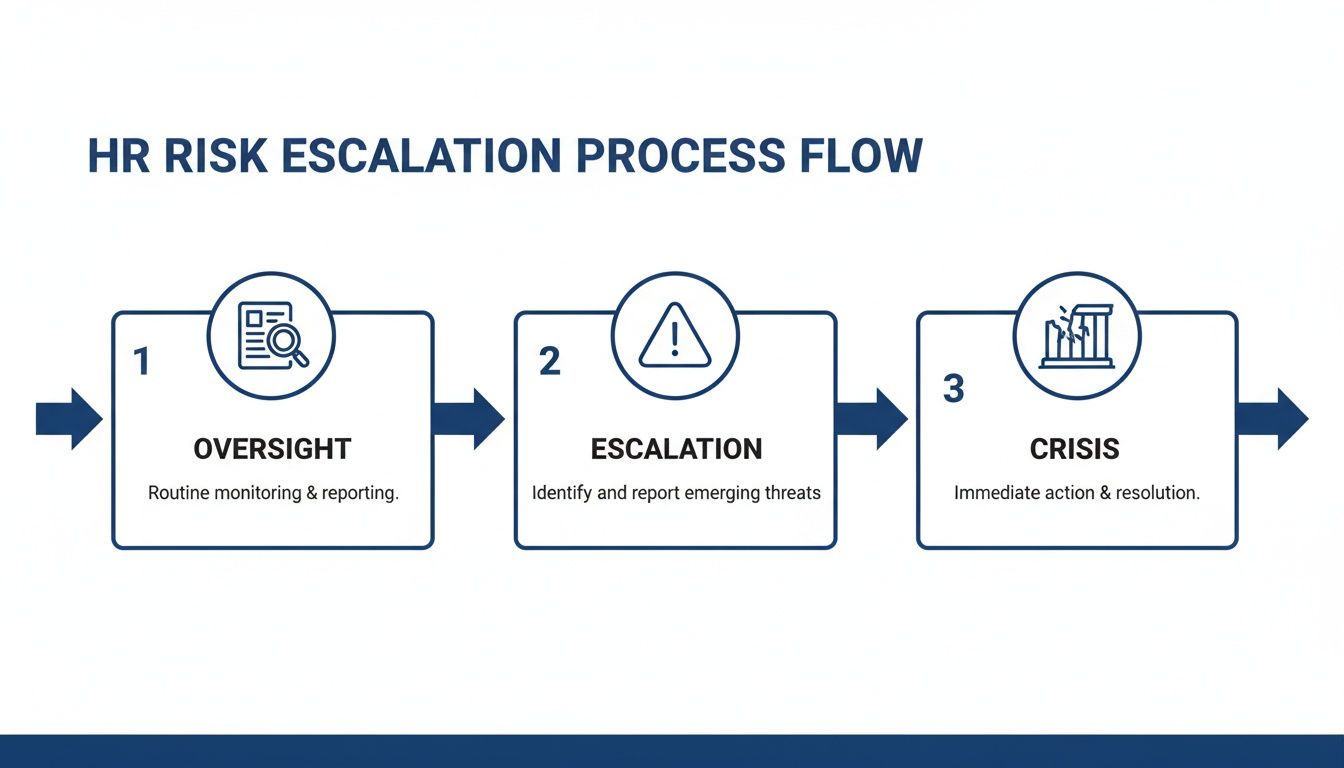
This illustrates why early intervention is so critical. Documented oversight and clear escalation protocols can turn a potential disaster into a manageable situation.
Once you have a list of potential issues, you need to determine which ones demand immediate attention. Not all risks are created equal, and you cannot fix everything at once. Assess each risk based on two simple factors: the likelihood of it happening and the potential impact if it does. This helps you categorize risks and focus your resources where they will do the most good.
For instance, an incorrect overtime calculation is highly likely to occur without proper systems and carries significant financial and legal consequences. Prioritizing this risk over a less probable, low-impact issue is a smart use of your time and resources.
A common mistake is getting bogged down with low-impact, low-probability risks while ignoring the high-impact threats hiding in plain sight. Prioritize what can truly harm your business, not just what is easiest to fix.
This assessment creates a clear action plan. High-likelihood, high-impact risks—like inconsistent termination procedures or failure to investigate harassment claims—should jump to the very top of your list.
Focusing on these high-priority areas first will provide the greatest immediate protection for your business while you work on a more comprehensive strategy.
With your priorities set, the final step is to implement concrete strategies to neutralize these risks. Mitigation is about creating systems, policies, and training that reduce both the likelihood and the impact of potential problems. The goal is to build a defensible position through consistency and clear documentation. Effective mitigation is more than just writing a policy; it requires putting that policy into practice every single day.
To ensure your HR risk framework is truly defensible, it's also crucial to consider the implications of ethical and compliant employee communication monitoring, as poorly managed programs can introduce new liabilities.
Here are some high-impact mitigation strategies for any growing business:
Certain HR situations carry more weight than others. High-stakes moments, like involuntary terminations or sensitive internal investigations, can keep business owners up at night. One wrong move could lead to legal action or severely damage team morale. This is where having a clear, defensible playbook is non-negotiable. The aim is to manage these moments correctly, protect the business, and treat every employee with fairness.

No part of HR is more loaded with risk than letting an employee go. A poorly handled termination is a direct invitation for a wrongful termination lawsuit. The key to a defensible separation is a process built on consistency and airtight documentation. A termination should never be a surprise; it should be the final step in a documented performance management journey. The employee should already be aware of performance gaps from previous written warnings and conversations.
Your protocol should include:
A common mistake is letting personal feelings or lengthy justifications creep into the conversation. The meeting is to inform, not to debate. Stick to the facts and the next steps.
This structured approach removes emotion and inconsistency from the process, which is critical for minimizing legal risk, especially when operating in multiple states with different laws.
When an employee brings forward a serious complaint, such as harassment or discrimination, your response is put under a microscope. A prompt, thorough, and impartial investigation is not just a best practice; it is a legal necessity. A defensible investigation depends on its process. It means you take every complaint seriously and follow a predetermined set of steps every single time. This ensures fairness and proves the company took its duty of care seriously.
An effective process is one of the most important hr risk management strategies you can implement. You can explore our comprehensive guide on the workplace investigation process for deeper insights.
The cornerstones of a fair investigation are:
Requests for accommodation, whether for a disability under the ADA or for religious reasons, require a careful and interactive approach. The law requires employers to engage in a good-faith "interactive process" to determine if a reasonable accommodation is possible without causing undue hardship to the business. This is not a one-time decision; it is an ongoing conversation. Rushing to say "no" without properly exploring options is a significant compliance risk.
The interactive process involves several key steps:
Your HR policies, no matter how well-written, are only as strong as the people who implement them. In any growing business, that responsibility falls on your managers. They are on the frontline of your HR risk management strategies, making daily decisions that can either protect your company or expose it to significant liability. Empowering them with the right training and support is one of the most effective ways to build a defensible organization.
Even simple managerial missteps, like asking an illegal interview question or failing to document a performance issue, can create substantial legal risk. The goal is to transform managers from a potential liability into your most valuable asset in risk mitigation. This requires a commitment to consistent, practical training that goes beyond a simple policy review.
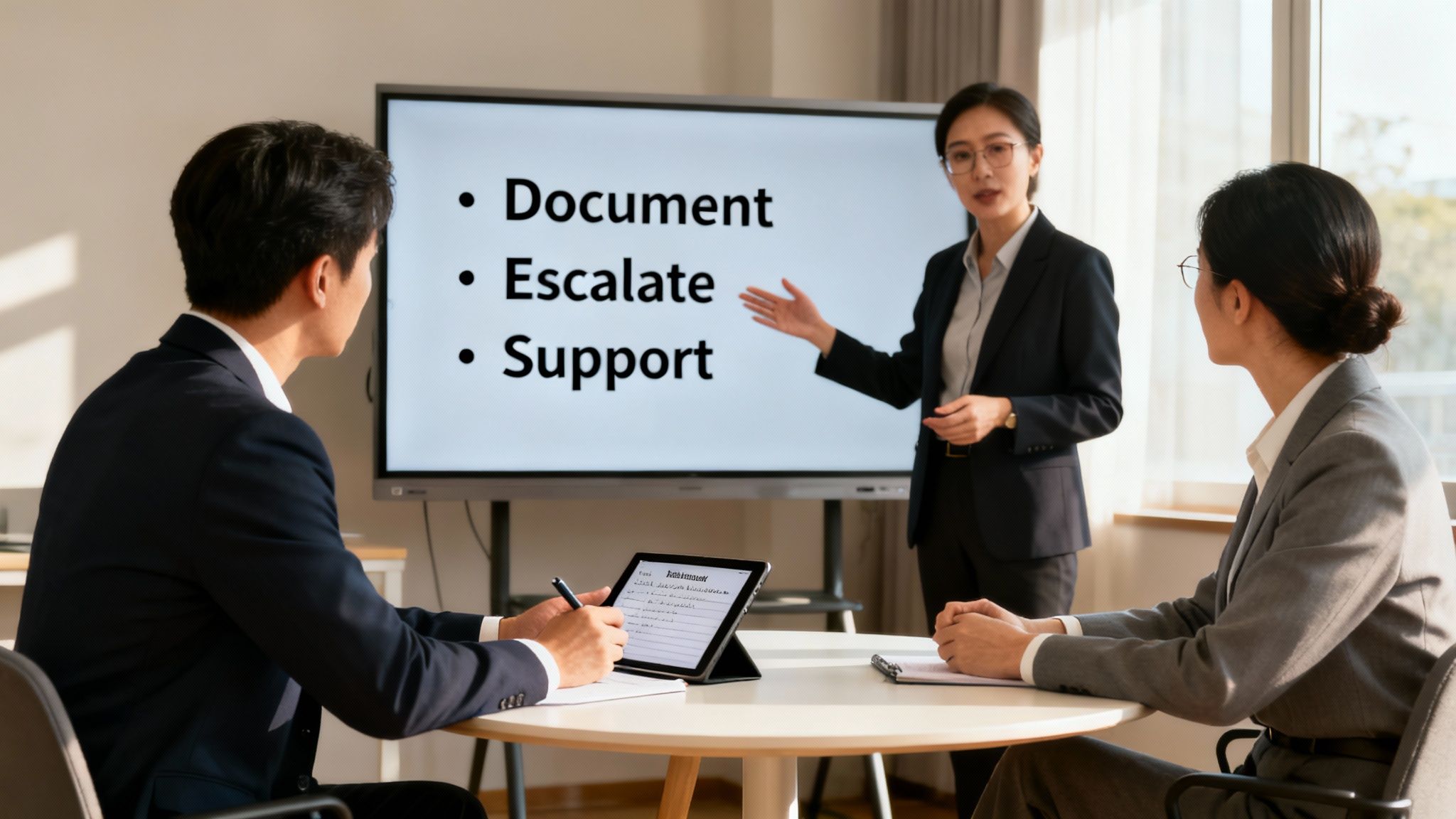
A robust manager training program should focus on the high-risk scenarios they are most likely to encounter. By equipping them with clear guidelines for these moments, you create consistency across the organization.
The most effective training programs are built around these essential pillars:
Training alone is not enough; it must be paired with a culture of accountability. Managers need to understand that upholding company standards is a core part of their job. Their performance evaluations should include how well they manage their teams in a compliant and ethical manner. This accountability is what turns knowledge into action.
A manager's actions—or inaction—can define the company's liability. Training gives them the tools, but accountability ensures they use them correctly every single time.
This culture of accountability also builds psychological safety among team members. When employees feel they can speak up without fear of retaliation, issues are surfaced and resolved much faster, which is crucial for both risk mitigation and engagement.
Abstract rules are difficult to apply under pressure. The best training uses real-world scenarios to illustrate how seemingly minor decisions can have major consequences. Walk managers through role-playing exercises to help them practice listening and knowing when to escalate an issue without trying to solve it themselves.
Effective workplace harassment training for managers is not just a compliance checkbox; it is a vital part of your risk mitigation framework. Your training should make it clear that managers are not expected to be HR experts. Their primary role is to be a consistent and reliable conduit to the proper channels.
Building an effective HR risk management strategy is not a one-time project. Think of it as a living system that needs continuous attention to remain effective. While creating policies and training managers is a fantastic start, the real work is in maintaining that momentum over the long term. This sustained effort transforms your framework from a reactive tool into a proactive system that addresses threats before they escalate.
Sustaining your strategy means going beyond just having policies. It’s about actively measuring whether they are working and being ready to adapt as new challenges arise. This is how you ensure your HR practices stay defensible and aligned with your business goals as you scale, especially when operating across multiple states.
You cannot manage what you do not measure. Key Performance Indicators (KPIs) are your dashboard for monitoring the health of your HR practices and spotting risky patterns. For a growing business, these metrics do not need to be overly complicated, but they must be tracked consistently to provide real insight. Think of these KPIs as your company’s vital signs.
Here are a few practical HR risk KPIs to track:
For any business, especially those in multiple states, a periodic compliance audit is non-negotiable. Employment laws change constantly at the federal, state, and local levels. What was compliant last year might expose you to fines and legal action today.
A proactive compliance audit is an investment in prevention. It allows you to find and fix vulnerabilities on your own terms, not because a government agency or a lawsuit pointed them out for you.
A proper audit is a systematic review of your core HR functions to ensure they align with current legal standards. This process gives you a clear picture of your risk exposure and a practical roadmap for improvement.
Your audit should always cover these critical areas:
By combining data from your KPIs with findings from regular audits, you transform your hr risk management strategies from a static rulebook into a dynamic system.
This commitment to continuous improvement is what separates a truly defensible organization from one that is just hoping for the best. If you need help building a framework for long-term monitoring and compliance, our team is here to provide the expert guidance you need. We invite you to contact us to learn more.
This guide has walked you through the core principles for building a defensible HR foundation. But some situations are too high-stakes to handle alone. A complex termination or a sensitive internal investigation is not the time for guesswork. This is where having an advisory partner can make all the difference. It is not about outsourcing HR, but about giving your leadership team a trusted decision-maker for the moments that matter most.
An HR risk advisor helps turn uncertainty into a defensible strategy. They provide the crucial second opinion needed to protect the business while treating employees fairly.
This approach gives you the peace of mind to stop reacting to problems and start focusing on growth. It ensures your HR risk management strategies are not just compliant but are fully aligned with where your business is headed.
Building a defensible HR framework is an ongoing commitment. If your team needs a trusted partner to navigate complex growth and ensure your practices are sound, we're here to help. Contact us to see how we support leadership teams.
Leading a growing business means navigating complex HR risks. Many business owners and leadership teams ask us similar questions about how to protect their organizations. Here are clear answers to some of the most common inquiries.
The single greatest risk for any business operating across state lines is inconsistency. When policies, disciplinary actions, or terminations are applied differently from one state to another, you create massive legal exposure. State and local labor laws vary widely on everything from final pay and meal breaks to protected leave and required documentation. A centralized, defensible framework is the only way to ensure every decision is consistent and compliant, no matter where your team is located.
Effective HR risk management is not about creating endless rules; it is about building clear, defensible processes for high-risk situations. The goal is to focus on high-impact areas rather than adding layers of unnecessary approvals.
Start with these non-negotiables:
Training your managers on these core processes is far more effective than creating a massive rulebook. It is about building muscle memory around the things that matter most.
The tipping point usually comes when the complexity of your people operations starts to outpace your internal expertise. This shift often happens during periods of rapid growth, when the stakes get much higher.
Investing in an HR risk advisor is a proactive move you make when the cost of a single misstep—a bad hire, a botched termination, a mishandled complaint—becomes too high to ignore. It’s about getting expert judgment before a crisis, not just reacting to one.
Look for these key triggers:
If your leadership team is spending more time putting out HR fires than focusing on the business, it is time to bring in specialized guidance. These proactive hr risk management strategies are what allow you to scale without breaking.
Building a defensible HR framework is a continuous process that protects your business as you grow. If your team needs a trusted partner to help ensure your HR practices are not just compliant but truly defensible, we can provide the support you need. To learn more about how we can help, please contact us.


