
As your business grows, every decision involving your people carries significant weight. Mismanaging a termination, expanding into a new state without understanding local laws, or mishandling an employee complaint can create massive legal and financial headaches. This guide simplifies the world of HR support, showing you why you need more than just basic administration—you need strategic, advisory-level guidance to protect your company.

Many leaders think "HR support" means routine tasks like running payroll or tracking time-off requests. While those administrative functions are essential for daily operations, they represent only one piece of the puzzle. True HR support, especially for a complex or growing company, goes far beyond paperwork.
The real value of expert HR support appears in high-risk, uncertain moments. These are the situations where one wrong move can trigger a costly lawsuit, damage team morale, and stain your company’s reputation. In these scenarios, proactive, expert guidance is not just helpful—it is indispensable.
A simple way to view the difference is that administrative support helps you manage the knowns of your business. In contrast, strategic advisory support helps you navigate the unknowns. As your company scales, the complexity and frequency of those unknowns grow exponentially.
This is where strategic support becomes critical:
Understanding the difference between basic administration and strategic advice is the first step toward building a more resilient organization. This guide provides a clear roadmap to determine what you need and how to choose a partner who delivers sound judgment, not just process management.
If your business is facing these kinds of high-stakes decisions, it may be time to evaluate your current HR support. You can learn more by connecting with our advisory team at https://paradigmie.com/contact.
To make smart decisions for your business, you must first understand the two fundamental types of HR support. Many leaders mistakenly assume all HR services are the same, but the distinction between administrative and advisory support is critical. Getting this wrong means you might be paying for paperwork when what you truly need is strategic protection.

Think of it this way: administrative HR is like a bookkeeper who accurately records transactions. It is essential, process-driven, and focused on maintaining existing systems. In contrast, advisory HR is like a Chief Financial Officer who provides strategic guidance to protect the company's future. One manages the present; the other secures the future.
Administrative HR support centers on the routine, repeatable tasks that keep an organization running. Its main purpose is to ensure efficiency and accuracy in day-to-day human resources functions. This type of support is the foundation for any business, as it ensures core employee needs are met and basic compliance requirements are handled.
Common administrative HR tasks include:
While these tasks are vital, they are fundamentally transactional. They follow established rules and checklists, leaving little room for high-level judgment.
Advisory HR support, on the other hand, deals with complexity, risk, and strategy. You engage an advisory partner when the path forward is unclear and the consequences of a misstep are significant. This is the level of support that protects a business from preventable legal and financial damage.
This strategic partnership is especially crucial for companies operating in multiple states, where the compliance landscape is a moving target. You can explore these functions in more detail in our article on HR advisory services. Advisory HR provides the judgment and defensible framework needed to navigate high-stakes situations, guiding leadership to make sound, compliant decisions under pressure.
Knowing where your needs fall is the first step toward finding the right partner. The table below breaks down the distinct roles of each HR support model.
Recognizing which type of HR support your business requires is crucial. A company relying solely on administrative help when facing a complex employee investigation is unprepared for the risks. The key is to align your support model with your current level of complexity and risk.
What worked for your business with ten employees can become a liability at fifty, especially if your team is spread across multiple states. Recognizing that you have outgrown basic HR support is a critical leadership responsibility. Waiting too long exposes the business to preventable legal, financial, and reputational damage.

The tipping point is rarely a single event. It is usually a series of high-stakes situations that highlight gaps in your current support. These are the moments when a simple checklist is not enough, and you need an expert’s judgment to protect the company.
Letting an employee go is never easy, but some terminations are particularly delicate. A high-risk termination could involve an employee from a protected class, someone who has previously lodged internal complaints, or a key person with access to sensitive company data. In these moments, a generic script is a recipe for disaster.
You need a defensible strategy. This means a thorough review of documentation, a clear assessment of potential legal claims, and a carefully planned termination meeting. The goal is to handle the separation professionally and reduce the likelihood of a wrongful termination lawsuit. Without this kind of advisory HR support, leadership teams often make tough calls without fully grasping the potential consequences.
When an employee brings a serious complaint—like harassment or discrimination—your response is immediately put under a microscope. An administrative approach might only involve documenting the complaint. This is a significant mistake. A proper response demands a formal, impartial, and well-documented investigation.
This process requires specialized skills to ensure fairness and legal compliance. It involves interviewing all parties, gathering evidence, and making a credible determination. If you mishandle an investigation, you could face legal claims from both the accuser and the accused. You can learn more about navigating these challenges by reviewing insights on defensible leadership practices.
Expanding into a new state is exciting, but it also introduces a new layer of complexity. Every state has unique labor laws covering everything from overtime to paid sick leave. A policy that is compliant in your home state could be illegal one state over.
Relying on a one-size-fits-all employee handbook is a common error that can lead to costly fines. Strategic HR support is essential for:
Navigating this regulatory patchwork is about building a compliance framework that grows with your business. If these challenges sound familiar, it might be time to take a closer look at your current HR setup. A consultation can help you determine what you need—you can connect with our team at https://paradigmie.com/contact to learn more.
Choosing an HR partner is one of the most critical decisions for your company’s health and stability. This is not just about hiring a service provider; it is about finding a strategic ally who understands the real-world complexities of your business. The right fit goes beyond a flashy software platform or a generic service package.
You need to look for a firm with proven, hands-on experience in the specific challenges you are facing, whether that is multi-state compliance or high-stakes employee relations issues. The goal is to find a partner who provides sound judgment, not just administrative support.
When vetting potential HR partners, you need to look for specific capabilities that prove they can manage risk effectively. A true advisory firm will not just talk about "best practices"—they will have a clear, structured methodology for navigating sensitive and complex situations.
Here are the key competencies to assess:
This vetting process is about distinguishing between firms that offer genuine strategic counsel and those built for high-volume, transactional tasks.
Just as important as knowing what to look for is knowing what to avoid. Certain warning signs indicate a provider is not equipped to offer the advisory-level support a complex business requires. Ignoring these red flags can leave you with inadequate guidance when you need it most.
Be cautious of any partner who exhibits the following:
As the regulatory landscape grows more complex, your HR partner must be equipped to meet this higher standard.
Finally, you need to understand the different ways you can work with an HR partner. The right model depends on your company’s immediate needs and long-term goals. For companies looking to offload HR functions entirely, it is worth exploring guides on the best HR outsourcing services to see the full spectrum of options.
Common engagement structures include:
By carefully evaluating a partner’s competencies, watching for red flags, and picking the right engagement model, you can secure the HR support you need. You can find additional guidance in our article about how to select an HR partner.
So, what does a strategic HR partnership actually feel like for a business owner? It is more than just having an expert on call. It is about building a structured, defensible process for every high-stakes people decision you make. This methodical approach transforms HR from a reactive chore into a proactive shield for your business.
Consider a common but stressful scenario: a high-risk employee termination. In a basic support model, you might make a quick call to check if the reason is legally sound. A true strategic partnership treats this event like a carefully managed project, with clear phases designed to minimize liability.
A real advisory partner does not just give you an answer; they build a protective framework around your actions. For something as complex as a termination, this process ensures every step is considered, justified, and documented. It gives leaders the confidence to act decisively while being shielded from preventable legal claims.
This structured workflow usually involves several key stages:
This level of detail creates a truly defensible position. It shows you acted fairly, consistently, and according to a well-thought-out plan.
Knowing how to engage with this level of HR support is key. The real return on investment from strategic HR is not measured in tasks completed but in the major crises, lawsuits, and costs that you actively avoid. It is a proactive investment in your company's stability.
For businesses dealing with constant complexity, a retainer model usually makes the most sense. This gives you ongoing access to senior-level judgment for a fixed monthly fee. On the other hand, project-based fees are a better fit for isolated, significant events, like a complex internal investigation or a handbook overhaul.
Ultimately, a strategic partnership brings structure and discipline to your people operations. Choosing the right model ensures you are not just buying HR services but investing in a capability that protects your organization. If you are ready to build a more defensible framework for your business, you can contact our advisory team to discuss what a partnership could look like.
The move from basic HR administration to a strategic framework is a sign of a maturing business. As your company becomes more complex, your old approach to HR will no longer be sufficient. Bringing in expert advisory support is a proactive strategy to protect your company from legal, financial, and reputational damage.
This support gives your leadership team the confidence to make tough people decisions, knowing they are standing on solid, compliant ground. It is all about building a resilient organization that is ready for the future.
What does a "defensible" HR framework actually look like? It is built on three pillars: consistency, clear documentation, and sound judgment. It is the difference between putting out fires and having a strategy that prevents them from starting in the first place.
This means you need a clear, repeatable process for every high-stakes situation. Without that structure, leaders often fall back on instinct, which can lead to inconsistent actions and legal exposure. A strong HR partner helps you formalize these processes, ensuring every decision aligns with the law and your company policies.
This simple workflow shows what a structured process looks like for a high-risk termination.
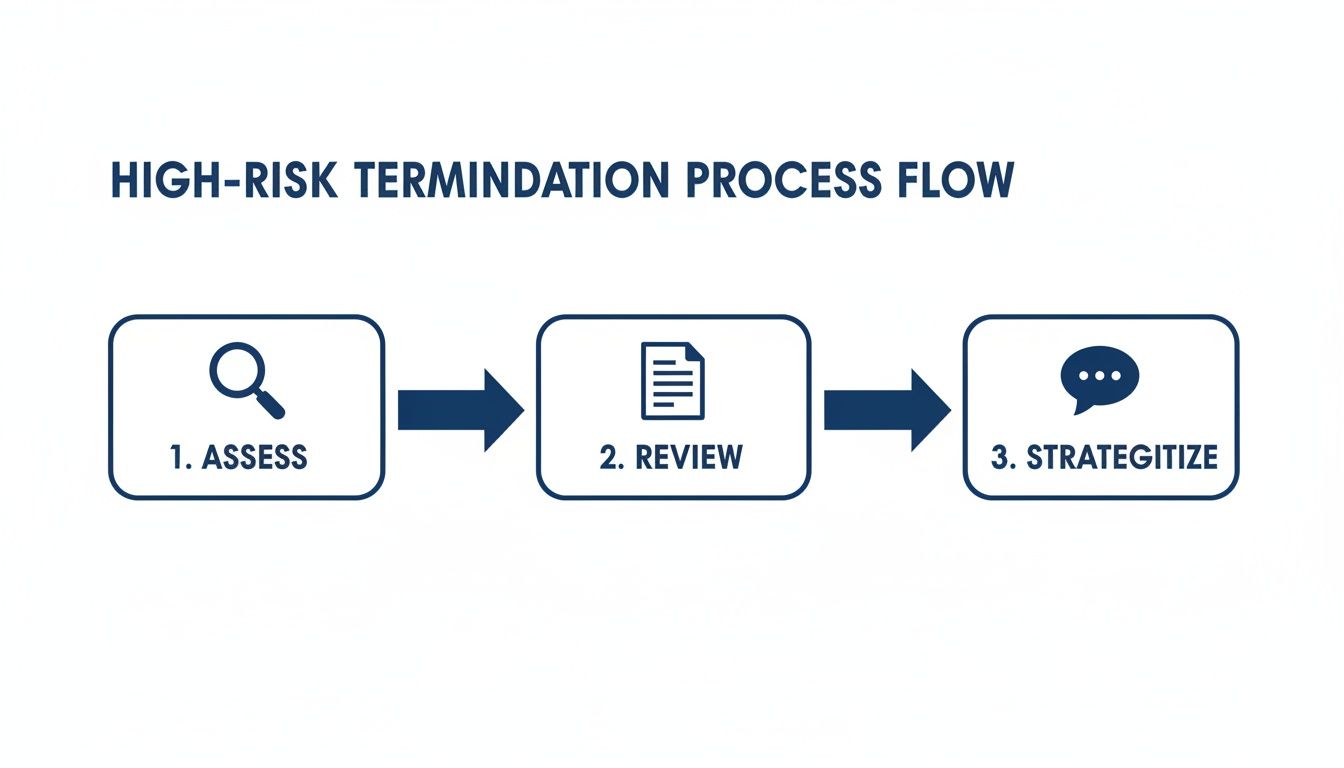
As you can see, a defensible approach moves methodically from assessing risk to reviewing documentation and, finally, planning the conversation. There is no room for improvisation when the stakes are this high.
Even the best policies are ineffective if your managers do not know how to apply them correctly. A crucial part of a defensible HR program is training your leadership team to manage people in a compliant and consistent way. Your managers are on the front lines, and their actions often represent the company's biggest source of employment risk.
Effective training gives your managers the tools they need to:
By investing in manager training, you create a culture of accountability and reduce the chance of someone making a costly mistake. You can get a deeper dive into this by reading our article on key HR risk management strategies.
As your business grows, shifting from basic HR administration to a more strategic approach is a significant step. Here are some of the most common questions we hear from founders and leadership teams.
The trigger for advisory HR is not just headcount—it is complexity. A 30-person company operating across three states often faces more legal risks than a 100-person business in a single location. The same applies to businesses in regulated fields like healthcare or finance.
It is time to consider advisory guidance when you see triggers like these:
If any of these sound familiar, your business has likely outgrown basic HR administration.
Not at all. In fact, they work best as a team. An advisory firm acts as a strategic partner to your leadership, supplementing the work your in-house HR manager is already doing. It creates a powerful, collaborative relationship.
Think of it this way: your in-house manager handles the day-to-day, while the advisory partner provides high-level guidance on risk and compliance. For example, your manager might run new hire orientation, while the advisory firm provides the defensible framework for a complex investigation. This dual approach ensures both daily operations and major risks are managed effectively.
It helps to think of advisory HR support as a form of insurance against the high costs of compliance failures and employment lawsuits. The engagement models are built to match your company's risk level and ongoing needs.
The two most common models are monthly retainers for ongoing access to expertise and project-based fees for specific, high-stakes needs. A retainer is ideal for businesses that need consistent strategic guidance. In contrast, project fees are a better fit when you need to bring in a specialist to handle a specific situation.
To build a truly defensible HR strategy, it is critical to understand the details around effective employee training, incident reporting, and compliance. This protects your business and helps create a fair, transparent workplace. The right HR support provides a clear path forward on your most challenging people decisions.
If your organization is navigating complex employment challenges and needs a partner dedicated to risk mitigation and strategic guidance, Paradigm International Inc. can help. For more information about our advisory-first approach, please contact us.