
Hiring the right people is one of the most critical decisions a business leader makes, yet many companies still rely on outdated, "gut-feel" interviews. In today's competitive and complex landscape, this approach is no longer sufficient. For any business serious about growth and managing risk, building a structured, repeatable, and legally defensible hiring process is not just a best practice—it is an absolute necessity.
In today's complex employment landscape, a single bad hire can have staggering financial and legal consequences. This is particularly true for small and mid-sized businesses (SMBs), especially those operating across multiple states where the web of regulations gets even more tangled.
When you rely on unstructured interviews—where questions are inconsistent and evaluations are purely subjective—you're opening the door to massive risk. This guide is designed to cut through that noise. We’re moving beyond the traditional, informal approach that exposes your business to claims of bias and discrimination. Instead, we’ll show you how to build a hiring framework that is fair, objective, and legally sound.
A defensible hiring process is one you can stand behind with clear, job-related evidence. It’s built on consistency and documentation, ensuring every decision is based on a candidate's actual qualifications, not an interviewer's intuition. This is non-negotiable for a few critical reasons.
Ultimately, this is about more than just filling an open seat. It’s about building a strategic asset that supports stable growth. By adopting a structured framework, you can transform your interviews from a potential liability into a powerful competitive advantage.
If you want to build a truly defensible and effective hiring process, it all starts with structured interviews. This is the bedrock of modern recruiting. Unlike the free-flowing, “gut-feel” conversations of the past, a structured interview asks every candidate for a specific role the same set of pre-planned, job-related questions.
This simple discipline creates a level playing field. It helps strip away unconscious bias and gives you consistent, comparable data to make a fair, objective decision. For any business scaling across state lines or operating in a regulated industry, this approach isn't just a good idea—it's non-negotiable for compliance. It’s about building a reliable system to hire the right people, every time.
Getting it wrong isn't just inconvenient; it's expensive. A bad hire can set your business back in more ways than one, from lost productivity to serious legal exposure.
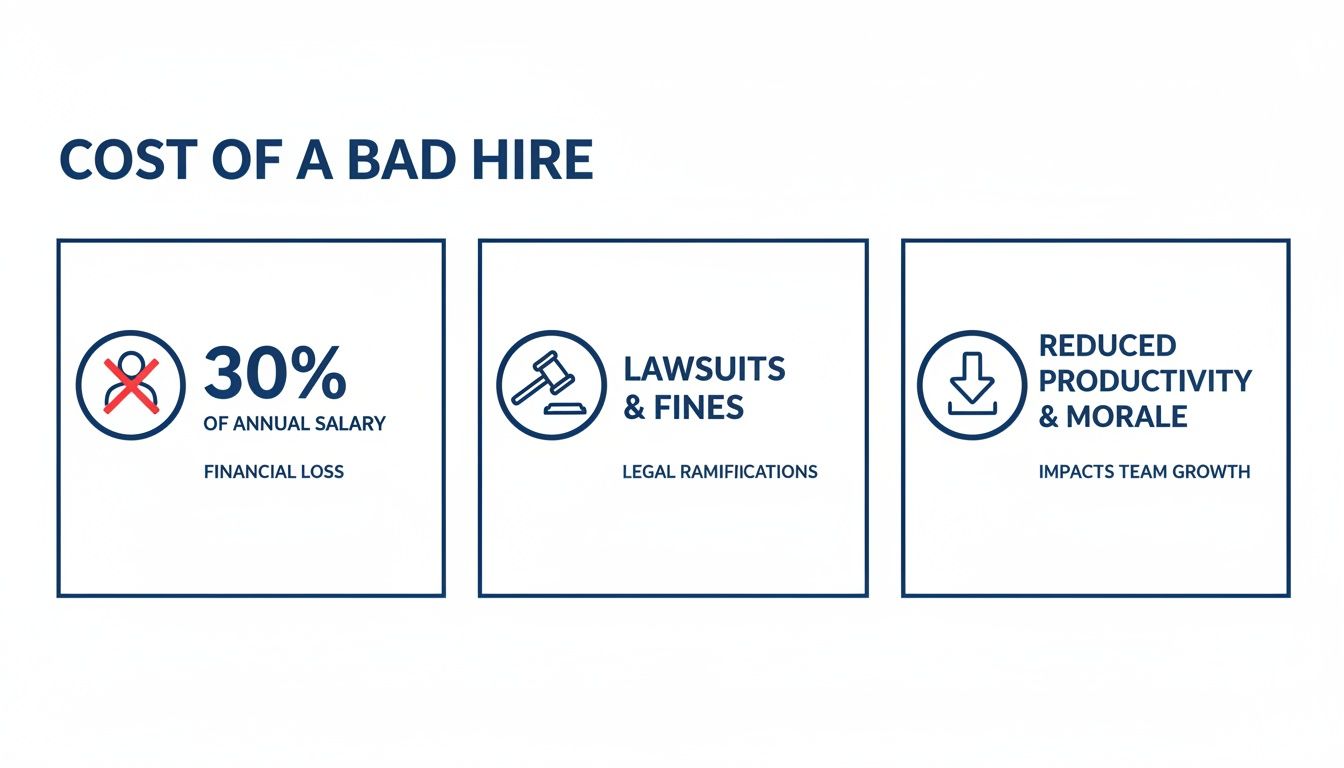
The fallout from a poor hiring decision ripples through your entire organization, affecting your bottom line, team morale, and overall momentum. Shifting from unstructured "chats" to a structured process is one of the most powerful risk-mitigation strategies you can implement.
The difference between these two approaches is stark when you look at the potential business impact. Unstructured interviews introduce inconsistency and subjectivity, while structured interviews provide a defensible framework for making sound decisions.
As the table shows, relying on unstructured interviews is a significant gamble. A structured approach isn't about being rigid; it's about being fair, consistent, and smart.
Before you can write a single interview question, you need to conduct a job analysis. This is simply the process of breaking down a role to identify its core competencies—the essential skills, knowledge, and behaviors someone absolutely needs to succeed. This step ensures your interview questions are directly tied to what the job actually demands, which is a cornerstone of fair and legal hiring.
For example, a job analysis for a project manager role might reveal these key competencies:
Once you’ve defined these, you can design questions that specifically test for them. A job analysis is your blueprint for a defensible interview, as it anchors your questions to real-world job requirements. To see how this fits into the bigger picture, check out our guide on recruiting best practices.
With your core competencies defined, it's time to write questions that actually reveal a candidate’s capabilities. The two most powerful question types for a structured interview are behavioral and situational. Using a mix of these questions ensures you’re gathering comparable, high-quality data points from every person you speak with.
To build an even stronger foundation, consider adding objective tools like pre-employment behavioral assessments. These can provide even deeper, data-driven insights that complement your interview findings.
By committing to a structured interview process, you’re not just improving a single step in your hiring workflow—you're building a more resilient, high-performing, and successful organization.
A structured interview is only as strong as the tools you give your team. To move beyond "gut-feel" hiring, you must equip your interviewers with a consistent framework for evaluation. Well-designed scorecards and question banks are your most valuable assets, turning subjective chats into objective, comparable data. These tools are the foundation of a fair, consistent, and defensible hiring process.

Without them, even your best-intentioned managers can fall back on unconscious bias, focusing more on rapport than on real capability. The goal is to provide a clear, simple system that forces interviewers to justify their ratings with specific evidence from the conversation. This doesn't just improve your decision-making; it creates the documentation you need to protect your business.
An interview scorecard is a simple grid that lists the core competencies for the role and provides a rating scale to assess each one. It's a powerful tool because it forces interviewers to think critically about why they feel a certain way about a candidate. The key is to keep it straightforward and tied directly to the job.
Start with the core competencies from your job analysis. For each one, create a simple rating scale, like 1 to 5. The most important part is to define what each number means. These definitions, called behavioral anchors, take the guesswork out of scoring.
For example, here’s what the behavioral anchors for a "Client Communication" competency might look like:
This structure makes interviewers document specific examples of a candidate's behavior to justify their rating. It shifts the evaluation from a vague "I liked them" to a defensible "They earned a 4 in Client Communication because they described a time when..."
Your question bank is the other half of the system. This should be a curated list of behavioral and situational questions tied directly to the competencies on your scorecard. Doing this ensures the conversation stays focused on job-relevant topics and steers clear of legally risky territory.
A well-built question bank acts as a guardrail for interviewers. It gives your managers a "safe" list of questions to pull from, dramatically reducing the chance that someone will accidentally ask an inappropriate or discriminatory question. Remember, every candidate interviewing for the same role should be asked the same core set of questions.
Navigating the legal minefield of interviewing is non-negotiable. Training your team on what they can and cannot ask is one of the most important things you can do. Deviating from job-related questions is the fastest way to invite a discrimination claim.
Here are some clear guidelines to follow:
Building these tools is a critical step, but they are part of a larger system. For more on creating legally sound hiring documents, you might be interested in our guide on how to write compliant job descriptions. By implementing scorecards and question banks, you’re creating a structured, evidence-based system for making better hiring decisions.
If you need help building a defensible interview framework for your business, we are here to be your decision partner. Connect with our advisory team to learn more.
Technology is changing how we interview, offering efficiencies we could only dream of a few years ago. However, jumping on every new tech trend without a plan can be risky. Innovations like video interviews and artificial intelligence should support your defensible framework—not replace human judgment.
Video interviews have become a staple in modern recruiting, especially for remote-first companies or those hiring across state lines. The right platform can boost recruitment efficiency, letting you screen more people in less time while cutting down on scheduling headaches. For businesses trying to hire outside their local area, it’s a game-changer.
Still, you need to find the right balance. While video is fantastic for initial screenings, remember that a majority of candidates still prefer an in-person final interview to get a real feel for the workplace culture. A hybrid model—using video for early rounds and bringing finalists onsite—is often the sweet spot, giving you efficiency without sacrificing the candidate experience.
Beyond video, artificial intelligence (AI) is quickly becoming a powerful way to reduce administrative work and help minimize bias in the early stages of hiring. AI-driven systems can handle interview scheduling, scan resumes for key qualifications, and automate candidate communication. This frees up your team to focus on what really matters: talking to people and making thoughtful decisions.
But not all AI tools are created equal. The key here is responsible implementation. Before you sign on with any AI vendor, you need to vet their platform for fairness and transparency. Ask them the tough questions.
Human oversight must remain central to any technology-assisted hiring process. AI should be used to augment your team's judgment by providing consistent data, not to make the final hiring decision on its own. You can explore AI-powered interviewing platforms like Saply to see how modern tools are designed with these principles in mind.
Even with the most advanced tech, your company is still accountable for every hiring decision. This is particularly true if you hire in multiple states, where employment laws can differ dramatically. Some jurisdictions, like New York City and Illinois, have already passed specific laws regulating the use of AI in hiring, demanding transparency and bias audits.
It’s your job to make sure any tool you use complies with all federal, state, and local rules. That includes giving candidates the required disclosures and keeping meticulous records. AI can help standardize parts of your process, but the final call—the one that requires nuance, empathy, and strategic insight—must always be made by a person.
Even the most carefully designed scorecards and interview guides are useless if your team isn’t trained to use them correctly. Your people are the engine of your hiring process. Investing in their training transforms them from well-intentioned interviewers into consistent, objective evaluators who protect your business.
A properly trained interviewer understands their mission: to gather job-related evidence in a structured way. Their role isn't to make friends or trust a "gut feeling." This discipline is the very heart of a defensible hiring process and is your single best tool for reducing risk.
The core purpose of interviewer training is to help your team recognize and sidestep their own unconscious biases. These are the mental shortcuts we all use to make quick judgments, and they can be incredibly destructive in an interview.
A few common biases can completely derail a hiring decision:
Training gives interviewers the self-awareness to spot these biases in real time and provides the tools to refocus on the objective data from the scorecard. Training isn’t a one-and-done event; it's an ongoing commitment to fairness and consistency.
Your training program needs to be practical, focusing on real-world skills your team can use immediately. A strong session teaches people how to stick to the interview guide, use the scorecard properly, and take effective, evidence-based notes. For example, instead of a subjective note like "good communicator," a trained interviewer writes, "Candidate clearly explained a complex project using the STAR method, confirming their communication skills."
The training must also cover legal basics. Your team needs to know which topics are off-limits and, just as importantly, why. Role-playing is a great way to practice how to gracefully steer the conversation back to job-related skills if a candidate volunteers sensitive information.
One of the most effective ways to dilute individual bias is to use a diverse interview panel. When you have multiple people from different backgrounds and roles evaluating a candidate, you get a much richer, more balanced perspective. Each panelist brings a unique lens, which helps challenge assumptions and ensures a candidate is measured against the core competencies from multiple angles.
Technology can also help reinforce good habits. According to recent job interview statistics and insights, a significant number of companies now use AI for initial screenings to reduce human error and improve consistency. Ultimately, your team is the final line of defense in making a great hire.
If you need a partner to help build a training program that strengthens your team and protects your business, we are here to help.
The work isn’t over once the final interview wraps up. What happens next is just as critical for making a great hire and protecting your business. This post-interview phase is where you turn raw data into a defensible decision, reinforcing the structure and consistency that underpin your entire hiring framework.

This final stage is all about making a collective, evidence-based choice. It demands a structured debrief meeting where every interviewer calibrates their feedback and challenges each other’s assumptions. The goal here is a consensus built on job-related evidence, not just one person’s gut feeling.
As soon as possible after the last interview, get every panelist in a room for a debrief. This is where individual scores transform into a collective, defensible decision. The structure of this conversation is essential for pushing back against the biases that can creep in, even with scorecards.
To keep the discussion productive and fair, stick to a simple process:
This calibration process forces your team to anchor their opinions in tangible evidence. The debrief meeting is your final check against bias, ensuring the hiring decision is based on a complete and objective view of the evidence.
Meticulous documentation is your number one legal safeguard. If a hiring decision is ever challenged, your records will be the first and most important piece of evidence showing you ran a fair and consistent process. The key is knowing exactly what to keep and what to discard.
Your hiring records should create a clear, defensible narrative. These are the documents that matter most:
Just as important is what you discard. Stray notes, subjective comments ("great personality," "not a good fit"), or any records outside the official scorecards create risk. They introduce subjectivity that can undermine your structured process. For a deeper dive, you can learn more about key aspects of hiring compliance for employers.
By keeping your documentation clean, focused, and evidence-based, you ensure every hire is a defensible one. This disciplined approach protects your brand and reinforces a culture of fairness.
As you work to build a more structured and defensible hiring process, some questions tend to pop up again and again. Having solid, experienced-backed answers is key to implementing best practices and creating a framework that truly works. Here are our answers to the most common inquiries we get from business owners and HR leaders.
The real goal here is to be thorough without dragging things out. For most professional roles, we've found a two-to-three-step process is the most effective. This typically looks like an initial screening call, followed by a deeper technical or behavioral interview, and a final conversation with key leaders.
This structure gives you enough touchpoints to make a well-rounded decision without causing candidate fatigue. Remember, lengthy processes that stretch over weeks are one of the biggest reasons top candidates walk away. Keeping your process tight and efficient is a genuine competitive advantage.
This is a critical question, and the answer is simple: stop trying to hire for "culture fit." That term has become a catch-all for unconscious bias, where interviewers favor people who are just like them. The much better, and more defensible, approach is to evaluate for "values alignment."
Start by defining your company's core values in clear, behavioral terms. What does "Collaboration" actually look like day-to-day? Then, write behavioral questions that ask candidates for specific examples of when they've demonstrated those values. This way, you’re collecting actual evidence tied to the principles that guide your company.
Nearly every major legal risk in the interviewing process comes back to a lack of structure and consistency. The top three dangers are:
A structured interview framework is your best defense. It's specifically designed to address these exact risks, creating a process that’s fair, consistent, and legally sound.
Building a defensible and effective hiring process is a strategic investment in your company's future. The team at Paradigm International Inc. specializes in helping leaders navigate these high-stakes decisions with confidence.
If you are ready to move beyond guesswork and implement a hiring framework that protects your business and secures top talent, we invite you to schedule a consultation with our advisory team.