
An employee reports misconduct by the COO, then asks whether the COO will see the complaint. The owner handles HR between operating meetings, and the person accused approves payroll, directs potential witnesses, and knows where the records sit. Investigating a complaint against an executive starts with removing that executive's control over the process, not scheduling interviews.
Judge an investigator's independence by what the accused controls. If the executive approves the investigator's payment, access to records, or continued employment, the process starts conflicted. Job title alone doesn't fix that.
The EEOC's harassment guidance summary emphasizes impartial investigation, planning, relevant evidence collection, and safeguards against influence by either party. The operating structure below translates those principles into reporting arrangements. Treat it as a starting governance model and check it against the company's actual ownership and decision rights.
| Target of the complaint | Who investigates | Who receives the report | Who must step aside |
|---|---|---|---|
| Manager in the complainant's reporting chain | HR lead or outside investigator outside that chain | Department head and HR lead | The accused manager and anyone who controls the complainant's schedule or pay |
| Vice president or COO | Outside investigator reporting to the CEO or a board designee | CEO or board committee | The executive, and direct reports who approve the complainant's work or budget |
| CEO or president | Outside investigator reporting to the board or an independent committee | Board chair or independent director | The CEO from scope, witness access, budget and final decisions |
| Founder or majority owner | Outside investigator directed by outside counsel and reporting to an independent advisor | Independent advisor or counsel, with the owner receiving the findings only as approved | The owner from scope, witness contact and discipline decisions |
| Board member | Outside investigator reporting to the board chair or a committee without the member | Board chair or committee | The board member and any director who is aligned with them |
For a manager complaint, an internal HR lead may be suitable if the lead sits outside the reporting chain and had no involvement in the events. For a vice president or COO, the CEO or a board designee should authorize the work and receive the findings directly.
The control piece is where most companies slip. The accused should have no say in which witnesses get interviewed, which records get produced, or whether the investigator's engagement continues. Route the investigator's invoices and evidence requests through the sponsor. If any payment or access decision crosses the executive's desk, the executive still has influence over the outcome.
A CEO or president complaint belongs with the board or an independent committee. A board member complaint requires excluding the member and directors whose involvement creates a conflict. Recusal should cover informal updates and private influence as well as attendance at meetings.
A founder without a board presents the hardest case. The company should appoint a neutral outside advisor with no reporting tie to the founder, with counsel establishing workable delegated authority. If the owner retains the ability to narrow scope, block witnesses, or suppress findings, the company shouldn't describe the arrangement as independent.
Practical rule: A recusal isn't meaningful if the accused still controls the investigator's invoices, evidence access, or continued engagement.
Before the first interview, the authorized sponsor should record who leads, who receives the report, and who is walled off from the file. The record should also name the person authorized to approve additional work and resolve access disputes. IT and finance need written instructions that match those decisions: who can pull mailbox and personnel files, who signs off on investigation spend, and what happens if the accused requests the same records for other reasons.
Escalate when the complaint names additional affected employees, the executive approves HR's budget or hiring, or HR reports to the accused. Bring in counsel when a senior leader is accused, discipline or termination is contemplated, medical or leave issues overlap, or employees work across state lines. An employment law consultation can help define those legal questions before fact-finding begins.
Privilege and factual independence are separate questions. Retaining counsel doesn't automatically make an investigation impartial, and it doesn't make every communication privileged. A senior-leader complaint is high-stakes and worth an expert conversation before anyone is interviewed.
International Inc. investigates board-level and executive misconduct, including CEO and owner allegations that require external neutrality. Its Schedule a Confidential Investigation Consult carries no judgment and no obligation.
A sound process starts with a written plan that the executive does not shape. The EEOC employer checklists call for prompt, thorough, impartial investigations with objective investigators, documentation, credibility assessment, and written findings. The protocol below turns those expectations into mechanics for the hardest version of this job: the accused holds organizational power.
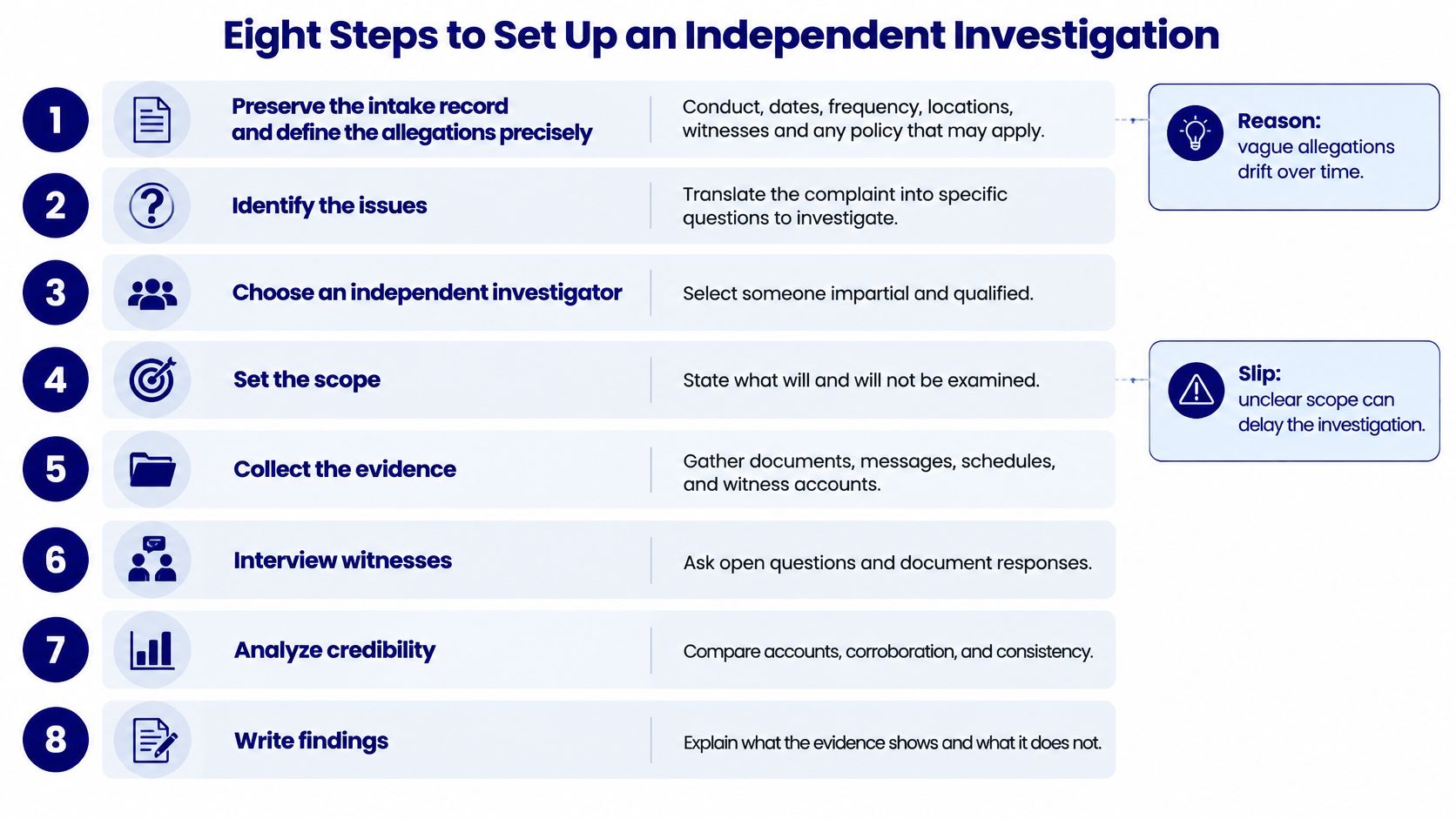
Preserve the intake record and define the allegations. Keep the original complaint, attachments, and contemporaneous notes. Identify conduct, dates, frequency, locations, witnesses, and potentially relevant policies. Vague allegations drift over time, and rewriting a complaint in softer language can erase the issue that needs examination.
Move every approval out of the executive's hands. A named sponsor signs the engagement terms, approves the investigator's invoices, and authorizes any additional work. Route payment through a budget line the accused doesn't control. If the accused still signs off on anything the investigation depends on, the investigation depends on the accused.
Strip the accused's access before anyone is interviewed. Have IT pull admin rights to the relevant mailboxes, shared drives, and HR systems. Have finance cut any authority the executive holds over the investigator's engagement. Witness selection belongs to the investigator alone, because an executive who chooses who gets interviewed has already shaped the outcome.
Issue written terms of reference. Define scope, decision rights, the report recipient, confidentiality limits, and whether recommendations are authorized. State how new allegations will be assessed. Undefined scope lets someone narrow the work after uncomfortable evidence appears.
An outside investigator earns its fee in this intake-and-scope work. The firm runs it as a formal phase: gathering initial facts, defining the investigation's boundaries, and identifying involved parties and risk areas. That preparation gives the investigator specific questions to answer rather than a general instruction to fix a personnel problem.
Build an evidence plan. Identify relevant email, messaging, HR files, performance records, access logs, calendars, and policy versions. Assign a collection owner and a deadline for each source. Evidence that only the executive volunteers will have predictable gaps.
Interview the relevant parties neutrally. Hear the complainant's account before presenting competing explanations. Interview witnesses and give the executive a meaningful opportunity to answer material allegations. Non-confrontational questions establish facts without assuming either account is correct.
Test every material assertion. Seek corroborating and contradictory evidence alike. Compare accounts against records and investigate inconsistencies rather than explaining them away. Seniority, confidence, and familiarity with the owner are not credibility.
Produce a fact-based report. Separate established, unestablished, and unresolved findings, and explain the evidence behind each classification. An unsupported allegation can still be an honest one. Keep the disciplinary decision out of the report until the evidence has been assessed.
The audit trail should explain what evidence was sought, obtained, unavailable, or excluded, and why.
The investigator should retain a scope-change log, collection record, interview record, and an explanation of material limitations. Missing records need a written reason in the file. A balanced process matters even when the evidence doesn't support a firm conclusion.
Confidentiality means limiting access to people who need the information. An employer can control who sees the complaint, who receives updates, and what gets shared at each stage, while accepting that it cannot promise word will never spread. The EEOC's 2017 Promising Practices guidance recommends confidentiality to the extent possible and a clear prohibition against retaliation.
Absolute secrecy would also break fair fact-finding. The executive needs enough information to respond, and witnesses need enough context to give useful evidence. Neither requires unrestricted access to the investigation file. One rule sits above the rest: the accused never controls the information flow. The investigator and the named sponsor decide who learns what and when, and the executive receives only what fairness requires. An executive who decides which witnesses get contacted or which complaints get escalated is running the investigation, and that is exactly what the process exists to prevent.
Communication rules should protect employee rights during an HR investigation. A blanket gag order that nobody can explain creates more legal exposure than the rumor it was meant to stop. Counsel should review any proposed restriction on employee discussions. The communication log should identify the date, recipient, sender, and substance of each material update.
For supervisor harassment under Title VII of the Civil Rights Act of 1964, the EEOC's small-employer guidance recommends preventing further conduct while investigating and cautions against burdening the complainant through involuntary transfer. Possible measures include schedule changes, reporting-line adjustments, or paid, non-disciplinary leave for the accused. None of those measures is a finding of misconduct.
The sponsor should assess whether an interim change affects pay, duties, access, supervision, or professional opportunities. Moving the complainant looks administratively easier and usually is, but it shifts the cost onto the person who reported the concern. A written rationale should explain why the chosen measure is proportionate, who approved it, and when it will be reviewed.
At closure, the complainant should receive an appropriate explanation of the outcome and the steps taken, within confidentiality limits. The message should name the person to contact if concerns continue or new conduct occurs, rather than promising access to another employee's personnel details.
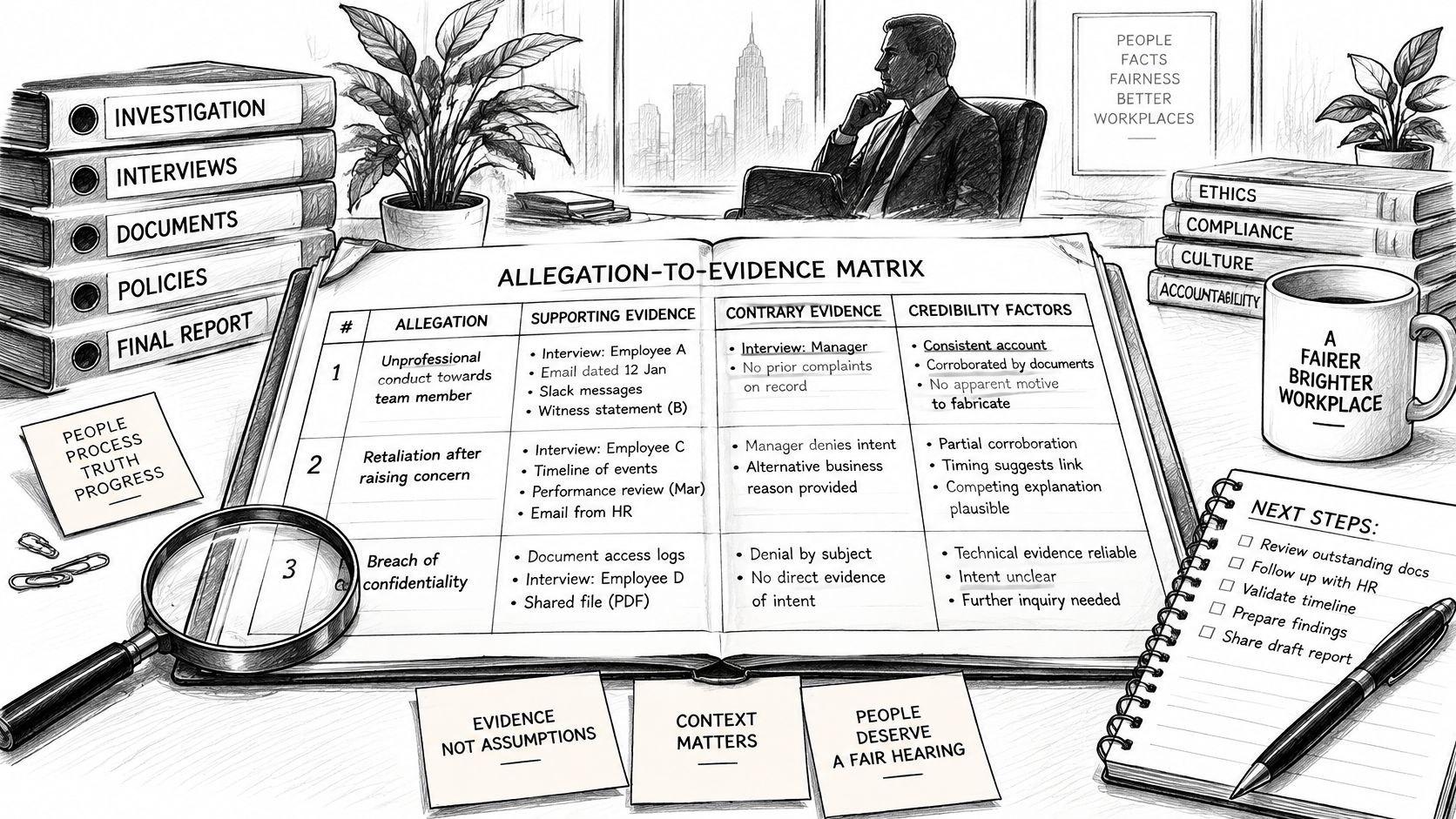
An executive under investigation still controls budgets, IT access, and the loyalty of potential witnesses until someone takes those levers away. The evidence file is where that control gets neutralized. The investigator should use an allegation-to-evidence matrix, not a running narrative. Each allegation needs its factual elements, supporting evidence, contrary evidence, witness credibility factors, applicable policy standard, and current finding status. Unanswered questions become visible before the report is drafted.
Consider an allegation that a vice president repeatedly made demeaning comments during weekly meetings. The investigator should establish the words used, dates, attendees, context, and whether the comments continued after the employee objected. The matrix should separate evidence of poor management from evidence supporting the particular policy allegation. If the accused controls the meeting calendar or the staff who maintain it, pull those records through IT or an outside custodian rather than through the executive's office.
| Evidence source | What to collect | Handling note |
|---|---|---|
| Threads, forwards and sent items tied to the alleged dates | Preserve native files with metadata; avoid relying on forwarded copies | |
| Messaging and chat | Direct messages, group chats and call logs | Export with timestamps and participants; record any deleted messages |
| HR and personnel records | Intake, prior complaints and discipline history | Keep separate from leave and medical files |
| Performance documents | Reviews, goals and changes made after the complaint | Compare dates against the complaint timeline |
| Access logs and system records | Logins, building access and file views | Request through IT with a written scope |
| Calendars and travel records | Meetings and travel connected to the alleged events | Confirm time zones and who controls the calendar |
| Relevant policies | The version in force on each alleged date | Save version history, not only the current handbook |
For electronic evidence, the collection record should identify the source, collection date, custodian, access restrictions, and any redaction or conversion. Every request should go to IT in writing under a defined scope, so the accused never sees or shapes what is being pulled. A file hash can verify that a preserved file hasn't changed where that level of verification is useful. Original files should remain separate from annotated working copies.
For PDF copies circulated to authorized reviewers, the PDFWix guide to PDF security provides context for document-protection options. Password protection doesn't replace controlled storage, recipient verification, or an access log. Sensitive files shouldn't circulate through ordinary forwarding chains.
The Acas guidance on investigation meetings offers practical interviewing guidance, rather than a U.S. legal standard. A useful sequence begins with the complainant's chronology, proceeds through independent witnesses and documentary checks, and reaches the executive once material allegations and contradictions are defined. Follow-up interviews may still be necessary.
Open questions should come before specific questions about dates, documents, or inconsistencies. The investigator should record refusals, corrections, and proposed additional witnesses. When new evidence contradicts an account, collection should reopen rather than forcing the evidence into an early theory.
The executive sits for a formal interview only after the file defines the material allegations, and never receives the witness list or questions in advance. The investigator conducts confidential interviews with all relevant parties and reviews physical and digital evidence. Confidential handling still allows testing of competing accounts, and every statement gets verified.
The report should contain:
A workplace investigation report template can organize the work, but it can't replace allegation-specific reasoning. Legal conclusions should be left to counsel unless counsel directs otherwise. A named decision-maker outside the executive's influence should decide corrective action.
Before release, a separate reviewer should check for scope gaps and unsupported conclusions. Counsel should address privilege and distribution where appropriate, and the sponsor should document closure communications and follow-up monitoring.
When the record supports a finding the executive disputes, the report should state the disagreement plainly rather than soften the conclusion. The decision-maker weighs the executive's objections against the documented evidence, and any revision should come from new evidence, not pressure from the person accused.
Leave requests and accommodation needs that surface during an executive complaint require separate files and a separate decision-maker from day one. The accused executive should hold no authority over the complainant's schedule, leave approval, or interview availability. An executive who can delay an interview, question an absence, or influence a return-to-work decision can influence the evidence. Removing that control is the point of this step.
The investigator still needs the employee's account, so treat leave-related unavailability as a scheduling constraint and coordinate a new interview time rather than recording non-cooperation. Document how the interview was offered and rescheduled.
The U.S. Department of Labor's FMLA guidance explains that the Family and Medical Leave Act of 1993, under 29 U.S.C. § 2601 and 29 C.F.R. Part 825, prohibits discrimination and retaliation for exercising FMLA rights. DOL can inspect records, question employees, investigate practices, and issue subpoenas. Bring employment counsel in before disciplining or terminating either participant when leave or medical issues overlap the complaint.
The enactment years below are reference points. Have counsel confirm current coverage and requirements before acting on any of them.
| Law | Enforcing agency | Year | Why it matters in this process |
|---|---|---|---|
| Title VII of the Civil Rights Act | Equal Employment Opportunity Commission | 1964 | Harassment, discrimination and retaliation complaints; EEOC guidance calls for prompt, impartial investigation |
| Americans with Disabilities Act | Equal Employment Opportunity Commission | 1990 | Medical conditions and accommodation requests that surface during the complaint |
| Family and Medical Leave Act | U.S. Department of Labor | 1993 | Leave requests, return from leave and protection against retaliation for using leave |
| Fair Labor Standards Act | U.S. Department of Labor | 1938 | Wage, overtime and pay complaints raised alongside the complaint |
| Florida Civil Rights Act | Florida Commission on Human Relations | 1992 | State discrimination claims for Florida employees; state rules can differ from federal rules |
Identify which laws touch each participant, which agency could review the matter, and which records need preservation. Then assign each overlapping question to the right file. ADA accommodation analysis is distinct from FMLA leave administration, and neither decision belongs anywhere near the accused. A review of reasonable accommodation under the ADA can help distinguish those questions before interview arrangements or return-to-work decisions are made. Route the answers through the investigation sponsor or an HR lead outside the executive's reporting line, and record who decided and why.
For a multi-state employer, headquarters location is not the only relevant location. The employee's work state can impose additional obligations, and remote work belongs in that review. Florida employees, for example, may hold state discrimination claims under the Florida Civil Rights Act of 1992, administered by the Florida Commission on Human Relations.
No table replaces a review of the specific facts with employment counsel. Federal leave eligibility, disability accommodation, state protections, and investigation participation call for coordinated decisions made by people the accused cannot influence.
A genuine performance problem still deserves review after a complaint. The danger comes from a rushed adverse action, particularly when the accused executive helped create the supporting record. The correct response is a documented review, not automatic discipline or an indefinite freeze on management.
Executive influence is usually the hardest part to test. The accused leader does not need to sign the recommendation to shape it. They can steer the timeline through a subordinate, supply a one-sided account, or signal the expected outcome while staying formally outside the decision. The retaliation check needs to account for that influence.
For discrimination complaints, the EEOC explains that federal law, including Title VII of the Civil Rights Act of 1964, prohibits firing, demotion, harassment, or other punishment for protected reporting, participation, or opposition. The agency describes the standard as conduct that might deter a reasonable person from opposing discrimination or participating in the complaint process. That standard reaches beyond termination.
Identify protected involvement. List the complainant, participants, and relevant witnesses. Counsel should assess which activities receive protection under the applicable law.
Compare the dates. Put the proposed action beside complaint dates, interview dates, and relevant management communications. Record when the decision was first proposed and when it would take effect.
Check consistent treatment. Compare the performance or conduct standard with the standard applied to comparable employees. Give a concrete reason for every meaningful difference.
Examine the original documentation. Confirm whether the concerns and supporting records predate the complaint. For documentation created afterward, scrutinize who generated it, when, and how well it aligns with earlier records.
Map decision-maker knowledge. Identify who knew about the complaint, when that person learned about it, and whether that person influenced the proposed action.
Exclude the accused executive. Keep the executive out of the recommendation and approval chain. Confirm that no decision-maker acted at the executive's direction, relied solely on the executive's account, or received pressure about the outcome.
A practical review of how workplace retaliation is assessed explains why timing, inconsistent explanations, and changed treatment matter. The goal is to determine whether the proposed action has a reliable, consistently applied basis.
Leaders should keep the allegations out of public discussion and limit details to people with a legitimate need to know. They should not isolate participants, remove routine opportunities, or change schedules and assignments before review. Exclusion from ordinary work can create risk even when salary remains unchanged.
A performance concern deserves examination. Management cannot bypass review because it already finds the complainant difficult.
The reviewer should document the proposed action, supporting evidence, comparators, decision-makers, executive contacts, and the reasons for approval or rejection. When timing makes an action look connected to the complaint, pause it and obtain expert review. Termination after a complaint or protected leave warrants an employment-counsel conversation before notice is delivered.
The hardest part of an executive complaint is the executive. Accused leaders control budgets, direct managers, and shape what reaches the board, so the investigation plan has to remove them from the process before it begins.
This week, leadership should work through a short checklist:
Outside support earns its cost when the company lacks a neutral reporting route or enough senior HR capacity to run the work. International Inc. is an HR consulting and advisory firm, not a law firm. Its team supports investigation intake, scope, and impartial fact-finding, while employment counsel addresses legal advice and privilege. Start with a defined question about authority, scope, or an upcoming decision rather than waiting for a complete file.
This article is general information, not legal advice. Employment laws change and vary by state; consult qualified employment counsel about your situation.
Paradigm International Inc. offers structured investigation support and HR decision guidance for employers handling sensitive executive complaints. Its team helps leadership define scope, organize impartial fact-finding, and document next steps. Readers can Schedule a Confidential Investigation Consult, which carries no judgment and no obligation.