
Letting an employee go is one of the toughest responsibilities for any business leader. The formal term for this is involuntary termination, and while its definition seems straightforward, the process itself is complex. At its core, involuntary termination is when an employer initiates the end of an employment relationship. It is not a resignation or a mutual agreement; the decision rests solely with the business. This distinction triggers a process filled with legal risks, operational challenges, and a true test of leadership.

Thinking of involuntary termination as just a definition is a common mistake. For business owners and HR leaders, it represents a high-stakes process where every action counts. One wrong move can lead to a costly lawsuit, damage team morale, or tarnish your company's reputation. A solid grasp of what constitutes an involuntary termination is your guide to navigating these challenges safely. It helps you distinguish between different types of employer-led separations, each with its own set of rules and best practices.
While "involuntary termination" is an umbrella term, these separations typically fall into a few key categories. Understanding which category applies is the first step toward handling the situation correctly and legally. Each one demands a different approach to documentation, communication, and risk management.
Key types of employer-initiated separations include:
An involuntary termination is always an employer’s decision. This simple fact places the burden on the company to show the separation was for a legitimate, non-discriminatory reason. Without this proof, even a justifiable decision can become a costly legal battle.
Understanding this concept frames your responsibilities, especially if you operate in an "at-will" employment state. While the what is employment at-will doctrine generally allows termination for almost any reason, it does not provide a blank check to act without justification. A structured, fair, and well-documented approach to involuntary termination is what protects your business. It ensures the departing employee is treated with dignity and helps maintain stability with the team that remains.
Knowing the difference between an employee who chooses to leave and one you must let go is a critical leadership skill. Both voluntary termination (an employee resigning) and involuntary termination contribute to turnover, but they tell two very different stories about your organization's health. Misinterpreting this distinction is like a doctor misdiagnosing an illness; you risk applying the wrong solution to a critical problem.
A surge in resignations might point to issues with company culture or compensation, while a spike in firings could signal a flawed hiring process or ineffective management training. The diagnosis dictates the cure. This distinction is more vital than ever, as management-led separations are becoming a larger part of the turnover picture. For example, a recent workforce turnover report from Mercer highlights how these trends are shifting and what they mean for employers.
This table breaks down the fundamental differences between the two types of separation, from who makes the decision to the risks involved.
| Aspect | Involuntary Termination | Voluntary Termination |
|---|---|---|
| Initiation | The decision is made solely by the employer. | The decision is made solely by the employee. |
| Common Reasons | Poor performance, misconduct, policy violations, or business needs like layoffs. | Seeking a new job, better pay, career change, relocation, or retirement. |
| Documentation | Requires a comprehensive file showing a legitimate business reason for the decision. | Typically involves a simple letter of resignation from the employee. |
| Primary Risk | High legal and compliance risk, such as wrongful termination or discrimination claims. | Primarily a business risk, including loss of talent, knowledge, and productivity. |
Each type of termination demands a different response from leadership. When good employees leave voluntarily, the mission is to understand why through exit interviews, compensation analysis, and reviews of management effectiveness. The goal is retention. In contrast, managing involuntary termination is about risk mitigation and process integrity. The focus shifts to ensuring every decision is fair, consistent, and legally defensible through rigorous documentation and clear communication.
A rising involuntary turnover rate is a direct reflection of your hiring and management systems. It indicates that the people you bring in or the way they are being led is not aligning with business expectations, a problem that requires a structural fix.
By correctly reading the story behind your turnover numbers, you can move from a reactive position to a proactive one. This allows you to address root causes, whether they lie in your culture or your operational processes. If you're grappling with these complex decisions, connecting with an expert at Paradigm can provide clarity and guidance.

Knowing the common reasons for employer-led separations is key to managing them with clarity, fairness, and consistency. The "why" behind the decision is everything; it dictates your documentation strategy and frames the final, difficult conversation. By learning how to categorize these situations, you can build a structured and defensible process for each one.
A performance-based termination occurs when an employee cannot meet the job's core expectations, even after you have provided support and clear feedback. This type of separation should never be a surprise. It is the final step in a thoughtful performance management journey that includes regular coaching, documented one-on-ones, and often a formal Performance Improvement Plan (PIP).
While performance is about how an employee does the job, conduct is about how they behave while doing it. Conduct-based terminations result from actions that violate company policies, ethical standards, or the law. These can range from a single, serious incident to a pattern of smaller issues.
Common examples that fall into this category include:
A conduct-based termination must be preceded by a fair and thorough investigation. Your goal is to gather objective facts to ensure your response is proportional to the offense. This is your best defense against claims of unfair or retaliatory treatment.
This category is different because it has nothing to do with an individual’s performance or behavior. Business-based terminations are driven by strategic, operational, or economic shifts affecting the company, often called layoffs or a reduction in force (RIF). For example, a company might eliminate a department to outsource the work, making those roles redundant. Recent economic shifts have made these decisions more common, as seen in the tech sector's widespread job cuts. This mid-year analysis from HireBorderless offers a deeper look into these global trends.
Correctly identifying the reason for a termination is the first and most critical step in building a defensible process. If you need a hand navigating these sensitive decisions, our team can provide the expert guidance to ensure you act with confidence and clarity. Contact Paradigm to discuss your situation.
Handling an involuntary termination correctly is about more than just good management—it’s about sidestepping a legal and financial minefield. "At-will employment" does not provide a shield against a wrongful termination claim. Every employer-led separation must be handled with a keen awareness of the complex web of laws designed to protect employees. Getting compliance right is not a cost center; it is a strategic advantage.
The most frequent and expensive legal challenges arise from claims of discrimination and retaliation. A termination becomes illegal if the decision is based, even in part, on an employee's protected status, such as race, gender, religion, age, or disability. Similarly, retaliation claims occur when an employee is terminated for engaging in a legally protected activity, like filing a harassment complaint or requesting a reasonable accommodation. Practices like employer social media screening must also be handled carefully to avoid legal exposure.
The federal Worker Adjustment and Retraining Notification (WARN) Act is a critical compliance checkpoint for growing businesses. It generally requires employers with 100 or more employees to provide at least 60 days' advance written notice of a plant closing or mass layoff. A mass layoff is typically defined as a reduction in force affecting a certain number of employees at a single site. Failing to comply can result in significant penalties, and many states have their own "mini-WARN" acts with different rules.
A mass layoff under the WARN Act is typically defined as a reduction in force that results in an employment loss at a single site for 500 or more employees, or for 50-499 employees if they make up at least 33% of the active workforce.
A host of administrative duties carry their own legal weight, and how you handle these final steps is just as important as the termination decision itself.
Understanding these legal duties is vital. For a more detailed look, consider our guide on key employment laws for small businesses. If you're facing a complex separation and need to ensure your process is defensible, connect with us at Paradigm to discuss your specific needs.
Knowing the risks is one thing, but building a solid process to avoid them is where great leadership shines. A defensible termination process is not about being cold; it is about being fair, consistent, and methodical. This framework protects your organization from legal claims and ensures every employee is treated with respect. A strong process turns a high-risk event into a manageable one.
The cornerstone of a defensible process is consistency. Your company policies must be applied fairly to every employee in a similar situation. If you terminate one person for a policy violation but allow another to slide for the same offense, you create an opening for a discrimination claim. Your employee handbook is a legal document, and leaders must ensure it is enforced without favoritism.
This simple flow chart shows exactly what’s at stake and why a structured process is so important.
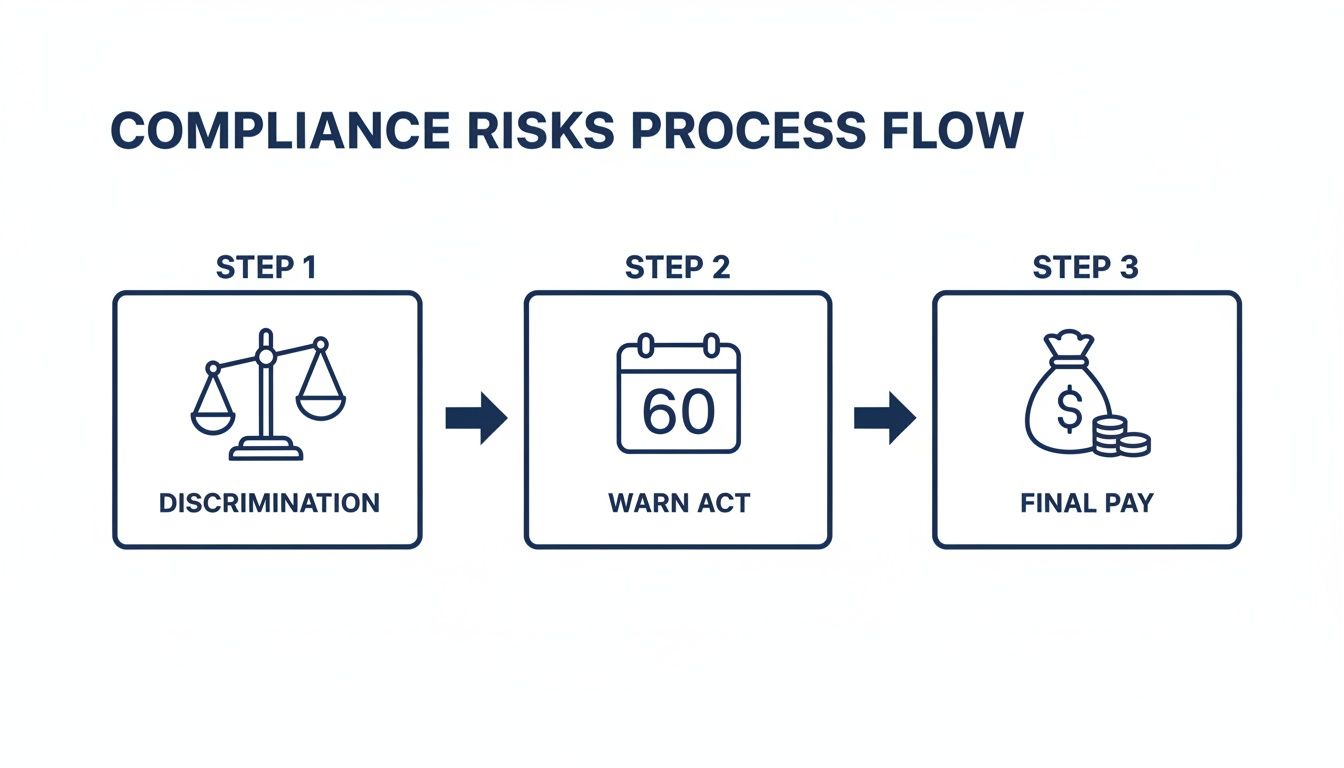
As you can see, a single termination can trigger reviews for discrimination, WARN Act compliance, and final pay obligations. It’s a clear illustration of why a deliberate, step-by-step approach is mission-critical.
If consistency is the foundation, then documentation is the structure you build upon it. Without clear, objective records, even a legitimate business decision can appear arbitrary. Your goal is to create a paper trail that tells a clear, factual story.
For a termination based on poor performance, that documentation must include:
Documentation must always be objective and fact-based. Avoid emotional language or subjective labels like "bad attitude." Instead of writing, "Alex was lazy," write, "Alex missed the project deadline on May 15, May 30, and June 12."
Before any final decision is made, it is essential to have a neutral party review the entire situation. This is typically a role for HR, a senior leader outside the employee's direct chain of command, or legal counsel. This second set of eyes helps ensure the decision is free from bias and that the process was followed correctly.
The reviewer should be asking these critical questions:
This step acts as a crucial quality control check to catch potential mistakes before they become costly liabilities. Our comprehensive termination checklist can help you walk through these key steps.

The final conversation is often the most lasting memory an employee will have of your company. It is a high-stakes discussion requiring a balance of directness, professionalism, and genuine respect. Getting this meeting right minimizes distress for the employee and reduces legal risk for your business. The objective is to deliver a clear message without getting pulled into an argument. The meeting is a notification, not a negotiation.
Walking into a termination meeting without a plan is a mistake. You need to know what to say and what not to say. The language must be direct and final to avoid confusion.
Here are a few guidelines for your script:
The most compassionate thing you can do in a termination meeting is to be clear. An employee should leave the room with no uncertainty about their employment status. This clarity prevents false hope and allows them to begin processing the next steps.
The structure of the meeting itself is critical for managing risk and ensuring a professional outcome. Always have a witness present, usually someone from HR or another manager. This person is there to observe and take notes, which is invaluable if a dispute arises. Before the meeting, gather all necessary paperwork, including the final paycheck, separation agreement, and COBRA information. Handing over a prepared packet helps shift the conversation toward logistical next steps.
This structured approach transforms a difficult event into a manageable process. If you need support navigating these sensitive conversations or building a defensible involuntary termination definition and process, our team is here to help. You can contact Paradigm to discuss your situation.
When it comes to involuntary termination, uncertainty can lead to costly mistakes. Business owners and HR leaders often have the same pressing questions. We’ve gathered some of the most common queries to provide immediate clarity on these high-risk situations.
The core difference is the reason for the separation. Getting "fired" is a termination for cause, related to an individual’s performance or conduct. In contrast, a "layoff" is a business decision driven by restructuring or downsizing and has nothing to do with the employee’s personal performance. This distinction is critical, as it impacts unemployment eligibility and internal communications.
No. While at-will employment offers flexibility, it is not a free pass to terminate someone for an illegal reason. You cannot fire an employee based on a protected status—like race, age, or gender—or in retaliation for a protected activity, such as filing a harassment complaint. Even in an at-will state, firing someone without a legitimate, documented business reason is a significant legal risk.
A termination without a clear, defensible "why" can easily be interpreted as an illegal "why." The burden of proof falls on the employer to show the decision was based on legitimate factors, not discriminatory ones.
The most important "document" is never a single piece of paper; it is a complete file of consistent, objective documentation. For a performance-based firing, this means a history of performance reviews, written warnings, and a well-executed Performance Improvement Plan (PIP). For a layoff, it is the documented business case and objective selection criteria. A well-documented history showing a fair and consistent process is your strongest defense.
You should seek expert guidance before making a final decision in any high-risk situation. Proactive advice is always better—and less expensive—than reactive damage control.
Call an expert when the termination involves:
These scenarios are legal minefields that require careful handling to manage risk and ensure full compliance with complex laws.
Navigating these high-stakes decisions is a defining challenge for any business leader. At Paradigm International Inc., we help you manage these moments with confidence and precision. If you are facing complex employment situations and need expert guidance to ensure your processes are fair and compliant, we are here to help. To learn more about how we can support your business, contact us to discuss your needs.