
Trust is the foundation of effective leadership, yet it's becoming a scarce resource in many workplaces. When the connection between leaders and their teams weakens, the impact is felt everywhere—from daily engagement to long-term employee retention. Building and maintaining trust isn't a soft skill; it's a critical business asset that directly affects your bottom line. In today's world of hybrid work and complex regulations, old command-and-control tactics no longer work.
A significant gap exists between how leaders perceive their performance and how their teams actually feel. Many executives believe they are transparent and communicative, but employees often feel disconnected and uninformed. This is more than a simple communication error; it's a serious business risk. Low trust leads to decreased engagement, higher turnover, and stalled innovation.
The consequences are both real and costly. Employees who lack trust in their leaders are less likely to voice concerns, propose new ideas, or go the extra mile. Instead, they operate cautiously, focusing on self-preservation rather than collective success. This quiet disengagement can be more damaging than open conflict, as it silently undermines a company's culture and competitive edge.

The nature of work has changed dramatically. With remote and hybrid teams now common, leaders cannot rely on physical presence or informal office interactions to build relationships. Managing employees across different states also introduces new layers of legal and cultural complexity. This new environment demands a more deliberate and consistent approach to leadership.
Trust today is not built on charisma or authority. It is the result of intentional, predictable, and fair actions, repeated consistently. Your team needs to see that processes are applied uniformly to everyone, regardless of their location or job title.
This modern landscape requires a shift from discussing ideals to demonstrating concrete behaviors. A high-trust organization is not built on occasional team-building events, but on creating transparent and defensible systems for every aspect of the employee experience. Key areas include:
Ultimately, investing in leadership and trust provides a significant strategic advantage. Companies with high levels of trust are more agile, resilient, and innovative. Their employees are more engaged, collaborative, and committed to the organization's success. This guide offers an actionable roadmap to move beyond theory and build the trust your business needs to thrive.
This playbook is for leaders who understand that trust is an asset to be built and protected. If you are ready to implement defensible practices that create and sustain a high-trust culture, our team can help you build the right framework. Contact Paradigm to learn more.
Trust can often feel like an abstract concept. In reality, it is built on a foundation of tangible, observable behaviors that your team witnesses daily. For leaders, these actions can be organized into four distinct pillars. Consistently demonstrating these behaviors helps build credibility, foster psychological safety, and create a resilient culture where your team has confidence in your leadership. Think of these as the essential building blocks for leadership and trust.

Character is defined by your actions when no one is watching. It is the ethical core that guides your decisions, particularly under pressure or when facing difficult choices. Your team is always observing—do you prioritize profit over people, or fairness over favoritism? A leader with strong character makes the right decision, even when it is the more difficult one. This means taking full ownership of mistakes, protecting your team from unfair blame, and upholding company values without exception.
Competence is your ability to perform your job effectively. It encompasses not just technical skill, but also strategic thinking, sound judgment, and the capacity to make intelligent decisions that benefit the entire team. Your employees need to believe in your ability to guide them toward success. Competence builds that belief. When you can calmly assess a complex situation, define a clear path forward, and allocate resources effectively, you demonstrate that the team is in capable hands. For more on developing these skills, our guide on the characteristics of a good mentor is a helpful resource.
When leaders demonstrate genuine competence, they reduce uncertainty and anxiety. Their teams can focus on execution instead of worrying about the overall direction. This is especially important during times of organizational change or market instability.
Consistency is perhaps the most powerful pillar in building daily trust. It means your actions are predictable and the application of rules is fair and impartial. People perform best in environments where they know what to expect from their leaders. When policies are applied selectively, or a leader's mood dictates their decisions, trust quickly erodes.
Consistency involves:
This is particularly crucial for managers of distributed or multi-state teams, as it ensures an equitable experience for everyone, regardless of location. A lack of consistency creates instability that undermines morale and productivity.
Candor is the practice of being open, honest, and direct. It involves sharing information transparently, even when the news is difficult. Leaders who practice candor do not sugarcoat reality or withhold critical information from their teams. A culture of candor encourages genuine dialogue and makes it safe for employees to voice concerns without fear of reprisal. For example, a leader practicing candor might say, "Our sales numbers for Q2 were below target. Here is the data, our analysis of the cause, and the plan we will execute together to improve." This approach fosters partnership, not fear.
The current leadership landscape highlights the urgency of this issue. The 2023 Global Leadership Forecast revealed the largest drop in leadership confidence in a decade, with only 46% of leaders fully trusting their own managers. To sharpen these skills, an Entrepreneurs Organization's leadership guide offers valuable insights into effective strategies.
This table provides a simple framework for evaluating your own leadership behaviors and identifying areas for improvement. Building an organization on these four pillars is an ongoing commitment. By integrating Character, Competence, Consistency, and Candor into your daily interactions, you can create a workplace where trust is the standard.
Effective communication is essential for a high-trust organization. It's not just about what you say, but also how, when, and why you say it. Intentional communication moves beyond generic updates to create predictable and psychologically safe channels for information to flow honestly. This approach is fundamental to strengthening the bond between leadership and the team.
This involves establishing clear protocols for all types of interactions, from routine one-on-ones to major company announcements. When employees know what to expect and feel safe to speak up, they become active partners in the company's success. A structured approach is especially important for remote and hybrid teams, where ambiguity can quickly undermine connection and confidence.
To build trust, communication must be both consistent and purposeful. Leaders who improvise during important conversations risk sending mixed signals, creating confusion, or appearing evasive. A better approach is to develop specific protocols for common scenarios to ensure fairness and clarity every time. These frameworks act as guardrails, helping managers deliver messages with both empathy and precision.
How you handle difficult conversations is a true measure of leadership. Delivering bad news—such as a poor performance review, a canceled project, or layoffs—requires a careful balance of directness and compassion. The goal is to preserve the individual's dignity while communicating the necessary information clearly. A simple yet effective model for these situations is "Facts, Impact, Path Forward."
First, state the situation clearly and objectively (Facts). This is not the time for vague language. Instead of saying, "We're rethinking your role," be direct: "We have made the difficult decision to eliminate your position."
Next, explain the direct consequences (Impact). This provides context and demonstrates respect. For example, "This is part of a broader restructuring aimed at focusing our resources on core product development."
Finally, outline the Path Forward. Provide clear next steps, whether it's details about a performance improvement plan, severance information, or available resources. This structure removes uncertainty and shows the decision was thoughtful, not reactive. For more guidance, our insights on addressing poor communication in the workplace can help.
Trust is not earned when things are easy; it is forged during moments of difficulty. A leader's ability to communicate with honesty and empathy during a setback can reinforce, or even rebuild, a team's confidence.
Meetings are a reflection of your company culture. A psychologically safe meeting is one where every person feels comfortable asking questions, challenging ideas, and admitting mistakes without fear of punishment or humiliation. Fostering this environment requires active facilitation from the leader.
Start by establishing clear ground rules, such as a "no interruptions" policy, and make a point to actively solicit opinions from quieter team members. For instance, a leader might say, "That's an interesting point, Sarah. David, you have experience in this area. What are your thoughts?" This simple act of inclusion signals that all voices are valued. While focusing on internal trust, remember that external communication strategies, like building that trust at scale, can also enhance your organization's reputation.
Trust is a two-way street. It is not enough for leaders to communicate downward effectively; you must also create reliable channels for feedback to flow upward. Employees often have valuable insights but will only share them if they believe they will be heard and not penalized for their honesty.
A mix of formal and informal systems can help achieve this:
By designing communication with this level of intention, you create a resilient framework where trust can thrive. Your team will understand the rules of engagement, feel respected and heard, and have confidence in your leadership's consistency.
When sensitive employee issues arise, such as performance problems or misconduct allegations, the integrity of your response is paramount. How you handle these moments sends a powerful message. A defensible process not only protects the company but also demonstrates that fairness is a core value, reinforcing the trust between leadership and employees. This is where process integrity becomes the bedrock of trust.
This decision tree provides a quick visual guide on how leaders can choose the appropriate communication method for different situations.
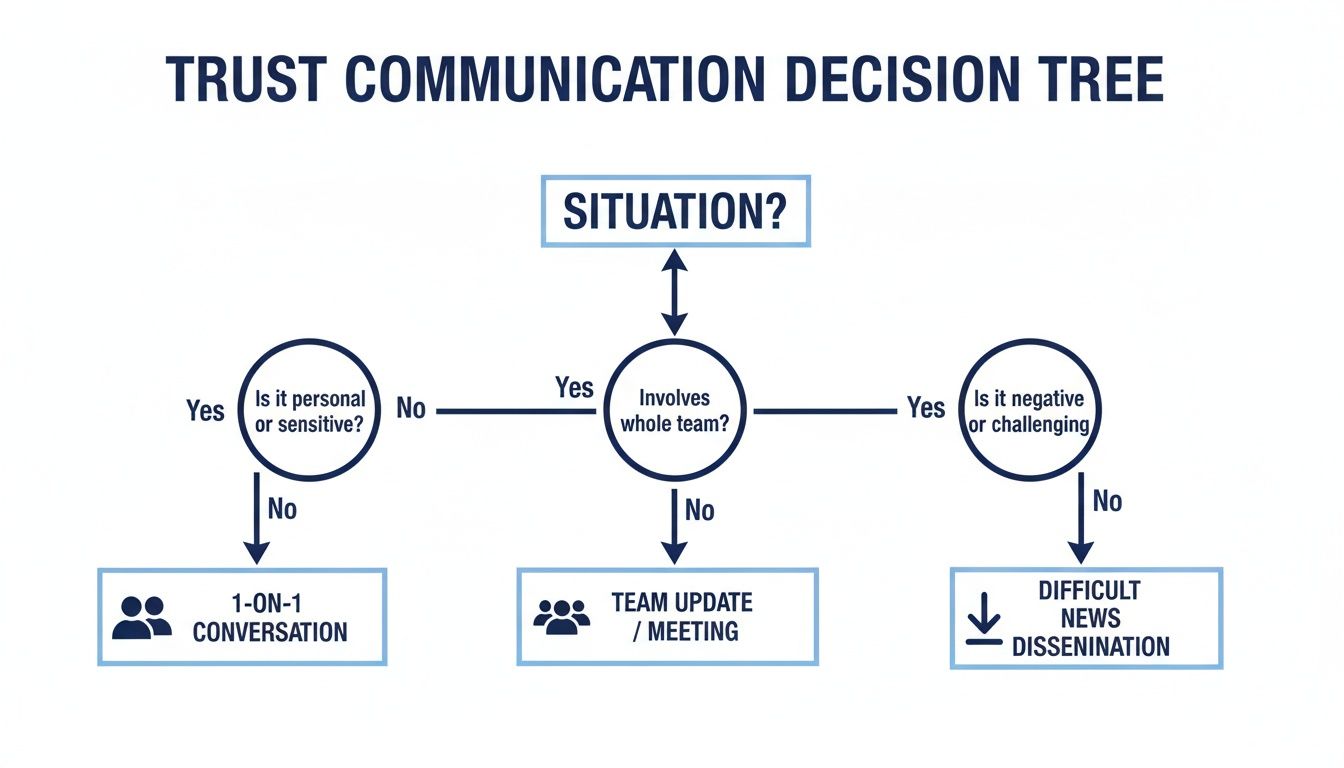
The key takeaway is that every scenario requires a thoughtful, structured approach to communication to maintain clarity and trust.
Applying company policies inconsistently is one of the fastest ways to erode trust. When one employee is held to a standard that another is not, it signals favoritism and can damage team culture. Your credibility as a leader depends on demonstrating that the rules apply to everyone, regardless of their role or performance. This means if your handbook outlines a disciplinary process, you follow it every time. Consistency is your best defense, both legally and culturally, as it proves your actions are based on policy, not personal bias.
When an employee files a complaint, your investigation process is critical. A fair, impartial, and timely investigation shows that leadership takes every concern seriously. The goal is to create a process where people feel safe coming forward, confident that their issue will be handled professionally. A solid investigation framework should include a few key components to ensure the process is thorough and objective from start to finish.
For a more detailed roadmap, our guide on how to conduct an HR investigation offers further insights.
A well-structured investigation does more than solve a single problem. It reinforces the company's commitment to a safe and equitable workplace, strengthening the overall relationship between leadership and trust.
Clear, objective documentation is the backbone of any defensible HR practice. It serves as your factual record of events, decisions, and conversations, which is invaluable for performance management, disciplinary actions, and legal inquiries. Good documentation is not about building a case against an employee; it is about creating an honest record of what occurred and the steps taken.
Effective documentation should always be:
For example, instead of writing, "John had a bad attitude," a better entry would be, "During the 10 a.m. project meeting on October 26th, John interrupted a colleague twice and stated, 'This plan will never work.'" The second version provides a clear, behavioral record that can be addressed constructively. By making process integrity central to your approach, you demonstrate a deep commitment to fairness, which protects your organization and builds a culture where your team trusts they will be treated with respect and equity.
Leadership failures are inevitable. Whether it's a poorly handled layoff, a failed project, or a flawed strategic decision, every leader will face a moment when trust is broken. In these critical situations, it is your response, not the mistake itself, that defines you. Your actions determine whether the breach becomes a permanent setback or a catalyst for building stronger relationships. The natural instinct may be to defend or minimize the damage, but the most effective way to rebuild leadership and trust is through radical accountability. The recovery must be swift, sincere, and transparent.

The first step is to take full responsibility for the failure. This is not the time for excuses or blame. A sincere apology should be direct and focus on the impact the mistake had on the team, not on your intentions. For instance, if a project failed due to poor planning, a weak response is, "Mistakes were made." A powerful, trust-building response is, "I take full responsibility for the failure of this project. My planning was inadequate, which placed an unfair burden on all of you. I am sorry for the wasted effort and stress this caused." This clarity and ownership show respect for your team's experience.
After acknowledging the issue, you must demonstrate a commitment to understanding what went wrong. A transparent post-mortem is not about assigning blame; it is a structured review aimed at identifying the root cause of the failure. It is essential to invite the team to participate and create a psychologically safe environment where they can share their perspectives without fear of retribution.
Key questions to guide the conversation include:
This collaborative approach signals that you value your team’s insights and are serious about fixing the underlying problems.
An apology without action is meaningless. The most critical step in rebuilding trust is to communicate a clear, credible plan to prevent the same mistake from recurring. This plan must be specific, measurable, and visible to everyone. For example, if communication around layoffs was mishandled, the corrective action cannot be a vague promise to "be more transparent." It must be a concrete change.
A leader might state, "Moving forward, any organizational changes impacting roles will be communicated directly by me in a team-wide meeting, followed by individual conversations. We are also implementing a clear severance and outplacement policy, which will be shared with everyone this week." This specificity transforms a promise into a tangible commitment.
Words can only go so far. Lasting trust is rebuilt through sustained, consistent action over time. If the breach was related to inconsistency, you must become a model of fairness. If it was about poor communication, you must become exceptionally transparent. The path forward requires vulnerability. Leaders who show genuine vulnerability are 5.3 times more likely to earn trust, and those who own their failures are 7.5 times more trusted. You can learn more about these leadership findings from the study.
Restoring trust is a long-term process. Your team will be watching to see if your changed behaviors are genuine and lasting. Every consistent action you take reinforces your commitment and slowly repairs the damaged foundation. If you are facing a breach of trust and need guidance on navigating the recovery process with defensible, structured steps, we can help. Contact Paradigm to discuss your situation.
Building a high-trust organization is not a one-time project; it is an ongoing commitment that must be integrated into your company's culture. Sustaining trust requires deliberate and continuous effort, especially for businesses operating across multiple states with complex legal environments. The goal is to create scalable systems that make fairness and transparency the default settings for your entire organization.
This long-term strategy depends on more than just good intentions. It is built on consistent manager coaching and ongoing leadership development that reinforces trust-building behaviors. When your management team is equipped with the right frameworks, they can handle sensitive issues with both integrity and consistency, ensuring every employee has an equitable experience.
You cannot improve what you do not measure. To ensure your culture remains resilient, you must regularly assess your organization’s trust levels. This provides a clear picture of what is working and where potential issues may be forming before they become significant problems.
Practical methods for auditing trust include:
Sustaining trust means embedding accountability at every level. It's about creating a culture where transparent, fair processes aren't just encouraged but are expected from everyone, every single day.
The stakes for getting this right are higher than ever. Recent data shows that business is now the only institution consistently trusted worldwide, with a 62% trust average, leaving companies to fill a significant leadership void. For multi-state businesses facing a web of complex regulations, this positions ethical leadership as a critical pillar for long-term stability and success. You can read the full 2023 Edelman Trust Barometer report to explore these findings.
For leaders committed to building and sustaining high-trust organizations, an expert partnership can make a significant difference. If you need help creating the defensible systems that foster lasting trust, we are here to guide you. Connect with Paradigm to learn more.
Building trust can present complex, real-world challenges. Here are straightforward answers to some of the most common questions from business owners and HR leaders.
As a new leader of an established team, your initial instinct might be to prove yourself. Instead, focus on listening. For the first few weeks, your primary role is to listen more than you speak. Schedule one-on-one meetings with every team member to understand their roles, challenges, and goals. Then, identify a small, early win that makes their work easier, demonstrating your competence without disrupting existing processes. Most importantly, be consistent. Do not make promises you cannot keep, and be transparent about your decision-making process. Show respect for their expertise first, then begin building a new vision together.
The most damaging mistake is not a single dramatic event, but inconsistency. This occurs when a leader's words do not match their actions, such as applying rules selectively or constantly changing priorities without explanation. This creates a culture of uncertainty and unfairness, where employees learn they cannot rely on their leader's word. Trust is built on predictability. Even when making difficult decisions, being fair and consistent is essential to maintaining your team’s trust.
Yes, it is possible, though challenging. First, self-reflect to determine if you contributed to the mistrust. If so, address it directly, apologize if necessary, and change your behavior. From that point on, consistently demonstrate the four pillars of trust: Character, Competence, Consistency, and Candor. Your actions must be impeccable with the entire team, not just those who already trust you. Focus on fair processes and transparent communication. While you may not win over every individual, your trustworthy behavior will build a strong foundation with the majority and isolate the impact of those who remain skeptical.
Building and sustaining a high-trust culture is not about good intentions; it is about implementing deliberate, defensible systems. At Paradigm International Inc., we partner with leadership teams to establish the structured practices that reduce risk and foster lasting trust.
If you need assistance creating these essential frameworks for your organization, we are here to help.