The hardest leadership moments are rarely loud. They happen in a small room, with one manager, one employee, and a decision that won't be reversed by good intentions. If you're running a 75-person company across three states, you already know the problem, the meeting has to be humane, the documentation has to hold up, and the rest of the team is watching how you handle it.
The COO closes the door, sits across from a long-tenured manager, and says the role is ending today. The employee is upset, but the issue is bigger than the moment. Everyone involved will remember whether the conversation was clear, respectful, and documented, or whether it was softened into confusion.
That's why leading with empathy matters most when the stakes are uncomfortable. In a small or midsize business, one mishandled termination, one inconsistent investigation, or one muddled performance plan can ripple through retention, trust, and manager conduct. Employees don't just judge the outcome, they judge whether leadership acted with consistency and basic respect.
Practical rule: empathy is not extra kindness after the decision is made, it is the way the decision is delivered, explained, and documented.
Many leaders get it wrong. They confuse empathy with delaying action, or they assume a compassionate tone will cover for weak process. It won't. People can forgive hard outcomes more easily than they forgive confusion, favoritism, or a lack of straight answers.
When the decision is difficult, empathy becomes a discipline. It means you can acknowledge the human impact without losing the business standard. That balance is what employees remember, and it's what leaders need when the meeting ends and the paperwork begins.
Empathetic leadership is not softness, and it is not a bid to be liked. It is a set of visible behaviors that tell people they were heard, while the leader still holds the line on performance and standards. Research from EY survey report connects empathy with satisfaction, retention, efficiency, creativity, and idea sharing, and Catalyst's work shows that employees respond differently when senior leaders are highly empathic.
That matters for SMB leaders because turnover, disengagement, and manager conduct problems are expensive even when they never turn into formal disputes. If your engagement survey data is shaky, or supervisors handle people differently from one location to the next, employees notice fast. Empathy only helps when people can see it in decisions, language, and follow-through.
Cognitive empathy is understanding what someone is experiencing. Affective empathy is sensing the emotional weight of it. Behavioral empathy is what you do next, the tone you use, the follow-up you send, the clear next step you set.
That last part is where a lot of leaders fall short. They think understanding is enough, but employees experience empathy through the conversation, the documentation, and the follow-through. If those three pieces do not match, the message is not empathy, it is inconsistency.
A useful outside lens comes from the idea of an attunement gap in rebuild connection strategies. The terminology comes from a different field, but the lesson lands in the same place. People notice when a leader's words and actions do not line up.
| Workplace Outcomes Under High vs Low Empathy Leadership | High-Empathy Leaders | Low-Empathy Leaders |
|---|---|---|
| Innovation | More often innovative at work (Catalyst) | Much less often (Catalyst) |
| Engagement | More engaged (Catalyst) | Less engaged (Catalyst) |
| Inclusion | Reported stronger inclusion (Catalyst) | Reported weaker inclusion (Catalyst) |
For SMB operators, the practical takeaway is blunt. Empathy is not a vibe. It is a leadership behavior that changes how people report their experience, and that should show up in retention, manager coaching, and how seriously you treat employee feedback.
See also people-first leadership, because empathy only works when it shapes how leaders make decisions, not just how they talk about people.
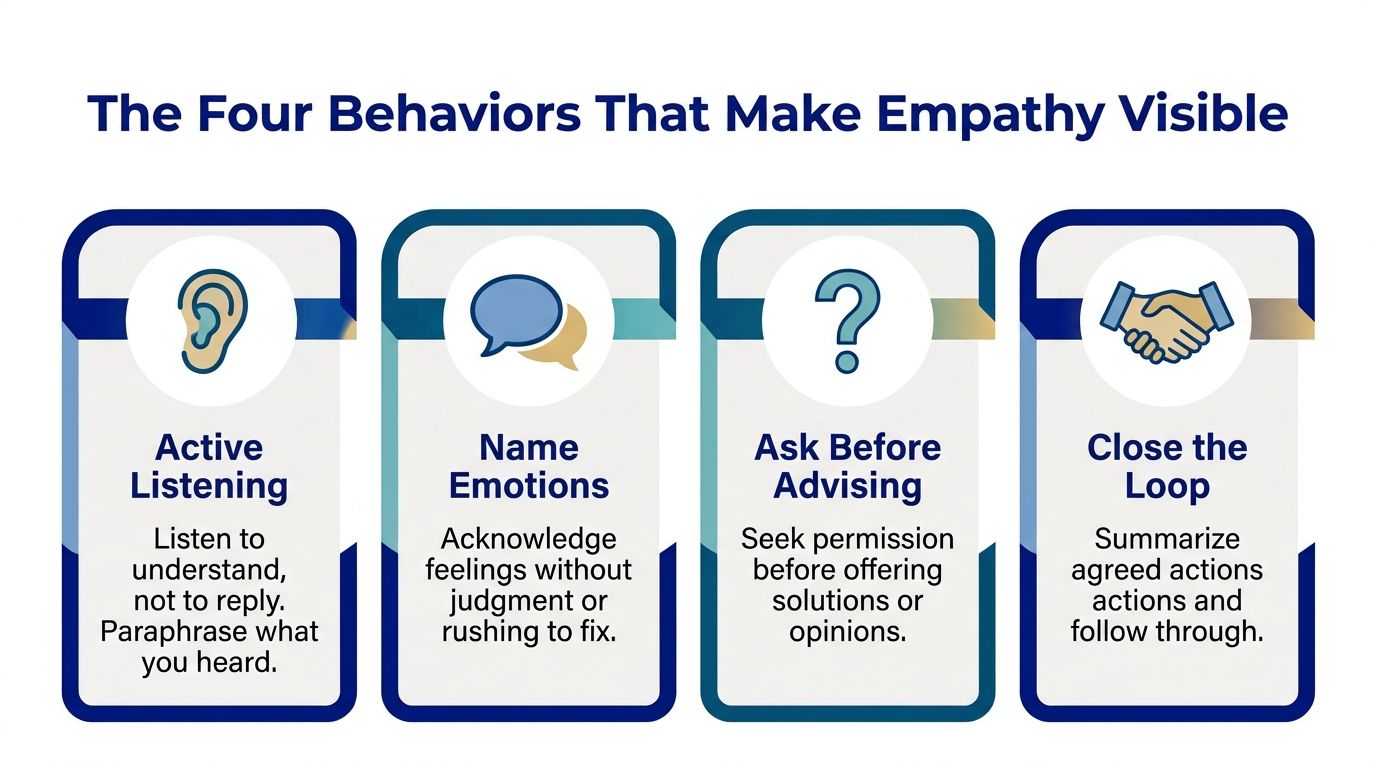
A leader does not need a polished speech to sound empathetic. People notice four behaviors instead, and they notice quickly. The Center for Creative Leadership describes effective listening as paying attention, withholding judgment, paraphrasing, and summarizing, while also noticing tone, pace, facial expression, and gestures. That is the skill to teach managers, not a vague instruction to “be nice” (CCL listening guidance).
Use plain language that proves you heard the issue. Say, “Let me make sure I've got this right. You're saying the client change hit your team late, and you didn't have enough time to prepare.” Then stop. That paraphrase shows you are listening to understand, not waiting for your turn to defend the decision.
If that move is missing, the conversation feels like a trap. “I hear you, but here's what we need to do” jumps straight to control. People remember that bypass, especially in high-stakes moments.
Say, “I can see this is frustrating,” or, “You sound concerned about how this will land.” You are not agreeing with every reaction. You are naming what is in the room so the other person does not have to fight to be seen.
Skip that step and the exchange gets colder fast. “Let's stay objective” can sound polished and still land as dismissal. The employee walks away feeling that the manager values control more than context.
Start with consent. Say, “Would it help if I shared a few options?” or, “Do you want input, or do you want me to just hear you out first?” That keeps you from dumping solutions on someone who is not ready for them, and it prevents the fake empathy move where the leader listens for a moment and then takes over.
If you skip the question, the conversation turns into, “You should just do X.” The advice may be useful, but it skips consent. People resent that more than leaders expect, because it makes their situation feel managed instead of understood.
End with a clear next step. Say, “Here's what we agreed to do next, I'll send the summary by 3 p.m.” That final step turns empathy into reliability. Employees trust the leader who follows through, not the one who sounded warm for ten minutes and left everything fuzzy.
Empathy also needs a practical handoff after hard meetings. If you want a reminder that people do better when they know where support lives after the conversation, review the counselling options in the Okanagan. Leaders do not need to become therapists. They do need to point people toward the next step without making promises they cannot keep.
For the hard reset moments, the legal side matters too, so keep a separate playbook for how to fire an employee legally.
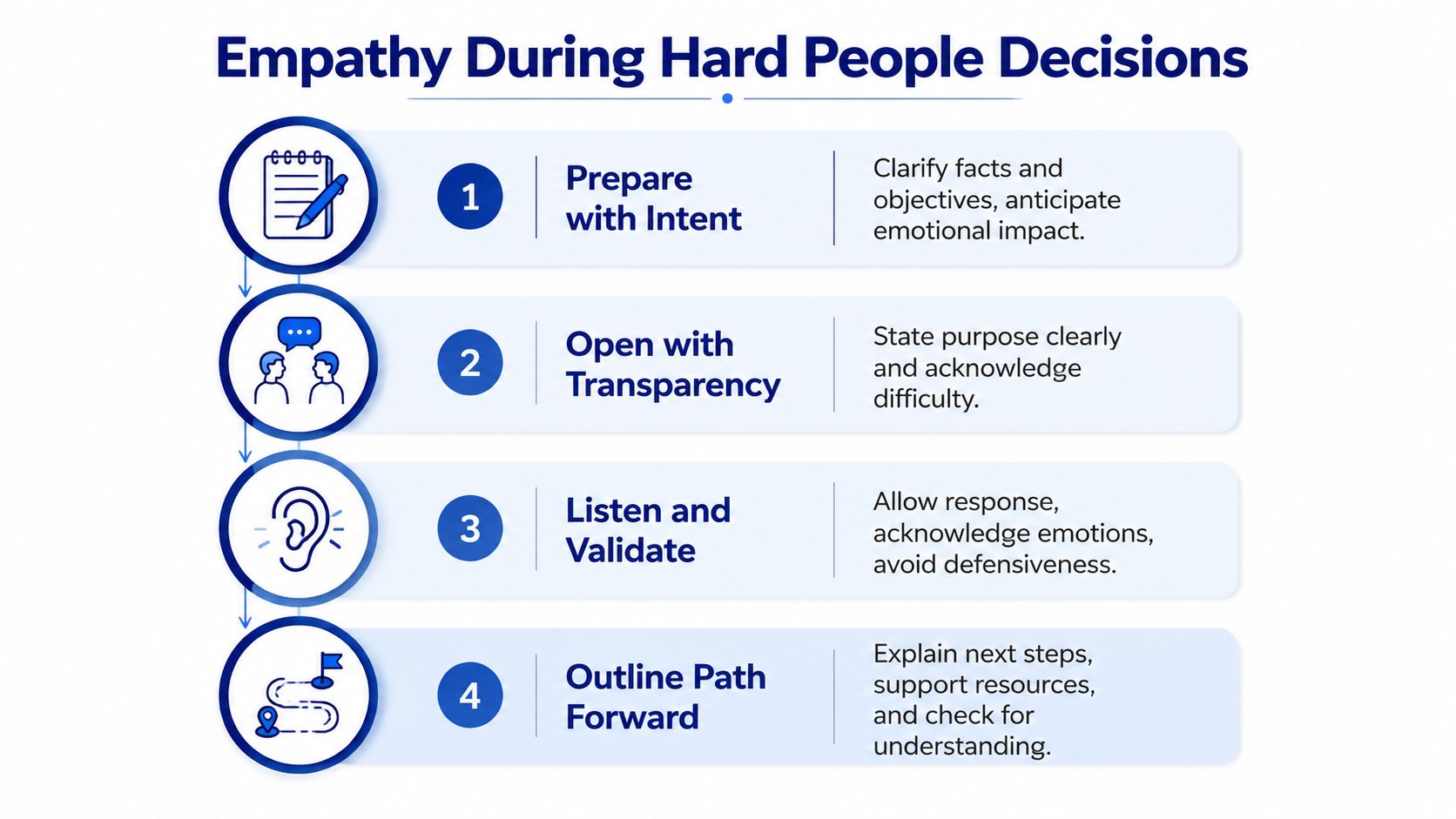
The hardest people decisions demand two things at once, dignity and precision. If you are giving a warning, running an investigation, or ending employment, the message has to show respect without blurring the facts. The record has to match the policy, the timeline, and the standard being enforced. For a practical legal framework around separations, see how to fire an employee legally.
A COO should expect the room to feel tense. That does not change the job. Say what the decision is, say why it is happening, and write it down so no one has to guess later.
A termination meeting can begin with, “This is a difficult conversation, and I want to be direct. We've decided to end your employment effective today based on the documented performance issues we've reviewed.” That phrasing does two things. It respects the person enough to be clear, and it protects the company from sounding evasive.
For a performance plan, say, “The expectations are not changing, but the support around you will be more structured for the next period.” That communicates firmness without cruelty. Do not soften the standard, and do not promise an outcome you cannot control.
After the meeting, write down the objective reason, the date, the policy or standard involved, the options offered, and the employee's response. Keep the language plain. Avoid adjectives like “attitude problem” or “didn't seem committed,” unless you can tie them to specific behavior and a manager witness.
That documentation style matters even more in a multi-state business where different managers may react differently to similar cases. A little empathy in the room, followed by sloppy notes, creates risk later. A respectful conversation paired with precise documentation is stronger than a warm tone with no record.
In a misconduct interview, open with, “I want to understand what happened from your perspective, and I'll ask the same basic questions of everyone involved.” That sentence lowers defensiveness without signaling a conclusion. It also tells the employee the process will be even-handed.
When the person becomes emotional, respond with, “I can see this is upsetting. Take a moment, then tell me what you observed.” That keeps the conversation human while preserving the fact-finding structure. A good investigator does not absorb the emotion and lose the trail.
Document this way: factual summary, date, policy reference, employee response, next step. That sequence is boring on purpose. Boring records are easier to defend.
If your team needs support after a hard conversation, direct people to the counselling options in the Okanagan rather than pretending the leader can fill that role. Keep the boundary clear. Empathy stays useful when leaders point to real support and do not overstep their lane.
Empathy fails most often when leaders use it to avoid discomfort. The manager keeps extending a performance plan because the employee has personal stress, but the work standard never changes. That's not compassion, it's postponement. The employee stays stuck, and the company carries a problem that should have been resolved earlier.
Another common failure is inconsistency. One manager lets a late project slide because “she's having a rough quarter,” while another manager in another state is disciplined for the same issue. Once that pattern appears, employees stop believing the rules are real. They start watching who gets flexibility instead of focusing on performance.
A leadership team can also accidentally turn empathy into favoritism. If one high performer gets endless grace while a peer gets corrected quickly, the organization doesn't read that as generosity. It reads as bias. In a larger or multi-state environment, that kind of inconsistency can create real employment risk because managers are no longer operating from the same standard.
The fix is not less empathy. The fix is clearer expectations, tighter documentation, and faster escalation when a manager starts blending personal sympathy with business decisions. If you can't explain the rule in one sentence, you probably can't enforce it consistently.
Empathy gets harder when people work in different places, different states, and different communication cultures. A leader who relies on direct verbal feedback may read a more reserved employee as disengaged, when the employee is being respectful in the style they know best. That's where empathy becomes operational, not emotional.
A useful approach is to keep the standard fixed and the expression flexible. The standard is clear expectations, timely feedback, and respectful treatment. The expression changes by format, some people need written follow-up after hard conversations, some do better with a shorter check-in plus a later summary, and some need a more explicit invitation to speak.
For teams spread across locations, Insight Diagnostics Global ADHD advice is a helpful reminder that communication needs often vary, and leaders should not assume one style fits everyone. That doesn't mean lowering the bar. It means making the bar legible in more than one way.
Hybrid and cross-state teams need that structure because inconsistency spreads fast. One leader's generous interpretation becomes another leader's rigid rule, and employees notice the gap immediately. Empathy works best when everyone knows what respectful treatment looks like, even if the delivery differs.
If you want empathy to hold up under pressure, measure it the same way you measure any other leadership behavior. Use a short pulse survey with three direct questions, whether people feel listened to, whether their emotions are considered in decisions, and whether they feel supported during difficult times. Then review real cases every quarter, not just manager self-assessments, because self-rating is usually the least reliable data in the room.
Tie that measurement back to the engagement work you already track with how to measure employee engagement. The test is simple, do survey answers match what people experience when a termination, investigation, or performance plan is on the table.
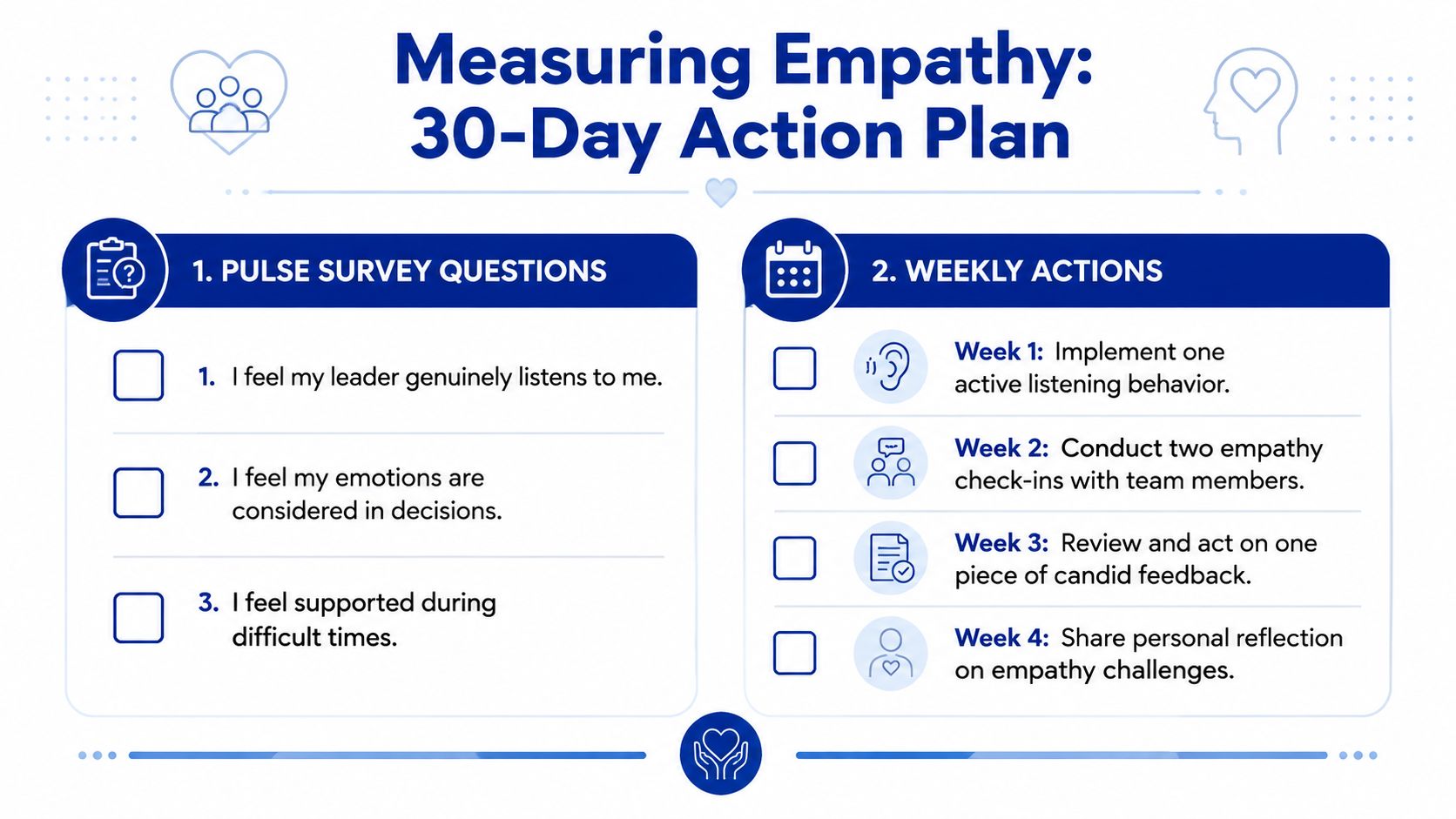
Use this 30-day sequence. Keep it practical and visible.
If you are serious about leading with empathy, do not treat it as a vague value. Write the behaviors down, check them against real cases, and look for gaps between what managers say and what employees experience. That is where empathy becomes credible, especially when the decision is hard and the record matters.