You're probably here because the PEO relationship that once simplified hiring, payroll, and benefits now feels too restrictive, too expensive, or too misaligned with how your company operates. That's common in Florida. What catches leadership teams off guard is that leaving a PEO in Florida isn't just a vendor offboarding exercise. It's a controlled change in employer-of-record, and if you sequence it poorly, you can create tax filing gaps, benefits confusion, workers compensation exposure, and documentation problems that are entirely avoidable.
I've seen COOs treat this like a procurement decision. It isn't. It sits closer to a regulated employment transition, where contract terms, reporting rules, employee notices, payroll timing, and internal communications all have to line up. If you've ever dealt with ownership disputes, the logic is familiar. Form matters, but so does who holds responsibility in practice. That same discipline shows up in topics like constructive trust explained, where legal responsibility turns on structure and evidence, not assumptions.
For smaller employers especially, the risk usually isn't the decision to exit. The risk is trying to move too fast without rebuilding the employer infrastructure the PEO had been carrying. If you need context on when a co-employment model fits in the first place, this small business PEO guide is a useful companion before you finalize your transition plan.
Florida is the right place to take this issue seriously because the state has an unusually large PEO footprint. One state review noted that Florida has long been the nation's largest market for PEOs and employee leasing arrangements, and a federal Census analysis cited in that review ranked Florida first by share of leased employees at 3.56% of total employment, or 197,632 leased workers out of 5,550,307 workers. The same review also reported that Florida's PEO count rose from 677 in fiscal year 2016 to 2017 to 760 by March 2020, while average fiscal-year employment grew from 537,930 to 572,798. It further noted that 332 of 760 PEOs with client-level reporting represented 53,237 client companies with $6.3 billion in payroll in early 2020, based on the Florida PEO market review.
That scale matters. In Florida, a PEO relationship isn't a niche outsourcing arrangement. It's a mainstream employment structure, which means regulators, payroll teams, insurers, and counterparties all expect the transition to be documented and handled correctly.
Practical rule: If your company is leaving a PEO in Florida, treat the move as an employer-of-record transition first and a vendor termination second.
A successful exit has a clear shape. Your final PEO payroll aligns with your first direct payroll. Your tax accounts are active before wages are processed outside the PEO. Your benefits and workers compensation coverage move without a gap. Your employees receive clean, consistent communication. Your records can support an audit, agency inquiry, employee complaint, or lender diligence review without anyone reconstructing what happened from inbox fragments.
Most transition failures come from sequencing errors, not bad intent. The company sends notice before confirming account readiness. Payroll assumes tax registration is complete when it isn't. Benefits enrollment opens after the PEO coverage has already ended. Managers ad-lib employee explanations and create inconsistent records.
Use this as your working standard:
That's the posture that keeps this transition controlled.
A Florida PEO exit goes off course early. The company treats it like canceling a service contract, sends notice, and only then learns the agreement locks termination to a renewal window, a payroll cycle, or a benefits date. By that point, the legal date, the operational date, and the coverage date no longer match.
Start with the signed client service agreement and every document that changes it. In Florida, this relationship is not casual vendor paper. It is a written employee leasing arrangement governed by Florida's employee leasing statute. Read the contract as an employer-of-record transfer document, because that is what it becomes on exit.
Pull the full contract set before anyone drafts notice. That means the master agreement, amendments, renewal terms, pricing exhibits, benefit attachments, workers compensation terms, service schedules, and side letters. If procurement or finance holds part of the file, get it now. Missing paper causes bad assumptions.
Focus on the clauses that control sequence and liability:
Do not let the PEO define the process from memory. The signed agreement controls.
Florida's employee leasing rules divide responsibility between the leasing company and the client company under a written arrangement. That matters on exit. If your documents are inconsistent about the termination date, service cutoff, or record ownership, you have more than an admin problem. You have an allocation problem that can affect compliance, claims response, and who must defend what after separation.
The practical rule is simple. If a clause could support two timelines, assume it will.
Pay close attention to these pressure points:
| Contract issue | Why it creates risk |
|---|---|
| Notice language tied to "receipt" rather than "send" | A late receipt can push the exit into the next cycle or renewal term |
| Termination effective only at month-end or quarter-end | Payroll, benefits, and workers compensation may not line up with your target date |
| Unclear record-delivery language | Wage history, deductions, and enrollment files may arrive late or incomplete |
| Broad indemnity language that survives termination | Disputes can continue after the relationship ends |
| Undefined responsibility for open claims or corrections | Employee issues can bounce between parties with no clear owner |
One sentence in the agreement can change the whole sequence.
The legal notice date should follow internal approval, not drive it. Have one decision-maker sign off on the target termination date after legal, HR, payroll, finance, and benefits confirm they can support it. If the contract requires certified mail, specific addressees, or a portal submission, follow that instruction exactly. Sloppy notice creates avoidable disputes.
Document the approval package. Keep the executed agreement, a clause summary, the proposed notice, the target effective date, and the operational assumptions behind that date in one file. If outside counsel needs to review fee exposure or responsibility language, do it before notice is sent.
A short control file is enough:
| Item | Why it matters |
|---|---|
| Executed agreement and amendments | Confirms the actual termination rights and timing |
| Written summary of notice requirements | Prevents a defective notice |
| Approved target termination date | Keeps legal and operational dates aligned |
| Record request list | Improves the odds of complete data transfer |
| Internal approval memo or email trail | Shows disciplined decision-making if challenged |
If your company also separates contractors during the same transition period, use the same documentation discipline to reduce risk when terminating contractors. Consistency helps. It also makes your process easier to defend.
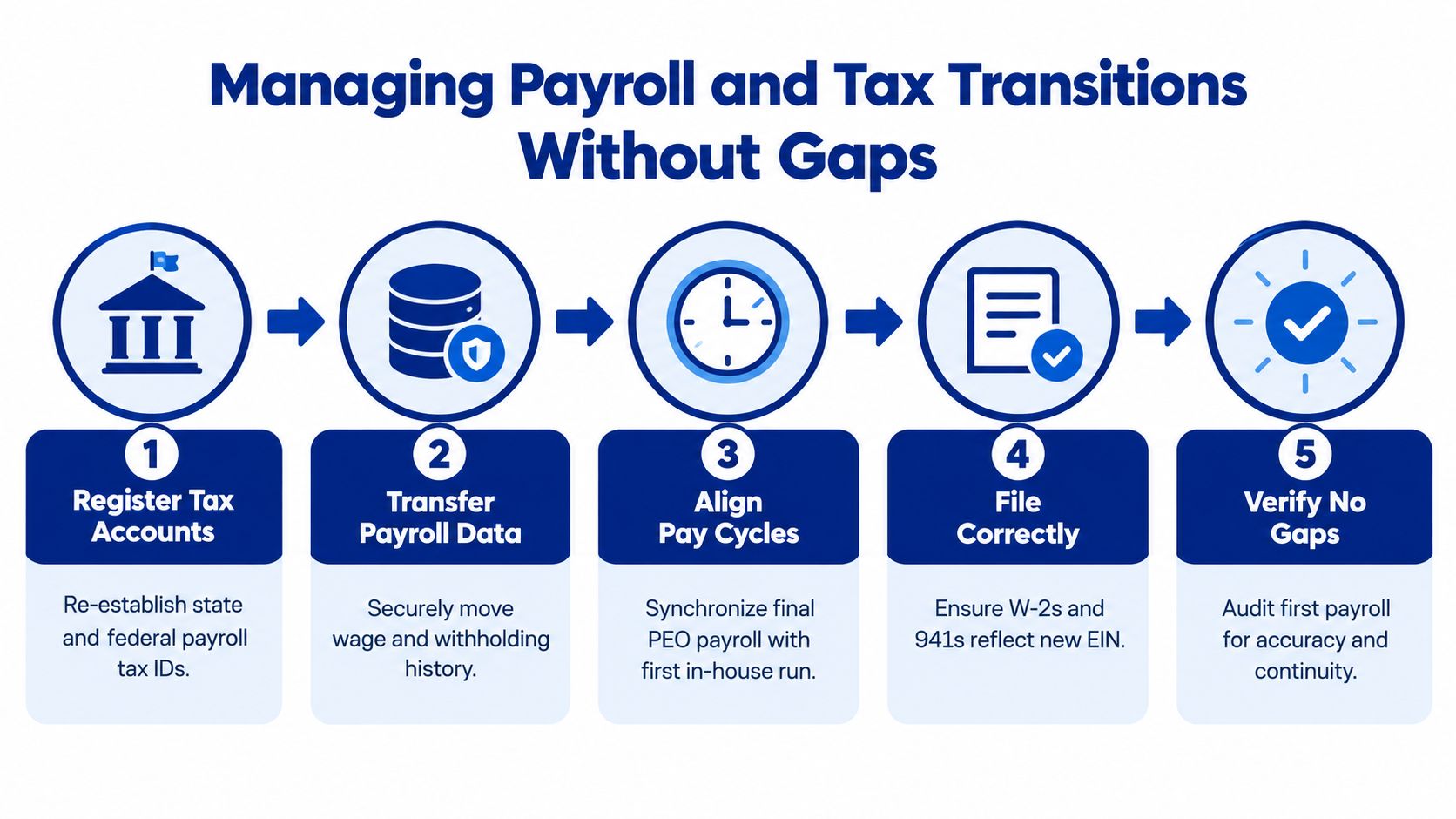
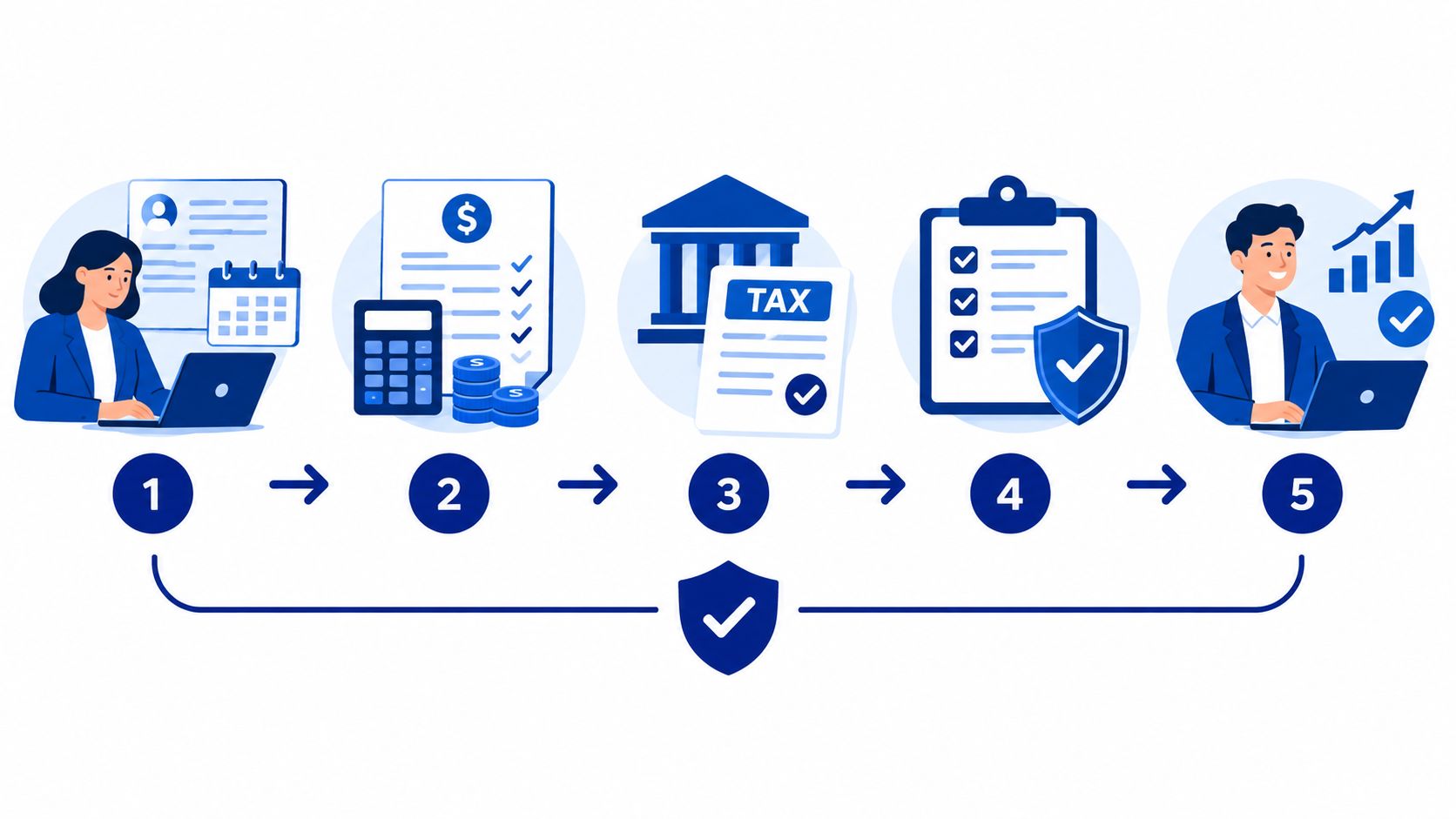
Most of the operational risk lives here. A PEO exit fails when the company focuses on the contract end date but doesn't rebuild payroll tax infrastructure in time for the first direct wage payment. The handoff has to be sequenced. Not just completed.
Florida requires a PEO to notify the Department of Revenue within 30 days after the initiation or termination of its relationship with a client company. If the employer will continue employing workers in Florida after leaving the PEO, the employer must also notify the Department in writing about the termination of the PEO relationship, and the state says that notice can be submitted by mail, fax, or email without a specific form, according to the Florida Department of Revenue guidance on employee leasing companies.
That sounds simple. It isn't, unless someone owns the sequence.
Use this order:
The Florida Department of Revenue also indicates that a Florida Business Tax Application may be required depending on how long the PEO relationship lasted. Don't guess. Validate that point before go-live.
The common failures are mechanical, but the consequences are not.
At the federal level, if the provider is a Certified Professional Employer Organization, the IRS says the CPEO generally must file Form 8973 within 30 days of starting or ending the service contract, based on the IRS Form 8973 instructions overview. You may not be the filer for that form, but leadership should still verify whether the provider is a CPEO and confirm that federal transition reporting is being handled.
Don't treat the first post-PEO payroll as a normal payroll run. Treat it like a controlled audit event.
Review:
The first direct payroll should be checked line by line against the final PEO output. If leadership won't review exceptions personally, designate one accountable reviewer who will.
One more point matters in Florida. The state's employer system handles terminations and separations through a defined reporting process, which means employee status reporting is not just a generic payroll edit inside your new platform. That becomes especially relevant if you're cleaning up employee records during the transition, and it belongs in your payroll and unemployment coordination plan.
Benefits disruption creates faster employee distrust than almost any payroll issue. People will tolerate a confusing memo. They won't tolerate a pharmacy rejection, a denied claim, or uncertainty about whether they're covered after the PEO relationship ends.

When the PEO stops serving as employer of record, several benefit and coverage arrangements may end under the PEO-sponsored structure and need to be replaced under your company's direct arrangements. That doesn't automatically mean employees lose coverage. It means continuity has to be planned, documented, and communicated.
The practical categories look like this:
| Area | What to confirm |
|---|---|
| Health coverage | End date under the PEO plan and effective date under the replacement plan |
| COBRA or continuation | Who sends notices, on what trigger, and from which plan sponsor position |
| Retirement plan access | Whether employees move to a new plan, remain in a separate arrangement, or face a blackout period |
| Workers compensation | Exact end date of PEO-sponsored coverage and start date of your replacement policy |
| Unemployment setup | Account responsibility, wage reporting continuity, and separation reporting process |
Workers compensation deserves special handling. If your company is moving from PEO-sponsored coverage to its own policy, the key issue isn't just obtaining a policy. It's proving continuity. Keep the binder, policy declarations, effective dates, and any payroll classification detail in one transition file.
This matters later if an injury claim falls near the transition date. Adjusters, auditors, and counsel will ask which policy applied and why. If your records are fragmented, you'll lose time proving what should have been obvious.
Employees need a simple answer to three questions:
That's where many employers overcomplicate things. They send dense legal language when employees need action steps. Use plain language, short deadlines, and direct instructions.
If continuation coverage obligations may be triggered, use a disciplined process and check your notice responsibilities carefully. This Paradigm International COBRA guide is useful for tightening that workflow before notices go out.
Coverage continuity is proven with dates and documents, not with assumptions made during an enrollment call.
Florida's reporting framework also matters on the unemployment side. The state's employer portal allows registered employers and service bureaus to report terminations and separations online through a specific process, as reflected in the Florida employer reporting help guidance.
That should shape your transition controls. If employee records are being cleaned up, moved, or reclassified during the exit, keep separation reporting distinct from payroll setup work. They are related, but they are not the same task.
At 4:30 p.m. on the day before your first payroll outside the PEO, an employee asks whether their coverage is active, a manager gives a different answer than HR, and the former PEO still appears to be the employer of record in part of the file set. That is the failure pattern to avoid.
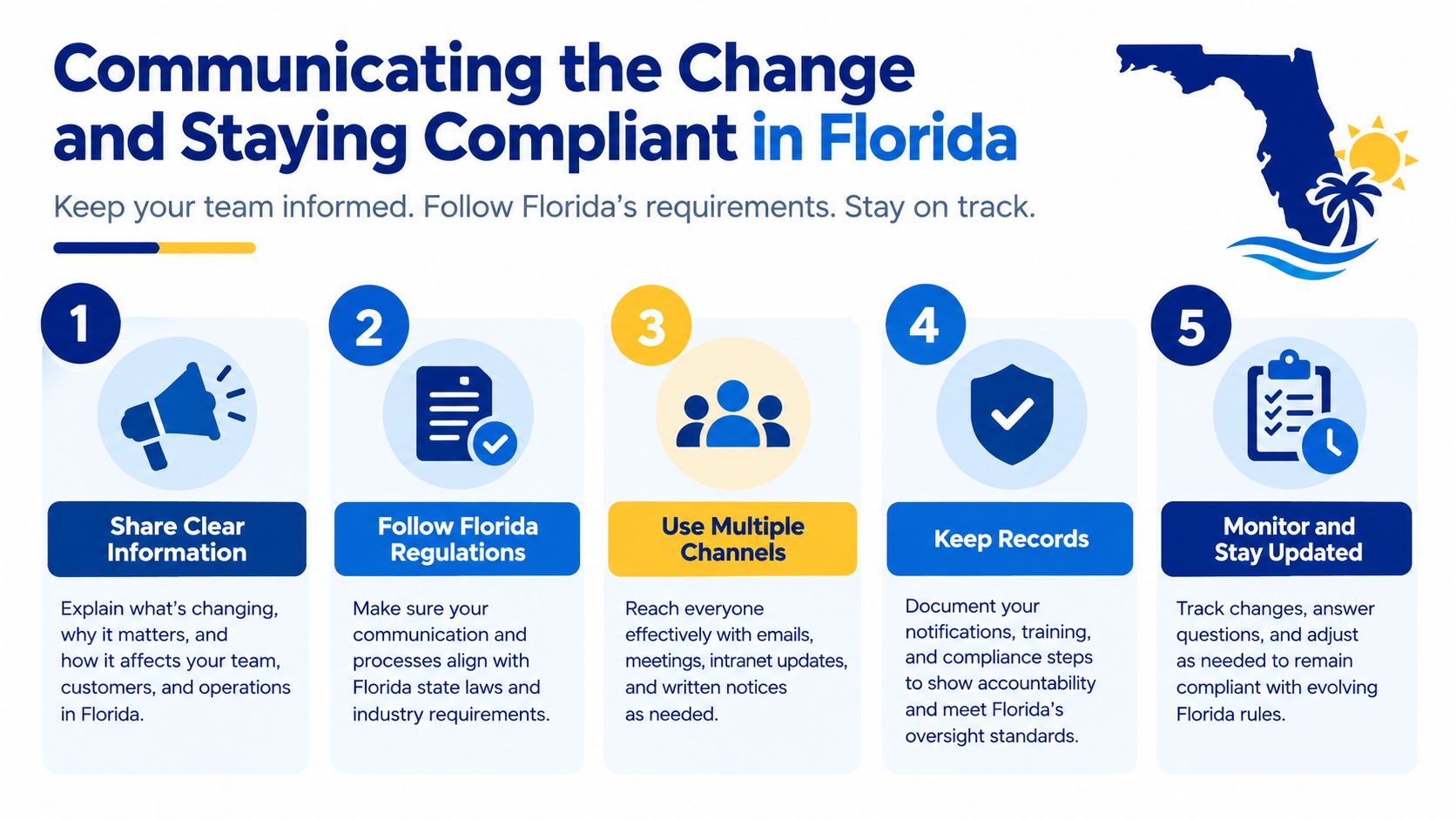
Treat communication as a control step in a regulated employer change. In Florida, leaving a PEO means shifting employer-of-record responsibility under the state's employee leasing framework. If your message, dates, and records do not line up, you create avoidable risk with employees, carriers, agencies, and auditors.
Employees do not need a legal memo. They need a clear statement of what changes on a specific date, what does not change, and what action is required from them.
Tell them the company is changing administrative employer arrangements. Tell them whether pay dates, benefit cards, tax forms, reporting lines, and timekeeping will change. Give one deadline for each required action. Give one contact point for questions.
Your communication package should include:
Florida does not treat employee leasing as casual back-office outsourcing. The state regulates it through a licensing and contractual framework, as noted earlier, and that should shape how you handle the exit. This is not just a vendor replacement. It is a documented change in who carries key employer responsibilities and from what date.
That is why verbal alignment is not enough. Keep the signed agreement, the termination acknowledgment, employee notices, carrier confirmations, payroll implementation records, and tax correspondence in one controlled file. If a dispute surfaces later, your defense will rest on dated documents, not on anyone's memory.
Set one standard and enforce it. Do not let payroll keep one timeline, HR keep another, and benefits rely on email fragments. A Florida PEO exit should produce a single record that shows who approved the change, when responsibility shifted, what employees were told, and how exceptions were handled.
Use a record set that includes:
Clear communication is a compliance control. It limits inconsistent statements, reduces avoidable complaints, and gives leadership a defensible file if questions surface later.
If you want outside support during this kind of transition, some employers use legal counsel for contract interpretation, a payroll provider for execution, and an HR risk advisor for documentation standards, employee communication discipline, and judgment calls between operations and compliance.
A clean exit starts with one decision. Stop treating this as routine administration. Leaving a PEO in Florida is a structured employer change, and the companies that handle it well move in a fixed order with clear ownership.
Use this as your baseline:
If you can choose your timing, avoid forcing the transition in the middle of unresolved renewals, open enrollment confusion, or a rushed payroll cycle. Clean calendar positioning helps. So does resisting pressure to accelerate the exit before the replacement systems are ready.
For multi-state employers, complexity rises fast. Even if Florida is the trigger point, your wage reporting, benefits administration, employee communications, and documentation standards may need to work across several jurisdictions. That's where judgment matters more than speed.
If your leadership team is split between urgency and caution, side with caution. Not delay. Discipline.
International Inc. helps leadership teams manage high-stakes employment transitions with stronger documentation, clearer decision frameworks, and practical HR risk guidance. If your company is planning a Florida PEO exit and wants a more defensible process around payroll timing, employee communication, or compliance handoffs, visit Paradigm International Inc. to learn more.