You're probably looking at payroll because something has already started to strain. Maybe your team is spending too much time fixing mistakes. Maybe you've added employees in new states and realized your old process depends on one person remembering too many details. Or maybe you're tired of treating payroll as a routine admin task when one bad run can create tax issues, wage claims, and trust problems with employees.
A managed payroll service can help. But don't buy it for convenience alone. Buy it if you want a tighter operating model, cleaner controls, and a more defensible process when your business is growing faster than your internal payroll discipline.
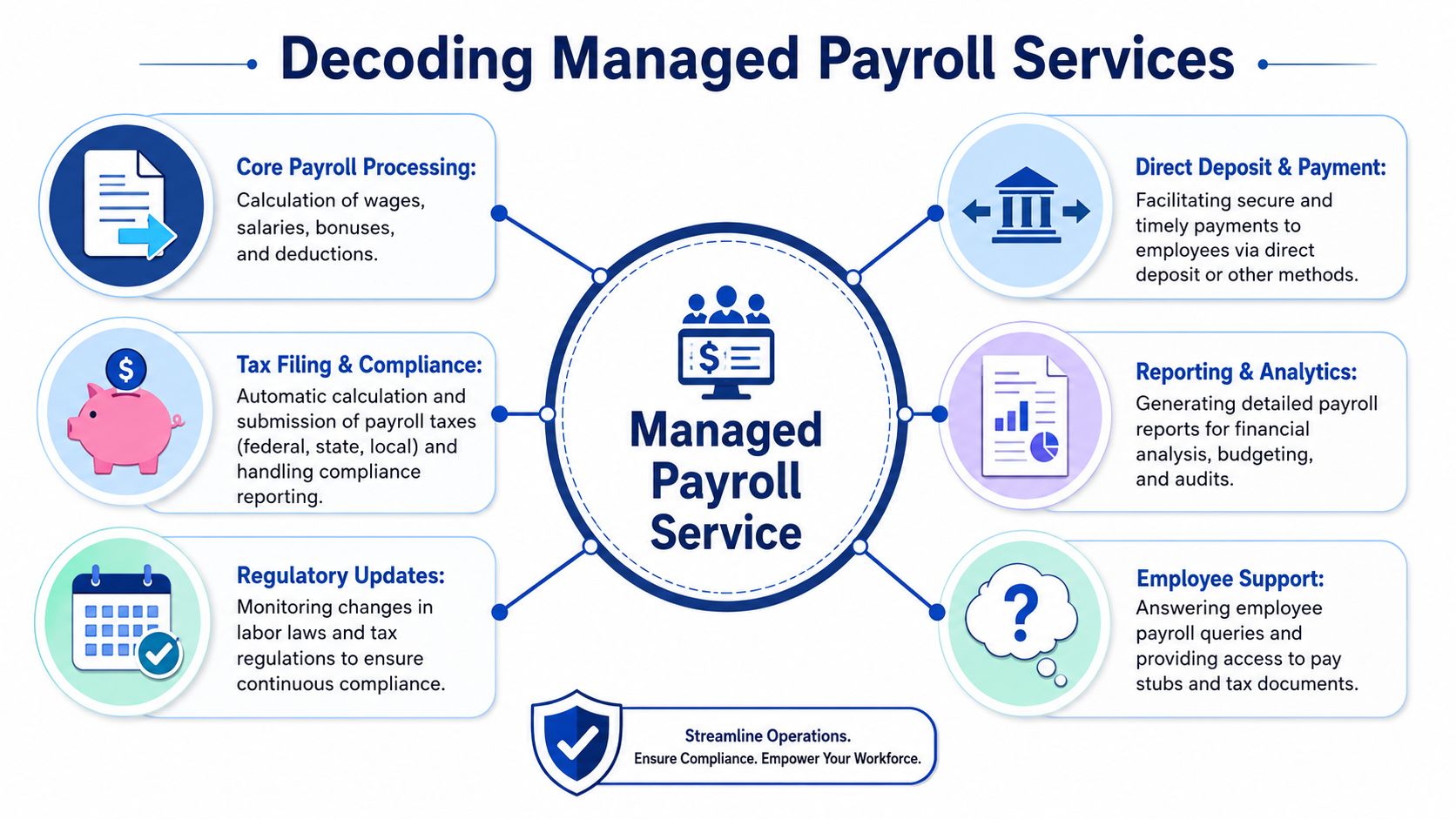
A managed payroll service is an outsourcing arrangement where a third-party provider handles payroll calculations, tax withholding, wage distribution, filings, and compliance administration for the employer. It's a mainstream model, not a niche one. One industry summary notes that 61% of companies outsource some or all payroll needs as complexity rises, according to NAWBO's payroll statistics summary.
That definition is accurate, but it's incomplete if you're making an actual business decision.
The model looks like this. The provider runs gross-to-net calculations, prepares payments, manages remittances, produces payslips, and handles tax form preparation. Your business still supplies the core inputs that make payroll right or wrong, including employee data, hours worked, pay rates, deductions, classifications, and approvals.
A lot of leaders think managed payroll means handing over the keys. It doesn't. It's closer to hiring a professional driver. The driver can handle the route, the mechanics of the trip, and the timing. You still have to provide the destination, the passenger list, and the right instructions.
That distinction matters because payroll errors often start before payroll runs.
If an employee's tax status is wrong, if hours are incomplete, or if a new hire is set up with the wrong pay code, the provider may process those inputs correctly and still produce the wrong result. A managed payroll service is a control system, not a substitute for internal accountability.
Practical rule: If your upstream data is weak, outsourced payroll will process weak data efficiently.
Use this split when evaluating any provider:
If your team needs a plain-language primer before going deeper, this overview on demystifying the payroll process is useful because it breaks payroll into understandable operating steps.
For businesses trying to tighten internal workflow before or during outsourcing, this guide to streamlining your payroll process efficiently is also worth reviewing. The cleaner your handoff process, the more value you'll get from a managed provider.
Payroll gets harder when your business crosses state lines because wage rules, tax treatment, local requirements, and timing obligations don't stay uniform. The more jurisdictions you touch, the less room you have for informal practices.
That's why a managed payroll service should be evaluated as an operating model with clear boundaries. If you treat it as outsourced data entry, you'll miss the core issue. The issue isn't whether the vendor can run payroll. The issue is whether your company can govern payroll in a way that stays accurate, reviewable, and defensible.
Most business owners start with the obvious benefit. Payroll outsourcing saves time. That's true, but it's not the strongest reason to do it.
The stronger reason is control through specialization. Payroll has become too technical, too deadline-driven, and too exposed to be managed casually once your company adds complexity. A managed payroll service can give you a more stable compliance process, better continuity, and more room for leadership to focus on operations instead of chasing payroll issues.
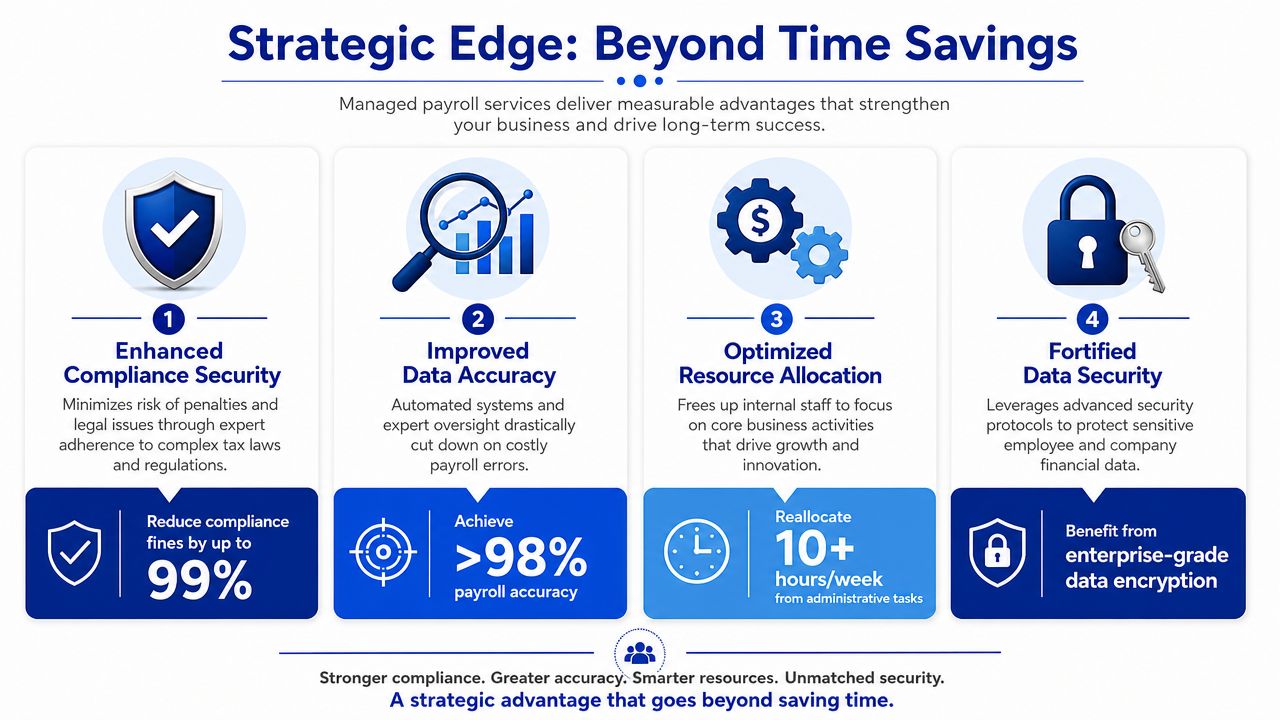
The market has already moved in this direction. Clockify's payroll statistics summary reports that 45% of small businesses outsource payroll services, that outsourcing can reduce HR costs by 40% to 50%, and that 88% of small businesses say tax laws are too complex to manage on their own.
Those figures matter because they reflect a pattern. Businesses aren't outsourcing payroll just to get admin help. They're doing it because payroll complexity has outgrown the capacity of many internal teams.
A good managed payroll service helps in ways that don't always show up on a feature list:
Payroll is one of the few processes where a small clerical mistake can become a tax problem, a wage claim, and an employee relations problem at the same time.
Smaller organizations often sit in the hardest spot. They've outgrown informal payroll management, but they don't yet have a large internal compliance infrastructure. That's exactly where managed payroll can be a smart decision.
This becomes even more relevant when payroll interacts with benefits and broader people operations. If your team is also evaluating insurance and workforce support decisions, resources like ISU Insurance small business solutions can help frame the wider employment-cost picture.
If you're weighing payroll support against broader employer service models, this explanation of the benefits of a PEO can help clarify where managed payroll fits and where it doesn't.
Don't justify a managed payroll service by saying it will “save the payroll person time.” That's too narrow.
Justify it if your company needs:
That's a strategic investment, not a clerical convenience.
Most vendor conversations get too soft. They explain what the provider handles and skip the harder question. Who is still on the hook when something goes wrong?
In most cases, your business is.
A managed payroll service can take over processing, filings, and administration. It does not erase the employer's responsibility for wage-and-hour accuracy, worker classification, and approval of hours. That residual responsibility is one of the most important facts leaders miss when outsourcing payroll.
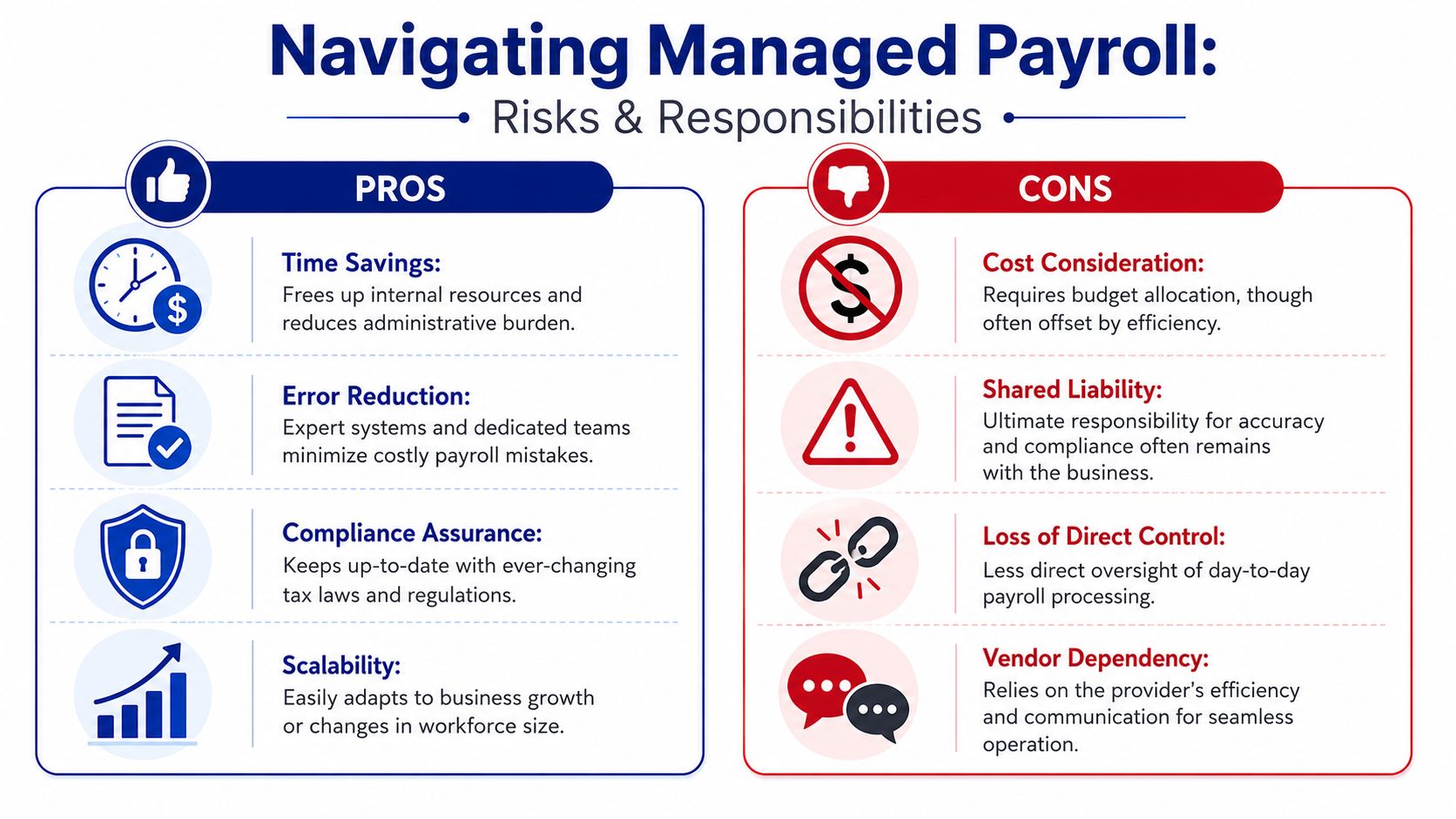
TCWGlobal's discussion of managed payroll services makes the key point clearly. The employer typically still owns wage-and-hour accuracy, worker classification, and approval of hours, and even vendor-driven errors can still surface as employer liability.
That means if a provider underpays overtime because your coding was wrong, or if a worker was treated incorrectly from the start, the practical exposure still lands with your company first. The vendor may help correct the issue. The employee, regulator, or tax authority will still look to the employer.
This gets riskier when you operate across multiple states.
The problem isn't only tax withholding. It's the interaction of pay practices, local rules, leave impacts, final pay timing, deductions, and employee status decisions. Those issues often sit outside the narrow mechanics of a payroll run.
Here's where leaders get caught:
The most dangerous outcome isn't a vendor mistake. It's a leadership team assuming the vendor has absorbed responsibility that never transferred.
If your payroll provider makes a mistake, your company still has to catch it, correct it, and document what happened.
That's why payroll outsourcing should be managed with the same seriousness you'd apply to any compliance-sensitive vendor. Review the contract. Understand who does what. Build internal signoff points. Don't rely on a vague promise that the provider “handles compliance.”
If your business has any exposure around contractor status, exempt classification, or inconsistent treatment across states, this guide on employee misclassification penalties is relevant because those errors often begin upstream and show up in payroll later.
Even if you only operate in the U.S., it helps to think like a company dealing with multiple regulatory authorities. For example, summaries of how Israeli tax authorities operate show the same broader truth. Once payroll touches different jurisdictions, assumptions become dangerous and documentation becomes critical.
My advice is blunt. Never let a provider presentation convince you that managed payroll is risk transfer. It is risk support. Your business remains the accountable party, and your controls have to reflect that.
Most companies shop for payroll vendors the wrong way. They compare dashboards, user interfaces, and price per employee, then treat compliance as a bullet point.
That's backward.
If you're choosing a managed payroll service, start with risk controls. You need to know whether the provider can produce a payroll process you can defend in an audit, dispute, correction cycle, or employee complaint. Nice software matters. Defensible records matter more.
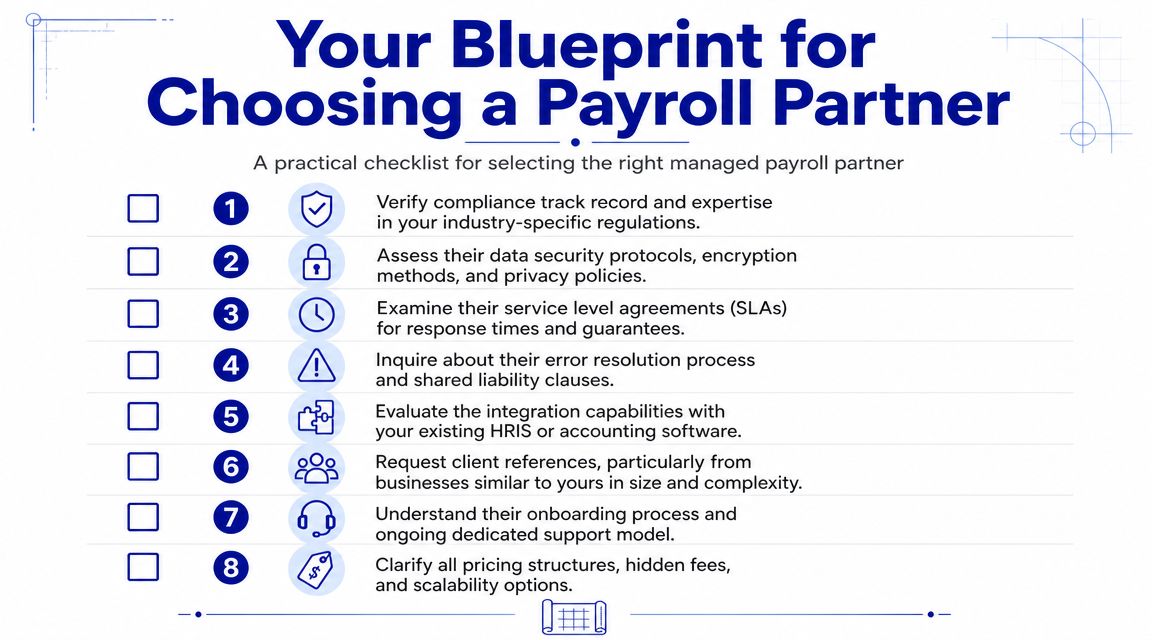
A useful benchmark comes from Namely's managed payroll overview. It notes that a strong vendor should preserve defensible records and produce clear audit trails for wage calculations, deductions, and filings. It also notes that some providers use encrypted platforms, role-based access, and data encrypted in transit and at rest with AES-256.
That's the baseline. Not the finish line.
Ask direct questions that force operational answers.
Use this quick screen before you get too far into demos:
| Red flag | Why it matters |
|---|---|
| Vague answers on liability | The vendor may be strong on software and weak on accountability |
| No sample audit trail | You may struggle to defend payroll decisions later |
| Weak correction workflow | Small errors can become recurring compliance problems |
| Generic multi-state claims | The provider may not be equipped for your actual footprint |
| Limited implementation testing | Bad data can move into production without being caught |
Buy the provider that can explain failure handling clearly, not the one with the slickest demo.
I'd rather see a slightly less polished platform with strong controls, disciplined onboarding, and responsive issue management than a prettier system with weak governance. Payroll failure rarely starts with bad design aesthetics. It starts with unclear ownership, poor data controls, and sloppy exception handling.
For companies that want outside guidance during vendor review, firms can support leadership teams on governance, compliance exposure, and role clarity around people operations in multi-state environments. That isn't payroll processing. It's decision support around the risks attached to payroll-related employment practices.
A managed payroll service fails when leadership treats it as a handoff instead of a governed process. Selection matters, but implementation is where most preventable problems are created.
The weak point is usually not payroll math. It's source data. Lano's overview of managed payroll notes that payroll defects are often caused by bad inputs such as incorrect hours, job codes, benefit elections, or tax status. It also warns that outsourcing without validation can increase compliance exposure.
That should change how you run the relationship.
Every payroll cycle should have a defined intake path. Not a loose mix of emails, verbal updates, spreadsheet changes, and manager messages.
Your handoff process should answer five questions every time:
If any of those answers are unclear, your process is exposed.
Don't let one person control the entire chain unless you have no alternative and understand the risk. Even in a small business, basic separation helps.
A workable internal model often looks like this:
That structure won't remove every risk, but it will catch more problems before money moves.
This is one of the simplest controls and one of the most neglected. Compare the current payroll run to the prior run and investigate anything unusual.
Look closely at:
A payroll run should never be approved only because it arrived on time.
When payroll goes off pattern, document it. That includes reversals, amended filings, manual checks, disputed hours, and late changes after cutoff.
Create a short exception log with the date, issue, owner, correction taken, and any policy fix needed. Over time, that log tells you whether your problem is vendor execution, manager behavior, weak onboarding, or inconsistent internal approvals.
At least periodically, step back and assess the system itself.
Use a simple governance check:
| Governance point | What to confirm |
|---|---|
| Data quality | New hire, pay change, and termination inputs are complete and timely |
| Approval discipline | Reviews happen before release and are documented |
| Vendor responsiveness | Errors and notices are handled with clear ownership |
| Process drift | Informal workarounds haven't replaced the official workflow |
A managed payroll service works best when your internal role shifts from processor to overseer. That's a true maturity move. You stop trying to do every transaction yourself and start enforcing a process that can stand up to scrutiny.
No. Software gives you tools. A managed payroll service gives you a provider that operates the process with you.
That difference matters. If you buy software alone, your team still owns the day-to-day administration, calculations, filings, deadlines, and issue handling. In a managed model, the provider takes on much more of the operational work, but your company still owns critical inputs and approvals.
No.
It can reduce operational burden and help lower the risk of mistakes, but it doesn't remove your responsibility for accurate hours, worker setup, classification choices, and review of unusual items. If a pay issue leads to an employee complaint or regulatory question, your company still has to respond and document what happened.
Pricing structures vary. Some providers charge on a per-employee or per-payroll basis. Others package services based on complexity, entities, jurisdictions, support model, and add-on services such as tax notice management or benefits administration.
The important point isn't just the fee. It's what's included. Ask whether corrections, year-end forms, amended filings, off-cycle runs, implementation support, and dedicated service contacts are included or billed separately.
It depends on complexity. A company with one entity, one state, and clean data will move faster than a business with multiple states, varied pay groups, and inconsistent records.
Don't force a rushed launch. Good implementation should include data cleanup, role mapping, approval design, and validation of payroll outputs before you rely on the new process live.
Prepare your current-state documentation first. That includes employee records, pay policies, earning and deduction codes, tax setup, reporting needs, approval roles, and any open payroll issues.
Also identify your exception categories. If your company regularly runs bonuses, retroactive changes, commissions, shift differentials, reimbursements, or special deductions, those should be mapped clearly before transition.
A PEO is broader. Managed payroll focuses on payroll administration. A PEO typically involves a wider employment-services model.
Here's the simple comparison:
| Aspect | Managed Payroll Service | Professional Employer Organization (PEO) |
|---|---|---|
| Core function | Payroll processing, filings, remittances, payroll administration | Broader HR and employment administration model |
| Employer control | Employer usually retains direct control over employment structure and policies | Structure may involve a co-employment model |
| Main use case | Businesses that want payroll expertise without changing overall employment model | Businesses seeking broader HR infrastructure and administrative support |
| Key risk question | Who owns data quality, approvals, and compliance review? | How does the co-employment arrangement affect responsibilities and control? |
No. If your company has very simple payroll, one location, low headcount, and strong internal capability, a managed model may be more than you need.
It becomes far more valuable when you have multi-state operations, recurring payroll exceptions, limited internal depth, or leadership concerns about compliance defensibility. Those are signs that payroll has become an operating-risk issue, not just a clerical one.
Monitor three things closely:
If those three areas are stable, the relationship is usually healthy. If they aren't, don't wait for year-end to address the problem.
If your leadership team is weighing a managed payroll service and wants a clearer view of the residual HR, compliance, and governance risks around that decision, Paradigm International Inc. can help you assess the exposure, define internal ownership, and build a process that stays defensible as your organization grows.