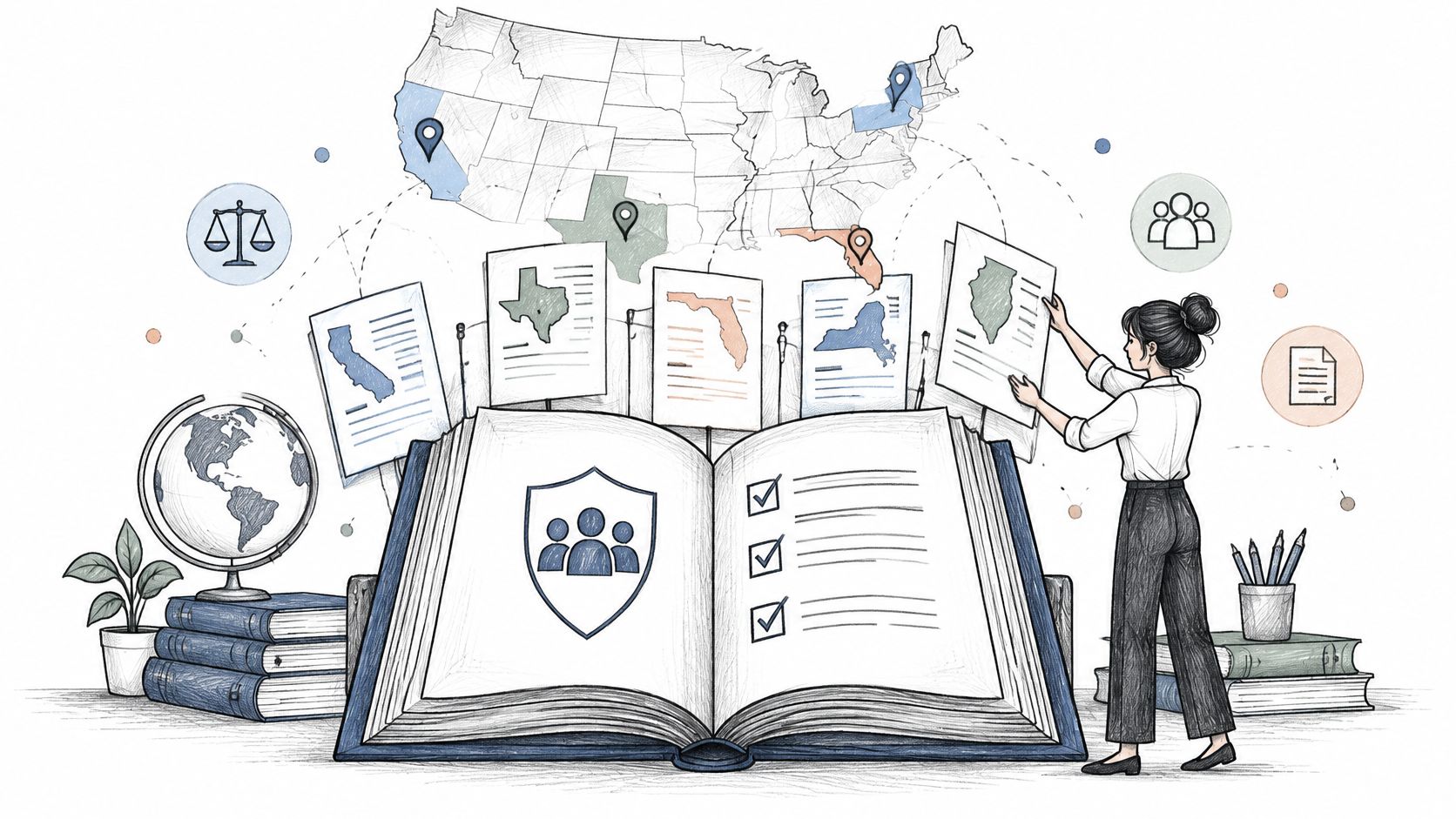
You hired someone who works from a spare bedroom in another state, and the handbook on the shared drive still describes the office you run from headquarters. Payroll is set up. The offer letter went out. Nobody has checked whether that person's sick leave, final pay, or protected-leave rules match the state where the work takes place. For a company of 25 to 500 people with no senior HR leader, that gap sits on the owner's desk, next to everything else. A multi-state employee handbook only works when it behaves like a controlled operating system: one core, state addenda, a work-location decision path, and a triage method for changes, not a yearly rewrite that is already stale by spring.
A remote hire starts working in New Jersey while a small office opens in Massachusetts. Your federal policies still apply, but state and local rules can add protections. The U.S. Department of Labor overview for employers explains that employees may be entitled to the more protective requirement when federal and state rules differ. For employees covered by the Fair Labor Standards Act, the federal minimum wage is $7.25 per hour, as stated by the Department of Labor's minimum wage guidance.
| Policy area | Federal baseline | Where states differ | Handbook action |
|---|---|---|---|
| Minimum wage | $7.25 per hour under the FLSA | States and localities may set higher rates; some set separate rates for minors or trainees | List each state and local rate in its addendum |
| Earned sick leave | No general federal paid sick leave requirement | New Jersey requires earned sick leave for eligible employees working in the state; New Hampshire has no statewide sick-or-safe-leave law | Write accrual and use rules for each state |
| Family and medical leave | FMLA: unpaid, job-protected, up to 12 workweeks | Massachusetts allows up to 26 weeks of combined leave in a benefit year, depending on the reason | Keep federal and state leave in separate sections |
| Final pay timing | No general federal final-pay deadline | Deadlines differ by state and by type of separation | Confirm each state's deadline with employment counsel |
| Pay deductions | FLSA limits on certain deductions | State deduction rules differ | Address deduction rules state by state |
| Protected classes | Federal categories under Title VII and related laws | State-protected categories differ | Add state-protected categories to each addendum |
| Exempt classification | Federal salary and duties tests under the FLSA | State tests may differ | Flag roles for review by state |
The National Conference of State Legislatures' survey of state leave laws describes how these requirements vary: New Hampshire has no statewide sick-or-safe-leave law, New Jersey requires earned sick leave for eligible employees who work in the state, and Massachusetts provides up to 26 weeks of combined family and medical leave in a benefit year, depending on the reason. In Massachusetts, employers with fewer than 25 employees are not required to make employer contributions under the program. A handbook that only repeats federal standards can leave state protections out. Connect pay policies to your wage and hour compliance review, and treat state changes as updates to controlled policies, not as annual paperwork.
If employees work with children, state the reporting duty clearly in your conduct policies. Staff who need training can take a course on identifying and reporting child abuse.
Use two layers, not a stack of unrelated manuals. The national core handbook holds standards you want everywhere: conduct, pay practices, timekeeping, and how people acknowledge the document. A state addendum for each jurisdiction overrides the core where state or local law gives greater rights. The U.S. Department of Labor basic compliance toolkit is built around the same point. Employers must follow federal requirements and state laws that provide additional worker protections. One uniform policy is not enough for a distributed workforce.
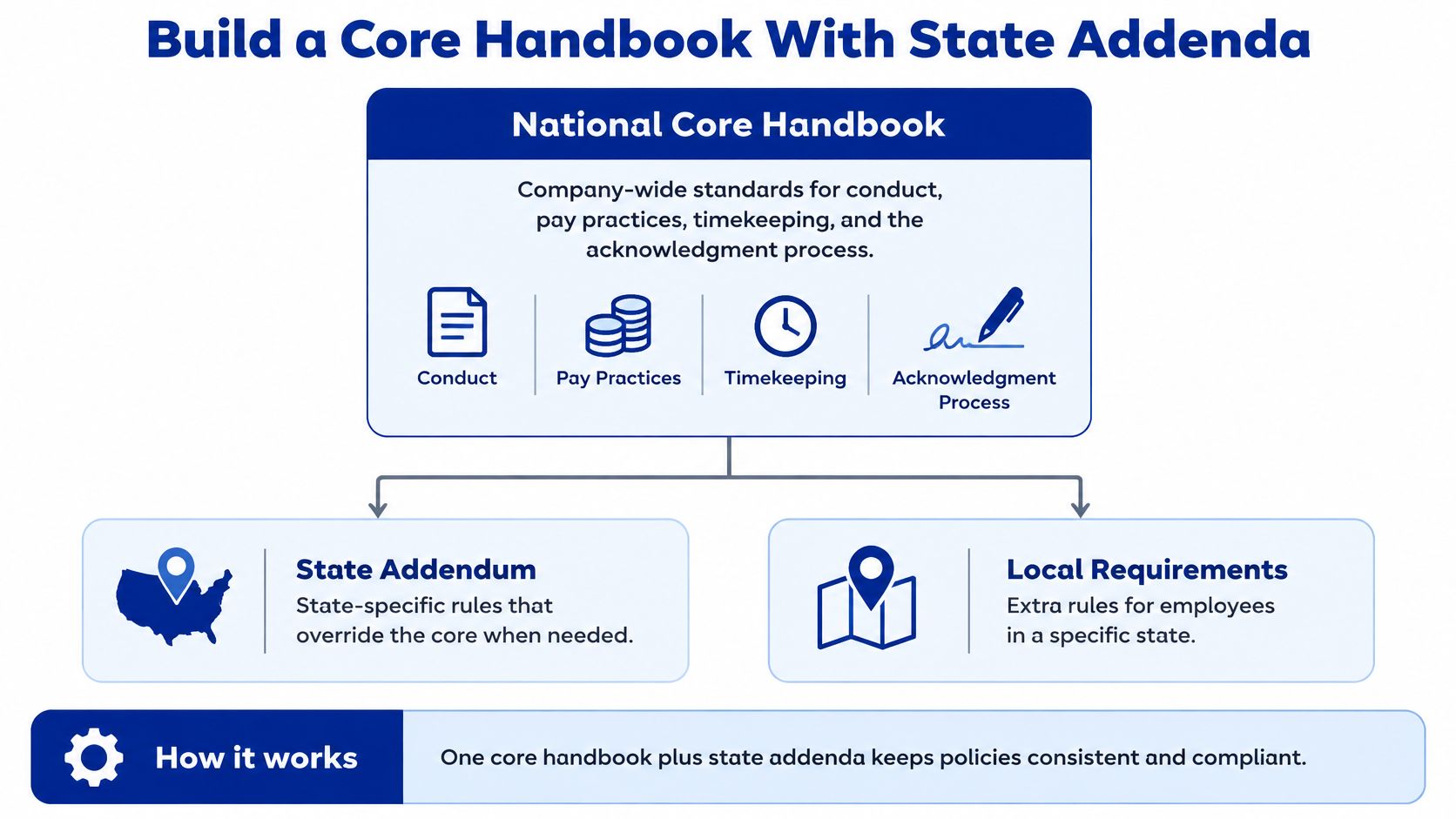
Each addendum should identify the same fields, filled with that jurisdiction's rules:
A company-wide sick accrual is a core rule. It has to yield for eligible employees working in New Jersey when that state's sick-leave right is greater. Don't hide the override in a footnote managers never open. Pair the addenda with a governance habit: quarterly legal review and version-controlled acknowledgment records. A legislature can change an entitlement or a qualifying event between your planned rewrites. The DOL Employment Law Guide is meant to help employers build wage, benefit, safety, health, and nondiscrimination policies. Treat that as a control list, not a narrative to paste once. A usable workplace policy template still needs the state page beside it. Managers should run one location decision path for every addendum, not a different habit in each office.
The work location usually decides which law applies. The company address does not. The state on the offer letter does not. Remote work can also trigger unemployment-insurance registration and taxes in the worker's state, which is outside handbook wording. A 2025 Columbia University economic report describes that state-by-state burden as a significant challenge for employers. In 2024, 22.8% of U.S. persons at work teleworked or worked from home for pay, according to the U.S. Bureau of Labor Statistics. Location is not a rare exception.
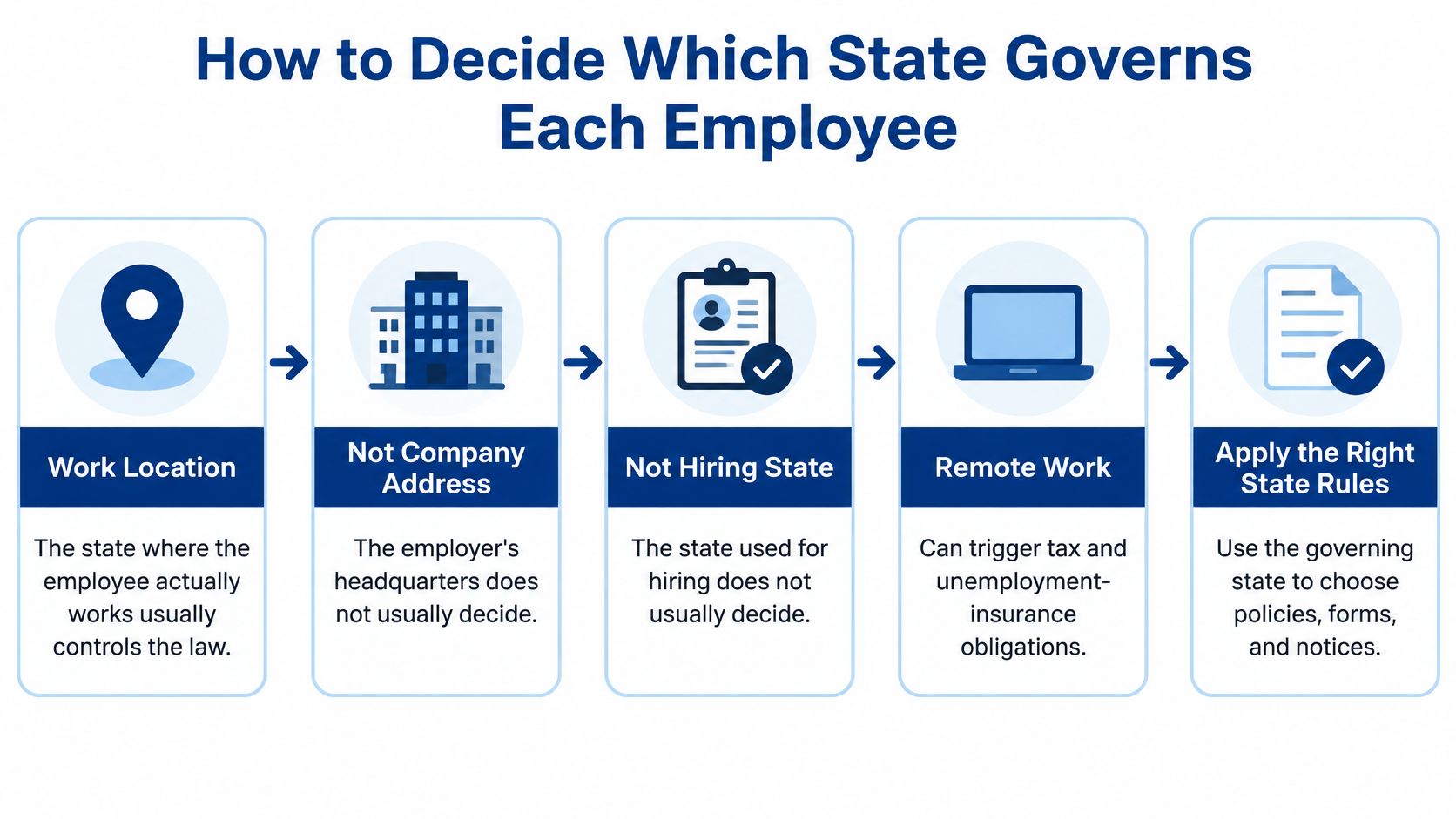
Temporary work in another state, a move nobody announced, travel-heavy jobs, and people who split weeks across a border all break a handbook that was accurate on the day you published it. For a 25 to 500 person employer, the practical failure is simple. The PDF is fine, and the person's actual worksite is not. More on that choice sits in which state law applies to remote employees.
Handbook pages don't detect a move. The location record does, and only if someone is required to update it before the person starts working somewhere new.
A clean record shows one governing state per employee, an effective date, an approver, and a reason. If any of those four is missing, don't apply a new addendum on a guess. Freeze the exception and get the record straight first.
A leave request can trigger federal FMLA, state family leave, paid sick time, pregnancy-related protections, or more than one rule at once. The handbook should give employees a clear route to report leave and give HR a process for checking which rules apply. The U.S. Department of Labor's FMLA guidance sets out the federal eligibility tests and notice requirements.
| Requirement | Federal FMLA rule | Handbook note |
|---|---|---|
| Employer size | 50 or more employees on each working day in 20 or more workweeks in the current or preceding year | Track headcount and record the count each year |
| Employee tenure | 12 months with the employer | State how months are counted |
| Hours worked | 1,250 hours in the 12 months before leave | Define the measurement period |
| Worksite | 50 or more employees within 75 miles | For remote staff, use the office the employee reports to or from which assignments are made |
| Leave entitlement | Up to 12 workweeks unpaid and job-protected in a 12-month period | Name the 12-month method the company uses |
| General notice | Required in the handbook or other written guidance | Keep federal and state leave rules in separate sections |
| Individual notices | Eligibility, rights and responsibilities, and designation notices | Route all requests to a designated HR contact |
For remote employees, the worksite test generally looks to the office the employee reports to or the office that assigns the work. Record that office in the leave process so eligibility decisions do not depend on a manager's recollection.
The DOL's FMLA materials explain the required general notice. Covered employers must provide it in the handbook or other written guidance. State the leave entitlement, name the company's 12-month calculation method, describe any certification process, explain whether accrued paid leave runs at the same time as FMLA leave, and state how health-insurance premiums are handled.
Individual notices also matter. When an employee requests leave, or the employer has enough information to recognize that leave may qualify, route the request for eligibility, rights-and-responsibilities, and designation notices.
State programs add rules that differ in eligibility, pay, duration, and job protection. Keep state requirements in separate handbook sections and link employees to a guide to state family leave laws. Send medical, family-care, pregnancy, and military-related requests to a named HR contact. Before denying leave, disciplining an employee who requested it, or ending employment during or after leave, get qualified HR or employment-law advice. Federal leave, disability accommodation, and state protections can overlap, so managers should not make that call from the handbook alone.
A return-to-office or scheduling change can affect accommodation requests, notice obligations, wage-and-hour exposure, and which state addendum applies. The 2025 Littler Employer Survey reflects how state and local workplace legislation continues to change. Treat the handbook as a controlled operating system: record each location and policy change, assess its effect, and issue the right update with a clear effective date.
The outsourced HR team handles ongoing HR and compliance work and judgment calls, while the client's PEO, payroll provider, or HR app handles payroll and administrative tasks. Keep that division clear. A system can calculate accruals; the employer still needs a decision path for whether a work-location change affects the employee's applicable addendum.
Schedule retrospective audits alongside updates. Select a quarter, compare a sample of locations and leave files against the version log, and correct mismatches before they carry into later decisions.
A handbook can look complete while a recent relocation, complaint, or leave request exposes a gap. Check the records that show how the policies work in practice.
Get expert HR support before acting on a termination connected to a complaint or leave request, during a workplace investigation, or when leave and disability rules overlap. International Inc. supports employers with 25 to 500 employees across several states, including companies without an in-house HR department. Its Multi-State HR Advisory plan includes policy alignment and state addenda, oversight for high-risk investigations, leadership and board HR strategy sessions, concise quarterly executive HR memos, and counsel coordination for sensitive matters. Bring qualified employment counsel in for legal questions.
For help updating an existing handbook, adding policies for multi-state operations, or creating a first-time handbook, contact Paradigm International Inc..
This article provides general information, not legal advice. Employment laws vary by state and change over time. Consult qualified employment counsel about your situation.