


A hiring manager finds a strong candidate in Denver who won't relocate. The offer goes out Tuesday. By Thursday the company has a Colorado employee, a state registration nobody has filed, a leave program nobody has read, and a handbook written for one state.
The offer letter took an hour. The compliance work behind it takes a quarter, and it only gets finished when someone decides it matters more than the next hire. That decision usually gets made after the first problem, which is the expensive order to do things in.
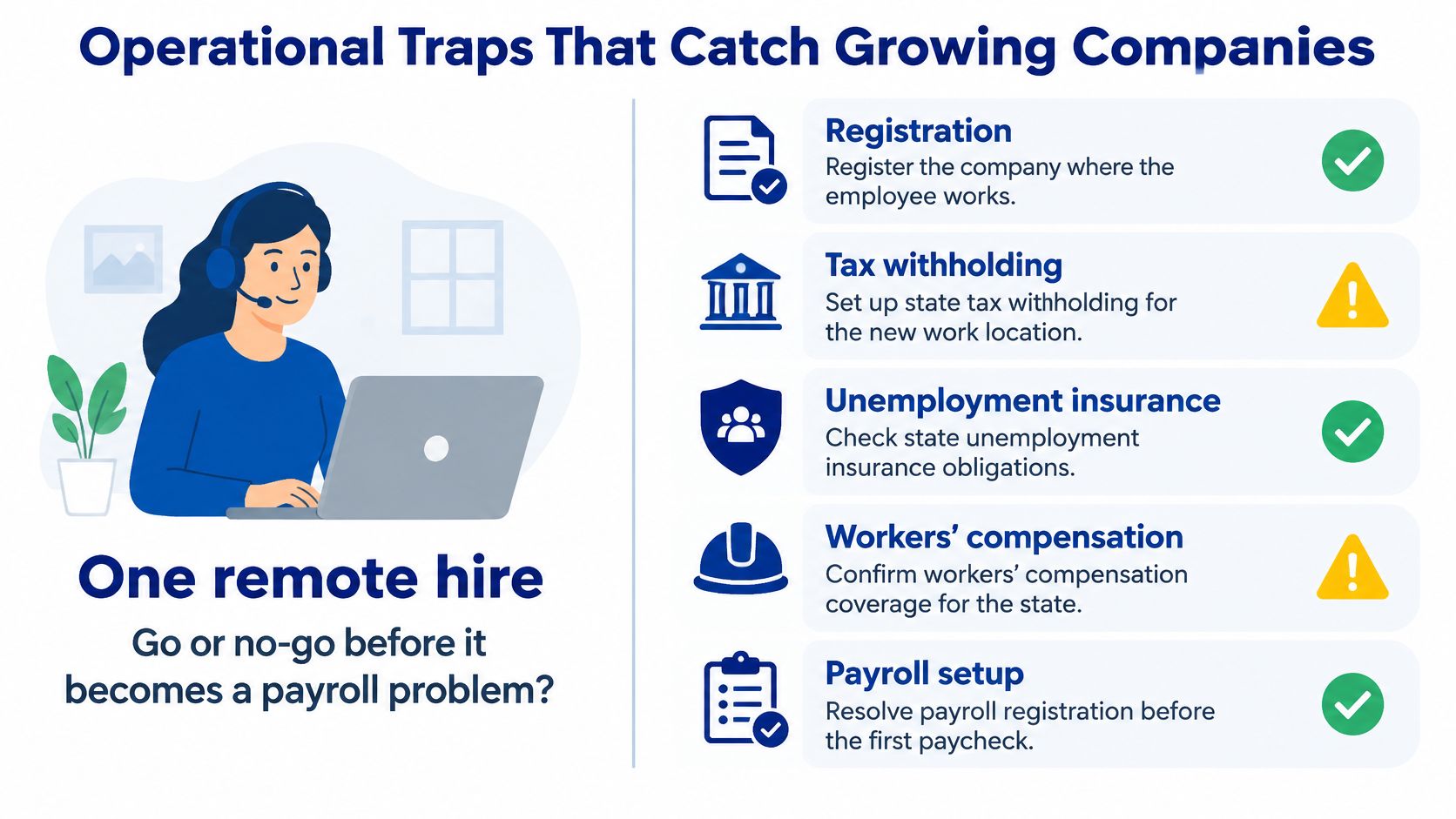
A company with every employee in Ohio becomes a Colorado employer the moment it approves one remote hire. No filing deadline announces the change, and payroll will run the check without flagging which state's rules it has to satisfy. That first out-of-state hire is a go or no-go decision, and it belongs before the offer goes out.
For a company with no senior HR leader, the hard part is knowing which differences apply to the eleven people outside the home state and in what order to fix them. The comparison below shows where a single national policy breaks down.
| Area | Federal Baseline | Where States Commonly Differ |
|---|---|---|
| Wage and hour | Fair Labor Standards Act, enforced by the U.S. Department of Labor: overtime at 1.5 times the regular rate above 40 hours in a workweek, plus a federal minimum wage | California adds daily overtime after 8 hours in a workday; states may set higher minimum wages |
| Leave | Family and Medical Leave Act (FMLA), administered by the DOL Wage and Hour Division: up to 12 weeks of unpaid, job-protected leave for eligible employees of covered employers | State-run paid family and medical leave programs, each setting its own eligibility rules, benefit amounts and funding split |
| Paid sick time | No general federal requirement | Paid sick leave laws in 18 states and DC as of December 2024, per the U.S. Department of Labor |
| Final paycheck | No immediate federal deadline, per DOL guidance applicable in 2026 | Deadlines range from immediate payment on termination to a set number of days, depending on the state |
| Noncompetes | Governed by state law, not federal statute | California generally voids most noncompetes; Minnesota bans most noncompetes, effective July 1, 2023 |
| Payroll and tax | Federal income tax withholding and FICA | State and local withholding, unemployment insurance and registration apply where the employee works |
| Anti-discrimination | Title VII, ADA and ADEA, enforced by the EEOC | States add protected classes and may cover employers below federal thresholds |
Federal law sets a minimum every state must meet. Most states build above it.
That gap is where national policies fail. A paid time off bank can exceed a state's minimum sick leave accrual and still violate that state's sick leave law, because the law carries its own carryover, notice and recordkeeping rules that a general PTO policy never mentions. A handbook written for the home state works the same way: complete right up until the first hire in a state that requires its own leave notice, its own sick time language and its own addendum.
Four areas produce the widest gaps in multi state employment laws: wage payment timing, paid leave funding, restrictive covenant enforceability and pay transparency. Each carries its own vocabulary, its own enforcement agency and its own timeline, so a single answer from a generalist rarely settles a question that spans them.
Obligations generally follow the employee's physical work location. Headquarters, the state of incorporation and the manager's desk are all beside the point. A remote employee in a new state pulls the company into that state's wage, leave, notice and withholding rules from the first day of work.
The governing-law question gets harder when an employee's home state, the office state and the client's state all differ. Which state law applies to remote employees works through that scenario in detail, including how to decide when more than one answer is defensible.
Practical rule: Build the map from the employee's home address and daily work location, then check the city. Chicago and New York City add their own wage, leave and scheduling requirements on top of state law.
The first action is a list: every state where the company has at least one employee, including anyone working from home. Mark which rows of the table apply to each state. Six states produces six columns, and the empty cells are the actual work.
Date every cell. Thresholds, covered reasons and dollar amounts change every legislative session, and a row that was right two years ago can be wrong today. Then rank the states by exposure: any state with a pending termination, an open leave request or a signed noncompete gets checked first, because those are the policies most likely to be tested before the next update cycle. Verify each cell against the current statute for the state where the employee works before relying on it.
When two wage laws cover the same hours, the employee gets whichever one pays more. That single principle decides most multi-state wage questions, and it's the rule most payroll configurations violate.
The federal baseline is familiar. Covered nonexempt employees generally receive overtime at 1.5 times the regular rate for hours worked above 40 in a workweek, as the DOL Wage and Hour Division explains. Where a state law also applies, the employee is entitled to whichever standard produces the higher overtime payment. The same higher-standard principle governs minimum wage: the employee covered by both systems receives the higher rate.
California shows how far a state moves. It adds daily overtime after 8 hours in a workday on top of the weekly trigger, so a four-day schedule of 10-hour shifts generates overtime in California and none under the federal rule alone. A payroll system configured to count only weekly hours will miss it every week, and it will miss it identically for every affected employee.
Remote work makes the comparison harder, not easier. An employee who splits time between two states can be owed the higher standard for the hours worked in the stricter state, and timekeeping has to capture which hours happened where. A monthly allocation decided after the fact won't hold up, and it won't survive a records request.
Five steps produce the matrix. Each one exists because skipping it creates an error that repeats every pay period instead of once.
The sequence below is the control that keeps a national payroll rule from overriding a state rule.
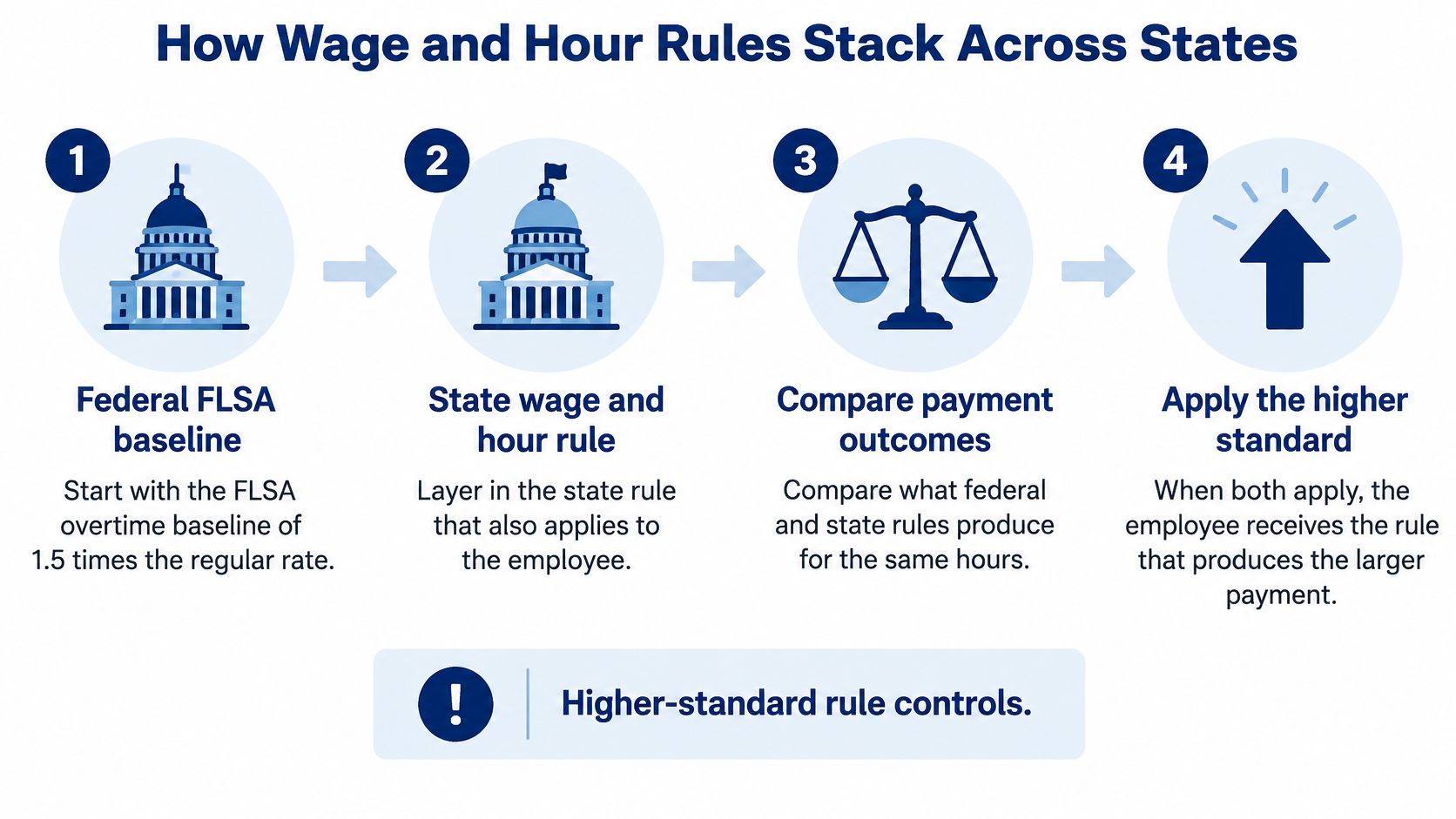
The expensive mistake isn't a wrong answer on one employee. It's one national payroll configuration applied to everyone on the assumption that the federal standard is the ceiling. That assumption systematically underpays employees in the more protective state, and the gap compounds with every pay period until someone adds it up.
Overpayment is a budget problem. Underpayment is a liability that grows with penalties, and employees have their own route to recover it. How to report wage theft explains the process and the agencies involved, which is worth reading to understand what a complaint looks like from the inside before one arrives.
What good looks like: One spreadsheet coded by jurisdiction and linked to timekeeping. Every row shows the state and city, the overtime trigger, the minimum wage, the exemption basis, and the date it was last reviewed.
A working wage and hour compliance program ends with something less glamorous than a policy: a jurisdiction-coded wage matrix that payroll and timekeeping both read from, plus a documented review every time an employee transfers, relocates or starts working from another state. That matrix is what turns a national policy into a defensible one.
A single absence can sit inside four rulebooks at once: the federal FMLA, a state paid family and medical leave program, a state paid sick time law, and the company's own policy. Each rulebook has its own eligibility test, and the tests don't stack neatly. Hire in a new state without mapping which of them switch on, and you inherit every one.
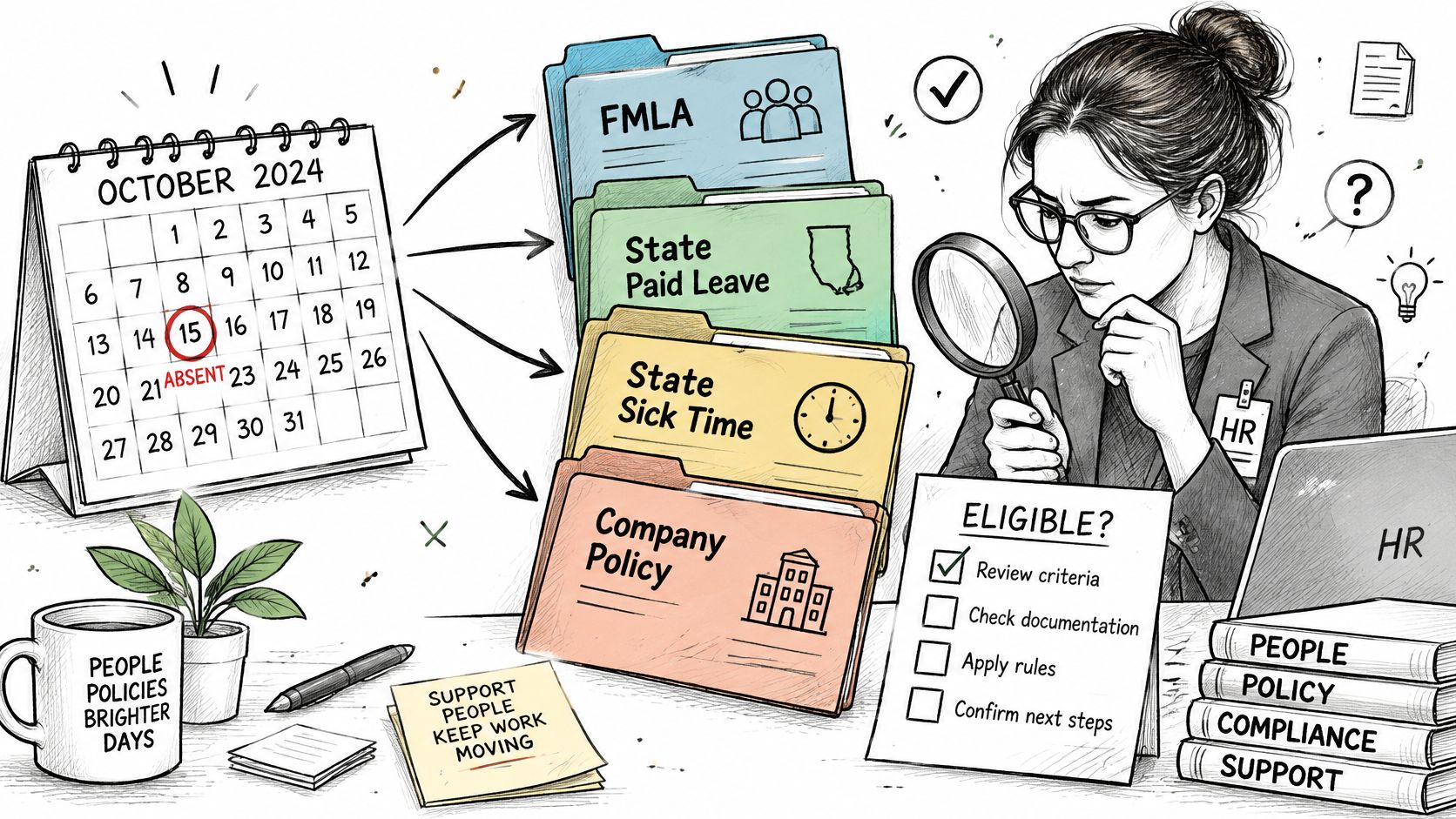
The FMLA is administered by the U.S. Department of Labor under 29 U.S.C. § 2601 and 29 C.F.R. Part 825, and these rules apply as of 2026. Company coverage runs on a company-wide count, so the worksite question is a separate test.
| Requirement | Federal Rule | What to Check |
|---|---|---|
| Employer coverage | 50 or more employees for at least 20 calendar weeks in the current or preceding year, per DOL FMLA rules | Count employees company-wide, not only at one office |
| Employee tenure | At least 12 months with the employer, not necessarily consecutive | Track service dates and any breaks in service |
| Break in service | A break longer than seven years ordinarily ends counting earlier service (DOL e-laws) | Military obligations and written rehire agreements are exceptions |
| Hours worked | At least 1,250 hours of actual service in the 12 months before leave, under DOL Fact Sheet #28 | Paid leave, unpaid leave and prior FMLA leave do not count |
| Worksite | 50 or more employees within 75 miles of the employee's worksite | Check the employee's actual work location, including remote workers |
The worksite test is where multi-state employers get caught. It uses the employee's actual work location, so a remote hire hundreds of miles from headquarters may have no 50-employee worksite within 75 miles even though the company employs far more than 50 people overall. Run this check before the offer letter goes out, not after a leave request lands.
State programs add a second layer. As of 2025, California, Colorado, Connecticut, Massachusetts, New Jersey, New York, Oregon, Rhode Island and Washington, plus the District of Columbia, had operating paid family and medical leave programs, while Delaware, Maine, Maryland and Minnesota were scheduled to begin paying benefits in 2026, according to the National Conference of State Legislatures. These programs differ on wage replacement, covered reasons and job protection, and state family leave laws often reach smaller employers or grant broader rights than the federal baseline. A headcount under 50 does not clear you from every leave obligation.
In one leave and PTO eligibility case, the review team examined the employee's work status, medical restrictions and the employer's policy language, then guided leadership on a consistent, defensible response. That is the right sequence. Overlapping absences need one escalation path in your handbook, not four separate ones. Before you deny leave, issue discipline or terminate an employee who has requested it, get expert help. Retaliation risk is a separate question from eligibility, and it is usually the more expensive one.
Treat any exit involving an out-of-state employee as a go/no-go check before payroll releases the check. Federal law does not require an employer to issue a final paycheck immediately when employment ends, according to DOL guidance applicable in 2026. Timing is set by state law, and some states require payment immediately or within a short deadline.
The rule follows the employee's legally relevant work location, not your headquarters and not the state where the offer letter was signed. A remote employee who transferred, worked through a leave from another state, or was terminated while assigned elsewhere is where one national payroll setting fails. Final paycheck laws by state is the reference to check before the check is cut.
Before the final check goes out: confirm whether wages, commissions, bonuses, expense reimbursements and accrued vacation are treated separately in that state, and whether the state requires a specific delivery method.
A payroll platform processes the payment. It does not choose the governing state rule or warn you that a handbook policy conflicts with statute.
Restrictive covenants travel badly. An agreement drafted for a Texas sales director can be void the moment that director moves to California, where Business and Professions Code § 16600 generally voids most noncompetes. Minnesota's ban took effect July 1, 2023, so a template built before then cannot be relied on for Minnesota employees without a rewrite.
Timing carries its own risk. A separation after a complaint, leave request or investigation is a different decision from a routine exit, because documentation, timing and final-pay compliance each create separate exposure. Get employment counsel involved before acting. In a multi-state case, the team paused a sensitive termination and rebuilt the client's employee handbook with a focus on enforceability across all operating states.
One remote hire is a go or no-go decision, and it is cheaper to make before the first paycheck than after. A single employee can trigger registration, state tax withholding, unemployment insurance, workers' compensation coverage, wage and hour rules, leave obligations and notice requirements in the new state. Say yes casually and you inherit all of it.
Separate the paths before approving anything. Permanent relocation, short-term travel, employer-requested remote work and employee-requested remote work each need their own approval and their own checklist. Convenience-of-the-employer rules can affect withholding even when the employee works elsewhere, which is one more reason the approval belongs in writing.
A national handbook without state addenda misses notice, leave and sick time rules that apply at the employee's location. The core policy stays consistent, and the addenda carry the state-specific language that cannot be. Keep one handbook and maintain the addenda on a regular update cycle, because a state rule change should trigger a targeted addendum revision, not a full document rebuild.
Pay transparency spreads the same way. Maryland began requiring employers to provide salary ranges to applicants on request in January 2020, and Colorado became the first state to require salary ranges in public job postings in January 2021. Connecticut, Nevada, Rhode Island, Washington, California and New York followed with statewide disclosure rules of their own. One remote requisition can fall under several of those rules at once, which turns a recruiting question into a compensation-design question.
Run this intake before any location is approved:
The control is a documented location-change process tied to payroll, insurance, handbook addenda and a named approver. Put the policy in writing, then apply it the same way to every request so no manager approves a move ad hoc. In a remote work case, the firm rewrote the client's remote and hybrid work policy to define approved work locations, employee obligations and enforcement authority, and the employer regained visibility and control over remote work practices while eliminating hidden jurisdictional risk.
Defensibility comes from consistent records and a clear decision path. No process prevents a claim, and no honest advisor promises otherwise. What a process does is make the company's reasoning visible when someone asks why a decision was made.
Name one accountable owner for the matrix before anything else. In a company without a senior HR leader, that's usually the COO or the CFO. The work fails when ownership is shared across three people who each assume someone else is watching it.
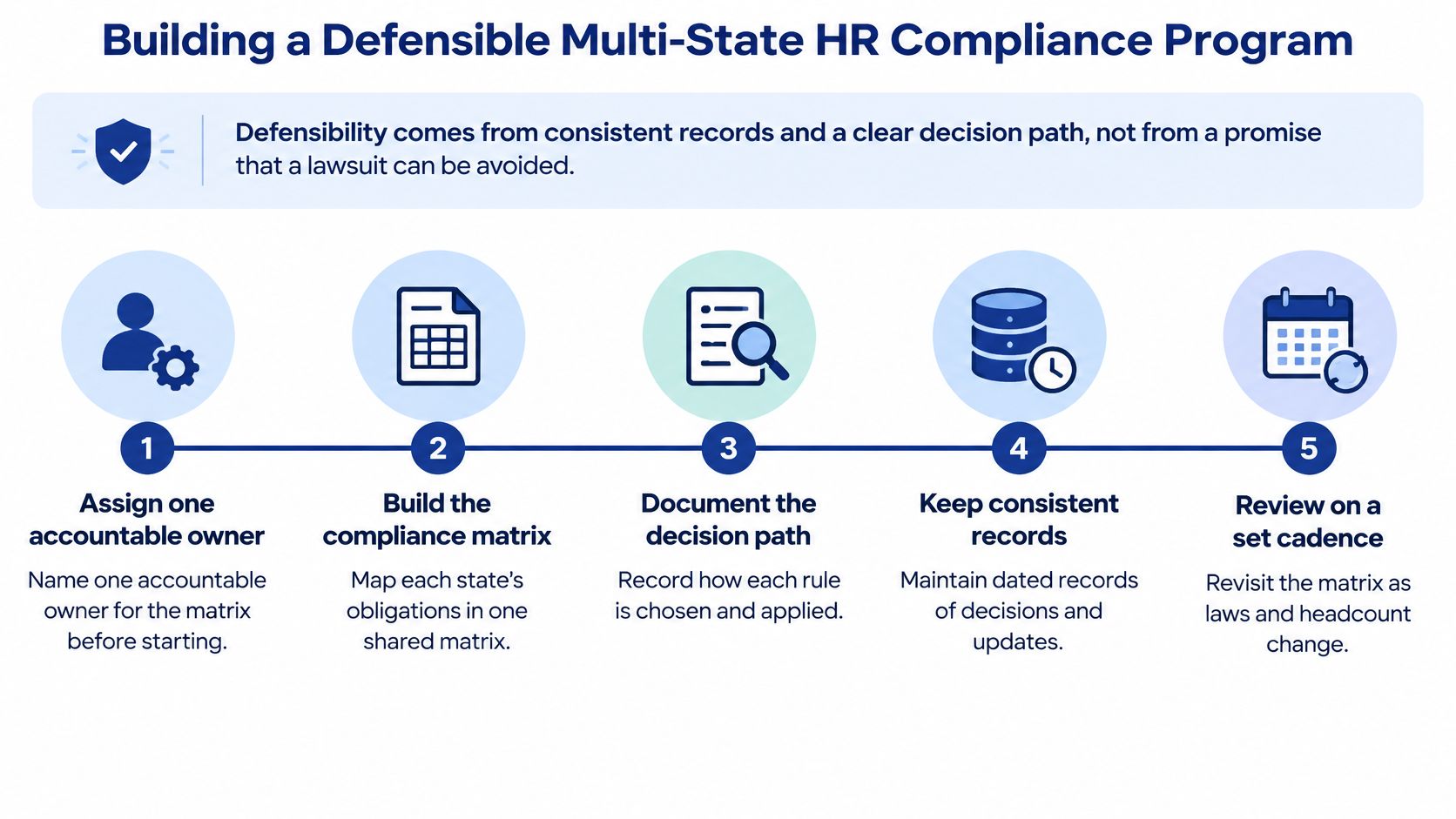
A matrix nobody updates is a document, not a control.
The multi-state case that shaped this approach involved a nationwide employer with approximately 75 employees across multiple states and no in-house HR department. Terminations, leave denials and investigations should still involve qualified employment counsel before any action is taken. The matrix tells you what applies. It doesn't authorize the decision.
Run one check this month. Pull the employee inventory and mark every current employee, pending hire and open remote request sitting in a state with no compliance map. The count usually comes back bigger than the owner expects, and that number sets the work.
Treat each new state as a go/no-go decision made before the offer goes out, while there is still time to walk away or price the risk. Confirm the final-pay deadline, the noncompete rules and the handbook addenda that state requires. A single remote hire in the wrong state can trigger registration, leave and wage obligations nobody budgeted for, and one national policy will not catch them.
Once the map exists, the questions get narrower: which rules follow each employee, and who owns the update when a state shifts a threshold. An outside HR advisor can structure that work and keep it current without adding headcount.
This HR risk and decision advisory firm is built for companies of 25 to 500 employees with people in several states. It acts as the client's HR and compliance function where no senior HR leader sits in-house, and engagements are scoped to the client's size, structure and states of operation. Legal questions still go to qualified employment counsel.
Book a Free HR Risk Review to start a conversation about where the gaps are.

