
A non-solicitation agreement is a restrictive covenant that protects key business relationships by limiting a former employee's ability to solicit coworkers, customers, or vendors after departure, and many are written for a 6 to 12 month post-employment period. In today's talent market, that narrower focus matters because it targets the relationships a business has built instead of trying to block someone from working altogether.
If you're running a business, this issue usually becomes urgent at the worst possible moment. A manager resigns, a salesperson joins a competitor, or a practice leader leaves with access to your team and client base. The immediate concern isn't abstract legal theory. It's whether your people, accounts, and referral channels are about to walk out with them.
That's where a non solicitation agreement becomes useful. Used well, it acts like a fence around relationships your company spent time and money developing. Used poorly, it becomes a template that looks protective on paper but creates false confidence when a dispute starts.
For SMBs, the stakes are practical. You need something that helps preserve team stability, reduce customer disruption, and support a defensible response if someone crosses the line. You also need to avoid clauses that are so broad they create enforceability problems or trigger scrutiny under labor law.
Many leaders still treat these agreements as a standard HR form. That approach is where problems begin. A clause that might look acceptable in one state, for one role, can become a liability when you operate across multiple states, use remote employees, or apply the same language to non-supervisory workers and senior rainmakers alike.
A non solicitation agreement is a contractual tool that tells a departing employee, in simple terms, “you can move on, but you can't take our relationships with you for a limited period.” That usually means restrictions on soliciting employees, customers, and sometimes vendors or business partners after employment ends.
For business leaders, the purpose is straightforward. You're not trying to stop someone from earning a living. You're trying to protect the specific network of trust your business created, including client goodwill, team cohesion, and supplier relationships that can be vulnerable during a transition.
Courts often view non-solicitation obligations more favorably than non-competes because they are narrower and tied to defined relationships rather than a broad ban on working in an industry, as noted in Outside GC's discussion of non-solicitation clauses. That distinction matters when you're deciding which restriction fits your risk profile.
Small and midsize businesses usually don't need the broadest possible restriction. They need the one most likely to hold up and calm a real risk.
A non solicitation agreement is often most useful when an employee has:
A good agreement doesn't try to control everything after departure. It isolates the relationships that create the most immediate harm if they are targeted.
The common mistake is copying one clause into every offer letter and assuming consistency equals compliance. It doesn't.
A customer-facing sales executive, a remote coordinator, and a non-supervisory support employee don't create the same post-employment risk. If your agreement doesn't reflect those differences, it may be harder to enforce and easier to challenge.
A non solicitation agreement bars a former employee from soliciting an employer's customers or employees, and well-drafted provisions often prohibit both oral and written solicitation and can apply even when the former employee did not initiate the contact, according to Volin Employment Law's overview of non-solicitation agreements.
That last point catches many employers off guard. Solicitation isn't limited to a direct message saying “come work with me” or “move your account.” Depending on the clause, it may also cover indirect efforts, coordinated outreach through others, or conduct designed to pull relationships away from the company.
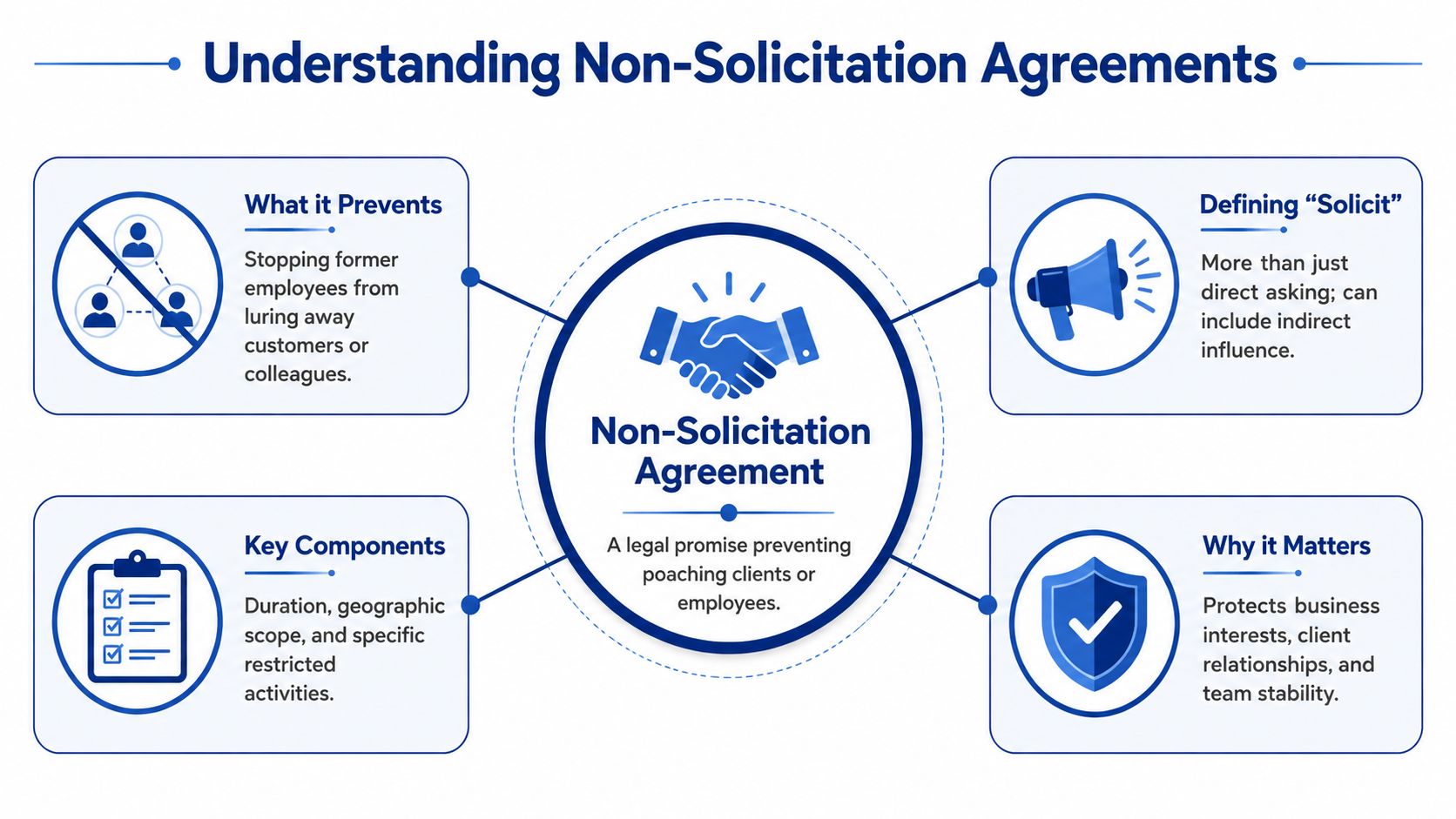
Think of your business relationships as a cultivated garden. A non solicitation agreement doesn't stop someone from going elsewhere to work. It tells them they can't raid the garden you spent years building.
In practice, that protection usually falls into two separate categories:
These categories shouldn't always be treated the same. Employee poaching risk is different from customer diversion risk, and each should be tied to a real business interest.
Many leaders think the issue is only active outreach. That's too narrow.
A clause may be written to cover conduct such as:
That's why precision matters. If the agreement is too vague, employees may not understand what's prohibited. If it is too broad, a court or agency may question whether it goes beyond protecting legitimate relationships.
Practical rule: If you can't explain the restriction to a manager in plain English, the language is probably too loose or too broad.
Business leaders often lump restrictive covenants together. That creates drafting mistakes. A non solicitation agreement, a non-compete, and a confidentiality agreement solve different problems, so the right choice depends on what you're trying to protect.
| Covenant Type | Primary Purpose | Scope of Restriction | General Enforceability |
|---|---|---|---|
| Non-solicitation agreement | Protects business relationships | Limits solicitation of employees, customers, and sometimes vendors or contractors for a defined period | Often viewed more favorably than a non-compete when narrowly tailored |
| Non-compete agreement | Restricts competitive employment | Limits a former employee's ability to work for or start a competing business | More heavily scrutinized and, in some jurisdictions, broadly unenforceable |
| Confidentiality agreement or NDA | Protects information | Restricts use or disclosure of confidential or proprietary information | Often easier to justify when tied to legitimate confidential information |
The practical difference is scope. A non-compete focuses on where or for whom someone can work. A non solicitation agreement focuses on who they can target after leaving. An NDA focuses on what information they can use or disclose.
If you want a deeper baseline on how non-competes differ in structure and risk, this overview of what a non-compete agreement is is a useful companion.
Enforceability usually turns on reasonableness. Even without getting into abstract legal doctrine, most employers can evaluate that through three practical questions:
This is also why a non solicitation agreement can work better than a non-compete for SMBs. It gives you a more targeted tool. You're asking for a limited restriction around defined relationships, not a broad bar on competition.
Remote work made old assumptions less reliable. The employee may report to one state, serve customers in another, and live in a third. That creates a mismatch between your template and the law that may apply when enforcement matters.
For owners preparing for a sale or transition, the covenant mix matters even more because confidentiality and relationship protections often work together. If you're also thinking about safeguarding data during your business sale, it's worth aligning non-solicit language with your confidentiality controls instead of treating them as separate documents.
The biggest drafting mistake I see is assuming one agreement can cover every employee the same way, no matter where they work. It usually can't. Multi-state businesses need to treat a non solicitation agreement as a state-sensitive risk control, not a universal template.
The broader restrictive-covenant environment tightened quickly when California enacted AB 1076 and SB 699 in 2023, both effective January 1, 2024, making non-competes void and unenforceable regardless of when they were signed, while a Georgia appellate court ruled in June 2023 that employee non-solicitation clauses require an express geographic limitation under that state's Restrictive Covenant Act, as summarized by Mintz in its year-end review. The same review noted that 11.4% of adult workers in Minnesota had non-competes in 2022, a reminder that restrictive covenants remain common even as states diverge sharply.

A defensible agreement usually starts with role-by-role analysis, not document-by-document consistency.
Ask these questions:
Specificity makes these agreements easier to defend and easier to administer. Broad language usually does neither.
Use language that aims at identifiable groups, such as:
Avoid language that sweeps too widely, such as restrictions on all customers, all employees, or all business contacts regardless of whether the employee knew them or could realistically identify them.
If a former employee couldn't reasonably tell who is covered, the clause is already in trouble.
Some leaders assume geography doesn't matter in a non solicitation agreement because the restriction is relationship-based. That's not always safe. Georgia is a clear example where express geographic limitation became important for employee non-solicitation enforceability.
This matters even more for distributed teams. A salesperson hired in one state and relocated later may trigger a different analysis than the one your original offer letter anticipated. For businesses trying to compare how regional enforceability issues are discussed in practice, these Mississippi non-compete lawyer insights offer a useful example of why local review still matters.
The strongest non solicitation agreement is usually the narrowest one that still protects the business problem you have. The most defensible clauses are narrowly constructed for a defined set of relationships and a specific time window, such as 6 or 12 months post-employment, which helps align the restraint with a legitimate business interest and reduce overbreadth risk, as reflected in Law Insider's clause guidance.

A solid clause starts with a simple drafting discipline. Match the restriction to the employee's access, influence, and likely damage path after departure.
That means the agreement should answer specific questions:
For employers also focused on confidential know-how, this should sit alongside a separate strategy for trade secret protection, because relationship protection and information protection are related but not identical.
Here's the kind of clause that creates trouble:
Former employee shall not solicit any customer, employee, contractor, vendor, or business contact of the company in any manner following termination.
That language is expansive, vague, and hard to administer. It doesn't define who is covered, what conduct counts, or how long the restriction lasts.
A more defensible approach looks like this:
For 12 months following separation, the employee will not directly or indirectly solicit for competitive services any customer the employee personally serviced, managed, or learned confidential information about during the last part of employment, and will not target identified employees for recruitment. General public job postings are excluded.
This version does three useful things. It narrows the relationship set, limits the time period, and distinguishes targeted solicitation from general market activity.
Modern drafting can't stop at state contract law. Recent labor-law scrutiny changed the conversation, especially for non-supervisory workers.
A recent employment-law review noted that NLRB positions have increasingly questioned employee non-solicits, and an ALJ decision in J.O. Mory found certain customer and employee non-solicit provisions unlawful for non-supervisory workers, according to Felhaber's analysis of NLRB scrutiny. That means a clause that looks routine in an offer letter can still create risk if it is broad enough to chill protected concerted activity or ordinary worker mobility.
The drafting question isn't only “Will a court enforce this?” It's also “Could this language be seen as chilling protected employee activity?”
For multi-state SMBs, that's where advisory support often becomes operational rather than legalistic. Firms, such as those specializing in this area, work with leadership teams on role-based HR risk decisions, including how to align employment documents with actual workforce structure instead of relying on generic templates.
A non solicitation agreement doesn't help much if rollout is inconsistent. Businesses get better results when they decide in advance who should sign, when the document is presented, and how managers explain it.
The second common mistake is overuse. If every employee gets the same restrictive language, the company sends the message that the clause is boilerplate. That weakens the business rationale and can make later enforcement harder to explain.
Use these agreements selectively. Focus on roles where relationships provide a significant advantage, not just job titles that sound senior.
Good candidates often include:
Timing also matters.
If your offboarding process is informal, start there. A structured employee exit process gives you the right moment to restate obligations, recover company property, and document acknowledgment.
Recent NLRB positions have increasingly questioned employee non-solicitation clauses, and an administrative law judge in J.O. Mory found certain customer and employee non-solicit provisions unlawful for non-supervisory workers, showing that compliance risk extends beyond traditional state contract law. For HR leaders, that means employee status and labor-law context now matter as much as contract wording.
In practical terms, review clauses for language that might be read to restrict ordinary employee communications, organizing activity, or broad peer contact unrelated to poaching. A clause aimed at stopping targeted raiding may be workable. A clause broad enough to deter employees from talking with coworkers about jobs, pay, or workplace issues creates a different kind of exposure.
As businesses tighten documentation across employment and lending matters, some owners also compare how advisory firms are assessed in adjacent contexts, such as evaluating Smb Law Group for SBA loans. The larger lesson is the same. Documents that affect risk need context, review discipline, and a clear operating purpose.
Navigating these complexities requires expert guidance. If you need support developing defensible employment agreements that protect your business, our team can help. Contact us to learn more at Paradigm International Inc..
If your business is using a standard non solicitation agreement across multiple roles or states, it's worth reviewing whether that document still matches current risk. Paradigm International Inc. helps SMB leaders build defensible HR practices around agreements, offboarding, and multi-state employment decisions so protection on paper can hold up in practice.