
Growth often creates a strange kind of drag. You add a new payroll system, tighten policies, roll out a scheduling change, update manager expectations, and maybe expand into another state. On paper, those are signs of progress. On the ground, people start missing details, projects slow down, and managers who used to handle issues well begin making inconsistent calls.
That pattern is easy to dismiss as temporary friction. It often isn't. In many small and mid-sized businesses, especially those operating in regulated or multi-state environments, that slowdown is organizational change fatigue taking hold.
When that happens, the risk isn't limited to morale. A tired team documents less carefully. A stretched manager communicates less clearly. A rushed supervisor skips a step in a performance conversation or applies a policy unevenly across employees. Those errors don't stay cultural for long. They become operational, then legal, then expensive.
A familiar scenario plays out in growing companies. The business is moving forward, but the team doesn't feel stronger. Leaders are asking for adoption of new systems, tighter workflows, more reporting, and faster execution. Employees aren't openly rebelling, but they aren't leaning in either.
Instead, the signs are subtle at first. A manager delays follow-up on an employee issue. A department starts doing the “minimum viable compliance” version of a new process. People nod in meetings, then revert to old habits because learning yet another workflow feels harder than anyone wants to admit.
That's where organizational change fatigue becomes dangerous. It doesn't always announce itself through obvious resistance. Sometimes it shows up as quiet depletion. People keep moving, but with less focus, less judgment, and less margin for error.
For business owners and HR leaders, that distinction matters. A disengaged employee can hurt performance. A fatigued organization can also weaken documentation, consistency, managerial judgment, and policy execution. In a regulated setting, those aren't just management concerns. They are exposure points.
This is why change fatigue has to be treated as more than a people issue. It's a business stability issue. If leaders want growth to remain defensible, they need a practical way to spot saturation early, assess where risk is building, and respond before the organization starts paying for it through turnover, failed initiatives, or preventable employment problems.
Change fatigue rarely starts as a crisis. It starts as a series of small compromises in attention, communication, and follow-through.
Organizational change fatigue isn't just a hard season at work. It's a depleted operating condition. The organization has asked for more adaptation than its people can absorb cleanly, and the cost shows up in execution.
Definition: Organizational change fatigue is a state of exhaustion caused by continuous, rapid, or overwhelming change that reduces a team's ability to adopt, decide, communicate, and perform reliably.
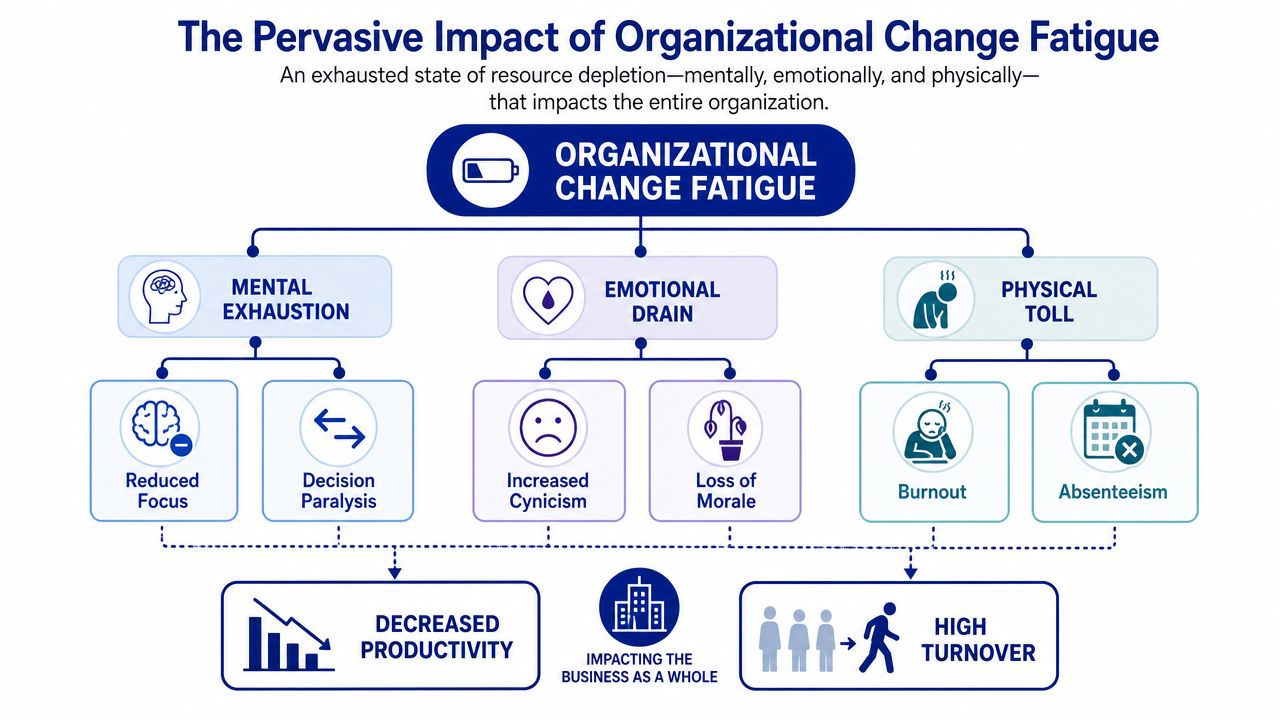
Burnout is often discussed at the individual level. One employee is overloaded, emotionally drained, or struggling to recover. Organizational change fatigue is different because it affects the system around that employee.
You see it when departments stop coordinating well, when rollout timelines slip because people can't absorb one more change, and when managers become translators, firefighters, and enforcers all at once. The issue isn't just stress. It's reduced collective capacity.
That decline is showing up over time. Employee willingness to support organizational change fell from 74% in 2016 to 43% in recent years, according to research summarized by CCL. That matters because every new initiative depends on some level of employee readiness, trust, and follow-through.
Owners and operators usually don't first notice fatigue through survey language. They notice it through friction:
Change fatigue doesn't only weaken enthusiasm. It drains the practical resources employees use to adapt: attention, patience, judgment, and energy. Once those reserves run low, even a sensible change can feel disruptive.
A business can survive a difficult rollout. It struggles when every rollout starts landing on the same already-tired managers and teams. That's when change stops being an initiative problem and becomes an operating risk.
| Business signal | What it often means |
|---|---|
| Slower project velocity | Teams are spending energy coping, not executing |
| More rework | Employees heard the instruction but didn't fully absorb it |
| Low initiative from managers | Frontline leaders are overloaded or unconvinced |
| Quiet compliance | Employees are doing what's required, not what's needed |
Most leaders can sense when something is off. The harder part is naming what they're seeing accurately. If you misread fatigue as attitude, you'll respond with pressure when the team needs capacity, clarity, or support.
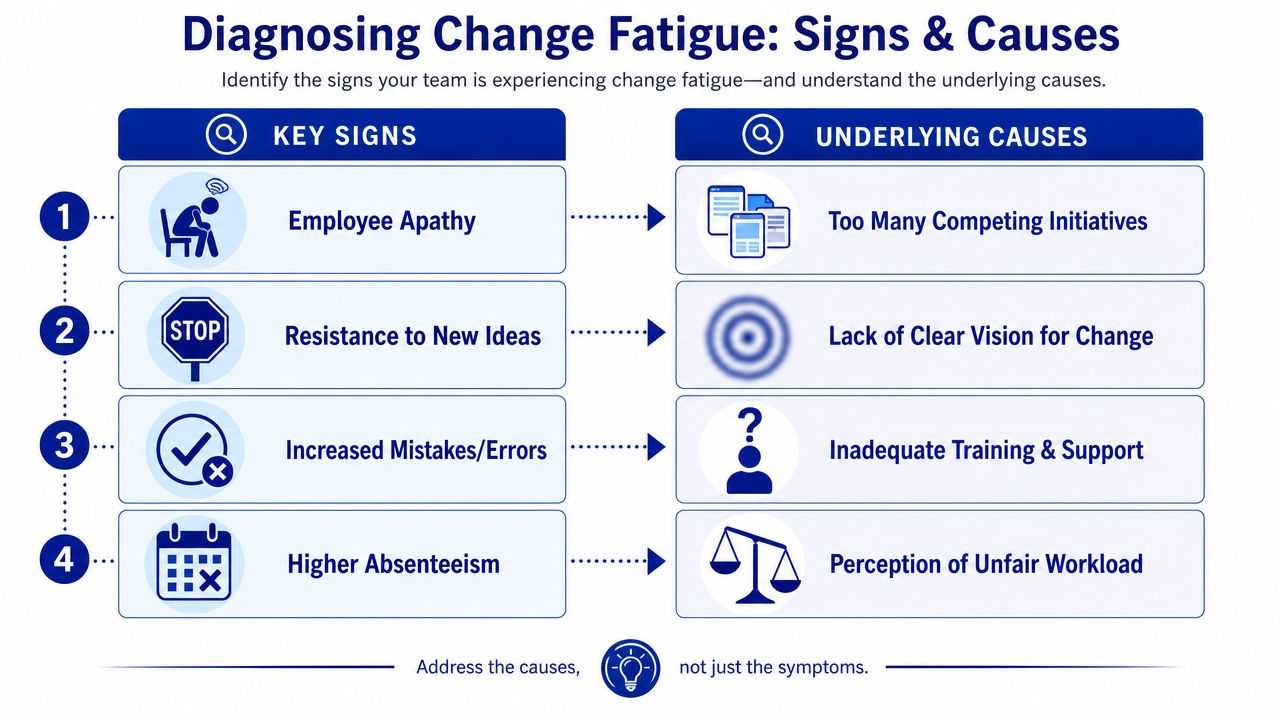
A practical diagnosis starts with observable signs. Then it connects those signs to likely causes in the business.
In a 2024 survey of 473 HR leaders, 73% said employees were fatigued from change, and 74% said managers lacked the skills to lead teams through it effectively, according to change management findings compiled by Flair. That combination is important because fatigue often becomes visible first through manager strain.
Look for patterns like these:
These signs usually trace back to a small set of root problems. In SMBs, the pressure is often sharper because there are fewer layers to absorb disruption.
Here, leaders make better decisions. The same behavior can come from different sources.
| Sign | Likely cause |
|---|---|
| Apathy in meetings | Competing initiatives or depleted energy |
| Resistance to new ideas | Lack of clear purpose or low trust |
| More mistakes | Inadequate training or rushed implementation |
| Absenteeism and call-outs | Unfair workload, stress, or low perceived support |
A team that looks resistant may actually be saturated. If you treat saturation like defiance, you usually make both worse.
That distinction is especially important when managing performance or conduct. A fatigued employee still has to meet standards, but leaders need to understand whether the issue is unwillingness, inability, or a system that keeps introducing change without enough support. Those are not the same risk profile, and they should not trigger the same response.
Unchecked fatigue becomes expensive long before it becomes obvious. It slows execution, weakens management discipline, and creates inconsistency across the organization. For SMBs in healthcare, professional services, franchise environments, or multi-state operations, that inconsistency can quickly become a compliance problem.
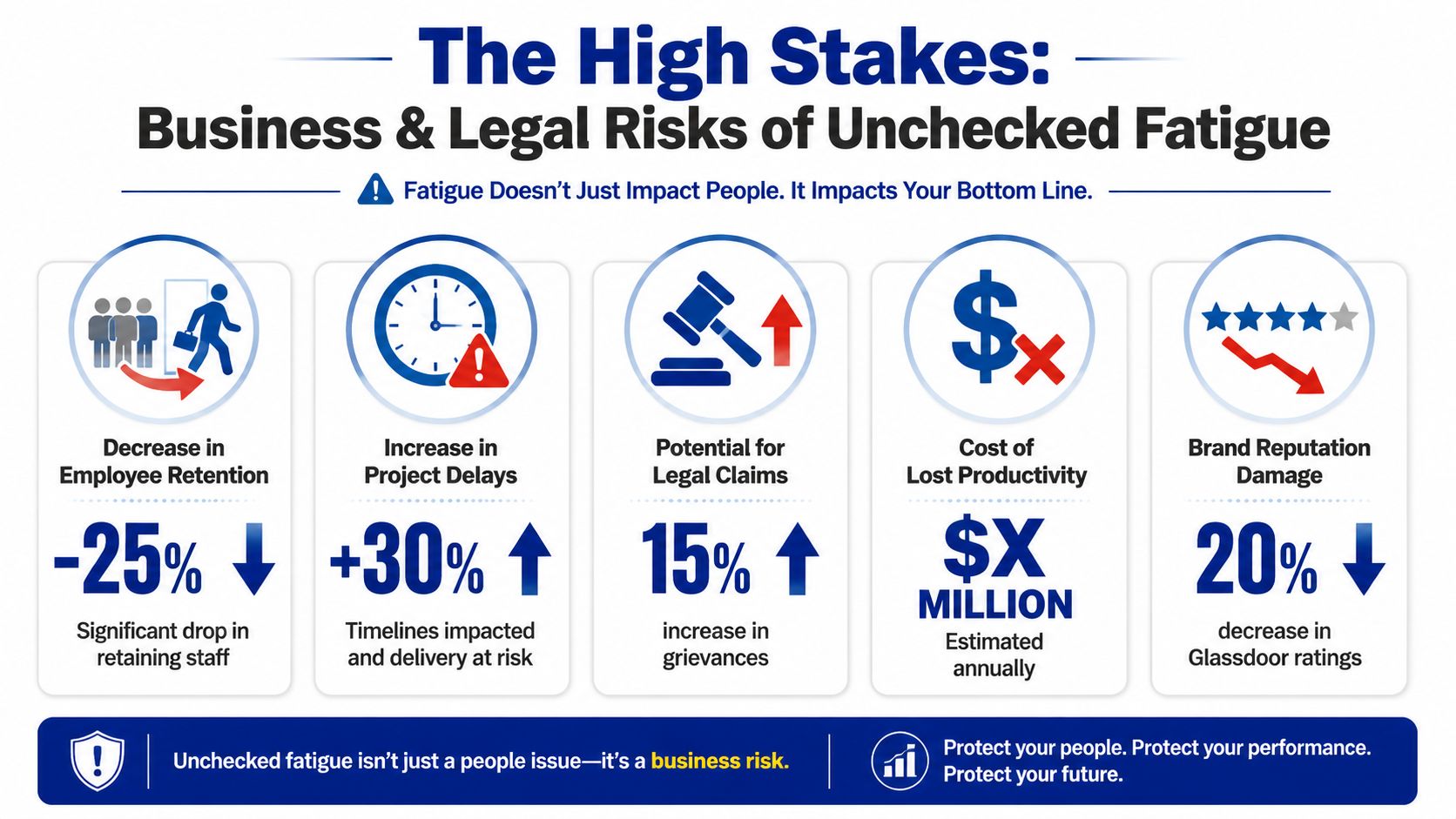
One of the biggest mistakes leaders make is treating fatigue as a soft issue while expecting hard-risk outcomes. The team is exhausted, but the organization still expects clean documentation, sound investigations, consistent discipline, and precise policy execution.
That's exactly where exposure grows. Research noted in this discussion of SMB employment risk points out that existing work often fails to define a clear change saturation threshold for SMBs, even though fatigue in these settings can translate directly into employment risk. In practice, that means manager conduct lapses and poor documentation can create serious defensibility problems.
The legal risk is usually indirect at first. Change fatigue doesn't “cause” a claim by itself. It lowers the quality of decisions and records that would otherwise protect the business.
Common pressure points include:
For leaders trying to strengthen governance around these issues, this guide on HR risk management strategies is a useful companion because it frames people decisions as risk controls, not administrative tasks.
A local company with one site can sometimes recover from inconsistency informally. A business operating across states or under industry-specific rules has less room for that. If one location applies leave rules differently, if one manager documents conduct issues while another relies on memory, or if one department adopts a new workflow without proper oversight, the business now has uneven facts and uneven controls.
That creates two practical problems.
First, the organization becomes harder to manage. Leadership can't tell whether the issue is isolated, cultural, or systemic because the record is messy.
Second, the business becomes harder to defend. If an employee challenges discipline, termination, accommodation handling, or differential treatment, fatigue-related shortcuts often leave the employer with a weak paper trail.
Leaders often assume the risk is highest when employees resist change openly. In reality, the more dangerous state can be silent compliance. People appear cooperative, but they stop using judgment, stop surfacing concerns, and stop catching errors before they travel.
When employees comply without engagement, leaders often overestimate adoption and underestimate exposure.
That's why organizational change fatigue belongs on the same risk radar as turnover, documentation quality, and manager conduct. If the business treats it only as a morale issue, it will miss the point where operational strain turns into legal vulnerability.
Most companies wait too long to assess change saturation. They react after burnout complaints, resignations, failed rollouts, or manager mistakes. A stronger approach is to audit for fatigue while the organization still looks functional.
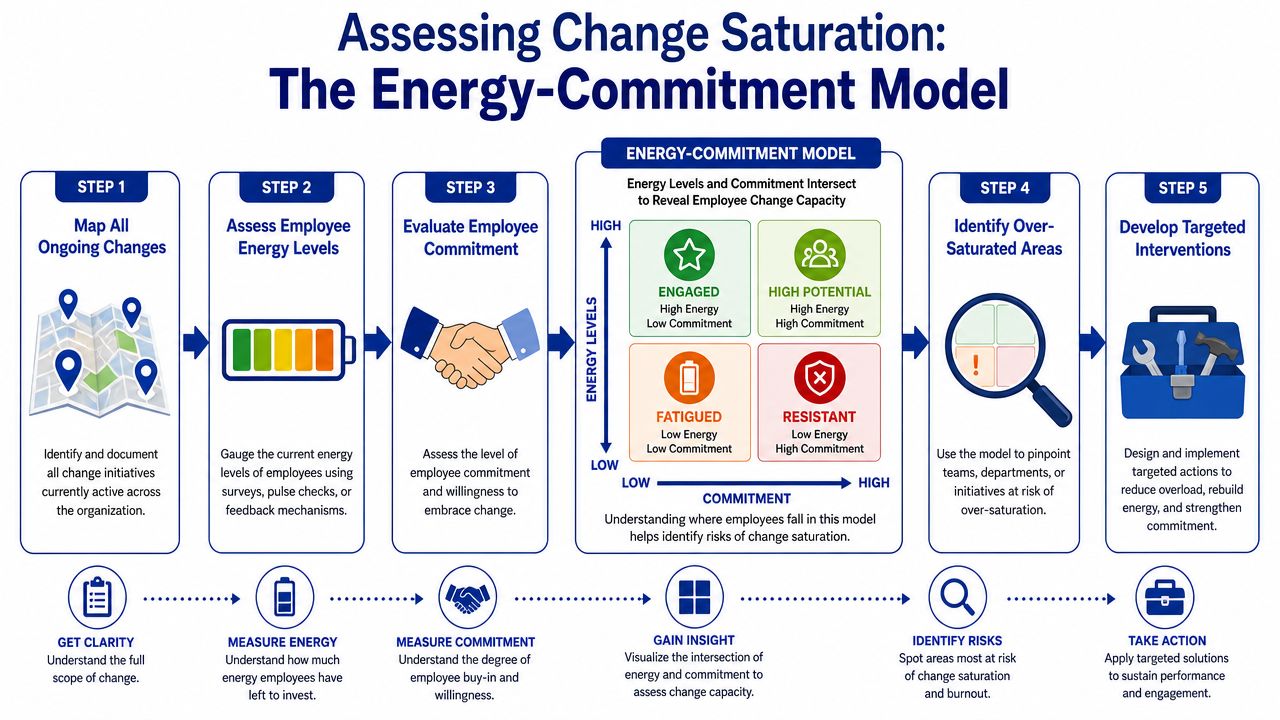
The most useful lens here is the Energy-Commitment Model. It matters because fatigue doesn't always look like defiance. As explained in this overview of the Energy-Commitment Model, fatigue often produces passive acceptance rather than overt resistance. In high-risk settings, employees may follow the new rule without the agency or engagement needed to prevent errors.
That means leaders should assess two things at the same time:
A team can be committed but depleted. It can also have energy but low belief in the initiative. Both conditions create different risks.
Use a short operating review instead of a broad culture survey. The point is to identify pressure zones quickly.
Map all active changes
List current system rollouts, policy updates, reporting changes, staffing restructures, benefit changes, expansion projects, and manager expectation shifts.
Identify who is carrying the burden
Fatigue is rarely evenly distributed. It usually concentrates in frontline managers, admin-heavy teams, and departments responsible for both service delivery and compliance.
Check for adoption dips
Look at software usage, process completion rates, escalation volume, repeat mistakes, and workarounds. Quiet decline matters.
Track slowdown indicators
Watch for project drag, delayed approvals, slower follow-up, rising sick-day usage, or unusual turnover conversations.
Separate resistance from depletion
Ask whether a team is unwilling or out of room. The response should differ.
A more structured engagement lens can help if you need supporting data. This article on how to measure employee engagement is useful when you want to connect observable fatigue to employee experience indicators without relying on guesswork.
A good audit doesn't end with impressions. It creates a record leaders can act on.
Capture:
Operational rule: If adoption is shallow, errors are increasing, and managers are improvising, assume the organization needs pacing before it needs another announcement.
The point isn't to slow every change. It's to stop treating all change as equally absorbable. Once leaders can see saturation as a measurable operating condition, they can intervene before fatigue becomes a conduct, compliance, or retention problem.
Preventing organizational change fatigue requires more than better messaging. Leaders need to control pace, build support into implementation, and equip managers to carry change without creating risk. That's what separates a sustainable transition from a destabilizing one.
Studies show that 60 to 70% of major change initiatives fail, with insufficient project management skills tied to 32% of failures, inadequate communication to 20%, and unclear objectives to 17%, according to change management statistics summarized by Mooncamp. Those drivers are leadership issues, not inevitable side effects.
A common failure pattern is stacking major initiatives because each one is individually justified. The problem is cumulative load. Employees don't experience change one project at a time. They experience it as one combined demand on time, focus, and energy.
Leaders can reduce that load by:
Many businesses benefit from practical outside frameworks. If you want a grounded resource on strategies for sustaining adoption, Acheloa Wellness, Inc. offers a helpful lens on how to keep change from fading after rollout.
Communication fails when leaders assume one announcement equals clarity. It doesn't. Employees need repeated, consistent explanation of what is changing, why it matters, what will be different in practice, and where to go when the process breaks.
A stronger communication approach usually includes:
If your business needs a more structured way to support this, an internal communications plan for organizational change can help formalize who says what, when, and through which channels.
Most change efforts succeed or fail at the manager level. If supervisors are confused, overloaded, or unconvinced, teams will feel it immediately. In many companies, managers are expected to champion changes they had no role in shaping and little time to absorb.
That's not just unfair. It's risky.
Manager enablement should include:
Employees adapt better when support is tangible. That means checklists, scripts, updated SOPs, manager talking points, practical job aids, and visible follow-up after launch. When those tools are missing, leaders often misread poor adoption as laziness.
The best interventions are rarely dramatic. They are structured, visible, and repeatable. They help the business slow down just enough to implement change cleanly, which is very different from slowing growth.
Resilient organizations don't avoid change. They manage its cost. They understand that every process shift, system rollout, policy update, and leadership decision draws from the same employee capacity pool.
That's why organizational change fatigue should be treated like any other business risk. It affects execution, judgment, retention, documentation quality, and compliance consistency. For SMBs operating in complex employment environments, those are not separate concerns. They are tightly connected.
A stronger approach starts with one mindset shift. Don't ask only whether a change is strategically necessary. Ask whether the organization can absorb it well, whether managers are equipped to lead it, and whether the business can defend the decisions made under that pressure.
When leaders build pacing, communication discipline, manager support, and saturation monitoring into the way they operate, change stops feeling random and starts becoming governable. That's the foundation of a more resilient business.
If you're working through repeated change, expansion pressure, or higher-risk people decisions, getting a second set of eyes on your practices can help you move more deliberately.
When organizational change fatigue starts affecting manager judgment, documentation quality, or compliance consistency, it's worth getting experienced guidance. Paradigm International Inc. works with SMB leadership teams that need defensible HR practices during growth, operational change, and high-stakes employment decisions.