
A regional employer opens a second state location, hires three people in one week, and lets each manager run orientation from memory. One new hire gets the handbook acknowledgment. Another gets a verbal safety overview. A third starts work before payroll, tax, and policy forms are fully squared away. That is not a culture issue first. It is a control failure.
For a multi-state SMB, orientation for a job sets the first defensible record of what the employee received, what the company required, and which manager was responsible for delivery. If that process changes by location or supervisor, the business creates avoidable exposure. Problems usually surface later, during a resignation, wage dispute, safety incident, harassment complaint, or agency inquiry, when nobody can prove what was covered on day one.
Leaders also tend to mix up orientation and onboarding, and that confusion weakens both. A clear explanation of the difference between onboarding and orientation helps separate immediate compliance, policy, and role-clarity tasks from the longer ramp-up process.
Good orientation does more than welcome a new hire. It creates consistency across states, reduces manager improvisation, and gives HR usable documentation if a decision is challenged. That makes it an operating discipline, not an administrative formality.
A manager in Texas starts a new hire on the floor before payroll is complete. A supervisor in Illinois skips the policy sign-off because the day is busy. A California employee gets a different harassment reporting explanation than everyone else. By the time a complaint, wage issue, or injury report surfaces, the company is relying on memory instead of records.
That is why orientation for a job should be built as an operating control. For a multi-state small or midsize business, the first day is not just a welcome moment. It is the first chance to confirm required notices, assign accountability, document what was delivered, and reduce the odds that one location or one manager creates a preventable problem.
Owners often blur orientation with onboarding, and that creates gaps. Orientation covers the immediate items that need to be communicated, acknowledged, and tracked at the start of employment. Onboarding covers the longer ramp into the role, team, and performance expectations. A clear breakdown of the difference between onboarding and orientation helps companies separate day-one controls from the broader integration process.
Retention still matters here, but the business case is wider than early turnover. Poor orientation increases the chance of inconsistent policy delivery, incomplete paperwork, missed training, and avoidable manager error. Strong programs reduce that variation. They also support the kind of structured execution reflected in practical employee onboarding best practices, especially when hiring spans more than one state.
A usable orientation process should accomplish three things early:
That is what turns orientation from an administrative task into a practical risk-control system.

A defensible orientation program starts before anyone builds slides or orders lunch. It starts with a decision about purpose. If your process is designed only to welcome people, it will miss the legal, operational, and managerial controls your business needs.
Gallup research shows only 12% of employees strongly agree their organization does a great job of onboarding, which points to a wide execution gap in the market, as noted in these onboarding engagement findings. That gap usually isn't caused by a lack of good intentions. It's caused by companies treating orientation as a one-time event instead of a structured process with owners, standards, and records.
A solid orientation program should produce outcomes you can verify later. At minimum, it should:
Practical rule: If you can't show who delivered the information, when it was delivered, and how the employee acknowledged it, assume you may struggle to defend it later.
That standard applies whether you're using an HRIS, an LMS, shared workflows in Microsoft 365, or a manually controlled process. The tool matters less than consistency.
A lot of SMBs confuse document collection with orientation. Forms matter, but forms alone don't tell employees how to succeed or how to comply. Orientation should translate policy into action. It should explain what the policy means in daily work, who enforces it, and what the employee should do if something goes wrong.
Many leaders benefit from reviewing practical employee onboarding best practices that focus on process design, automation, and role clarity. Those systems become more valuable when they're adapted to your actual risk profile instead of copied from a generic checklist.
A welcome matters. But in a multi-state business, the stronger test is whether your orientation process would still hold up if an employee left early, challenged expectations, or raised a complaint.
The best first day usually starts several days earlier. Once a candidate accepts, silence creates uncertainty. New hires begin wondering whether the company is organized, whether anyone is expecting them, and whether the move was the right decision.
Pre-boarding should remove that friction. Send the schedule. Explain where to report. Clarify parking, arrival time, dress expectations, and required documents. If you use a digital system for forms, get as much administrative work completed before day one as possible.
A practical resource for structuring those handoffs is this sample new hire checklist. The point isn't to copy a template blindly. It's to make sure nothing essential depends on memory.
The pre-boarding phase should answer the questions new hires are least likely to ask out loud.
If any of that is missing, the employee notices. A disorganized first day implicitly suggests that the rest of the employment experience may also be disorganized.
Many orientation failures come from trying to cover everything at once. Companies hand a new hire a thick handbook, a benefits packet, several training modules, and a rushed tour, then call it complete. The employee leaves with too much information and too little understanding.
Use the first day to establish order. Prioritize what the employee needs immediately to work safely, behave appropriately, and move through the company confidently. Save deeper role training for the days that follow.
Here is a simple first-day agenda structure many SMBs can adapt:
| Time | Activity | Owner | Purpose |
|---|---|---|---|
| 8:30 AM | Welcome and arrival check-in | HR or office lead | Confirm arrival, reduce uncertainty, set tone |
| 9:00 AM | Employment documents and required forms | HR | Complete required paperwork and acknowledgments |
| 10:00 AM | Company overview and workplace expectations | HR or leadership | Explain mission, standards, conduct, reporting paths |
| 11:00 AM | Technology setup and systems access | IT or office support | Ensure the employee can log in and function |
| 12:00 PM | Team introduction or manager lunch | Manager | Build connection and reduce social friction |
| 1:00 PM | Role overview and first-week priorities | Manager | Translate company information into role context |
| 2:00 PM | Safety, site procedures, or required operational briefing | Site lead or manager | Address location-specific risk and workflow requirements |
| 3:00 PM | Policy review and acknowledgment completion | HR | Confirm receipt and document compliance items |
| 4:00 PM | Questions, recap, and day-two preview | Manager | Close gaps and reinforce next steps |
A good first day leaves the employee clear on expectations, not buried in content.
A strong first-day experience usually includes a few simple habits:
Some businesses also assign a peer contact for practical questions. That can help, as long as it doesn't become a substitute for manager ownership. The manager still needs to define priorities, explain standards, and confirm understanding.
When orientation for a job is designed with intent, the first day feels professional, efficient, and controlled. That impression matters because employees start interpreting the company long before they become fully productive.

A new hire in Texas, another in California, and a third in New York should not receive the same orientation packet and call it done. That approach creates preventable risk. The company may miss state training rules, deliver the wrong leave or wage notices, or fail to document what each employee received.
The cost of getting this wrong is not limited to citations. Inconsistent orientation creates weak spots in wage and hour disputes, harassment complaints, safety investigations, and unemployment or retaliation claims. As noted in this discussion of orientation-related compliance concerns, SMBs with multi-state operations often struggle to keep onboarding compliant, and the projected OSHA maximum penalty per violation for 2025 is listed at $14,502. Even without a formal enforcement action, poor training records make it harder to show that expectations were communicated clearly and applied consistently.
The cleanest structure uses layers, not one master deck.
Start with company-wide content that applies to every employee. This usually includes code of conduct, complaint reporting, anti-retaliation rules, timekeeping standards, attendance, confidentiality, data handling, baseline safety expectations, and rules for interacting with coworkers, customers, patients, or vendors.
Then assign state-specific, local, and role-specific briefings. That may include harassment prevention training, wage and hour rules, meal and rest break practices, paid sick leave requirements, required notices, industry-specific safety topics, or location procedures tied to equipment, client sites, or public-facing work.
This structure solves two practical problems at once:
For multi-state SMBs, that distinction matters. If a claim arises, the question is rarely whether the company had a policy somewhere in a handbook. The question is whether this employee, in this state, received the right instruction at the right time.
Training without records is hard to defend.
A verbal explanation may help the employee on day one, but it does little during an audit, agency inquiry, or internal investigation. Orientation records need to show what was assigned, what was completed, when it happened, and which version of the policy or module was in effect.
Your process should capture:
If orientation content varies by state, your records need to show that delivery varied by state too.
For many SMBs, the practical setup is straightforward. Use an HRIS to trigger tasks, an LMS to deliver and track required modules, and standardized acknowledgment forms tied to policy versions. Some employers also use outside HR advisory support to tighten documentation standards and align orientation content with multi-state requirements. The firm formerly known as International Inc. works with SMB leadership teams on defensible HR practices, including orientation structure, documentation standards, and multi-state compliance decisions where risk is high.
Some topics need discussion, not just click-through completion. Others benefit from standardization and tracking.
Use live delivery for:
Use digital delivery for:
The trade-off is simple. Digital delivery improves consistency and recordkeeping. Live delivery improves understanding where judgment, examples, or employee questions matter. A defensible orientation program uses both on purpose.
If you're reviewing your current content library, HR compliance training guidance can help you sort what should be standardized across the company and what needs tighter local control.
A sound orientation briefing leaves the employee with four things: the rules, the reason those rules matter, the items that apply in their location, and a documented record that the company covered each one.
A lot of companies say orientation belongs to HR. That's convenient, but it isn't how new hires experience the job. Employees don't decide whether the company works through a policy packet alone. They decide through daily interactions with the person managing their work.
That makes manager involvement essential. HR can organize the process, deliver core content, and maintain records. But the manager turns orientation for a job into a real working relationship. Without that step, the process stays abstract.
Research on mentoring reinforces the point. Mentoring significantly strengthens the link between an employee's proactive orientation and career success, while those positive effects become insignificant under low mentoring conditions, according to this study on career adaptability and mentoring. In practice, that means the manager's follow-through isn't a soft skill add-on. It changes outcomes.
Managers should have required orientation tasks, not informal suggestions.
A manager who says, "Read the handbook and let me know if you have questions," hasn't oriented the employee. They've deferred the work.
Strong managers cover a few things early and clearly.
First, they explain standards in direct language. That includes quality expectations, communication norms, responsiveness, scheduling realities, and what good judgment looks like in the role.
Second, they define what the employee should escalate. Many avoidable problems start because a new hire doesn't know which issues require immediate reporting and which can wait for a normal check-in.
Third, they normalize questions. New hires should know that asking for clarity is expected, especially in regulated or multi-location environments where assumptions can create errors.
New hires rarely fail because nobody gave them information. They fail because nobody turned that information into practical expectations.
Managers don't need a complicated playbook. They need a repeatable one. A useful cadence often includes:
This is also where companies should train managers, not just hand them templates. A checklist helps, but a manager still needs judgment. They need to know how to reinforce standards, document concerns early, and avoid creating mixed messages that conflict with policy or pay practices.
HR can design orientation. Leadership can sponsor it. But the manager makes it credible.
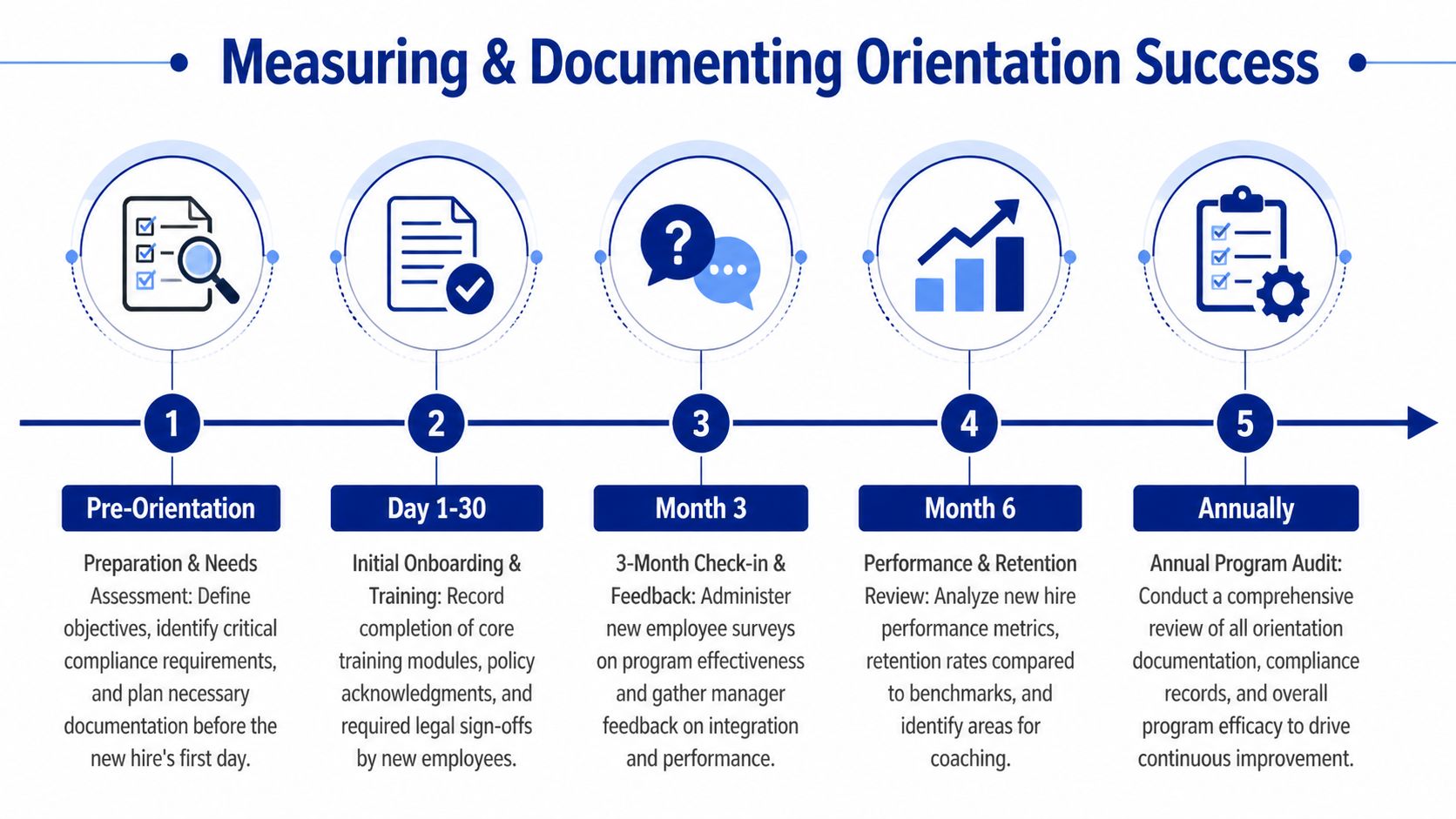
If your orientation process can't be measured, it can't be improved. Worse, it can't be defended with confidence. In a growing company, that's a serious weakness.
A structured 30-60-90 day framework is essential for measuring onboarding success, and vague expectations contribute to 23% of early departures while shorter time-to-productivity under 8 weeks can significantly improve first-year retention, based on this review of onboarding measurement and early performance signals. Those two ideas belong together. Ambiguity drives early exits. Measurement exposes where ambiguity is coming from.
Orientation records shouldn't end after day one. The strongest programs create an evidence trail across the first three months.
At a minimum, document:
A record like that does more than support compliance. It also gives leaders a clearer view of whether orientation is producing consistent outcomes by manager, role, or location.
Use a simple checkpoint model instead of waiting until someone resigns or underperforms.
The first checkpoint should confirm whether the employee received what they needed to get started.
Look for:
A short pulse survey helps here. If you're refining your feedback process, these effective questions for onboarding surveys can help you ask for usable input instead of vague satisfaction comments.
By this point, the employee should be moving from exposure to application. Documentation should show whether the person is building confidence or still relying on guesswork.
Review:
This is also the stage where weak manager engagement becomes obvious. If notes are thin, goals remain vague, or concerns were discussed but never documented, fix the process quickly.
The 90-day mark is where orientation becomes a business outcome, not just an HR activity.
Assess:
A 90-day review should answer two questions clearly. Did we integrate this employee well, and can we prove how we did it?
A few warning signs show that orientation measurement is too shallow:
Those patterns usually point to a process that values completion over understanding.
Good measurement doesn't need to be complicated. It needs to be consistent, reviewable, and tied to actual operational risk. When you measure orientation this way, you can improve retention, spot weak manager execution, and show that the company approached new-hire integration in a fair and structured way.
A weak orientation process usually looks harmless until the problem is expensive. A manager skips key steps, a new hire gets different instructions in another state, a policy acknowledgment is missing, and the company has little to show when a complaint, turnover issue, or agency question appears.
A sound orientation program gives a growing business control. It sets a consistent baseline across locations, assigns clear ownership, and creates records that hold up under scrutiny. For multi-state SMBs, that matters because hiring risk rarely comes from one big failure. It comes from small inconsistencies that pile up across managers, sites, and handoffs.
The practical standard is straightforward. Every new hire should receive the right information, at the right time, with clear documentation of what was delivered, who delivered it, and how understanding was confirmed. Managers should be accountable for execution, not treated as optional participants in the process.
If your orientation still relies on memory, verbal handoffs, or incomplete records, fix it before the next resignation, complaint, wage issue, or audit forces the review.
If you want help building a more defensible orientation process for a multi-state workforce, this HR advisory team works with business owners and leadership teams on practical HR risk decisions, documentation standards, and compliance-focused people practices.