


A hiring manager publishes one requisition, and it reaches candidates in California, New York, and Colorado before anyone checks the compensation language. The range is missing in one version, open-ended in another, and disconnected from what the manager intends to offer. That posting isn't a formatting mistake. It may be evidence that the company lacks control over job architecture, compensation approvals, and recruiting operations.
Pay transparency laws now require executives to treat every advertised range as a business commitment. The right response isn't to add salary figures to a template and move on. Leaders need ranges that are realistic, documented, consistently applied, and reconciled with incumbent pay.
A multi-state posting creates exposure at several points at once. California may require a pay scale in every job posting, including third-party listings. New York can cover promotions, transfers, and some roles performed outside the state. Colorado can require compensation, benefits, and application information in public and internal postings.
The same role may therefore need different disclosures depending on where candidates can work, who supervises them, and how the opportunity is advertised. A recruiter may publish a compliant version on the company careers page while a job board, staffing firm, or employee referral page carries incomplete language.
The operational consequences reach beyond a possible agency inquiry:
The market has already moved. In states with pay-transparency mandates, the share of job postings containing pay information increased by more than 50 percentage points from 2019 through 2023. In states without mandates, disclosure still rose from 15% of postings in 2019 to 42% in 2023, according to the Minneapolis Federal Reserve analysis of pay transparency's rise.
Executive decision: Treat every published range as a controlled compensation output, not as copy supplied by a recruiter.
That requires leadership to answer practical questions this quarter. Who approves the range? What evidence supports the minimum and maximum? Which employees are affected when the range changes? How does the company stop a manager from promising an offer outside the published boundaries?
For companies expanding into Europe, formalizing the legal entity and operating model can sit alongside this work. Resources such as EU single company form registration can help leaders understand the broader administrative context of establishing a European presence. Pay transparency still requires its own compensation controls, but the principle is the same: expansion increases the need for documented ownership and repeatable processes.
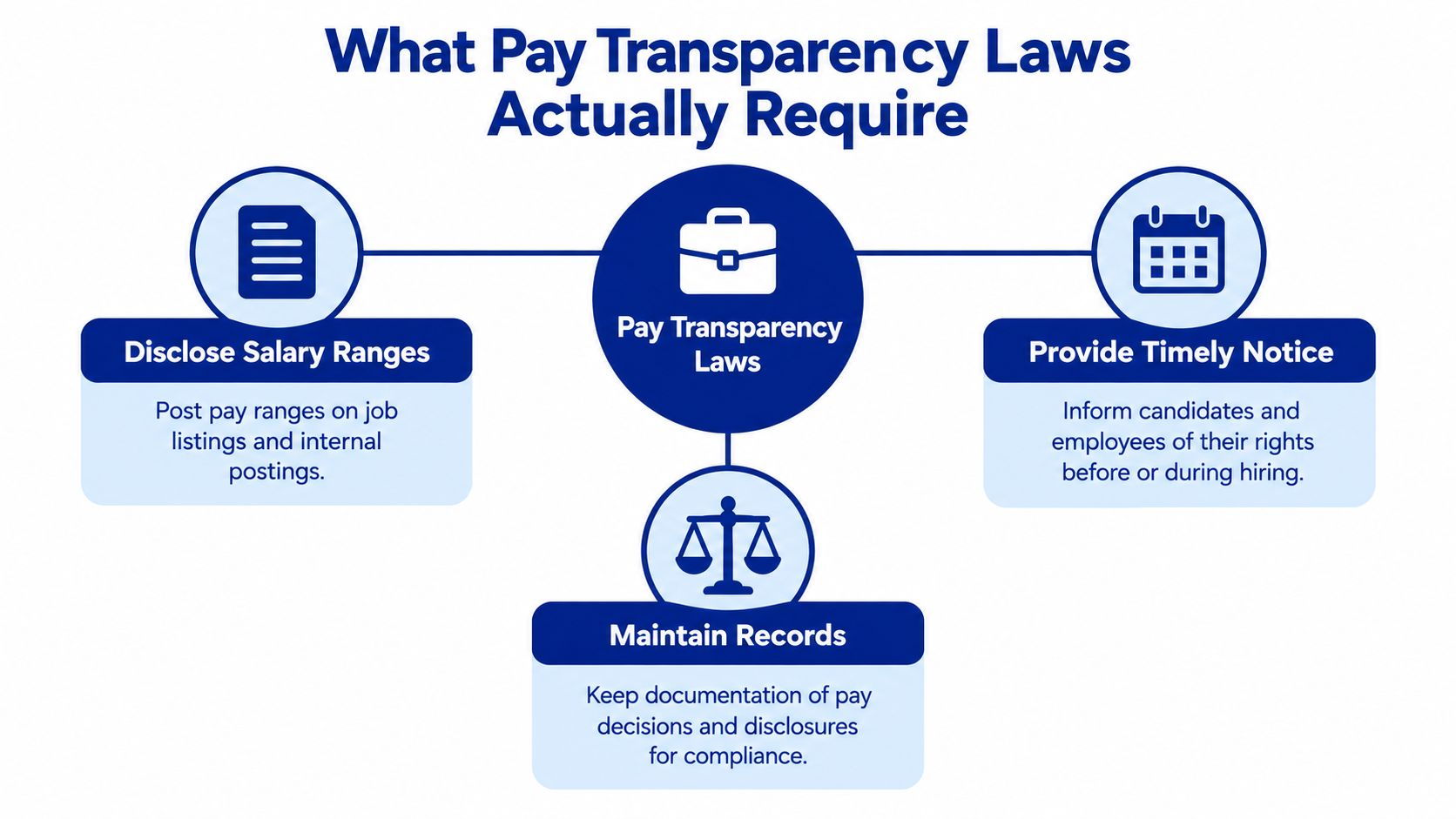
Pay transparency laws govern compensation decisions, not just job-ad wording. Employers commonly must control three connected obligations: disclosure, timely notice, and records. A published range signals the compensation opportunity the employer expects to make available, so it must align with job level, location, internal pay, and approval authority.
The first obligation is proactive disclosure. Depending on the jurisdiction, an employer may need to include a salary or hourly range in an external posting, an internal posting, or both. Some rules also require a general description of bonuses, commissions, benefits, or other compensation.
Timing creates a separate control point. Pay information may need to reach the applicant before an interview, before an offer, when an employee requests it, or when a worker considers a promotion or transfer. A manager who waits until the offer stage may have missed the required disclosure point. Configure recruiting systems and manager instructions so the information appears at the correct stage.
The European Union applies a broader framework. The EU Pay Transparency Directive, adopted in May 2023, requires employers to provide applicants with initial pay or a pay range before employment begins, prohibits questions about pay history, and requires covered employers to report gender pay gaps on a phased schedule starting in 2027.
The third obligation is evidence. Retain the job level, location logic, market or internal-pay rationale, approval record, and offer history needed to explain why a range was selected and whether actual offers stayed within it. California, for example, requires covered employers to retain job title and wage-rate history during employment and for a period after employment ends.
That record also helps leaders answer employee questions without exposing confidential details about individual colleagues. Train managers to explain pay structures, job-related factors, and progression criteria. Do not leave them to improvise explanations that contradict the published range or internal compensation framework.
For related workforce planning, review California full-time hour thresholds. Employment classification and compensation governance can intersect when a role's schedule, benefits, and advertised pay are described together.
The governing standard is good faith. A published range must reflect a genuine expectation, supported by a defensible compensation decision, rather than an artificially broad figure designed to preserve unlimited discretion.
A single national posting policy can reduce administrative complexity, but it won't eliminate the need to understand jurisdiction-specific triggers. California, New York, and Colorado illustrate why the same requisition can carry different requirements.
| State | Employer threshold | Posting scope | Good-faith expectation |
|---|---|---|---|
| California | Employers with 15 or more employees | Every job posting, including third-party listings | The pay scale must reflect the salary or hourly wage range the employer reasonably expects to pay upon hire |
| New York | Employers with four or more employees | Advertised jobs, promotions, and transfers, including certain roles tied to a New York supervisor, office, or worksite | The minimum and maximum must represent what the employer genuinely believes it may offer when the posting is published |
| Colorado | Public and private employers, including employers with at least one employee | Public and internal job postings, including promotions | The posting must disclose compensation, required benefits information, and application details in the required format |
California requires employers with 15 or more employees to include a good-faith pay-scale estimate in every job posting, including postings distributed through a third party. The state also requires employers to retain each employee's job title and wage-rate history for three years after employment ends, as described in the California Labor Code pay-scale requirement.
That means the company can't limit review to its careers page. An external recruiter, job board, or applicant-tracking integration can create the same compliance obligation.
New York applies its law to employers with four or more employees and covers jobs, promotions, and transfers. It can also reach positions performed outside New York when the worker reports to a New York supervisor, office, or worksite, according to the New York Department of Labor pay-transparency guidance.
The range must be tied to one opportunity and one geographic region. Language such as “$17 an hour and up” doesn't provide a genuine minimum and maximum. A company that combines different seniority levels or locations into one intentionally broad range may weaken its good-faith position.
Colorado requires compensation transparency in public and internal job postings, including promotions. Employers must disclose the hourly or salary rate, or a range, and provide a general description of bonuses, commissions, tips, or other compensation. The posting must also describe relevant benefits and explain how and when applicants can apply, as outlined in the Colorado Equal Pay for Equal Work Act guidance.
The practical lesson is straightforward. Don't ask HR whether a range was added. Ask whether the entire posting, audience, timing, and record trail satisfy the rule for every location involved.
A workable program begins with job architecture. If titles, levels, and responsibilities vary by manager, no approval workflow can make the resulting ranges reliable. Leaders should define what distinguishes one level from another and document which factors can move an employee within a range.
Use five operating controls.
Standardize job structure. Create consistent job families, levels, scope descriptions, and location rules. A senior analyst in one state should not represent a different level from the same title in another state unless the distinction is documented.
Govern range setting. Require each range to show its source, assumptions, location treatment, incentive-pay approach, and expected offer zone. Separate the published range from the hiring manager's authorized offer zone and from the employee's placement in the internal band.
Gate requisitions before publication. The approval record should identify covered jurisdictions, posting channels, required disclosures, approving owners, and the date the range was validated. A requisition shouldn't go live because a manager marks it urgent.
Control third parties. Contracts and operating procedures should require recruiters and job boards to use approved language and preserve the final version of each listing. Review referral pages and social posts as carefully as paid advertisements.
Preserve the evidence. Retain the posting, range calculation, approval history, job description, offer decision, and exception rationale. The record should allow an independent reviewer to understand what the company knew when it published the range.
The controls should connect with broader financial and administrative governance. Leaders reviewing Jumpstart Partners financial compliance advice can use the same principle here: assign owners, define approval points, preserve supporting records, and test whether the process operates as designed.
Research on state-level disclosure policies found that covered employers increased pay-bearing postings by roughly 30 percentage points, with associated wage increases ranging from 1.3% to 3.6% and no measurable effect on employment, posting volume, or skill requirements, according to the National Bureau of Economic Research study. The finding matters operationally. Posting a range can affect compensation decisions, even when the organization intended only to satisfy a disclosure requirement.
Your employee-facing materials should align with the same framework. Use the Paradigm International Inc. handbook breakdown when reviewing whether state-specific notices, policies, and employee communication processes are documented consistently.
A salary range can appear in the right place and still be indefensible. The difficult question isn't whether the posting contains numbers. It's whether those numbers represent what the employer expected to pay when the opportunity was published.
An intentionally broad range creates three problems. Applicants can't understand the actual opportunity, managers may use the range to preserve unlimited discretion, and employees may compare it with internal pay and find no coherent explanation. A range that stretches across several levels, locations, or compensation models often signals weak job architecture rather than flexibility.
Colorado provides a useful warning. Average posted salaries increased by approximately 3.6% after the state's pay-transparency law took effect, suggesting that employers had to formalize pay boundaries that previously existed only in managers' judgment, as discussed in the analysis of Colorado's pay-transparency effects.

For each role, leadership should compare:
Those figures should reflect documented factors such as experience, job-related skills, location, scope, and performance expectations. If the manager plans to hire everyone near the bottom, the range shouldn't suggest that offers commonly reach the top. If the manager expects to exceed the maximum, the requisition needs review before publication.
Incumbent pay creates another risk. A newly published minimum may exceed the pay of employees already performing substantially similar work. That doesn't automatically prove unlawful discrimination, but it creates a question the company must answer. The answer should rely on documented differences, not a manager's memory or personal preference.
Recruiters can also undermine the system without intending to. They may describe a wider range in a phone screen, promise a sign-on payment that wasn't disclosed, or route candidates through a third-party posting with different language. Referrals create similar risk when managers make informal promises before HR reviews the offer.
Practical rule: No one should be authorized to promise compensation outside the approved offer zone without a written exception, a business reason, and compensation review.
The exception record should identify the role, candidate-related factor, decision maker, alternatives considered, and effect on comparable employees. A pattern of exceptions may show that the range is wrong, the job level is unclear, or managers are bypassing the compensation model.
An audit should begin with the inventory, not with a policy rewrite. Export active and recent requisitions, identify every location where the role could be performed, and collect every version distributed through company pages, job boards, recruiters, referrals, and social channels.
As of January 2025, an estimated 24% of job advertisements in jurisdictions with established transparency rules were still noncompliant, according to Mayer Brown's employment law update. That makes sampling insufficient for a company with significant multi-state exposure. Review the postings most likely to create risk first, then expand the scope.
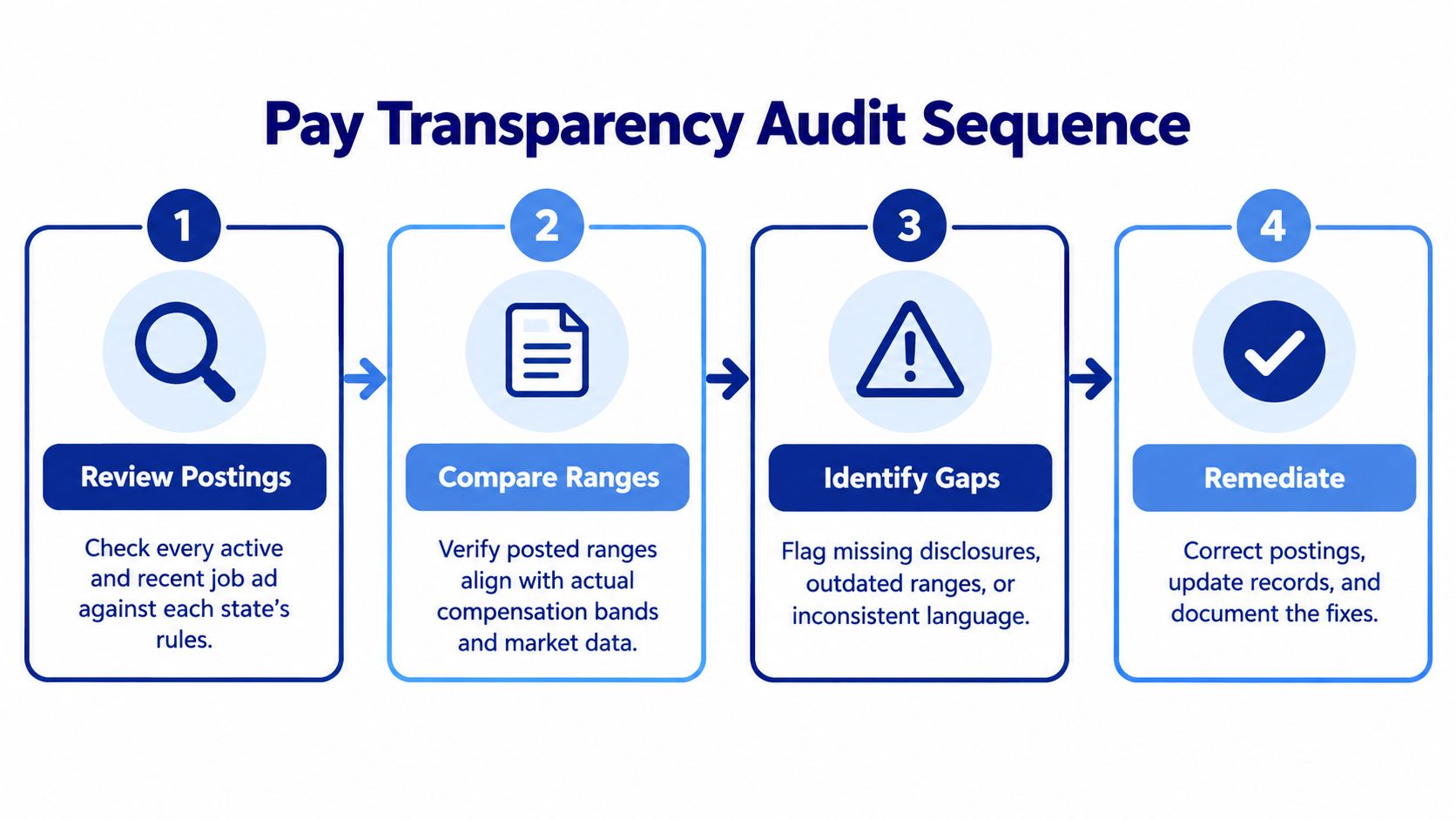
Review every posting. Check the salary or hourly range, benefits language, commission disclosures, promotion notices, application instructions, location, and publication date against the rules that apply to the role.
Compare ranges with internal pay. Map the posting to the job family, level, location differential, approved pay band, planned offer zone, and incumbent population. Identify employees below a newly published minimum and employees whose pay appears difficult to explain.
Test actual behavior. Sample offers, recruiter communications, referral conversations, promotions, transfers, and manager approvals. Look for off-range commitments, inconsistent descriptions, missing disclosures, and compensation changes that lack written rationale.
Remediate and document. Correct active postings, withdraw obsolete versions, notify responsible vendors, update records, and record the reason for each fix. If the company identifies a likely pattern, involve employment counsel before contacting affected employees or agencies.
Red flags warrant escalation rather than routine correction:
Use an HR advisory pricing guide when deciding whether the review belongs with internal HR, outside counsel, or an independent advisory team. The right scope depends on the number of jurisdictions, posting volume, data quality, and whether the audit has identified possible disparate treatment.
A pay transparency program stays manageable only when leaders run it as a recurring governance cycle that connects job design, range approval, recruitment, offers, promotions, employee requests, and record retention.
Employee requests need a controlled response process. Decide who receives them, define what can be shared, protect individual confidentiality, and give managers approved language. Employees need clear explanations of pay levels and job criteria, but the company should never disclose another person's private compensation without a lawful basis.
Compression needs prioritization. Compare affected incumbents by job scope, level, location, experience, and documented performance factors. Fix unexplained differences first, then check whether promotion rules, incentive pay, or hiring exceptions are creating the same problem elsewhere.
Exceptions should be rare and visible. A hiring manager who wants to exceed a published range should submit a written rationale before making the commitment. The approver should review internal equity, budget impact, future promotion implications, and whether the range itself needs revision.
The European framework also pushes employers toward stronger employee information rights and gender-pay reporting. Member States must transpose the directive into national law by 7 June 2026, and reporting obligations for covered employer groups are scheduled to begin on a phased timeline starting 7 June 2027, according to the European Commission's transposition materials. Companies with international operations should build the underlying data discipline before a request or reporting deadline exposes its absence.