
Choosing the right HR outsourcing model is a critical decision for any growing business. The choice between a Professional Employer Organization (PEO) and an Administrative Services Organization (ASO) directly impacts your legal responsibilities, operational control, and ability to attract top talent. While both offer support, they operate on fundamentally different principles. Understanding this distinction is the first step toward making a strategic choice that aligns with your company's long-term goals.
The core difference between a PEO and an ASO comes down to liability and who is legally considered the employer. A Professional Employer Organization (PEO) establishes a co-employment agreement, making it the employer of record for your team and sharing legal risks. In contrast, an Administrative Services Organization (ASO) is a vendor that manages HR tasks while you remain the sole employer and retain all liability.
Selecting between a PEO and an ASO is a pivotal decision for a growing business. It influences your control over the workforce, exposure to employment-related risks, and your company’s agility. To make the right call, you must look beyond simple definitions and understand what each model means for your daily operations and long-term objectives.

The heart of the PEO vs. ASO debate is the legal structure. One model partners with you as a co-employer, while the other functions more like a traditional third-party service provider. This single difference creates a ripple effect, influencing everything from benefits offerings to compliance management. For broader HR outsourcing advice, the Hire-Sense blog for HR insights offers valuable perspectives.
The table below breaks down the most important differences to consider.
This table provides a foundational overview. As you will see, the right choice hinges on your company's risk appetite, growth plans, and the level of control you wish to maintain. We also offer a dedicated guide on how to select an HR partner that provides more context for this decision.
In this guide, we will explore the operational, legal, and financial impacts of both PEO and ASO models. Our goal is to provide the practical insights you need to make an informed and defensible decision for your business.
Before weighing a PEO against an ASO, it is essential to understand the fundamental relationship each creates with your business. The entire decision hinges on the critical concept of co-employment. This single factor determines everything—from who holds liability and files taxes to how you offer employee benefits. Grasping this concept is the most important first step.
A Professional Employer Organization, or PEO, is built on a co-employment model. In simple terms, the PEO legally becomes the employer of record for administrative and compliance purposes. You still direct your employees' daily work, manage performance, and shape company culture, but the PEO shoulders a significant amount of the backend responsibility.
When you partner with a PEO, your employees are legally employed by two entities: your company and the PEO. This unique arrangement allows the PEO to take several critical functions off your plate.
The primary power of a PEO is shared liability. By becoming the employer of record, the PEO assumes a significant portion of the legal and financial risk associated with employment, from payroll tax errors to workers' compensation claims.
An Administrative Services Organization (ASO) operates like a traditional third-party service provider. An ASO will handle specific HR tasks for you but does not enter into a co-employment relationship. You remain the sole employer of record, retaining all legal responsibilities and final authority.
Think of an ASO as an outsourced HR department you can hire on an à la carte basis, selecting only the tasks you need them to handle. You can learn more about the strategic implications of these models by exploring risk advisory insights on paradigmie.com.
Here’s what defines an ASO relationship:
Understanding these two structures is the essential first step in the PEO vs. ASO debate. One offers a true partner that shares your risk, while the other provides targeted help while you maintain complete control. If you need guidance for your specific business, feel free to contact our team to talk through your needs.
When you place a PEO and an ASO side-by-side, the distinctions extend far beyond outsourced HR support. The fundamental difference lies in the employment model itself—a choice that dictates everything from who handles payroll taxes to who holds liability if something goes wrong.
The most critical distinction to grasp is co-employment. A PEO establishes this legal relationship, making it the employer of record for tax and compliance purposes. An ASO, however, operates as a straightforward administrative vendor, leaving you as the sole, undisputed employer.
This infographic breaks down the high-level differences between the shared-responsibility PEO model and the client-controlled ASO framework.
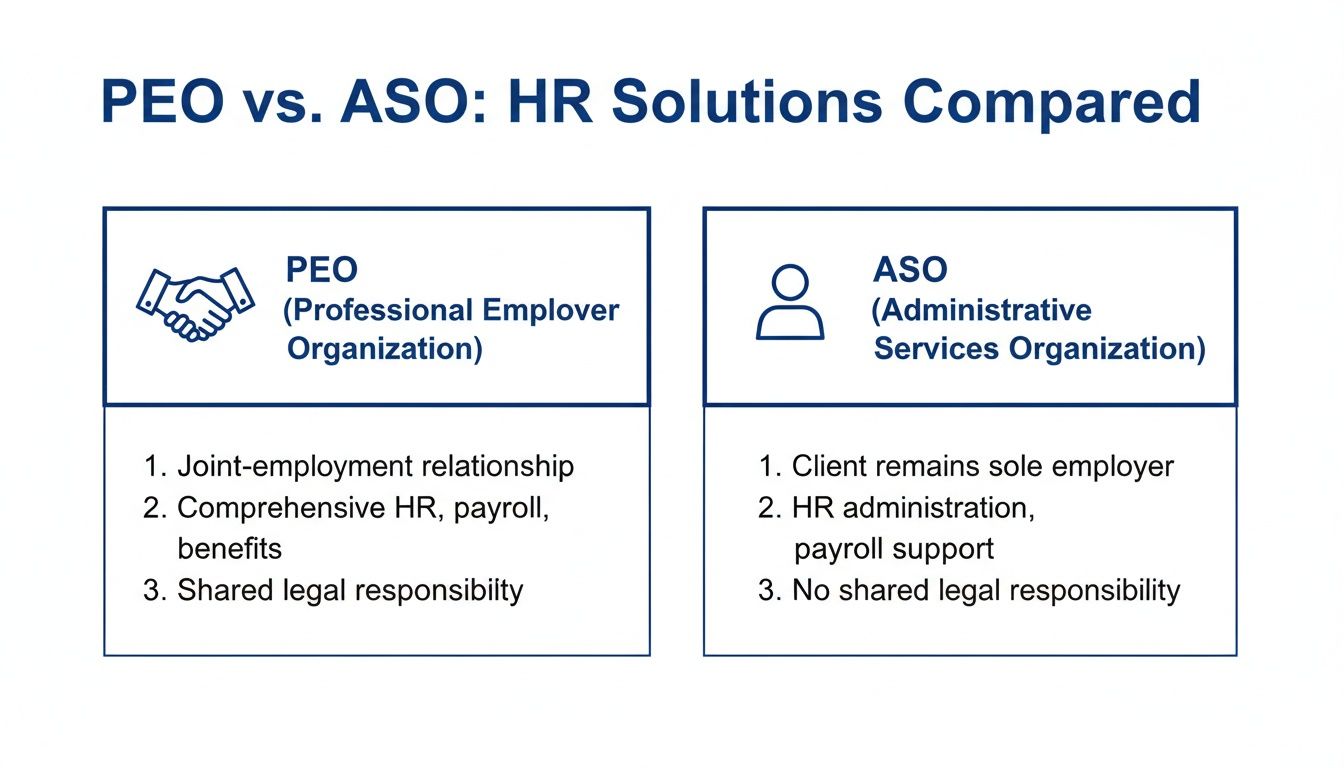
As you can see, while both provide HR services, the PEO's co-employment structure fundamentally shifts how administrative burdens and legal risks are managed.
To help you decide which model fits your business, we've broken down the key operational and legal differences in the table below. It clarifies exactly who is responsible for what in each arrangement.
Ultimately, this table highlights a core trade-off: a PEO shields you from significant administrative and legal burdens in exchange for a shared employment structure, whereas an ASO provides expert support while leaving you in full control of your HR framework and its associated risks.
How each model handles liability is a major deciding factor for most businesses. With a PEO, employment-related risk is shared. Because the PEO is the co-employer, it assumes significant responsibility for compliance with payroll tax laws, workers' compensation, and other complex employment statutes. This shared liability can be a powerful shield for small to mid-sized businesses that lack deep in-house legal or HR expertise.
In an ASO partnership, 100% of the employment liability remains with your company. The ASO provides administrative support and may offer compliance advice, but the ultimate legal and financial responsibility for any errors rests squarely on your shoulders. This model is often preferred by companies that already have a strong internal HR function and want to maintain complete control over their legal standing.
The core trade-off is control versus risk. A PEO reduces your risk by sharing it but requires you to adopt its processes. An ASO gives you full control but also full liability.
Another key area of comparison is the administration of employee benefits and workers' compensation—an area where a PEO often provides a compelling financial advantage for smaller companies.
For many small businesses, the ability to offer competitive benefits is a major driver for choosing a PEO. Data from the National Association of Professional Employer Organizations (NAPEO) shows that businesses using a PEO grow faster and have lower employee turnover.
While a PEO becomes the employer of record, it is crucial to understand what that means in practice. You, the business owner, still retain full control over your company culture, daily operations, hiring and firing decisions, and performance management. The PEO’s role is to manage the administrative side of employment, not to run your business.
With an ASO, your status as the sole employer is never in question. This straightforward structure appeals to leaders who want zero ambiguity in the employer-employee relationship. You maintain direct control over every HR facet, from the fine print in your employee handbook to the selection of your payroll software.
The choice in the PEO vs. ASO debate ultimately comes down to your priorities. If you need to offload administrative burdens and mitigate risk, a PEO is a powerful ally. If you value complete control and have the internal resources to manage liability, an ASO offers targeted support without altering your employment structure. If you are weighing these options and need guidance, our team is here to help. Feel free to contact us for a consultation.
Operating across state lines introduces a complex array of employment regulations. For businesses with a distributed workforce, what is compliant in one state may be a significant legal risk in another. This is where the structural differences between a PEO and an ASO become critically important.
The issue boils down to navigating complex, state-specific rules for paid leave, final pay, and termination requirements. Let's break down how each model handles it.
A PEO handles the core mechanics of multi-state employment, like registering for unemployment and withholding taxes under its own EIN. This lifts a huge administrative weight off your shoulders. They will also typically provide a standardized employee handbook designed to meet a baseline of compliance across all 50 states.
However, this one-size-fits-all solution has its limitations.
In an ASO model, you retain all legal responsibility for multi-state compliance. Your ASO partner processes payroll under your company's EINs and will help with state registrations, but the accountability is all yours. While that might sound daunting, it offers a crucial advantage: flexibility and precision.
When paired with a specialized advisory firm, the ASO model allows you to build a defensible, state-specific compliance strategy. Instead of a generic handbook, you can develop policies and procedures that are precisely tailored to the legal landscape of each state where you operate. You can get a better sense of these challenges in our guide on remote worker compliance for multi-state employers.
This tailored approach is invaluable in high-stakes situations. Imagine needing to conduct an internal investigation into employee misconduct involving workers in multiple states. A specialized advisory partner can provide guidance that respects the specific privacy laws and investigative standards of each jurisdiction, ensuring the process is both fair and legally sound.
Consider a rapidly growing tech company with employees in New York, Colorado, and Florida that needs to implement a non-compete agreement.
In the PEO vs. ASO discussion for multi-state employers, the decision comes down to your risk tolerance and need for specific guidance. A PEO offers a broad safety net for basic administrative compliance. An ASO, supported by expert advisors, empowers you to build a precise and defensible strategy for the high-stakes risks of a diverse team.
Ultimately, the choice between a PEO and an ASO often hinges on cost and financial impact. The two models have very different pricing structures, which will affect your budget and the clarity of your HR spending. The core distinction is that PEOs bundle their services, while ASOs typically allow you to select services individually.
Most PEOs use one of two pricing models: a percentage of your total payroll or a flat per-employee, per-month (PEPM) fee. The percentage-based model is more common, with fees typically falling between 2% to 12% of gross payroll. This single fee covers HR administration, payroll, compliance, and access to the PEO’s master benefits and workers' compensation plans.
This bundled approach is where the value often lies, particularly if it grants you access to large-group health insurance rates you couldn't get on your own. The trade-off, however, is a lack of transparency, making it difficult to see what each service costs individually. It is important to decoding small business health insurance cost to confirm that the bundled savings are genuine.
ASOs operate on a much more straightforward, unbundled model, almost always charging on a per-employee, per-month (PEPM) basis for the specific administrative services you select. This à la carte pricing gives you greater clarity and control over your HR budget.
Here is how that usually works:
The core financial difference in the PEO vs. ASO debate is transparency versus bundled value. An ASO gives you a clear, itemized bill, while a PEO offers a potentially lower all-in cost by leveraging its scale. For deeper insights, explore our guide on understanding HR support costs for growing businesses. If you’re trying to model these costs for your business, our team can help. Contact us for a detailed analysis.
Choosing between a PEO and an ASO is a strategic move that defines your company's operational backbone, risk exposure, and growth capacity. To get it right, you need to analyze how each model aligns with your core business priorities. This framework will help you turn our PEO vs. ASO comparison into a clear, actionable path forward.

The first step is a frank assessment of your internal capabilities and risk tolerance. Do you have the in-house expertise to navigate complex compliance issues, or would sharing that burden bring critical stability? Your answer will point you decisively toward one model or the other.
A PEO is often the right choice for businesses that need to offload significant administrative weight and mitigate employment-related risks. It acts as a comprehensive support system, making it an ideal fit for specific types of companies.
Consider a PEO if your business matches these scenarios:
A PEO provides a powerful solution for leaders who prioritize stability, risk reduction, and access to top-tier benefits. This allows you to focus on strategy and operations.
An ASO model is built for businesses that want to retain full control and liability but need to outsource specific, time-consuming administrative tasks. This approach is best for companies with a clear handle on their HR needs and a strong preference for flexibility.
Consider an ASO if your business fits these descriptions:
Getting your people strategy right directly impacts your bottom line. An advisory-focused ASO model that emphasizes precise documentation and manager training can significantly improve employee retention. You can discover more insights from McKinsey & Company on optimizing HR performance and retention.
The best decision in the PEO vs. ASO debate comes down to your long-term vision. The right model will not just solve today’s HR headaches; it will support your company’s responsible growth for years to come. If you are still weighing your options, we invite you to contact us to discuss your strategic HR needs.
When weighing a PEO vs. ASO partnership, a handful of critical questions almost always come up. Business leaders want to know about control, cost, and the real-world impact on their operations. Here are the most common questions, along with the straightforward insights you need.
Payroll software is a tool that automates calculations and helps with tax filings, but its function stops there. Both a PEO and an ASO provide a human service layer, bringing deep expertise in HR, compliance, and benefits. A PEO acts as a comprehensive partner through a co-employment relationship, while an ASO functions as a specialized service provider. Both offer strategic guidance that standalone software cannot match.
This is one of the biggest myths, but the answer is a firm no. You always retain full control over your company culture, brand identity, hiring and firing decisions, and the day-to-day management of your employees. The PEO’s role is strictly administrative, which actually frees you to focus more on building the team and culture you envision.
The co-employment model with a PEO is about sharing liability and administrative duties, not ceding control over your business operations or your people. You remain the leader, directing your company’s mission and vision.
Onboarding with either a PEO or an ASO is a thorough process that requires careful planning. You will need to provide detailed employee data, payroll history, and information on your current benefits and policies. A quality provider will assign a dedicated implementation team to guide you through every step, a process that typically takes several weeks.
The transition to a PEO is generally more involved because it includes moving your entire team onto their platform for payroll, benefits, and workers' compensation. An ASO implementation is often simpler since it usually involves fewer integrated services and does not change your legal status as the employer of record.
Absolutely. It is common for businesses to switch between models as their needs, size, and internal capabilities change.
The right choice in the PEO vs. ASO debate should always be driven by your company's current strategic goals and risk tolerance.
Making the right choice for your HR structure is critical for responsible growth. If you need expert guidance to determine the best path forward for your business, we invite you to contact us to learn more.