
An employee messages payroll before lunch. Their take-home pay looks lower than expected, and they're convinced the company deducted something incorrectly. Your payroll lead checks the stub, sees a Roth contribution, a garnishment, and a benefit premium, then realizes the actual problem isn't the math. It's that nobody gave the employee a clear explanation of what was taken out, when, and why.
That scenario is common, and it's not minor. Post tax deductions affect paystub accuracy, employee trust, tax treatment, and audit defensibility. If your business operates in more than one state, the risk gets sharper because deduction rules, notice requirements, and wage withholding rules don't always line up cleanly across jurisdictions.
Leaders often treat deductions as a payroll settings issue. That's too casual. A deduction that's classified incorrectly can trigger employee complaints, distort taxable wages, and create avoidable payroll corrections that waste time and expose the company to scrutiny.
The practical problem is simple. Employees don't care about payroll sequencing until their net pay changes. Then they care immediately, and they expect HR or payroll to answer with confidence. If your team can't explain a deduction in plain language, you already have an operational weakness.
Most employers understand gross pay and net pay. Fewer understand that post tax deductions are withheld after income and payroll taxes have already been calculated, so they reduce take-home pay but don't reduce taxable income, as explained in Gusto's overview of post-tax deductions. That distinction matters because a misstep doesn't just confuse the employee. It can affect how your payroll system calculates Social Security, Medicare, and income tax withholding.
A payroll error becomes an HR problem the moment an employee loses confidence in their pay.
That's why this topic belongs on an owner's risk list, not just in a payroll manual. When employees see deductions they don't understand, they often assume the company made a mistake or took money without proper authority. If your documentation is weak, that assumption becomes hard to rebut.
Single-state employers can sometimes get away with informal processes for longer than they should. Multi-state employers usually can't. Different deduction types carry different practical handling issues, especially when garnishments, retirement elections, and benefit premiums all hit the same paycheck.
Focus on three things:
If those three pieces aren't aligned, you're depending on luck.
Most confusion about post tax deductions comes from not understanding the order of operations. Payroll isn't one subtraction. It's a sequence, and the sequence controls tax treatment.
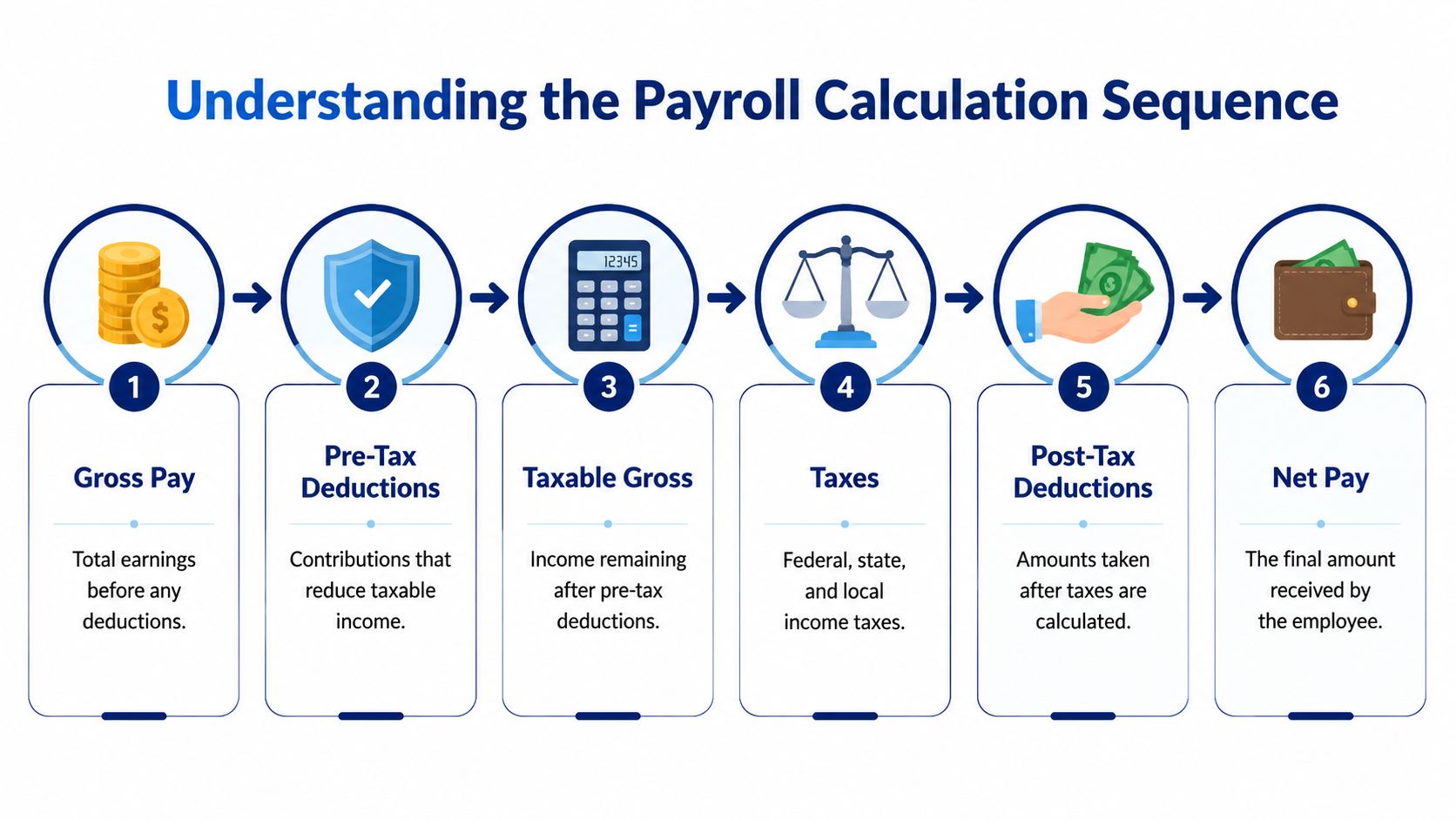
Use this mental model:
That's the cleanest way to explain it to a non-specialist. If you're building a household budget, you don't decide what's left in your wallet until you've already handled required obligations. Payroll works the same way. The timing of the deduction determines whether it changes taxable wages or only changes final take-home pay.
According to Paycor's explanation of post-tax deductions, federal income tax, Social Security, Medicare, and any state or local income tax are withheld first, and then post-tax items such as Roth contributions, union dues, garnishments, or certain insurance premiums are subtracted. That's why these deductions reduce net pay without lowering current taxable wages.
If your payroll system applies a deduction in the wrong place, the error doesn't stay contained. It can flow into tax withholding, employer payroll tax calculations, plan administration, and employee communications.
Practical rule: If a deduction is post-tax, it changes what the employee takes home. It does not change the current tax base.
That's the point many businesses miss. They think “deduction” automatically means “tax savings.” It doesn't. Some deductions are amounts withheld after taxes are already settled for that payroll run.
For leaders who want a broader process lens, Escrow Consulting Group's payroll guide is a useful reminder that payroll accuracy always depends on disciplined sequencing, documentation, and review. And if your challenge is operational consistency, this guide to streamlining your payroll process is a practical companion for tightening the process around deduction setup and review.
When an employee asks why a deduction didn't lower taxes, the answer should be direct:
If your team explains it this way every time, paystub disputes drop faster than if you rely on jargon.
The fastest way to create payroll problems is to blur the line between pre-tax and post-tax treatment. These categories are not interchangeable. They affect different parts of the paycheck, and they carry different consequences for the employer.
Pre-tax deductions generally reduce taxable wages before taxes are calculated. Post tax deductions come out after taxes have already been withheld. That's not a technical footnote. It's the whole issue.
Pre-tax changes the tax calculation. Post-tax changes the final paycheck.
That single distinction drives employee expectations, employer tax handling, and year-end reporting logic. It also affects how you explain elections such as retirement contributions and benefit premiums.
| Attribute | Pre-Tax Deductions | Post-Tax Deductions |
|---|---|---|
| Timing in payroll | Taken before applicable taxes are calculated | Taken after applicable taxes are calculated |
| Effect on taxable wages | Lowers current taxable wages | Does not lower current taxable wages |
| Impact on net pay | Reduces pay, often with current tax benefit | Reduces pay without current tax reduction |
| Employer payroll tax impact | Can affect the current tax base | Does not lower the employer's current FICA tax base |
| Common examples discussed in payroll practice | Traditional retirement or benefit deductions, depending on plan design | Roth contributions, union dues, garnishments, certain insurance premiums |
The most common mistake is assuming every employee-selected deduction should be treated the same way. That's wrong. Some elections are structured for immediate tax reduction. Others are structured for different downstream benefits or because the deduction is legally required and not elective at all.
That's why your payroll team needs a deduction map, not just software entries. Every deduction code should have an owner, a documented tax treatment, an authorization standard, and a review protocol. If you treat payroll setup as clerical work, classification errors become much more likely.
This gets even more important when you're modeling labor cost and cash flow. A deduction that doesn't reduce the employer tax base won't provide the same current-side impact as a pre-tax item. Leaders who are also reviewing financing and working-capital pressure should think about payroll decisions with the same discipline they apply to debt structure. For a useful finance-side framework, how to calculate business debt cost helps illustrate why small classification assumptions can change the true cost picture.
Use this quick internal test:
For a focused look at the other side of the equation, this explanation of a pre-tax contribution is useful when training HR staff or managers who need to distinguish the two cleanly.
The category becomes easier to manage once you stop thinking about it in the abstract. Most employers see the same post-tax deduction types again and again. The risk isn't that these items are unusual. The risk is that teams assume they're simple.

Roth 401(k) contributions are one of the clearest examples of post-tax treatment. The employee pays tax now, contributes after tax, and may later receive tax-free qualified withdrawals if the rules are met. As summarized in Oyster's post-tax deduction glossary, the account generally must satisfy a five-year participation period and the distribution must occur after age 59½ among other qualifying events for earnings to be tax-free.
That structure makes Roth elections strategically important, but it also makes employee communication important. Some employees see “retirement contribution” and assume all retirement deductions lower current taxes. Roth doesn't work that way.
Garnishments are different from elective deductions because the company often has little or no discretion once a valid order is in place. Payroll's job is to implement the withholding correctly, in the right order, and with the right documentation.
These deductions are often emotionally charged because the employee didn't “choose” them in the ordinary sense. That means your documentation needs to be tighter, your communication needs to be cleaner, and your payroll setup must match the order exactly as required.
If a deduction is mandatory, treat the paperwork like evidence. Because eventually, it may be.
A few other deduction types regularly show up as post-tax items in practice:
What matters isn't whether the deduction sounds voluntary, beneficial, or familiar. What matters is how the deduction is classified and administered in payroll.
When employees ask “Why is this post-tax?” they usually aren't asking about tax law. They're asking why the deduction reduced their check without reducing current withholding.
Use plain language:
If you also handle executive compensation or special reimbursement situations, this overview of tax gross-up can help your team understand how payroll design choices affect the employee's final pay experience.
Post tax deductions stop being a paystub issue and become a business exposure issue. If you operate across state lines, deduction handling can break in quiet ways. A setup error in one jurisdiction can sit unnoticed until an employee complains, a garnishment dispute arises, or a payroll audit forces you to reconstruct what happened.
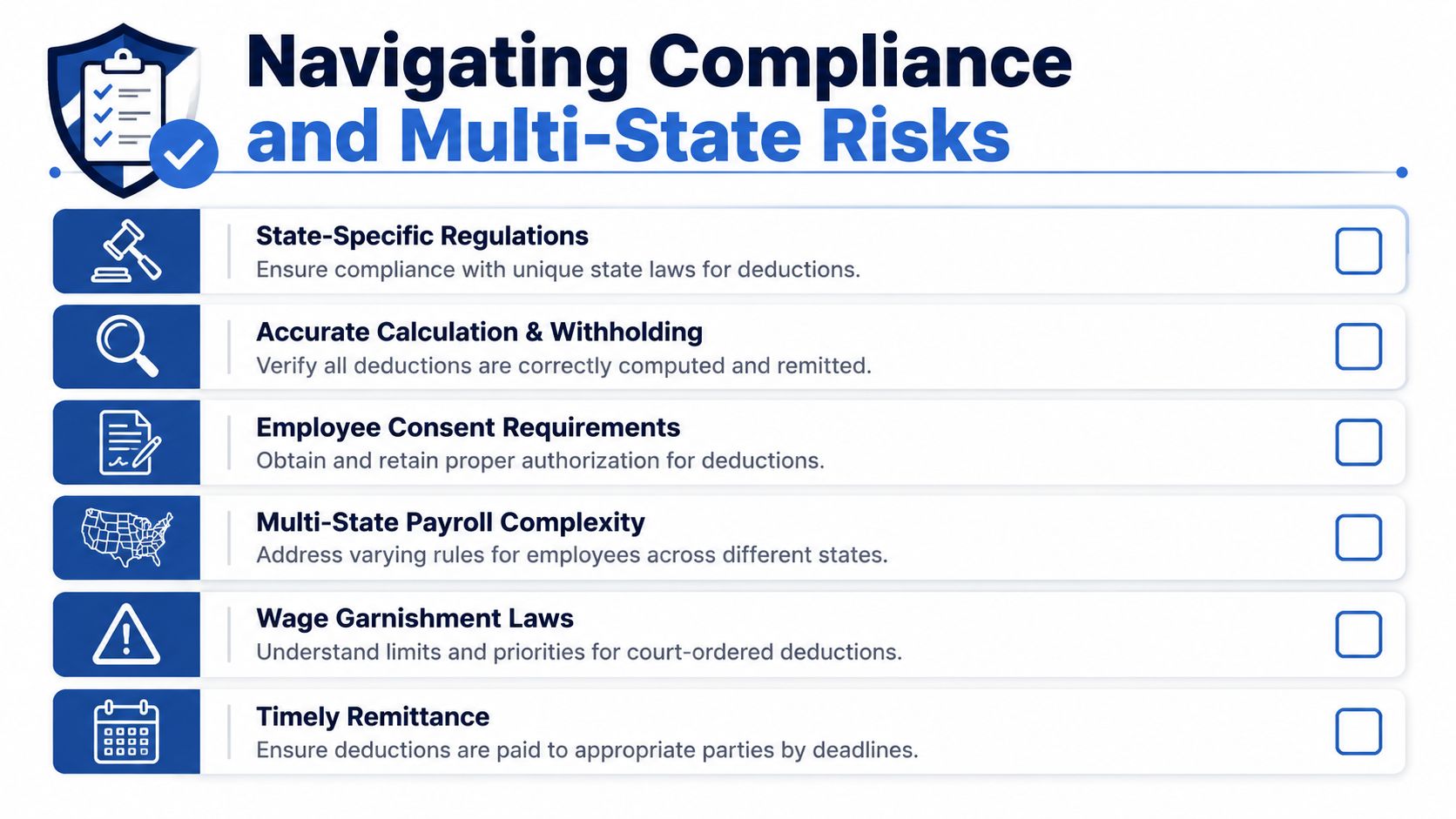
Misclassifying a deduction can affect taxable wages, employer payroll taxes, and plan administration. Paychex's payroll deductions guidance also notes the broader planning tradeoff that some post-tax benefits can leave both employee and employer paying more in current taxes, even if the employee may benefit later depending on the arrangement.
That means post-tax treatment is not just an employee net pay issue. It can alter employer cost, reporting assumptions, and benefit administration. Too many businesses delegate this entirely to software defaults. That's a mistake. Payroll systems process what people configure.
A single internal policy won't solve state-specific withholding differences. That's especially true when you're dealing with garnishments, notice handling, remittance timing, or overlapping employee elections.
Here's where multi-state businesses get exposed:
If your company has grown through acquisitions, rapid hiring, or geographic expansion, assume your deduction setup needs review.
A strong process answers four questions immediately:
| Question | What your team should be able to show |
|---|---|
| Why was this deducted? | A clear basis such as employee authorization, plan election, or legal order |
| Why was it treated as post-tax? | A documented classification tied to payroll and benefit rules |
| Was it applied correctly? | Paystub records, payroll code mapping, and review controls |
| Could you prove it later? | Retained notices, forms, and an audit trail of changes |
The real compliance test isn't whether payroll ran. It's whether you can defend each deduction after the fact.
That's the standard owners should use. “The system did it” is not a defense. If the deduction was wrong, regulators and employees won't care that the software made the calculation automatically.
If you need a practical starting point, focus on control points instead of theory.
The businesses that avoid payroll disputes aren't the ones with perfect employees. They're the ones with disciplined setup, clear ownership, and records that hold up under pressure.
Good payroll administration depends on two things. You need records that can stand up to scrutiny, and you need communication that keeps employees from guessing. If either piece is weak, post tax deductions become a recurring source of friction.

Every voluntary deduction should have a clear paper trail. That means a signed or authenticated authorization, the effective date, the deduction description, and the payroll code used to apply it. If the deduction changes, the change should be documented with the same discipline as the original setup.
Your payroll file should let a third party reconstruct what happened without relying on memory. That includes election forms, system change logs, remittance records where applicable, and paystub history. If a manager approved something informally by email or chat, formalize it before payroll touches the check.
A lot of confusion comes from terminology. As discussed in Deel's comparison of pre-tax and post-tax deductions, employees often ask payroll or HR to “deduct it post-tax” when they intend a personal tax-filing benefit. That misunderstanding creates documentation, authorization, and expectation-management risk.
Don't let your team mirror the employee's vague wording. Clarify what they mean before you act.
Use language like this:
Clear wording prevents bad assumptions. Bad assumptions create payroll disputes.
Use a short control checklist for every new deduction type:
Most employee pay disputes happen after the deduction appears. That's too late. Explain deduction timing during onboarding, open enrollment, and any point where employees make elections that affect net pay.
You don't need a long training session. A short paystub guide, a simple FAQ, and a disciplined escalation process are enough for most SMBs. What matters is consistency. If one employee hears “this lowers your taxes” and another hears “this comes out after taxes,” your process isn't stable.
When payroll complexity starts pulling managers, HR, and operations in different directions, outside guidance can help you create a cleaner, more defensible structure without overcomplicating the employee experience.
If your leadership team needs help building defensible payroll and HR practices around deductions, classifications, and multi-state compliance, Paradigm International Inc. can help you assess the risk, tighten the process, and improve documentation before a routine paystub issue turns into a larger problem.