
An employee asks for a proof of income letter on short notice. They may be trying to secure an apartment, close on a home, or complete an immigration filing. For the business, that request looks simple. In practice, it's a formal statement about employment and compensation that another party may rely on to make a high-stakes decision.
That's why a proof of income letter from employer shouldn't be treated like routine admin work. If the letter is vague, inaccurate, or signed without verification, the company creates avoidable risk. If the process is standardized and tightly controlled, the same request becomes a clean, defensible HR function.
A proof of income letter from employer is usually treated as a formal employment-verification document. Guidance on proof of income or employment letters states that it should include the employee's name, the employer's contact details, the employee's job title, employment status, dates of employment, typical salary or wage, pay basis, and sometimes bonuses or commissions. In other words, the letter needs to connect identity, role, tenure, and compensation in one employer-issued record.
Business owners often underestimate the legal weight of that record. A lender, landlord, or government reviewer may use it in place of other documents when payroll evidence is unavailable, incomplete, or under review. If your team issues these letters inconsistently, you risk conflicting statements, privacy problems, and unnecessary disputes.
A safer approach starts with structure. That means a standard template, a limited approval path, and a rule that no one improvises language under pressure. If you need a baseline on the broader employment verification context, the guide on what is a letter of employment is a useful companion.
Most risk in income letters doesn't come from the request itself. It comes from informal drafting, weak review, and statements that go beyond verified facts.
The letter should answer one question clearly: what can the employer verify from its own records today? Once you frame it that way, the drafting decisions become much easier.
A defensible income letter does one job. It confirms facts the employer can verify from current records, in language that will still hold up if the recipient asks follow-up questions or compares the letter against payroll data.

The strongest letters are narrow, specific, and easy to audit. Each field should tie back to a record your team already maintains.
Accuracy matters, but so does framing. For example, if an employee earns base pay plus commission, the letter should separate those categories instead of blending them into one number. That reduces the risk of overstating stable income and gives the recipient a cleaner record to evaluate.
Letters become risky when a manager adds extra commentary to be helpful. That is where defensibility starts to break down.
Avoid including:
From a risk standpoint, extra language creates two problems. First, it can conflict with payroll records or later employment actions. Second, it expands the scope of what the company appears to be certifying.
A rental request usually calls for a narrow confirmation:
This letter confirms that [Employee Name] is employed by [Company Name] as a [Job Title] and is currently employed on a [full-time/part-time] basis. Current compensation is [salary or wage] paid on a [pay basis] basis.
A mortgage request usually requires tighter drafting. State current base pay, identify the pay basis, and label commissions, bonuses, or other variable earnings separately if the company chooses to include them.
An immigration-related request often carries the highest wording risk. HR should not copy attorney-drafted language into the letter without review. A safer practice is to confirm only the facts the employer can support from current records and approved internal wording.
The strongest letters are specific to the request without becoming expansive. A generic template helps, but the final draft should reflect the decision the third party is trying to make.

Mortgage reviewers usually care about stability, current pay, and whether the numbers reconcile with payroll records. That means HR should slow down and verify every compensation field before release.
A useful mortgage-oriented letter often includes:
A sample line might read:
[Employee Name] is currently employed as a [Job Title]. Current base compensation is [amount] paid on a [basis] basis. Additional compensation, if any, is paid according to company plans and recorded through payroll.
That last sentence matters. It acknowledges that variable compensation may exist without overstating predictability.
Rental verifications are often simpler. Most landlords want to know whether the person is employed and earning enough to support the lease. Over-disclosure doesn't help.
Use a tighter version of the letter:
A rental version might say:
This letter confirms that [Employee Name] is currently employed by [Company Name] as a [Job Title]. [He/She/They] is employed on a [full-time/part-time] basis and currently earns [amount] on a [pay basis] basis.
That format is direct and easy for a property manager to review.
Immigration letters often create the most internal pressure because the employee may arrive with prewritten language from outside counsel. HR should be careful here. The company can support the employee without surrendering control over the wording.
Use a controlled workflow:
A compliant draft may include current title, current status, start date, and present compensation. If the request asks for words such as “permanent” or “full-time,” use those only if they accurately match your internal classification and approved terminology.
Practical rule: Tailor the letter to the use case, but never tailor facts to fit the employee's preferred outcome.
That principle keeps the process fair and keeps the document credible.
The letter is only one part of the risk picture. The stronger control point is the workflow behind it. A defensible verification workflow includes collecting authorization, confirming details against payroll or HRIS data, and issuing the letter only after those records align, as described in Experian's guidance on common income verification challenges.
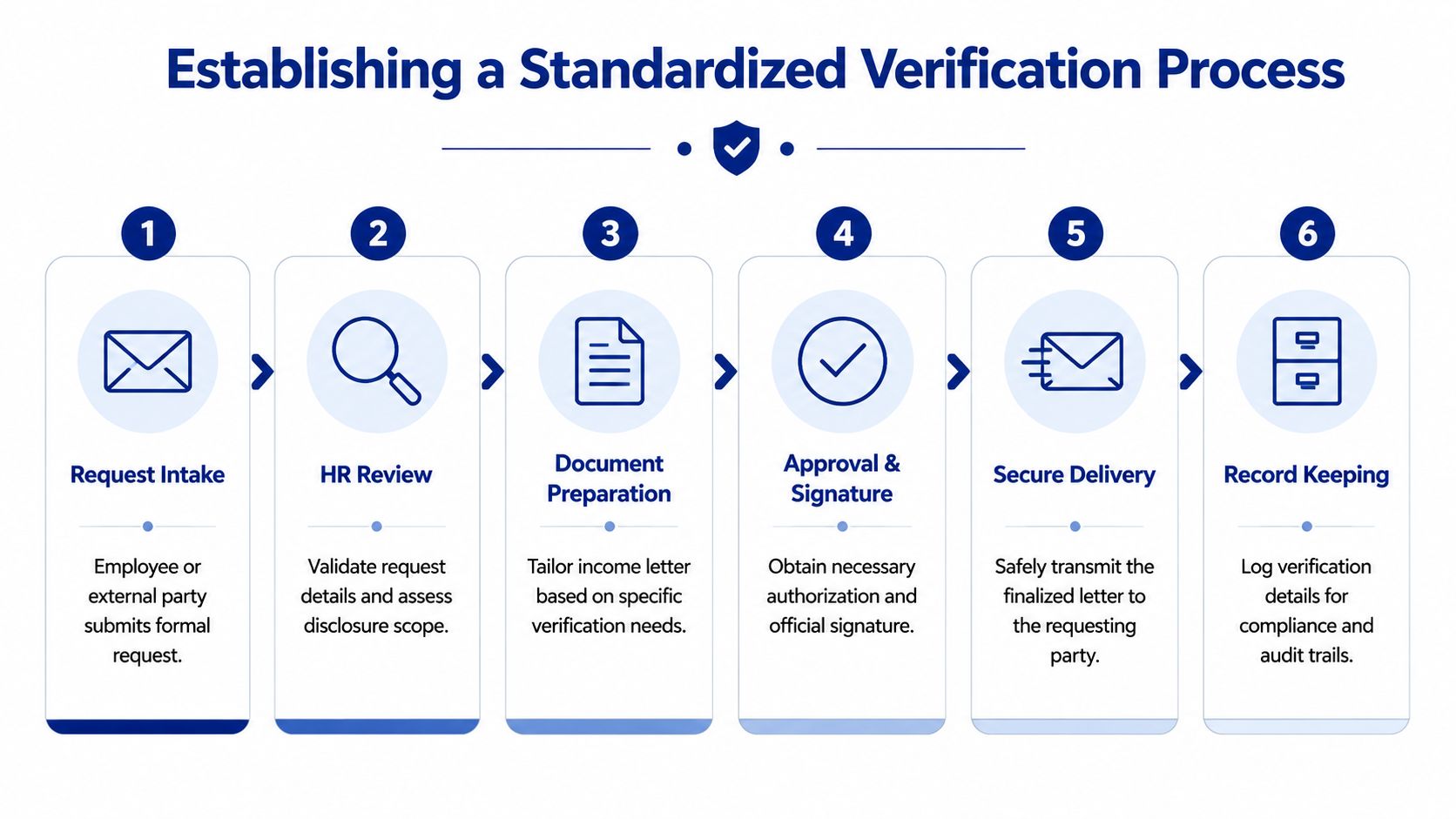
Start with a formal request. Don't let managers handle these over email or text with no documentation.
Your intake process should require:
This simple gatekeeping step prevents accidental disclosures and inconsistent responses.
Once the request is approved, verify the facts from source systems. Pull compensation and employment details from payroll, HRIS, and any necessary compensation records. If those systems don't match, resolve the discrepancy before drafting anything.
Many companies need better discipline. Teams that are serious about building compliant vetting procedures often apply the same thinking: centralize authority, define acceptable evidence, and create escalation paths for edge cases.
A practical internal table can help:
| Workflow stage | Control point | Common mistake |
|---|---|---|
| Intake | Confirm written authorization | Releasing information based on verbal approval |
| Verification | Match payroll and HRIS data | Using outdated salary information |
| Drafting | Use approved template language | Ad-libbing wording for special requests |
| Approval | Limit signature authority | Letting local managers sign |
| Delivery | Send securely | Emailing sensitive details to the wrong recipient |
| Record keeping | Retain request and final copy | Failing to log what was disclosed |
Use one approved template family, not dozens of local versions. Designate signature authority to HR, legal, finance, or another trained function. If your company uses an outside advisor for documentation standards, this is the kind of process Apex International Inc. supports for businesses that need more control over high-risk HR workflows.
Retention matters too. Keep the request, authorization, supporting data review, final signed letter, and delivery record together. If you're auditing your broader documentation practices, the guidance provided on employment records retention requirements is worth reviewing.
Standard templates break down when the employee's pay or status isn't simple. That's where policy matters most. Verification now extends beyond traditional salaried employees. Experian notes in its discussion of understanding income verification documents that acceptable proof may include variable income, gig work, severance, and benefits.
Centralization matters most in the unusual cases. Local managers tend to improvise, and improvisation creates unequal treatment and inconsistent records.
Multi-state employers often let branch leaders or practice administrators handle “simple” requests. That creates avoidable exposure. One location includes bonus history, another refuses to confirm pay, and a third sends a letter without written consent. The inconsistency becomes the risk.
A centralized policy solves that. It gives every location the same intake form, same template rules, same approval chain, and same escalation path for exceptions. It also protects local managers from being pulled into decisions they aren't trained to make.
Income verification has moved beyond the old model of a one-off letter typed on demand. Ondato's review of proof of income verification practices notes that employer-provided verification now sits within a broader, often digitized ecosystem alongside pay stubs, tax forms, and W-2s. For employers, that means the letter should be handled like a defensible record, not a favor.

Federal law may not require employers to issue these letters in a uniform way, but multi-state businesses still face privacy, personnel record, and consistency issues. If one state location discloses more than another, the company may create a disparate treatment problem even when the original request seemed harmless.
The practical risk points are familiar:
Use simple operating rules that every site can follow.
In some cases, a compensation question may intersect with payroll tax treatment, classification, or other accounting issues. That's where coordination with legal counsel or a qualified CPA can help clarify what should and should not be represented in the document. For businesses operating across jurisdictions, that discipline should also line up with broader wage and hour compliance controls.
A good policy doesn't just tell staff what to include. It tells them what they are never allowed to say.
That distinction is what turns a template into a risk-management tool.
A proof of income letter from employer is easy to underestimate because the document is short. The risk sits behind the page. Once a company signs and releases that letter, it has made a formal statement that another party may rely on.
The safest practice is straightforward. Use a standard request process, require written authorization, verify every fact against source records, limit who can sign, and retain a clean record of what was issued. Most technical failures happen when the letter doesn't match the underlying payroll evidence. LlamaIndex's guidance on income verification review controls notes that gross monthly income, year-to-date totals, and pay-period math should be reconciled before any letter is signed.
That level of care isn't bureaucracy. It's good operational judgment.
Creating and maintaining these systems gets harder as your company grows, adds locations, or handles more edge cases. If you need support building defensible HR practices around documentation, approvals, and multi-state consistency, it helps to work with a team that understands the risk.
If your organization needs a clearer process for proof of income letters, employment verification, or other sensitive HR documentation, Paradigm International Inc. can help you build practical, defensible systems that support growth without adding avoidable exposure.