A business owner calls payroll to process a final check for a departing employee. The balance looks simple. A few unused PTO days, regular wages, done. Then someone notices the employee worked in a different state than the company's headquarters, and the answer changes from routine administration to wage-law exposure.
That situation happens constantly in growing companies. PTO feels like a policy issue until separation turns it into a final-pay issue. If your workforce spans multiple states, the safest approach isn't memorizing every rule. It's building a framework that can hold up when the facts change quickly.
A multi-state employer can terminate two employees with the same PTO balance on the same day and still face two different payout obligations. The difference usually comes down to where each person worked, how the policy was written, and whether that state treats accrued leave as something the employee has already earned.
That is why final pay problems often start with an otherwise reasonable process. One handbook. One separation checklist. One payroll script. Those tools create consistency, but consistency alone does not reduce risk if the underlying state rules point in different directions.
In practice, the legal exposure usually comes from treating PTO as an administrative detail instead of a separation issue tied to final pay. Some states require payout of accrued vacation or PTO in at least some circumstances. Others give employers more room to control the outcome through policy language. For a company operating across state lines, the same termination can produce a lawful forfeiture in one state and a wage claim in another.
The recurring errors are predictable:
I see the same pattern in audits and separation disputes. A company writes a clean nationwide forfeiture rule, applies it uniformly, and learns too late that one state will not honor it. By then, payroll has already closed the file, the employee has raised a demand, and the cost of fixing a small payout issue has grown into attorney time, agency exposure, or a need for legal help for backpay claims.
The practical answer is not to memorize every state rule. It is to build a defensible framework. Confirm the employee's work state, classify the leave balance correctly, compare the handbook language to that state's limits, and review the payout decision before the final check is released.
Practical rule: For multi-state employers, PTO payout review should be a standard separation control, not a last-minute payroll judgment call.
A defensible process starts by identifying what the unused PTO represents under the governing state's law.
Everything turns on a single legal distinction. Is the employee's accrued PTO treated as earned wages or as a fringe benefit governed mainly by policy? Once you know that answer, the rest of the analysis gets clearer.
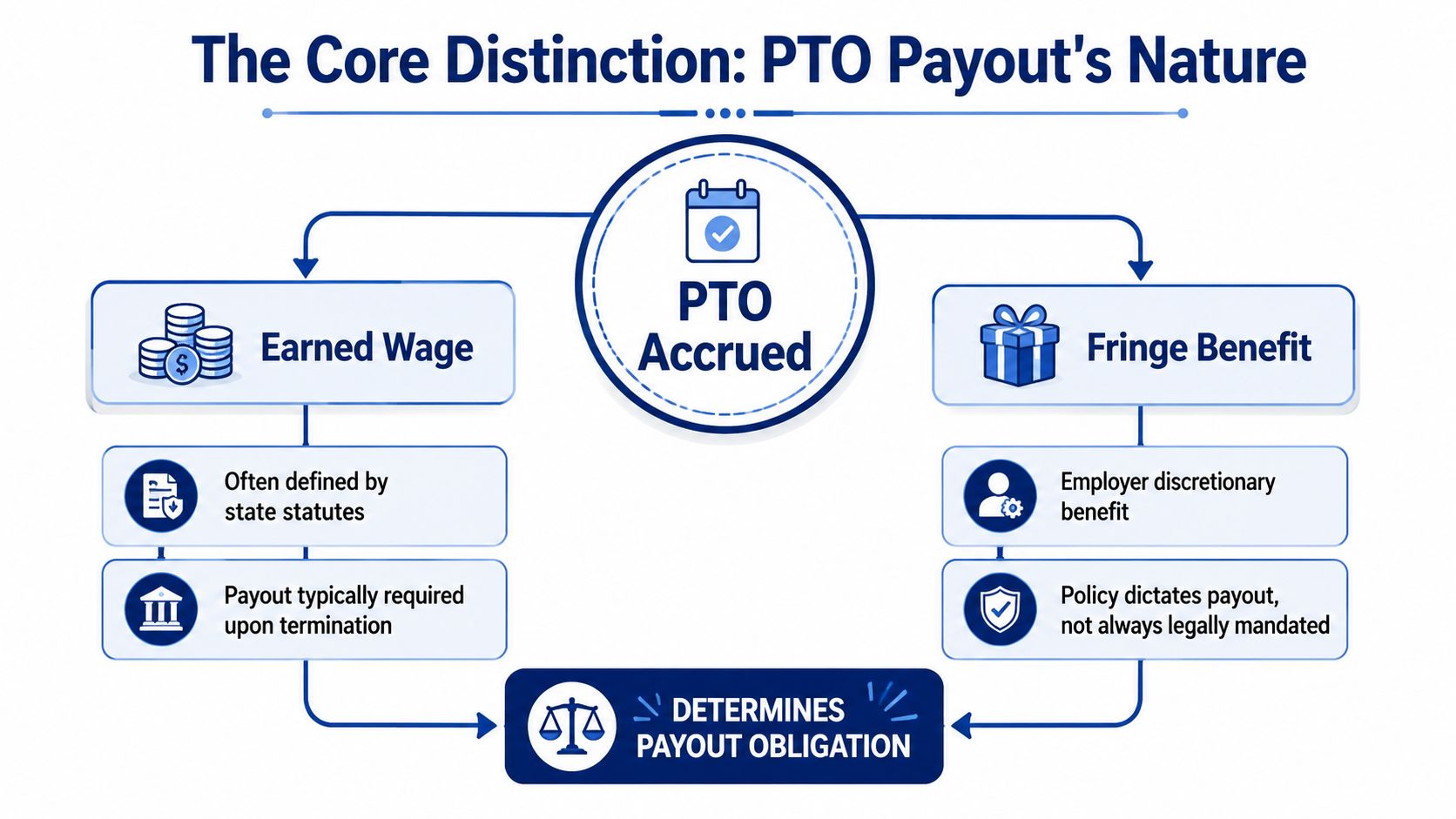
Some states take the view that accrued vacation is compensation the employee has already earned. In those states, the employer usually can't erase that value with handbook language. Others treat PTO more like an employer-provided benefit, which gives policy language much more control over whether unused time is paid out at separation.
A major split in PTO law is that some states treat accrued PTO as earned wages rather than a discretionary benefit. California is widely cited as requiring payout of all unused accrued vacation because earned vacation can't be forfeited. Colorado similarly treats earned vacation or combined PTO as wages and prohibits use-it-or-lose-it forfeiture. Massachusetts' Wage Act requires payment of all unused accrued vacation on separation, as summarized in TimeClick's state PTO law guide.
That classification matters for more than payout. Once PTO is treated like wages, timing rules tighten, final-pay obligations become more serious, and disputes can move quickly into wage-claim territory.
In other states, the employer's written policy often decides whether unused PTO is forfeited or paid. That gives employers more design flexibility, but only if the policy is clear, current, and applied consistently. A vague handbook creates its own risk because employees, managers, payroll staff, and judges may read it differently.
Here's the practical takeaway. Don't ask only, “Do we offer PTO?” Ask, “How does the controlling state characterize this PTO once employment ends?”
If a dispute does arise over unpaid time that may be treated like wages, business leaders sometimes need outside counsel with experience in wage disputes and legal help for backpay claims, especially when separation decisions involve conflicting policy language or multi-state facts.
The legal label attached to PTO often matters more than the PTO label in your handbook.
A termination can look routine until payroll asks one question: does this employee's unused PTO have to be paid out under the law of the state that controls the separation? In some states, the answer is yes, and the handbook does not change it.
Several states treat accrued vacation or PTO as a payment obligation at separation, including California, Colorado, Illinois, Louisiana, Massachusetts, Montana, Nebraska, New Mexico, New York, and North Dakota. The exact rule still varies by state. Some states treat the time as earned wages once accrued. Others reach a similar result through wage-payment rules or restrictions on forfeiture.
For employers with people in multiple states, the compliance problem is not just identifying the states on the list. The main issue is building a process that catches those employees before final pay is issued. If HR, payroll, and local managers are working from different assumptions, the mistake usually shows up at the worst time, after separation, when wage claim deadlines and penalty exposure are already in play.
The legal reasoning differs, but the operational effect is similar. Once a state requires payout of accrued leave at termination, policy language has limited value if it conflicts with that rule.
That creates a few practical consequences:
California, Colorado, and Massachusetts often set the floor for cautious employers because they reflect a stricter earned-leave approach. Even if your workforce in those states is small, those rules tend to influence the policy framework you apply across the company. That is often the cleaner choice from an administration standpoint, but it can increase payout cost if you apply a stricter rule nationwide than the law requires.
A more defensible approach is to group states by compliance risk and then decide where you want to standardize and where you want state-specific exceptions.
| Group | What it means for the employer |
|---|---|
| Earned-wage states | Accrued vacation or PTO is treated like compensation already earned, so forfeiture options are narrow or unavailable |
| Payout-trigger states | State law, court decisions, or agency rules create payout obligations in defined circumstances |
| Final-pay enforcement states | The payout amount may be only part of the risk. Timing errors can create separate exposure |
That framework helps business owners make real policy choices. A single national payout rule is easier to administer and easier to defend, but it may cost more. A state-by-state rule set can reduce unnecessary payouts, but only if your HRIS, handbook, offer letters, manager training, and separation checklist all stay aligned.
The strongest multi-state policies solve for both legal accuracy and execution. Tag the governing state for each worker in your HR system, define whether the leave bank is vacation, PTO, or another category, and require a final review before termination pay is approved. That is how employers reduce avoidable wage claims instead of reacting to them after the employee is gone.
In the majority of states, there isn't a statute that broadly mandates PTO payout at separation. That doesn't mean employers are free from risk. It means the risk shifts from statutory payout mandates to policy drafting, policy administration, and documentation discipline.
When policy governs, the handbook becomes evidence. If the language is unclear, inconsistent, or contradicted by actual practice, the employer loses the benefit of having a policy-driven state in the first place.
A defensible policy in these states should answer basic questions in plain language:
If your policy says one thing and your managers tell employees another, the written document won't carry much weight. The same problem comes up when payroll has an internal practice that doesn't match the handbook.
Many employers rely on short statements like “unused PTO is not paid at termination unless required by law.” That's better than silence, but it still leaves openings if the policy doesn't define accrual mechanics, doesn't distinguish vacation from sick leave, or doesn't address employees who transfer between states.
A short policy may look clean. In a dispute, that same brevity can leave too much room for argument.
In policy-driven states, the strongest employers do three things well. They write precise language, train managers not to improvise around that language, and make sure payroll follows the same rule every time. Consistency is what makes the handbook enforceable in practice instead of merely aspirational.
Executives rarely need a law-school survey. They need a fast way to spot which separations need deeper review. For PTO payout laws by state, the quickest framework is to sort jurisdictions into three operational buckets: mandatory payout states, policy-governed states, and states that require closer analysis because payout may depend on the employer's own promises.
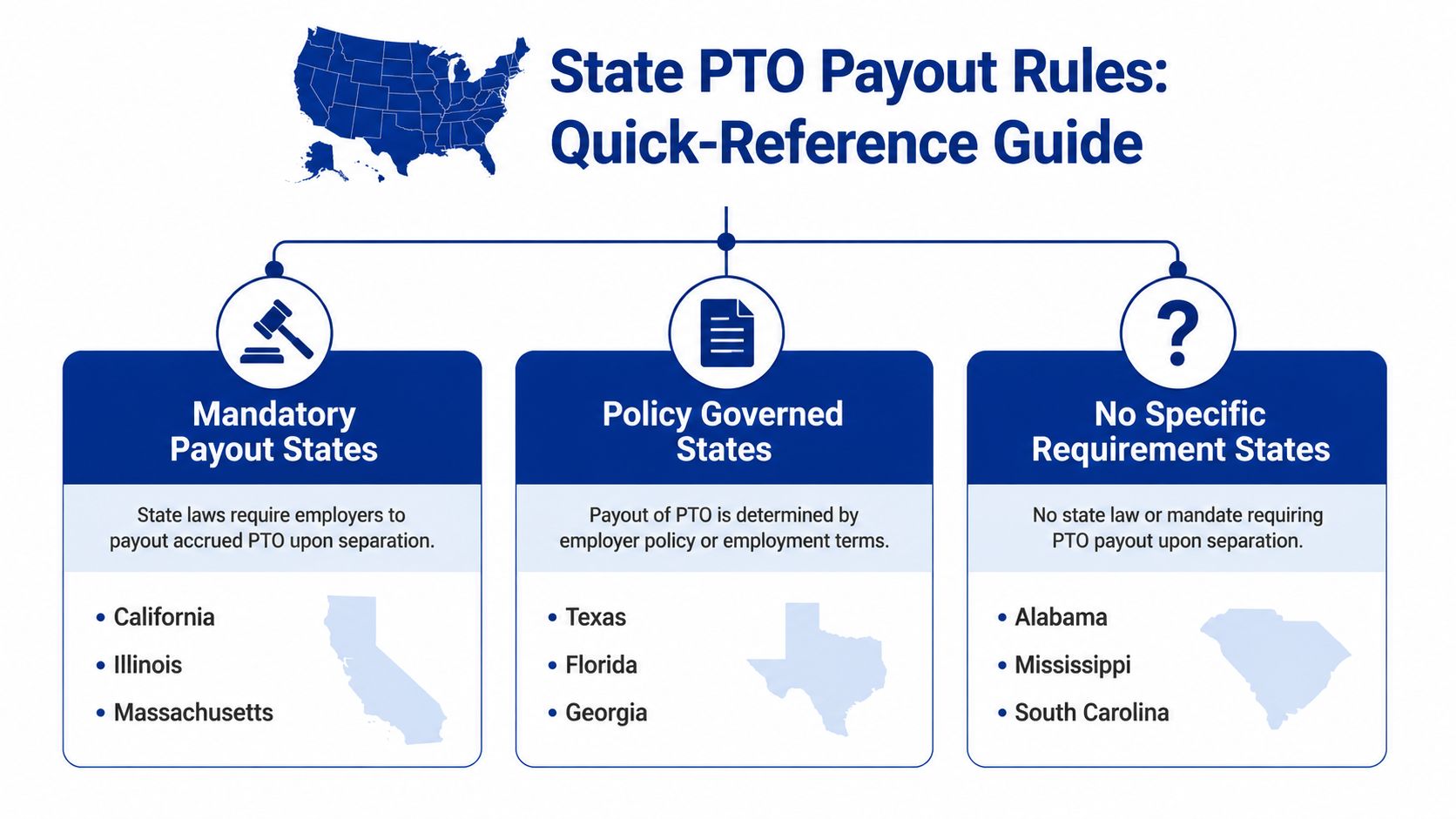
This chart isn't a substitute for legal review. It is a useful operating model.
| Category | How to think about it | What HR should do |
|---|---|---|
| Mandatory payout states | State law creates a payout obligation for accrued unused leave | Build payout into separation workflow by default |
| Policy-governed states | Written policy usually controls whether unused PTO is paid or forfeited | Audit handbook language and administration practices |
| Conditional or promise-based states | Employer commitments may create enforceable obligations | Review offer letters, handbook text, and historical practice together |
For a multi-state employer, that third category is where surprises tend to happen. The company assumes there is no statutory mandate, but its own handbook or onboarding documents create one.
A strong quick-reference guide should help your team answer these questions fast:
If your company operates in Texas, for example, final-pay timing and separation workflows still matter even where the PTO answer may depend more heavily on policy. That's why teams often pair a PTO matrix with a final-pay process tied to state-specific rules such as this overview of Texas final paycheck law.
A quick-reference tool should reduce delay, not create false confidence. It's a triage device. It tells payroll and HR which file can move forward and which file needs review before someone issues the check.
That distinction matters because payroll errors usually don't start with bad intent. They start with a rushed assumption that one state works like another.
Employers often ask whether they can require employees to use PTO by year-end or lose it. The answer depends on whether the state allows forfeiture of already-earned time. That's where many otherwise careful policies go off track.
The better question is narrower: are you taking away earned PTO, or are you limiting future accrual once an employee reaches a cap? Those are not the same thing.
States without a PTO payout statute generally defer to the employer's written policy, while states with payout mandates may still allow policy-driven limits only when they don't conflict with earned-wage rules. California and Colorado are repeatedly identified as prohibiting use-it-or-lose-it forfeiture of accrued vacation, while other states allow employer-designed accrual caps that stop future earning but don't erase already-earned time, as explained in OnPay's PTO payout primer.
That distinction is critical.
One approach destroys value the employee has already accrued. The other manages balance growth without confiscating earned time.
Accrual caps are generally easier to defend than forfeiture rules because they address liability growth prospectively. They also encourage employees to take time off without creating the same legal conflict in stricter states.
A practical policy design often includes:
If your goal is balance control, an accrual cap is often a safer policy tool than a forfeiture rule.
What doesn't work is mixing front-loaded leave, accrued vacation, and discretionary bonus days into one undefined bucket and then applying a blanket year-end forfeiture clause. That design creates confusion over what was earned and what can legally be excluded from payout.
The most defensible employers maintain a state-by-state matrix that tracks payout obligations, forfeiture limits, and separation timing rules. Without that matrix, “use it or lose it” language tends to migrate into places it doesn't belong.
A national PTO policy sounds efficient. In practice, it often creates blind spots. The more states you operate in, the more likely it is that a single uniform rule will be either too aggressive for some jurisdictions or too generous for others.
The better approach is a policy framework with controlled variation. That means one governing structure, paired with state-specific adjustments where the law requires them.
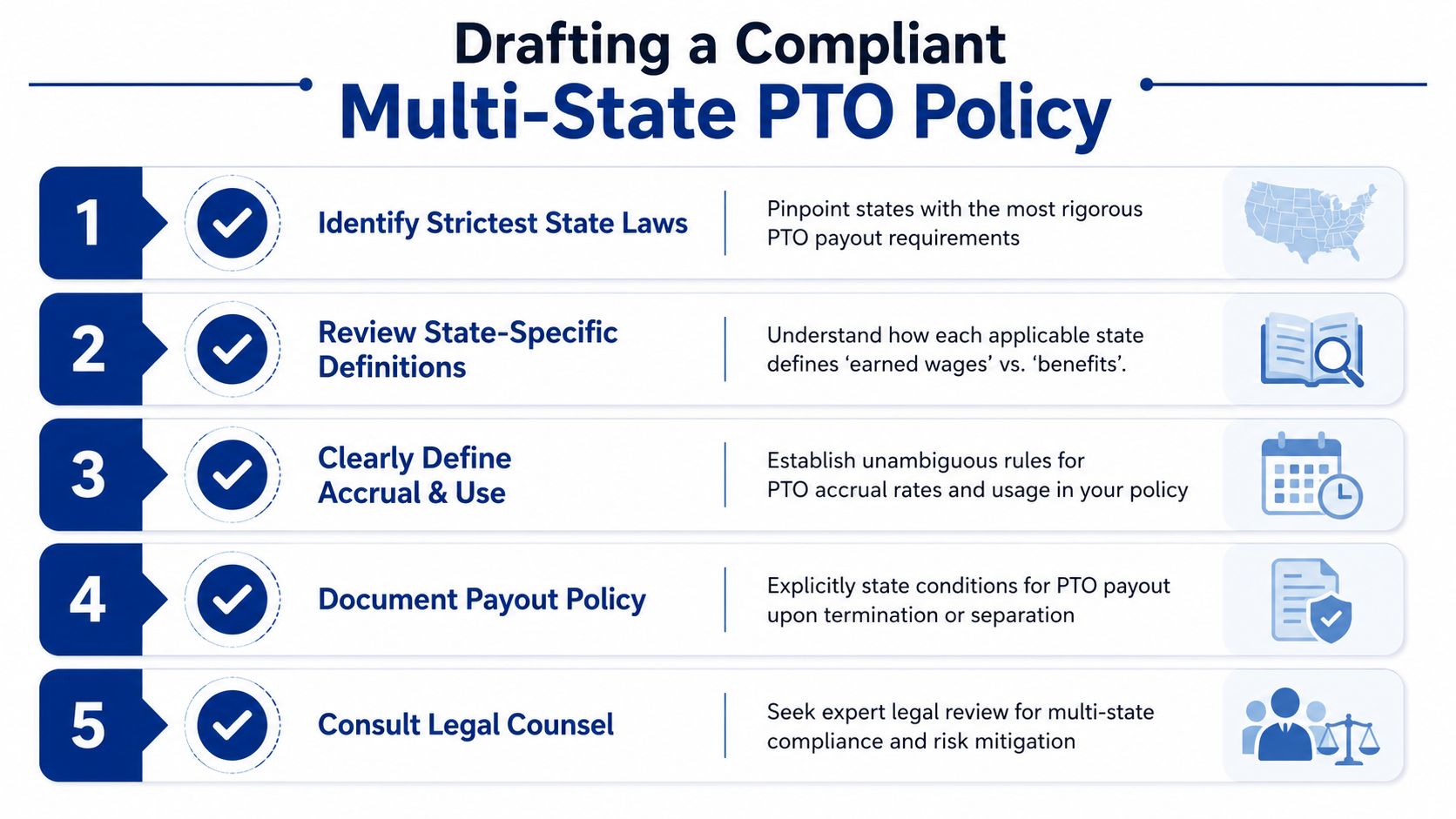
A defensible multi-state PTO policy should answer five core issues without ambiguity:
One drafting mistake appears constantly. Employers use the term “PTO” as if it has one legal meaning everywhere. It doesn't. If your plan includes front-loaded leave, discretionary shutdown days, or unlimited PTO arrangements, those features should be described separately so they aren't accidentally treated like accrued vacation wages.
Most multi-state employers end up choosing between two models.
This approach applies the strictest payout rule across the workforce. It reduces administrative complexity and lowers the chance that payroll will apply the wrong state rule. The downside is cost. You may voluntarily pay out balances in states where the law wouldn't require it.
This approach matches the policy outcome to each employee's governing state. It is legally adapted and can reduce payout expense where policy-driven forfeiture is allowed. The downside is operational risk. HR, payroll, and managers must execute the distinctions correctly every time.
Neither model is universally right. The right choice depends on your headcount spread, your payroll system, your tolerance for complexity, and how often employees transfer across states.
The strongest policies are not the longest. They are the clearest. They also connect policy language to actual payroll practice.
Use drafting concepts like these:
For organizations that need help building that structure, options may include employment counsel, payroll and HRIS configuration support, or an advisory partner such as Paradigm's paid time off policy guidance, which addresses state-dependent payout obligations as part of broader HR risk management.
Policy language should do two jobs at once. It should tell employees what to expect, and it should tell payroll exactly what to do.
A compliant framework also separates legal drafting from manager improvisation. Managers shouldn't promise departing employees that “we always pay PTO out” or “we never do” unless that statement matches the governing rule. Off-the-cuff assurances are how a manageable issue becomes a wage dispute.
The payout decision shouldn't start when payroll receives the termination notice. By then, the deadline may already be too close. A clean separation process starts with a checklist that links HR, payroll, and the governing state rule.
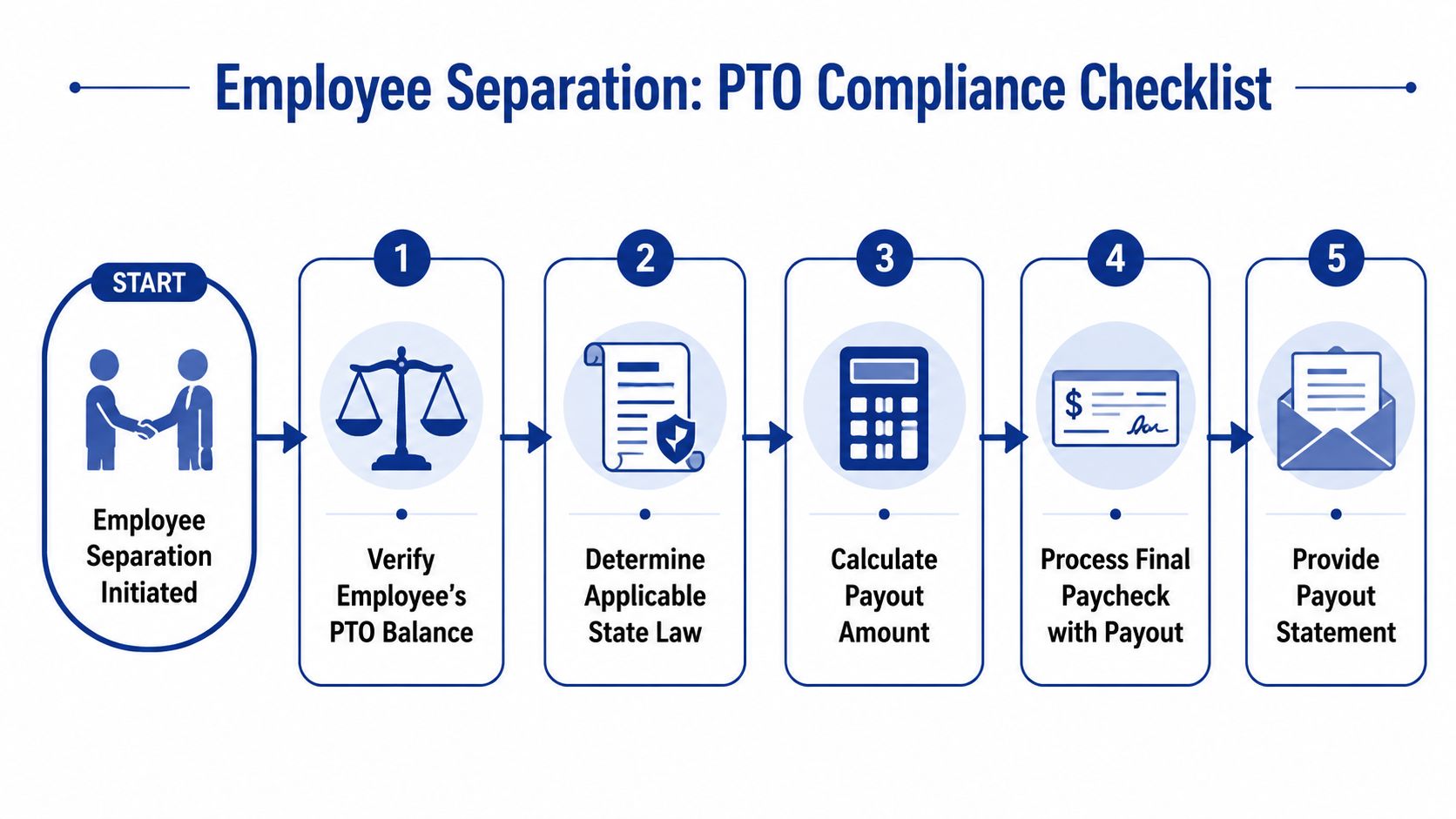
Use a repeatable sequence for every departure:
Confirm the work state
Don't assume the company office location controls. Verify where the employee worked for legal purposes.
Identify the leave type
Separate accrued vacation or PTO from sick leave, front-loaded grants, and discretionary time.
Check the governing policy and state rule
Review the handbook, any state addendum, and any offer-letter language that could affect payout.
Calculate the balance carefully
Make sure payroll uses the correct accrual cut-off and rate.
Match payout timing to final-pay timing
Many employers stumble on this point, especially when the amount is right but the timing is wrong.
California requires accrued vacation to be included in the final paycheck, which is due immediately upon involuntary termination, while Illinois pays by the next regular payday. Sources also warn that paying PTO after the final wage deadline, even in a separate check, can trigger late-payment penalties in states like California, as noted in Rippling's PTO payout law guide.
That means a late PTO payment isn't always a minor correction. In some states, it can become a final-pay violation.
Keep a short written record of:
This documentation matters when an employee later says the company misapplied its own policy. A brief, dated record can resolve a dispute faster than a long after-the-fact explanation.
A manager terminates a remote employee on Friday afternoon. Payroll runs from a different state. The handbook says one thing, the local rule says another, and the risk is no longer theoretical once the final check goes out.
The practical takeaway is straightforward. PTO payout should be handled as a final-pay control, not as a handbook footnote. Employers that get this right usually do three things well. They assign ownership across HR, payroll, and legal review, they build state-specific rules into the separation process, and they document why a payout decision was made before anyone closes the file.
That approach gives leaders something more useful than a chart of state laws. It gives them a policy framework they can defend. If a former employee, agency investigator, or plaintiffs' attorney asks why the company paid or did not pay a balance, the answer should be traceable to the governing state rule, the written policy, the leave classification, and the pay timing used.
The cost difference matters. A short review before termination often prevents wage claims, penalties, reissued checks, and credibility problems that start with PTO but rarely end there.
If you need help building a defensible PTO payout framework for a multi-state workforce, Paradigm International Inc. works with business owners and leadership teams to bring structure to high-risk employment decisions, clarify policy design, and reduce preventable compliance exposure.