


A candidate in another state accepts an offer on a Friday. Payroll adds the address, the first check clears, and the file closes. Months later a notice arrives from a revenue department in a state the company has never filed in, addressed to an entity that was never registered to do business there.
That gap is the whole problem. Setting up payroll in a new state is an administrative task. Registering as an employer in a new state is a legal one, and it runs on several tracks that a payroll provider doesn't own. Someone at the company has to know which tracks apply and start them before the first wage payment, not after the first notice.
One question decides the rest: does this hire make the company "doing business" in that state?
For most growing employers the answer is yes, and the trigger is wider than they expect. The U.S. Small Business Administration identifies an employee working in the state as one indicator that a company is conducting business there. An entity formed in one state is a domestic company there and a foreign entity in every other state where it is active, which is why the paperwork changes the moment someone works from a new address.
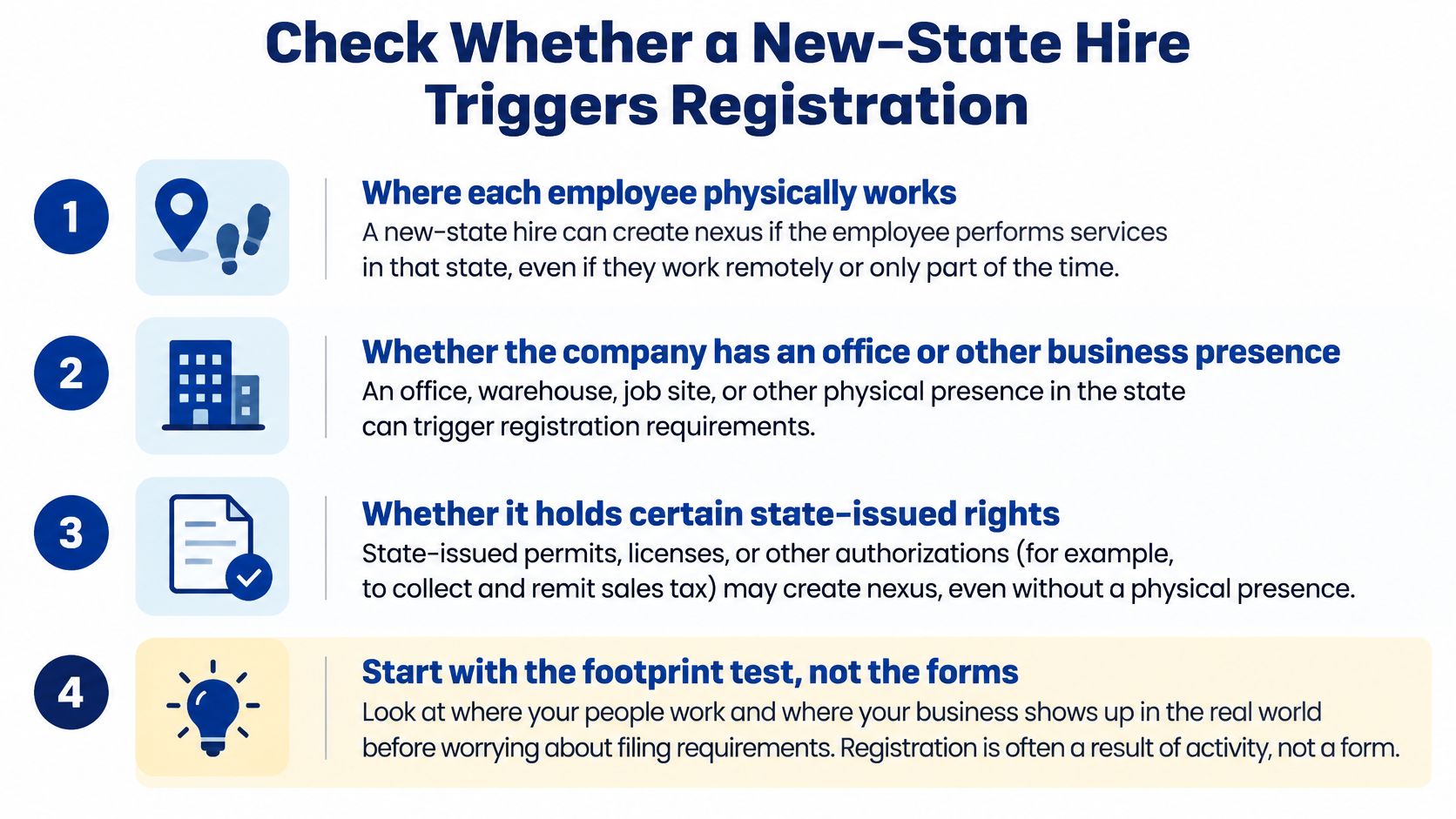
Answer four footprint facts for the new state before any offer goes out.
If any of the four applies, open a registration review before the start date.
That review is rarely one filing. Foreign qualification, state tax registration, unemployment insurance, payroll withholding, local licensing and a sales tax nexus check can all start with the same hire, and they sit with different agencies that don't talk to each other. The common failure is treating the first employee in a new state as a payroll change rather than a registration trigger.
International Inc.'s multi-state work has included a nationwide employer of roughly 75 people across several states with no in-house HR department. At that size, compliance is nobody's full-time job, so the hire gets handled by whoever owns payroll and the entity question never gets asked. The classification question sits underneath all of it too. A contractor who has been doing the work in that state for a year may already be an employee under the independent contractor versus employee test, which moves the registration date, not just the tax form.
Practical rule: put the new-state facts on one page, mark which of the four indicators applies, and name the person who signs off before an offer is released. If that page can't be filled in, the hiring decision isn't ready.
A payroll provider can process wages before the business has completed every registration required to operate in that state. Keep these filings distinct: foreign qualification, where required, registers the entity to do business; employer tax and insurance accounts address the employee and payroll obligations.
| Account or filing | Issued by | Needed by | Common miss |
|---|---|---|---|
| Foreign qualification (Certificate of Authority) | Secretary of State in the new state | Before operating, if required | Assuming payroll setup covers entity registration |
| Certificate of Good Standing | Secretary of State in the formation state | Before foreign qualification, if required | Ordering it too late for the filing |
| Registered agent | Appointed agent or officer in the new state | Before foreign qualification, if required | Failing to keep the agent's address current |
| Employer Identification Number (EIN) | IRS | Before paying wages | Registering the entity but omitting payroll-tax accounts |
| State withholding account | State tax agency | Before the first payroll, if required | Using the home-state account for an employee working elsewhere |
| State unemployment insurance account | State workforce agency | Before the first wage payment, if required | Using the home-state account for an employee working elsewhere |
| State temporary disability or paid family leave account | State workforce or leave agency | Before the first payroll, where required | Copying another state's wage base or skipping the program |
| Workers' compensation coverage | Insurance carrier or state fund | Before the employee starts work, if required | Policy does not cover the new state |
| New-hire report | State new-hire registry | By the state's reporting deadline | Filing only with the home state |
| Local business license or permit | County or city | Before operating locally, if required | Missing rules outside the state system |
Which filings apply depends on the entity, the state's rules and the work being performed. Confirm requirements with the agency responsible for each account. State employment obligations may include withholding, unemployment insurance, workers' compensation and temporary disability insurance, with different agencies and processes in each state. Identify the relevant tax and workforce agencies, confirm filing and deposit schedules, and arrange required coverage before the first payroll.
A state unemployment insurance account has its own rate, wage base and filing cadence. Review the state unemployment insurance tax basics before the first return.
One account number does not mean one worksite. The Bureau of Labor Statistics reported 2,089,392 establishments covered by Multiple Worksite Reporting, equal to 17.2% of establishments and 70,337,715 employees, or 45% of employment, in its Quarterly Census of Employment and Wages data. Employers may report multiple establishments under one state unemployment-insurance account, while still reporting employment and wages by location.
County and city requirements sit outside the state system, so a state filing will not trigger them. Check with the new state, county and city for required licenses or permits. A city business tax registration or county permit can remain unaddressed if the company checks only the state portal.
A provider may run payroll for an employee in a state where the entity has not completed required registrations. A processed paycheck does not establish that the business is registered to operate or that the correct state accounts are in place. Payroll and benefits administration remain with the client's PEO or payroll provider; HR compliance support can help assess whether the required registrations exist. For guidance on building a reliable employee payment process, see this payroll setup guide.
Sequence matters because later filings depend on earlier ones. Each step below has a gate: the point by which it has to be finished and the reason it can't slide.
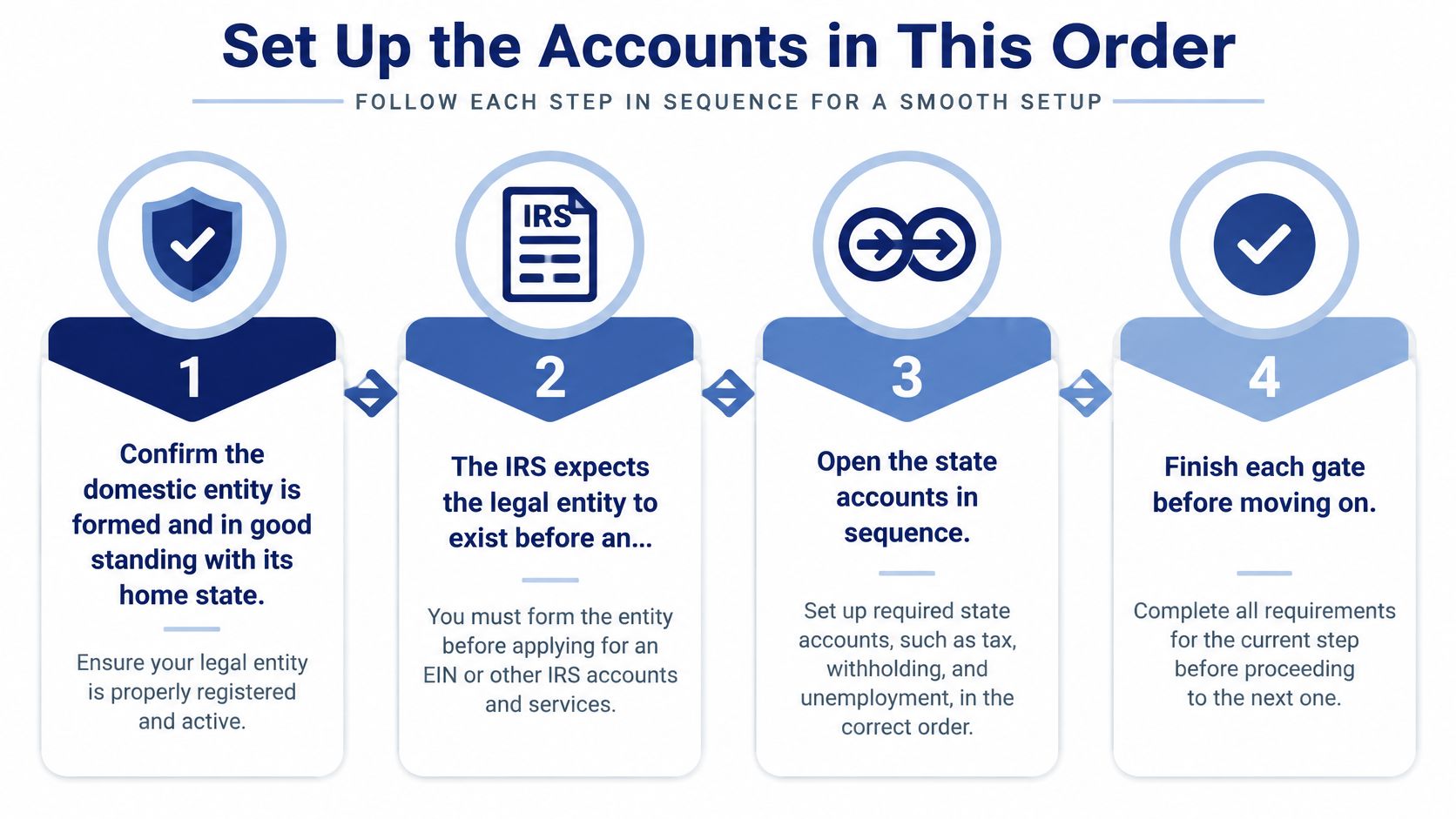
The SBA's registration workflow guidance notes that foreign-qualified entities commonly owe taxes and annual-report fees in both the formation state and the new state, so the objective isn't a certificate on the wall. It's a dual-jurisdiction compliance calendar that someone is responsible for keeping current. Because fees and documentary requirements vary by state and entity type, the same guidance recommends checking the relevant state agencies directly instead of applying a uniform national checklist.
The benchmark is simple: finish the review before the first payroll run or the start date, and keep filed certificates, confirmations and account numbers in one central register. Then test it. Sample each new-state employee and trace the hire date through entity qualification, withholding registration, unemployment registration, workers' compensation evidence, new-hire report and the first payroll filing.
A missing link is a pre-payroll fix, not a post-filing cleanup item. The difference between those two is usually a penalty and an amended return.
Registration puts the company on the state's books. The day-to-day rules that govern the employee follow the work state, and copying a home-state policy across state lines is where most exposure sits.
The federal floor applies everywhere: the Family and Medical Leave Act, 29 U.S.C. § 2601, with implementing regulations at 29 C.F.R. Part 825, covers eligible employees of covered employers in every state. Everything above that floor is state-specific.
New Jersey shows why a profile copied from another state goes wrong on arithmetic alone. The New Jersey Department of Labor set the 2023 taxable wage base at $41,100 for unemployment insurance and employer disability insurance, and at $156,800 for family-leave insurance and worker disability insurance. Two different bases, in one state, for programs an owner may think of as a single payroll line.
Wage and hour rules are the most common source of state-level drift, and the wage and hour compliance basics are the place to start when a policy written for one state gets applied in another. In a multi-state engagement, the company paused a sensitive termination and rebuilt the client's employee handbook with a focus on enforceability across every operating state. The pause mattered as much as the rewrite.
High-stakes situations deserve a review before anyone acts, not after. That covers a termination that follows a complaint or a leave request, an internal investigation, and a leave that overlaps with a disability. The sequencing and documentation in those cases carry consequences that a general policy can't absorb.
A remote hire, a mid-year move, and a traveling employee create different compliance checks. In 2025, 22.4% of people at work across the United States teleworked or worked from home for pay, including 10.5% who worked remotely for all of their hours, according to the U.S. Bureau of Labor Statistics. Treat each change in work location as a reason to review the company's obligations, not as a payroll update alone.

As covered in the trigger section, an employee's work in a new state can prompt registration questions. The next step depends on how the employee works there.
Run the checks before the next pay period, and before the start date when the location is known in advance. Record the work address and days worked by state. Then confirm payroll requirements, assess whether foreign qualification or a new unemployment account is needed, and update the relevant state accounts and records.
For policies and record-keeping, use this remote work compliance checklist for multi-state employers. A remote arrangement can leave an employer without a clear view of where work is being performed, creating hidden jurisdictional risk. If an employee plans to move or travel regularly, get an expert review before the change takes effect. Retrofitting the answer after a state notice costs more than reviewing it in advance.
The first payroll in a new state can run cleanly while the company is still not registered to employ anyone there. Each new-state account needs an owner after that first payroll. A certificate in a folder is the start of a control. It is not proof the footprint stays legal as people move, leave, or pick up work in another state.
Cost accumulates after the accounts exist. Dormant withholding accounts, missed zero-dollar filings, and a second annual report for a state the company already left all sit on the same calendar. IRS guidance for employers confirms that every state and most territories operate a new-hire registry, and reporting continues well past the first hire. A foreign-qualified business may owe taxes and annual-report fees in both the formation state and the qualifying state, so each added state multiplies fees rather than replacing them.
Three questions decide whether the control holds. Who owns state notices when they arrive. How payroll and HR records prove each employee's actual work location. Who closes or amends an account when the last employee leaves a state. If no named person answers all three, the process depends on memory. Memory fails the quarter that person is out, and a late notice or an open account is what the state still has on file.
Book the review before the offer, not after the first pay date. Put the footprint test, the account list, and the recurring audit on the table in one sitting. Name the owner for notices, location records, and account closure before anyone starts. Owners who want a second opinion on how those three hold together across their operating states can start with a compliance risk assessment instead of a stack of blank forms.
This article is general information, not legal advice. Employment laws change and vary by state. Consult qualified employment counsel about your situation.
Book a free HR risk review before the next hire in a new state, while the accounts are still small enough to correct.
The firm works with employers of 25 to 500 people who carry HR on top of another job. Registering as an employer in a new state needs a second set of eyes before the first payroll run. Multi-state advisory covers policy alignment, state addenda, and counsel coordination for sensitive matters. Paradigm International Inc. scopes that work to the client's size, structure, and states of operation.


