When your business is growing, everything gets more complicated. What used to be simple HR tasks can suddenly turn into high-stakes legal minefields, especially when dealing with multi-state employment laws, tricky employee situations, or dense compliance rules. A risk management consultant is the strategic partner who steps in to help you build a more resilient company, turning potential liabilities into a managed part of your growth plan.

Many leaders think of risk management as something you only worry about after a problem occurs. This reactive mindset misses the true value of strategic guidance. A great risk management consultant helps you see around corners, anticipating and preventing legal, financial, and reputational damage before it happens.
Their role is to bring objective, expert judgment to your most important decisions. This is especially true if you are in a regulated industry or expanding across state lines, where one wrong move can have serious consequences. They do not just solve problems; they help you build the internal frameworks to prevent them in the first place.
At its core, a risk management consultant's job is to shift your leadership team from constant reaction to deliberate, forward-thinking strategy. This is not just about writing policies; it is about embedding sound judgment and defensible practices into your daily operations. This allows your team to lead with confidence.
A consultant’s value isn’t just in handing you answers. It’s in helping you ask the right questions. They give your team the tools to spot vulnerabilities in your processes, documentation, and decision-making before those weaknesses become a problem.
This proactive approach provides support in a few key areas:
This expertise is critical when establishing solid strategies for tasks like secure data destruction, a key piece of corporate compliance & risk management. It is a perfect example of a high-stakes situation where a small mistake can be incredibly costly. You can explore how to fortify your company's defenses by reviewing our guide on risk advisory services.
Ultimately, bringing in a consultant is an investment in your company's stability. They help you create a disciplined operational environment where risks are understood, managed, and minimized. This frees you to focus on growing the business, knowing you have a strong, defensible foundation.
If navigating complex compliance rules and high-stakes HR decisions sounds familiar, it might be time to see how a dedicated advisory partner could protect your company’s future. To explore your options, Contact us to learn more.
When you bring in a risk management consultant, you are not paying for abstract theories—you are investing in practical tools that shield your business from real-world threats. Their value is measured in the tangible deliverables they create and the confidence this provides your leadership team. Guesswork is replaced with a structured, repeatable process for handling difficult situations, ensuring every high-stakes decision is defensible.
One of the most valuable things a consultant delivers is defensible documentation. This is not about creating more paperwork. It is about building a clear, factual record that proves you acted fairly and consistently, which is your best defense if a decision is ever questioned.
A great consultant helps you build processes that are both compliant and practical for your team to follow. The goal is simple: make sure every significant action, from a performance warning to a termination, is backed by a logical, well-documented paper trail. This turns documentation from a reactive chore into a proactive leadership tool.
When a serious complaint like harassment or discrimination arises, the stakes are incredibly high. An external risk consultant brings much-needed objectivity to the internal investigation process. They ensure it is thorough, impartial, and properly documented from start to finish.
The primary goal of an external investigator is to remove bias and follow the facts wherever they lead. This protects the integrity of the process and demonstrates to all parties that the company took the complaint seriously.
This is crucial for maintaining employee trust and heading off potential lawsuits. The consultant manages the entire investigation, delivering a clear report of the findings so leadership can take appropriate, defensible action.
For any business growing across state lines, the complexity of employment law multiplies quickly. A key deliverable here is a clear roadmap for navigating the maze of different wage-and-hour laws, leave policies, and local ordinances. This exact challenge is a major reason the global risk management consulting market is projected to reach over USD 230 billion by the early 2030s. You can explore the full research on this market growth to see the trends for yourself.
A consultant provides actionable guidance that turns complex legal requirements into practical steps your managers can follow. This ensures your policies are not just compliant on paper but are implemented correctly in every location. For a deeper look at this topic, you can review key HR risk management strategies. A consultant's work today also often includes a comprehensive cybersecurity risk assessment template to help you spot digital vulnerabilities.
By focusing on these practical deliverables, a risk management consultant does more than just offer advice. They equip your leadership team with the tools and processes needed to operate with confidence. If these deliverables address the challenges your team is facing, it may be the right time to strengthen your organization’s defenses. Reach out to discuss your specific needs.
Too many business leaders call for help only after a crisis hits. This reactive approach leaves your company vulnerable to preventable threats. The real strategic advantage comes from recognizing the early warning signs that you have outgrown your internal capabilities. Getting ahead of these problems before they escalate into costly legal battles is the first step toward building a more resilient operation.
This flowchart offers a quick way to see if you are facing scenarios where a risk management consultant’s expertise becomes critical.
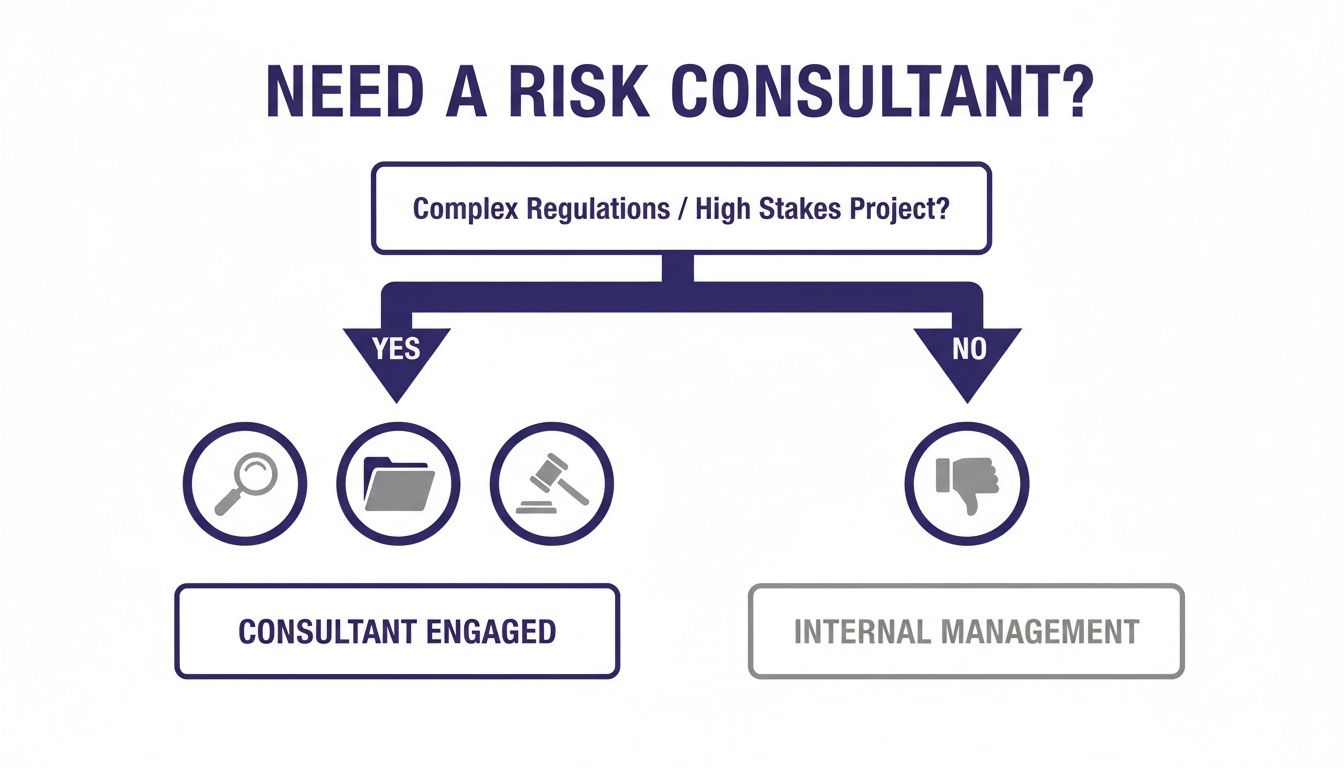
As the decision tree shows, common triggers like multi-state expansion, complex employee issues, or operating in regulated fields are clear indicators that it is time for specialized support. Sometimes, the need for a consultant is not a single event but a series of challenges that appear during periods of growth or change.
Each of these triggers represents a moment where your company’s risk profile changes. Navigating these transitions without expert guidance is a gamble most businesses cannot afford to take.
Moving into a new state is more than a simple geographic shift; it is like entering a new legal environment. Each state has its own unique rules for everything from wage and hour laws and paid leave to termination procedures. A policy that is perfectly fine in Texas could create legal issues in California or New York. This is precisely why leadership teams engage a risk management consultant during an expansion.
Scaling your team is exciting, but it puts immense strain on your existing HR infrastructure. The informal processes that worked for a team of 15 will break down when you reach 50 or 100 employees. As you grow, the need for standardized and well-documented practices becomes urgent. A consultant helps you build a scalable framework that supports growth without accumulating risk.
If your business is in a field like healthcare, finance, or government contracting, compliance is a fundamental requirement. In these sectors, a minor mistake in handling employee data, running background checks, or documenting performance can trigger audits, fines, and significant penalties.
For regulated businesses, the question isn’t if you will be scrutinized, but when. A risk management consultant helps ensure your people operations are as buttoned-up as your financial or clinical compliance, leaving no room for error.
They bring deep industry knowledge to the table, helping you craft HR practices that meet—and often exceed—the tough standards set by governing bodies.
A sudden rise in sensitive employee complaints, such as claims of harassment or discrimination, is a clear signal that your current processes may be failing. These situations demand a careful, objective, and thorough investigation. Mishandling the response can damage team morale and expose your company to significant legal liability. A risk management consultant provides the impartial expertise needed to manage these investigations correctly.
If these challenges feel familiar, it may be time to see how a dedicated advisory partner can provide the structure you need. Connect with Paradigm to learn more about building a more defensible future.
Finding the right advisory partner is a critical decision. This is not just about hiring another vendor; it is about inviting a trusted advisor into your inner circle who understands your company’s culture, goals, and unique pressures. The best risk management consultant is a strategic partner you can rely on for sound judgment when the stakes are high.
Your evaluation process must go beyond a simple resume review. You are looking for someone whose problem-solving approach aligns with your own—a professional who delivers clear, actionable guidance, not just theory.
Before you begin interviews, create a shortlist of candidates with the right foundational expertise. When dealing with complex employment issues, a generalist is not enough. You need to see specific, proven experience that matches the challenges you are facing.
Your vetting process should start with these non-negotiables:
Once you have qualified candidates, the interview is your chance to assess their methodology and communication style. Use pointed, scenario-based questions to see how they think and to evaluate their real-world judgment.
A consultant's true value is revealed not by what they know, but by how they guide you through what you don't know. The interview should feel less like a test and more like a preview of a working partnership.
Here are a few questions designed to dig deeper:
Globally, 82% of executives now cite compliance as a top risk. Regulatory missteps can lead to fines equaling 4-10% of annual revenue, while proper protocols guided by an expert can slash the likelihood of employment claims by over 40%. You can learn more about the market forces driving these risks. To evaluate your own internal processes, start with our detailed HR risk audit checklist.
Choosing the right consultant is an investment in your company’s stability. By asking the right questions, you can find a partner who will help you build a more resilient organization. If you believe your business could benefit from this level of strategic guidance, connect with the team at Paradigm.
Budgeting for a risk management consultant can seem unclear, but the pricing models are usually straightforward. It is helpful to see this as a strategic investment in your company's health, not just another cost. Once you understand the common structures, you can select the one that makes the most sense for your situation.
The goal is to match the payment structure to the scope of work. A sudden crisis requires a different approach than the need for ongoing strategic advice. Let's break down the three models you will encounter most often.
Most consultants offer services on an hourly, project, or retainer basis. Each is designed for a different purpose, and a good consultant will help you decide which option fits your immediate needs and long-term goals. There is no single "best" choice; it all depends on what you want to accomplish.
A retainer transforms a consultant from a reactive problem-solver into a proactive strategic partner. This ongoing relationship allows them to understand your business deeply, anticipate challenges, and provide real-time guidance before minor issues become major liabilities.
Just as important as cost is understanding how long an engagement will take. The timeline can vary widely depending on the complexity of the work, and a good consultant will be transparent about what to expect. For example, navigating a sensitive employee separation might take a week, while building a comprehensive employee handbook could take four to six weeks.
A thorough internal investigation typically requires two to four weeks, depending on the number of interviews and the amount of documentation to review. An experienced risk management consultant will always provide a clear timeline upfront, mapping out key milestones so you are never left wondering about progress.
Understanding these models means you can engage a consultant with confidence, knowing the financial and time commitments. That clarity is the foundation of a strong partnership focused on protecting your business. If you’re ready to explore how a structured advisory partnership can fit your budget and strategic goals, get in touch with the Paradigm team.

It is easy to think of a risk management consultant as someone you call only when there is a problem. While they are invaluable in a crisis, their real power comes from a long-term partnership. This ongoing relationship is what moves your business from reacting to problems to actively building a culture of sound judgment.
True resilience is not the result of a single project. It is built over time by weaving consistent, defensible practices into the fabric of your company. A long-term advisory partner ensures that consistency remains strong as your business grows, new leaders join, and unexpected challenges arise.
The relationship becomes most effective when a consultant shifts from being an outside expert to an embedded part of your leadership's decision-making process. They become a trusted advisor who deeply understands your business—your people, your pressures, and your unique culture.
That level of familiarity allows for nuanced, context-aware advice that a one-time consultant could never provide. This sustained relationship leads to several powerful outcomes for your business:
The ultimate goal of a strategic partnership is to instill a sustainable discipline of risk management. It’s about empowering your entire leadership team to operate with a shared framework for making defensible choices, protecting the company and its people for the long haul.
Proactive risk management is a continuous business function, just like finance or sales. It is absolutely essential for responsible growth. A risk management consultant acts as your guide and accountability partner in this ongoing effort. They bring the objective perspective needed to keep your operations aligned with legal requirements and your company’s values.
By working with an advisor over the long term, you build an organization that is not just compliant, but genuinely resilient. This foundation gives you the stability and confidence to pursue ambitious goals, knowing that your operations are built on a solid, defensible footing.
If the challenges discussed in this guide feel familiar, it might be time to see how a dedicated advisory partner can help secure your company's future. The team at Paradigm is ready to help you build that enduring strength. To learn more about our approach, we invite you to contact us.
When considering a risk advisory expert, it is natural to have questions. The stakes are high, involving your company's financial health and legal standing, so making an informed choice is essential. Here are straightforward answers to some of the questions we hear most often.
An HR manager typically focuses on daily people operations—like payroll, benefits, and recruitment. A risk management consultant, however, works at a more strategic level. They advise leadership on high-stakes decisions to prevent legal and financial risks before they start. While your HR manager executes existing policies, a consultant helps build and stress-test those defensible frameworks.
Complexity is the biggest signal. If you are expanding across state lines, operating in a regulated industry, or seeing more complex employee complaints, you have likely outgrown your internal team's capacity to manage risk.
The best time to engage a consultant is before a crisis forces your hand. If you see your leadership team hesitating on important people decisions because they're unsure of the legal risks, that’s your signal. You need specialized, objective guidance.
Think of it as a proactive investment in your company's stability, not just a reactive expense.
The first step with a risk management consultant is almost always a discovery phase. They will work to understand your specific pain points, review your current policies, and identify your biggest areas of exposure. From there, they will outline a clear scope of work with defined deliverables and timelines. Expect the focus to be on practical, actionable steps from day one.
Yes, and many small businesses cannot afford not to. The financial impact of a single employment lawsuit or regulatory fine can be devastating for a small or mid-sized business. The good news is that many consultants offer flexible engagement models to fit different budgets.
These options often include:
This flexibility allows you to access top-tier expertise in a way that makes financial sense for your business. It is a wise and manageable investment in your company's security.
Navigating high-stakes HR decisions requires more than good intentions—it demands precision, experience, and foresight. At Paradigm International Inc., we provide the strategic advisory support that gives leadership teams the confidence to operate decisively and build a more defensible, resilient organization. If you're ready to strengthen your company's foundation for responsible growth, contact us to learn how we can help.