
You usually don't get one clean legal problem. You get three at once, in different states, with different managers, different witnesses, and different clocks running. The wrong move is to treat that as a dollar negotiation. The right move is to treat it as a settlement strategy problem, because process, timing, and channel choice decide whether the matter stays quiet or turns into a larger fight.
A regional employer feels this fast. A wage claim lands in California, a termination dispute heats up in Texas, and a discrimination charge shows up in Illinois, all while operations keep moving and managers keep talking. If intake is sloppy, HR notes are inconsistent, or supervisors start freelancing, the case posture hardens before counsel even has room to work. Good employers don't wait for that damage. They build a settlement path from the first call, not the last meeting.
A Tuesday morning can go sideways in one hour. A former shift manager files in California, a Texas supervisor sends a defensive text thread to the wrong person, and an Illinois charge arrives with just enough detail to trigger panic. The leadership team now has three files, three narratives, and one real concern, whether the company can keep the story straight long enough to make a defensible decision.
The first seventy-two hours are where settlement value is won or lost, not in the final signature meeting. That is when you decide who speaks, what gets preserved, and whether the business looks disciplined or reactive. Once managers start improvising, the company creates contradictions that later show up in mediation, agency review, or litigation.
Practical rule: do not let line managers negotiate facts. Let them preserve facts.
This is why operational discipline belongs in the same conversation as legal exposure. If you already use tools that monitor field risk, safety, or lone-worker activity, you know the value of clean early documentation. A useful example is safety monitoring for lone workers, because the same habit applies here, identify the risk early, record it cleanly, and stop the story from fragmenting.
The business question is simple. Does settling now protect the company from larger exposure, or does it reward a weak position and invite more claims? The answer depends less on emotion than on whether the file is coherent, the witnesses are aligned, and the company knows which channel fits the dispute.
A settlement strategy is a repeatable method for resolving employment disputes before they become public fights. It is not a one-time payout, and it is not a reflex reply to a demand letter. It is the company's way of deciding what to investigate, what to concede, what to challenge, and whether the matter belongs in private settlement, mediation, or litigation.
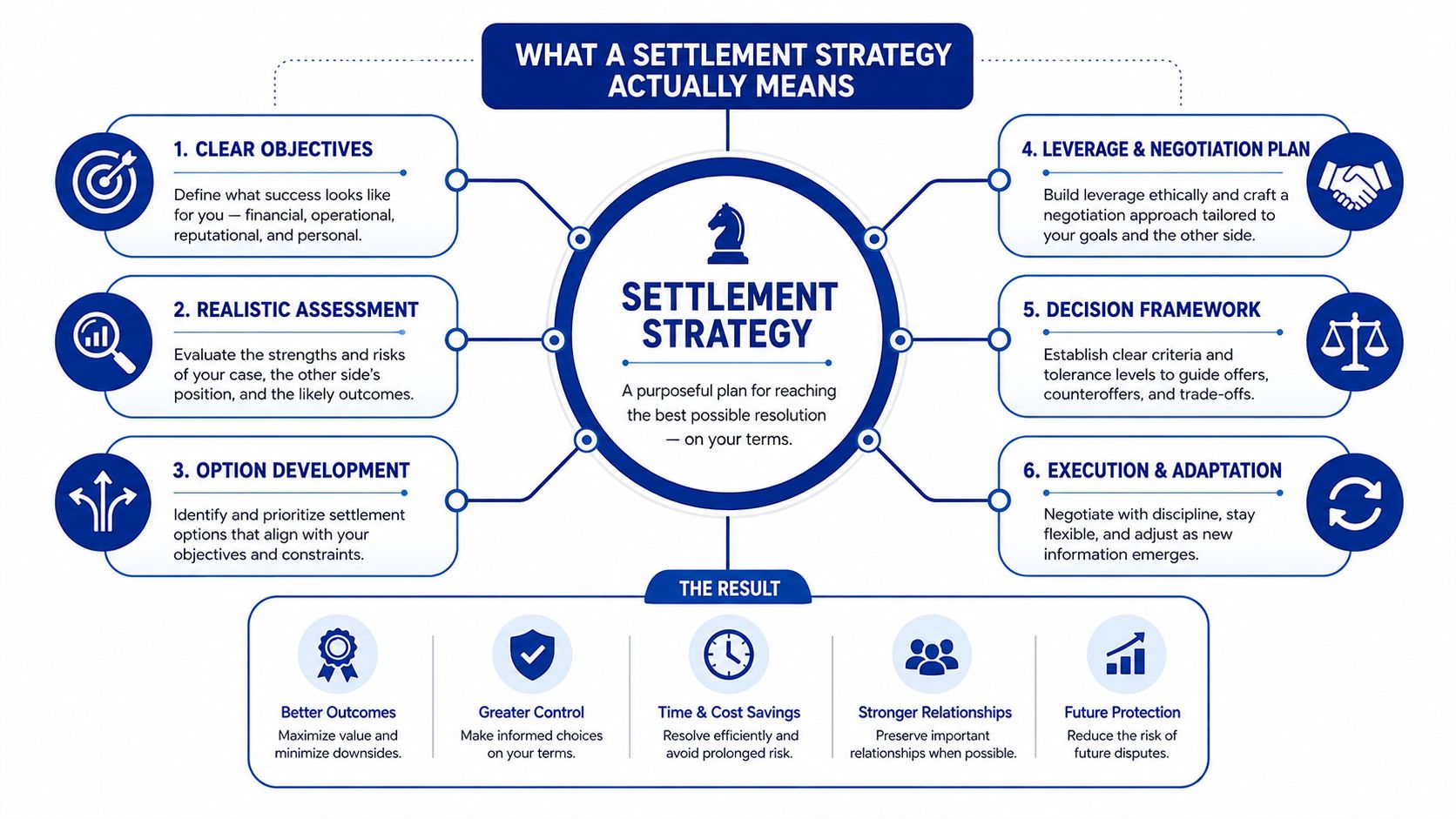
Most bad settlement conversations start with the wrong question, “What's the number?” That skips the core issue. The better question is, “Which resolution channel gives the company the best risk-adjusted outcome with the least collateral damage?” Sometimes that means paying to close the matter privately. Sometimes it means mediation. Sometimes the right call is to litigate because the business needs precedent, influence, or a hard line.
The distinction matters because each path changes pressure differently. Pre-litigation settlement can end a dispute before it becomes public. Mediation gives both sides a structured way to close a contested file without the full cost of court. Litigation is slower, more visible, and usually more expensive, but it can be the right choice when the company needs to defend a broader rule, not just one claim.
A good settlement strategy preserves options. A bad one locks you into the wrong path too early.
That is the difference between a company that manages disputes and a company that gets dragged by them. If you need a primer on how liability is framed before those choices are made, the employment practices liability overview is the right companion read. A strong strategy doesn't chase certainty too early. It keeps the company positioned to choose.
Leadership should never approve a settlement or push a dispute toward trial without asking what, exactly, the business is buying or refusing. Settlement buys certainty, capped cost, less management distraction, and a cleaner way to stop related claims from multiplying. It also reduces the chance that an agency inquiry or a public filing will drag the issue into a wider spotlight.
The reward is control. You know the outlay, you control the timing, and you stop the team from burning executive hours on a file that may never improve with more conflict. In regulated employment disputes, that matters because a clean early resolution can keep one bad fact pattern from becoming a recurring internal problem.
The value is also strategic. The EEOC reports that in FY2025 it resolved 7,929 of 11,346 mediations, a 70% resolution rate, and those resolutions produced nearly $245.3 million in benefits to charging parties. That is not a reason to settle every case. It is a reminder that structured early resolution can materially change the economics of a dispute.
The downside of fighting is easy to understand and expensive to ignore. Damages can remain uncapped, defense fees keep climbing, and a single ugly decision can fuel copycat claims or broader agency scrutiny. In public-facing disputes, reputational drag is real, especially when leadership has to explain why a matter that could have closed discreetly instead became visible.
For timing, the federal employment litigation data are hard to dismiss. Lex Machina reports that employee claims took a median 1,021 days to reach trial from 2023 to 2025, and courts approved nearly $2 billion in settlement awards for employment-related class actions. That doesn't mean trial is always wrong. It means delay can become its own cost center.
| Settlement vs. Litigation: Cost and Timing Trade-Offs | ||
|---|---|---|
| Factor | Settlement Path | Litigation Path |
| Cost control | More predictable, easier to cap | Less predictable, defense spend can grow |
| Management time | Lower disruption once terms are set | Ongoing depositions, discovery, and decisions |
| Visibility | Usually lower if handled early | Higher, especially once filed publicly |
| Timing | Faster closure when both sides are realistic | Often slower, with more moving parts |
| Strategic value | Best for containment and certainty | Best when precedent or principle matters |
A leadership team should be able to triage a dispute within 48 hours of a demand letter or agency notice. The first filter is liability. If the facts point strongly toward company fault and damages could expand in unpredictable ways, settlement is usually the smart move. If the facts are disputed but both sides want closure, mediation makes more sense. If the matter raises a broader rule, policy issue, or precedent the business cannot give up, litigation may be justified.
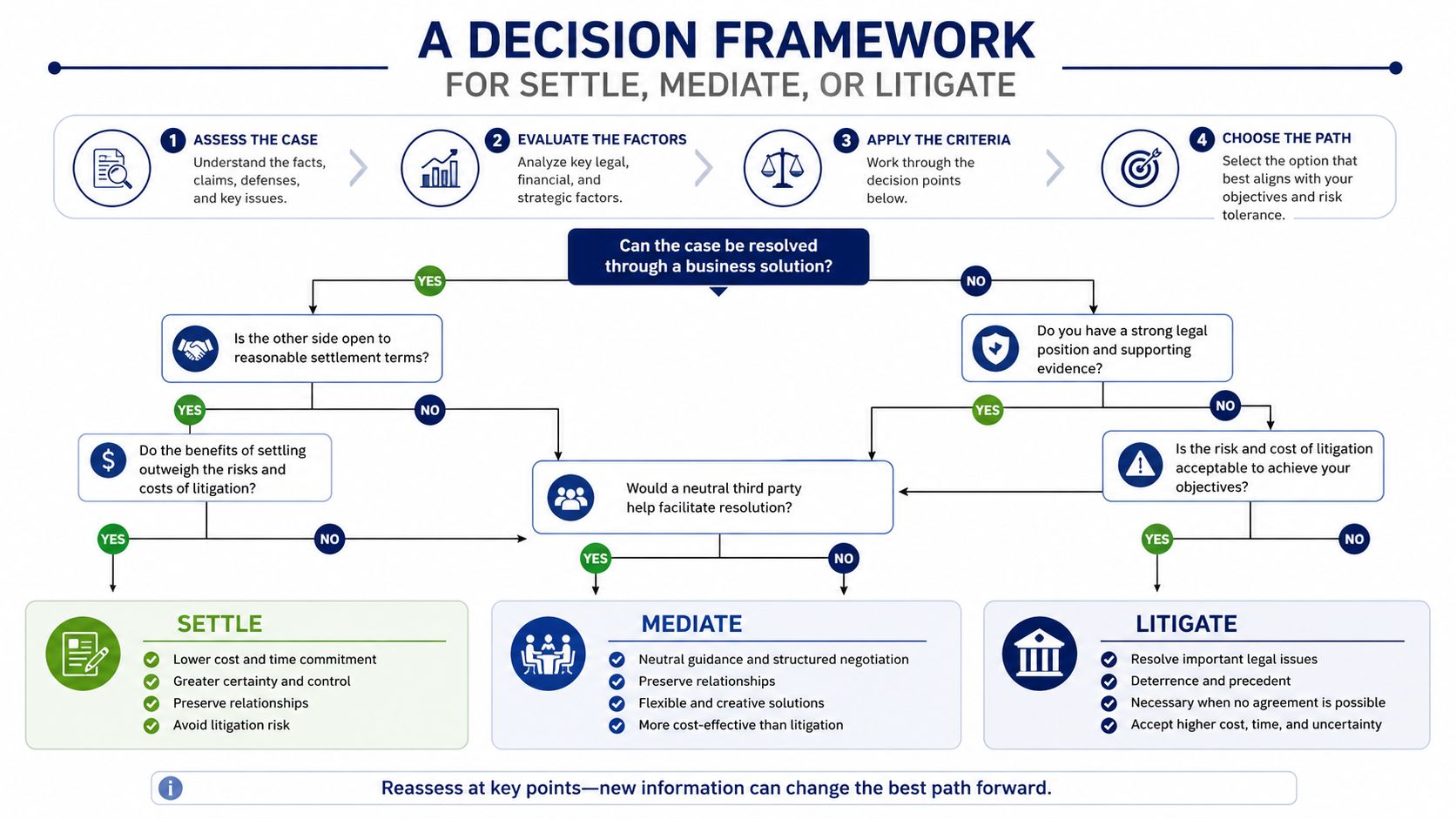
The best triage uses four questions. How strong is the claim? What does the paper trail say? How disruptive is the person or issue to the business? How badly would a public fight hurt customer trust, morale, or compliance posture? If you cannot answer those cleanly, you are not ready to negotiate intelligently.
A practical way to think about the choice is this. Repeat claimants and regulator involvement push you toward discipline, not improvisation. Key-customer exposure pushes you toward speed. Serious document gaps can push you toward settlement because weak records usually get more expensive, not less, when lawyers start testing them.
If you want a clean outside reference on the mediation-versus-court decision, the LA Law Group mediation guide is a useful comparator. It reinforces a point leadership should already accept, mediation is not a sign of weakness. It is a channel choice.
If the company cannot explain why it chose one path over another, it doesn't have a strategy. It has a reaction.
The strongest employer negotiators stay grounded in facts. They open with documentation, not frustration, and they tie every counteroffer to a business reason. That means no emotional speeches, no manager venting, and no vague “goodwill” offers that are impossible to defend later. The goal is not to win a debate. The goal is to narrow the issue set and keep the upper hand intact.
A good negotiation usually starts with a written position that reflects what the company can prove. If the exit reason is documented, say so. If there is risk in a manager's conduct, address that risk without turning it into an admission. Conditional counteroffers work best when they are tied to release scope, timing, and final paperwork.
Structured payment terms can also protect the business. If a payout is part of the deal, spell out how it will be reported, how payroll taxes are handled, and whether payment is spread over time. Those details matter because they affect clean administration and reduce later disputes about what was promised.
When the employee asks for non-monetary items, stay precise. Reference removal, neutral language, and manager reassignment can be negotiated without conceding wrongdoing. The key is to pair every concession with written terms that close the loop internally, including separation paperwork, non-disparagement language where lawful, and HR system updates so the same issue doesn't reappear in a different form.
Practical rule: never trade money for silence unless the paper trail makes the silence enforceable.
The biggest mistake is letting negotiation drift into retaliation risk. That happens when the company tweaks responsibilities, access, references, or reporting lines informally after the dispute starts. If the business wants to settle, it should make sure the operational changes are documented, justified, and consistent with the final release.
A handshake is not a resolution. A defensible settlement needs a clear trail, starting with the demand log and ending with a final agreement that matches what the business intended to buy. The sequence should be boring on purpose, demand letter log, negotiation memo, term sheet, final separation agreement, and release. If any one of those pieces is missing, the company is inviting confusion later.
The negotiation memo should capture who approved the strategy, what facts mattered, and why the company chose the channel it did. The term sheet should match the business deal in plain language, not just legal shorthand. The final agreement should then convert that business deal into enforceable language with no unresolved gaps.
A well-drafted release usually needs the scope of released claims, known and unknown claim waivers where allowed, age-related carve-outs when relevant, indemnity and cooperation language, and confidentiality mechanics that fit the forum and the claim type. If the company is settling with an older employee, the release needs the right statutory structure, not a generic template. If the company is handling a matter that may implicate protected activity, overbroad confidentiality or non-disparagement language can create a new problem.
The EEOC makes one point very clear for Commission litigation. Once it files suit, it will not enter settlements that contain confidentiality provisions or other restrictions on disclosure of the suit, the facts, the allegations, or the settlement terms by the EEOC, charging parties, or other aggrieved individuals. That same agency also requires litigation resolutions to include all settlement terms, including the total monetary recovery, in the public court record.
If you need a practical drafting reference, the separation agreement template for employers is a useful starting point, but it should never replace case-specific review. A template is only safe when it is adapted to the facts, the state, and the claim type.
| Release Language Checklist for Employment Settlements | ||
|---|---|---|
| Clause | Required Language | Common Pitfall |
| Scope of release | Identify the claims, dates, and parties clearly | Leaving the scope too vague |
| Age-related waiver | Use compliant waiver language where needed | Copying a generic release for every employee |
| Confidentiality | Match the clause to what the law allows | Trying to silence protected activity |
| Non-disparagement | Keep it narrow and enforceable | Writing language so broad it backfires |
| Revocation period | Include any required statutory timing | Forgetting the employee's review rights |
| Tax treatment | Spell out reporting and payment structure | Treating all settlement payments the same way |
A settlement that works in one state can fail in another if the company copies the same paper and hopes for the best. That is the reality for multi-state employers. Federal rules sit on top of state agencies, and both can shape the final deal. The EEOC, the NLRB, and wage-hour agencies all bring their own expectations, while state bodies add more variation.
California and New Jersey are obvious examples, but they are not the only ones. State civil rights agencies, wage-hour bodies, and labor departments can all affect what the company can release, how it can describe the claim, and what follow-up obligations remain after payment. A single template often misses those differences, especially around notice timing, protected activity, and post-settlement conduct.
Older-worker waivers need special care because the release structure matters. Non-disparagement language can conflict with protected concerted activity under labor law. Severance and backpay also need the right tax treatment, which is why payroll, finance, and counsel should review the payment mechanics before anything is signed. A company that gets the business terms right but the reporting wrong has not settled cleanly.
The NLRB's rules are especially concrete. Under its compliance materials, a valid reinstatement offer can end reinstatement obligation and backpay exposure, but a defective offer may not. The Board also says that if reinstatement is waived, the settlement should say so clearly and include a signed waiver in writing. That is not drafting trivia. It is exposure control.
The settlement posture should also reflect where the company is operating. Choice-of-law clauses, forum selection, and attorney-fee provisions can all behave differently by state. If the business uses one standard form across multiple jurisdictions, it should assume that form is only a draft until local counsel confirms it.
For background on how employee policy drafting can vary by jurisdiction, the employee handbook compliance resource is a good reminder that state-by-state consistency is harder than most owners think. Treat every settlement as multi-jurisdictional unless counsel has confirmed otherwise.
| Multi-State Settlement Compliance Snapshot | ||
|---|---|---|
| Issue | Federal Baseline | Common State Variation |
| Release wording | Must be clear and enforceable | Different rules on scope and waiver language |
| Confidentiality | Limited by protected activity rules | Some states scrutinize silence provisions more closely |
| Reinstatement | Must be valid if offered | Local enforcement and waiver language may vary |
| Payment handling | Must be reported correctly | State wage laws can change timing and treatment |
| Forum and law | Can be selected by agreement in some cases | Not every clause is equally durable everywhere |
When a claim lands, the company needs a decision map, not a debate club. Start with immediate triage. Preserve records, freeze side conversations, identify who can speak for the business, and keep the response team small. Then move into evaluation. Pull the cost projection, test the claim strength, compare the business disruption, and decide whether settlement, mediation, or litigation fits the facts.
The most defensible organizations separate investigation from budget approval. That keeps the fact-finding honest and prevents the money decision from distorting the record. They also define authority levels before pressure rises, so nobody improvises a settlement number in the middle of a tense call.
A practical checklist for leadership looks like this.
The business rarely loses because it lacked a settlement option. It loses because the option was handled casually.
The next move is straightforward. Get an advisor or law firm involved before the demand letter turns into a public dispute. If you're running a multi-state operation and need a disciplined review of risk, timing, and settlement posture, visit Paradigm International Inc. and start the conversation early.