If you're running a growing business, you've probably seen this happen. An employee sends “Not feeling well today” by text, a manager assumes it’s a one-day absence, HR never sees it, and by day three you’re dealing with coverage gaps, payroll questions, and possible leave-protection issues. That isn’t a minor communication problem. It’s a documentation failure.
A strong sick leave email format does more than sound professional. It creates a clean record, protects privacy, gives managers what they need to operate, and helps your business stay defensible across multiple states. If your process is casual, your risk is not.
Most employers treat sick leave messages like routine admin. That’s a mistake. A vague email, a Slack message with no dates, or a text sent only to one supervisor can create confusion fast.
The first problem is operational. Managers need to know who is out, for how long, what work needs coverage, and whether the employee is reachable for urgent handoff questions. When they don’t get that information early, the team loses time and starts improvising.
The second problem is legal. Once an absence stretches, recurs, or hints at a serious health condition, the quality of that initial communication starts to matter much more than most leaders realize. For multi-state employers, sloppy notice handling can become evidence.

For example, non-compliance with leave notification and documentation standards risks 30% higher litigation exposure, according to the claim cited in Grammarly’s discussion of sick leave emails. That matters because vague messages have been tied to FMLA denial disputes.
A business owner usually feels the cost in three places first:
Practical rule: If a leave notice can’t be found, dated, and matched to policy in under a minute, your process is too loose.
Ambiguity also damages morale. Employees notice when one manager accepts a casual chat message while another demands a formal email. They notice when some absences are documented and others disappear into private text threads. Inconsistency doesn’t just frustrate staff. It weakens management credibility.
Consider the common message: “I’m sick. Won’t be in.” That tells the manager almost nothing. There’s no date range, no expected return, no update timeline, no work coverage note, and often no HR visibility.
That missing detail creates avoidable questions:
| Problem | What the manager still doesn’t know |
|---|---|
| Attendance | Is this one day or the start of a longer absence? |
| Staffing | Who will cover urgent tasks? |
| Compliance | Does HR need to track this under company policy or protected leave rules? |
| Documentation | Was notice given on time and to the right people? |
A better system makes employees use one standard communication path every time. Email remains the cleanest baseline because it is searchable, timestamped, and easy to route to both management and HR.
If your workplace still relies on ad hoc texts and hallway updates, fix that. The same communication drift that causes absence problems usually shows up elsewhere too, including discipline, investigations, and manager instructions. If that sounds familiar, review how poor communication in the workplace compounds employment risk.
A sick leave email isn’t a courtesy note. It’s a risk-control document. It should tell the company four things immediately:
That’s the standard. Anything less leaves too much open to interpretation.
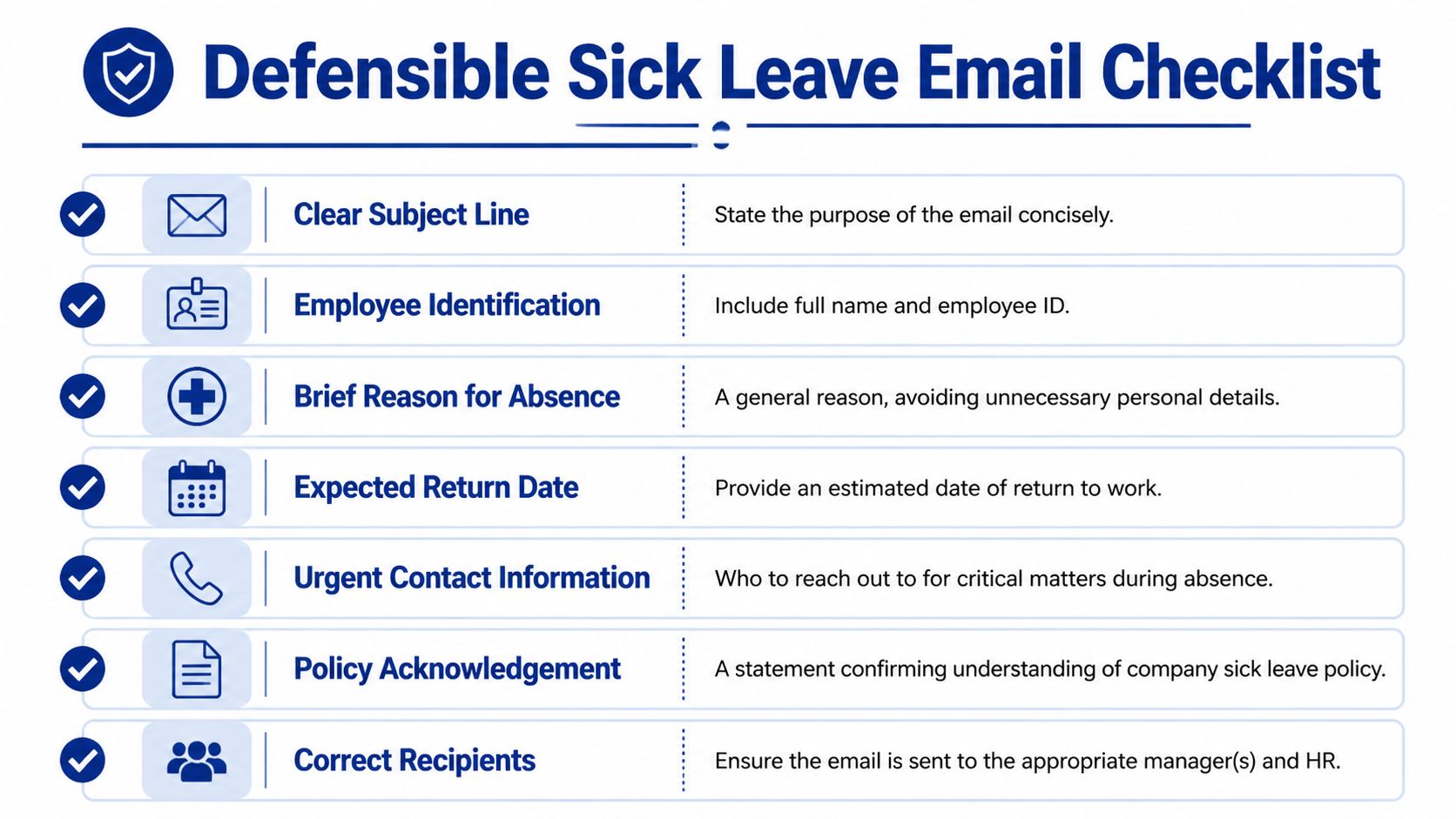
A defensible sick leave email format should be simple enough for employees to use when they’re unwell and structured enough for managers and HR to act on immediately. If your template invites long explanations, you built the wrong template. If it’s so minimal that nobody can plan around the absence, you also built the wrong template.
Use a standard format every time. The goal is clarity, not personality.
The subject line is not cosmetic. It determines how quickly the message is recognized and routed.
Emails with a clear subject line like “Sick Leave Request – [Name] – [Exact Dates]” achieve over 95% open rates in busy inboxes, according to HelixTAHR’s guidance on sick leave applications. Use that structure or something very close to it.
Good examples:
Bad examples:
Those vague subjects force managers to open the message just to understand what it is. That slows down response and weakens your recordkeeping.
The default recipient rule should be straightforward:
That audit trail matters. In the same HelixTAHR guidance, CC’ing HR is described as critical in states like New York and Illinois, where 62% of wrongful denial claims stem from undocumented notifications.
If your company is multi-state, don’t leave this to employee judgment. Write it into policy. Employees shouldn’t have to guess whether HR should be copied.
The cleanest process is the one employees can follow half-awake at 6:00 a.m. without making a judgment call.
The first sentence should make the absence unmistakable. Employees are informing the company, not asking for permission.
Use direct language such as:
Keep the medical reason general. That protects privacy and reduces the chance that managers collect more health information than they should.
Use:
Avoid:
Every sick leave email should answer one of these two questions:
That distinction matters. It is better to commit to an update than to promise a return date that may not hold.
A strong line looks like this:
That language gives the company a timeline without creating a false commitment.
Many otherwise decent sick leave emails fail at this point. Managers don’t just need absence notice. They need continuity.
A practical handoff note should include:
For example:
That is enough. Don’t turn the email into a project memo.
The closing should be short and consistent. For larger or more regulated organizations, include identifying details so HR can log the leave correctly.
A good closing includes:
Example:
Best regards,
Jordan Lee
Employee ID 2841
Operations
If you want one standard, require every sick leave email to include these items:
| Component | Why it matters |
|---|---|
| Clear subject line | Speeds recognition and filing |
| Direct statement of absence | Removes ambiguity |
| Exact date or date range | Supports staffing and records |
| Return date or update date | Sets expectations |
| General reason only | Protects privacy |
| Coverage note | Preserves continuity |
| Correct recipients | Builds an audit trail |
| Professional closing | Supports accurate recordkeeping |
A policy without a template invites inconsistency. A template without rules invites shortcuts. You need both.
Most businesses don’t need more theory here. They need language employees can copy, edit, and send. That’s where a standard sick leave email format becomes useful.
Keep these templates short. The ideal length is 50 to 75 words for a one-day absence and 100 to 150 words for an extended leave, and over 80% of sick leave notifications are for single-day absences, according to Tabular’s sick leave template guide. Standardize the short form first.
Use these examples as policy-ready starting points. They’re intentionally clean and direct.
| Scenario | Email Template |
|---|---|
| One-day illness | Subject: Sick Leave Request – [Name] – [Date] \nDear [Manager Name], \nI’m unwell and won’t be able to work today, [Date]. I expect to return tomorrow and will update you if that changes. [Colleague Name] can help with urgent matters related to [project/task]. I’ve copied HR for documentation. \nBest regards, \n[Name] |
| Multi-day absence | Subject: Medical Leave Notification – [Name] – [Start Date] to [End Date] \nDear [Manager Name], \nI’m unable to work due to a medical issue and expect to be out from [Start Date] through [End Date]. I’ve updated [Colleague Name] on immediate priorities, and key files are in [location]. I’ll provide an update by [Date] if my return timeline changes. HR is copied for recordkeeping. \nBest regards, \n[Name] |
| Emergency same-day absence | Subject: Urgent Sick Leave Notification – [Name] – [Date] \nDear [Manager Name], \nI’m dealing with an unexpected medical issue and need to begin leave immediately. I’m unable to confirm a return date right now, but I’ll send an update by [Date or time]. Please direct urgent issues to [Colleague Name]. I’ve copied HR so the absence is documented properly. \nBest regards, \n[Name] |
| Planned procedure | Subject: Planned Medical Leave – [Name] – [Date] \nDear [Manager Name], \nI’m writing to confirm that I’ll be out on [Date] for a scheduled medical procedure. I’ll be offline that day and will confirm my return status by the evening of [Date], if needed. [Colleague Name] will cover urgent matters, and all current files are updated. HR is copied for the official record. \nBest regards, \n[Name] |
These examples aren’t “good” because they sound polished. They’re good because they answer the company’s practical questions without inviting unnecessary detail.
Each one does five things:
That’s the formula worth standardizing.
Keep the email short enough that a manager can scan it once and act on it.
Uncertain return dates are where businesses often create avoidable confusion. Employees either overpromise or go silent. Neither works.
Use this version instead:
Subject: Sick Leave Notification – [Name] – [Date]
Dear [Manager Name],
I’m unwell and unable to work today. I’m not yet certain when I’ll be able to return, but I’ll provide an update by [specific day or time]. For urgent issues, please contact [Colleague Name]. I’ve copied HR for documentation.
Best regards,
[Name]
This language is especially useful for illnesses that may resolve quickly but shouldn’t be guessed at.
For longer absences, your handbook should tell employees when documentation is required and where to send it. The email itself should mention the documentation briefly, not narrate the medical issue.
Use this:
Subject: Medical Leave Notification – [Name] – [Dates]
Dear [Manager Name],
I’m under medical advice to remain out of work from [Start Date] through [End Date]. I’ve attached the required documentation and copied HR for processing. [Colleague Name] is covering urgent items, and I’ll provide an update by [Date] if anything changes.
Best regards,
[Name]
If your employees still default to texting or calling in without a written trail, fix that in policy and training. A clear process for calling out of work should point employees back to one written standard.
Don’t allow messages like this to stand as your process:
“Hey, not feeling great. Might be out. Will let you know.”
That message creates too many open questions. It’s vague, undocumented if sent casually, and useless for staffing. If your managers accept this regularly, they are building inconsistency into your leave administration.
The best template is the one your employees can use without thinking and your managers can trust without chasing follow-up details.
The process doesn’t end when the employee sends the email. A weak manager response can undo a good employee notice. A strong response confirms receipt, reinforces policy, and keeps the company’s documentation clean.
That response should be prompt. Structured emails combined with a prompt manager acknowledgment yield 97% approval and documentation compliance in formal corporate settings, versus 72% for casual notifications, according to TriNet’s sick leave email guidance.
Managers don’t need a long script. They need a repeatable response that does four things:
A clean response looks like this:
Received. Thank you for the update. Please focus on your recovery. We’ll route urgent matters to [Name]. If your return date changes, send an update by [date/time]. HR has been copied for documentation.
That works because it is supportive without becoming casual or careless.
For a one-day absence:
For a multi-day absence:
For a leave that may involve restrictions on return:
That last point matters more than many managers realize. If an employee may be returning with restrictions, leaders should understand the difference between simple absence management and return-to-work readiness. A useful clinical overview on understanding fitness for work helps clarify why return decisions should be structured, not improvised.
A bad manager reply usually creates risk in one of two ways. It either asks for too much medical information, or it says too little and fails to reinforce the process.
Don’t send responses like these:
Each one causes a different problem. The first invades privacy. The second undermines the leave. The third creates ambiguity. The fourth leaves no useful management record.
A manager’s job is not to diagnose, negotiate, or improvise. It’s to document, respond consistently, and route the issue correctly.
HR should confirm that the absence is logged correctly, check whether policy triggers apply, and keep documentation centralized. For short absences, that may be the end of it. For repeated, extended, or medically complex absences, HR should take over the compliance side quickly.
Use a simple internal checklist:
| HR action | Why it matters |
|---|---|
| Confirm notice was received | Preserves the record |
| Verify policy trigger points | Ensures consistent enforcement |
| Track documentation needs | Avoids late or selective requests |
| Centralize records | Supports future review |
| Escalate extended absences | Protects against leave mishandling |
Prompt acknowledgment is not about courtesy alone. It closes the loop and keeps the company from drifting into undocumented exceptions.
Single-location businesses can sometimes get away with loose practice for longer than they should. Multi-state employers can’t. Once you operate across jurisdictions, your sick leave email format needs to function as a baseline control that supports different notice rules, documentation thresholds, and protected leave issues.
That starts with a hard truth. Your company policy cannot be a generic “notify your manager if sick” sentence. It needs a standard written path, a retention habit, and clear escalation triggers for longer or more sensitive absences.

The best structure is a universal company rule that every employee follows, regardless of state:
Then layer state-specific requirements in your handbook and manager training. Don’t ask employees to interpret state law in the moment. That’s management’s job.
For businesses with distributed teams, speed matters too. Employees may need care quickly, especially when a same-day evaluation affects whether they can work, need documentation, or require restrictions. Operationally, resources on same day doctor appointments can be useful for understanding how employees may obtain prompt medical attention without delaying notice.
Most sick leave guidance is fine for one-day absences and weak for anything more complex. That gap creates exposure.
A critical gap in most guidance is handling sick leave for mental health, with EEOC data showing a 25% rise in related accommodation claims. Sixty percent of these claims fail employers due to inadequate email trails, as discussed in Indeed’s guidance on sick leave letters.
That should change how you write policy. If an employee’s message suggests a mental health crisis, recurring health issue, or longer-term limitation, managers need instructions that go beyond “approve or deny the day off.” They need to route the matter to HR, stop asking for detail by email, and preserve the timeline carefully.
Short-term absence policy and protected leave administration are not the same thing. Treating them as the same is where many employers get into trouble.
For multi-state businesses, document the process, not the diagnosis. Retain the communication trail that shows:
You do not need managers collecting detailed medical narratives. In fact, that often creates more risk than value.
A simple documentation standard should separate three buckets:
| Record type | Keep | Avoid |
|---|---|---|
| Employee notice email | Date, recipient, absence dates, update timeline | Irrelevant health detail |
| Manager response | Acknowledgment, coverage, next steps | Medical questioning |
| HR file | Required forms, certifications, leave tracking | Scattered records in personal inboxes |
Once an absence becomes extended, recurring, or tied to a medical limitation, your sick leave email format is just the entry point. The business then moves into leave administration, accommodation analysis, or return-to-work coordination.
If your organization doesn’t have a defined escalation path, create one. Your managers should know exactly when a routine sick email becomes an HR-led leave issue. If you need a broader framework, this guide on leave of absence from work is a useful operational reference point.
A clean email process won’t solve every compliance problem. But without it, even a valid leave process starts on a weak foundation.
Yes, as a default process, that’s the smart move. Email gives you a timestamped, searchable record and supports consistent routing to both the manager and HR. If a company allows text in emergencies, the policy should still require the employee or manager to convert that notice into email documentation the same day.
Tell managers not to encourage that. If an employee includes unnecessary health information, the manager should respond with acknowledgment and shift the conversation back to absence timing, coverage, and HR process. Managers don’t need symptom descriptions to administer a sick day.
No. The email should function as notice, not a request for approval in the ordinary sense. Managers may still need to apply policy, but the communication itself should be direct and informative.
That’s a management failure, not a reason to ignore the process. Require acknowledgment. A prompt reply helps preserve documentation and reduces confusion about whether the notice was received.
Many employers do for longer absences, and that requirement should be stated in the handbook and applied consistently. Don’t handle it informally through one-off manager demands. Put the threshold, submission method, and HR contact in writing.
The same way in-office teams should. Remote work doesn’t justify casual notice. If anything, distributed teams need more structure because there’s no physical visibility into who is absent and what work is exposed.
Require one of two things in every message: an expected return date or a specific date for the next update. That prevents employees from overpromising and prevents managers from guessing.
Then the sick day email is only the first step. Managers should stop improvising, involve HR, and shift to the company’s leave or accommodation process. That line needs to be explicit in policy, especially for multi-state employers.
A good sick leave process isn’t complicated. It’s disciplined. One standard format, one routing rule, one acknowledgment habit, and one escalation path for anything more serious.
If your business is growing across states or operating in a regulated environment, a loose leave notice process will eventually create avoidable exposure. Paradigm International Inc. helps leadership teams build defensible HR practices that hold up under pressure, including documentation standards, manager protocols, and multi-state leave processes that are built for real-world risk.