You're probably looking at a familiar problem. Payroll keeps moving, managers keep making people decisions, a remote hire just triggered another state compliance question, and someone has suggested a PEO as the clean fix. That can be a smart move, but only if you understand what a small business PEO solves, and what it absolutely does not.
A Professional Employer Organization, or PEO, is an HR outsourcing partner that operates through co-employment. That phrase confuses a lot of owners because it sounds like you're giving your company away. You're not.
A better analogy is a property manager. You still own the building, choose the tenants, and decide the rules. The property manager handles rent collection, maintenance coordination, and administrative issues. A small business PEO works in a similar way. You still run the business and direct employees. The PEO handles a defined set of employment administration functions.
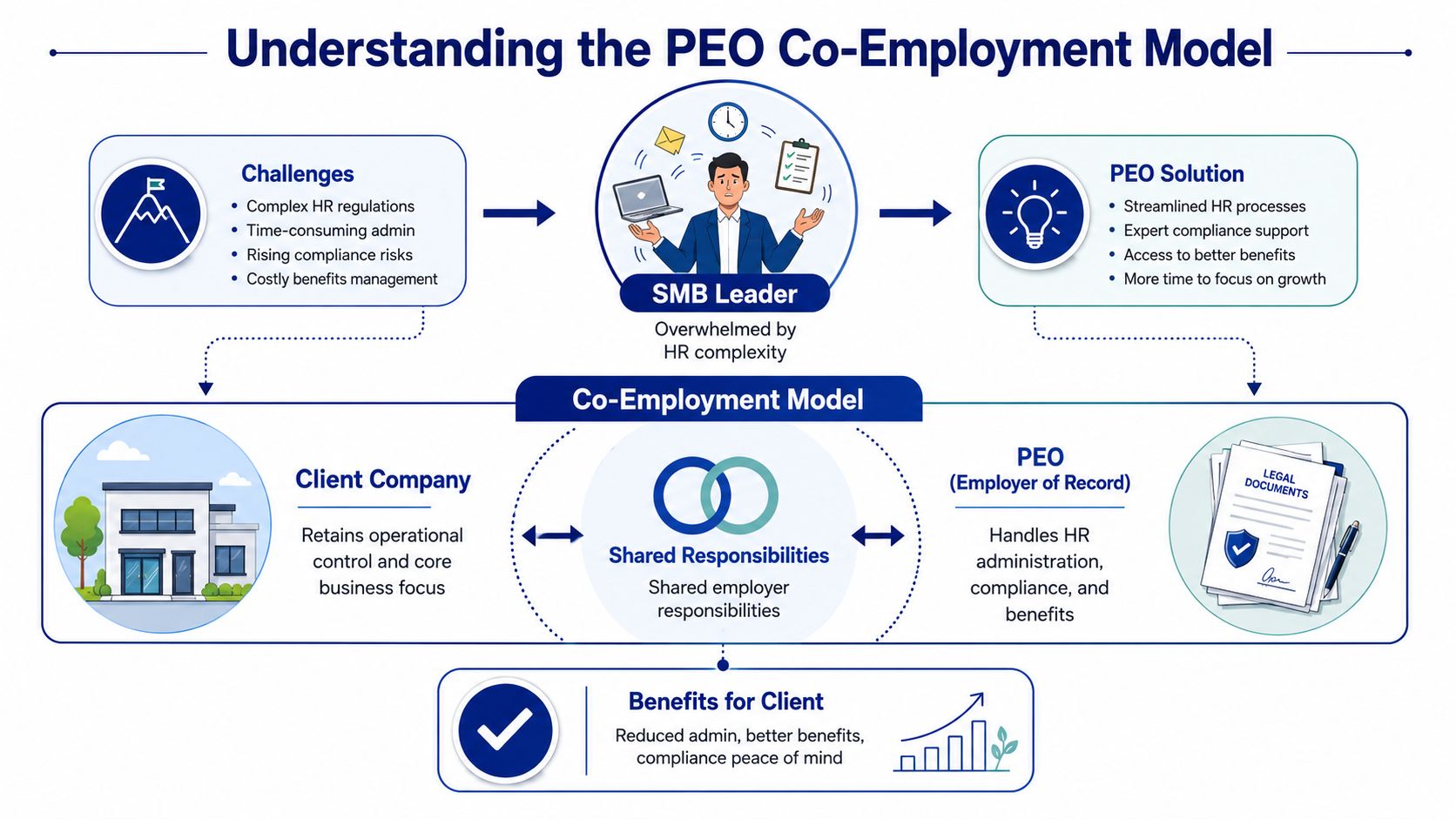
In a typical co-employment arrangement, your company keeps control over:
The PEO usually takes responsibility for:
That division matters because many owners hear “co-employment” and assume “shared everything.” That's wrong. The relationship is narrower and more technical than the sales pitch often suggests.
Not every provider deserves the same level of trust. PEOs are certified by the IRS as Certified Professional Employer Organizations, or CPEOs, which allows the small business client to remain the employer of record for tax purposes while the PEO assumes liability for federal employment taxes. The IRS also maintains public lists of active, suspended, or revoked CPEOs, so you should verify status before signing via the U.S. Chamber's guidance on choosing a PEO.
Practical rule: If a PEO can't clearly explain its certification status, tax handling, and liability boundaries, stop the conversation there.
If you operate with contract labor, staffing layers, or multi-party worker arrangements, your risk picture gets more complicated. In those situations, broad payroll outsourcing won't answer every exposure question. A useful reference point is this breakdown of 2026 PAYE changes for labour supply chains, because it shows how quickly worker classification and payment rules can become structurally complex when multiple parties are involved.
A good small business PEO can provide significant operational effectiveness. It removes repetitive administrative load from leaders who should be focused on revenue, staffing, service delivery, and execution. That's the primary advantage. Not convenience for its own sake, but recovered leadership capacity.
For many companies, the fit starts when the team is large enough that HR administration becomes a weekly distraction. Small businesses typically qualify for a PEO if they have between 5 and 500 employees, and many owners report spending more than six hours per week on HR administration before outsourcing, as noted in this overview of how a PEO can help small businesses.

A PEO tends to help most in these areas:
The strategic upside isn't just “HR help.” It's operational focus.
When owners spend hours each week answering benefits questions, fixing payroll inputs, and chasing forms, they're not leading. They're acting as a back-office patch. A PEO can remove that drag.
Here's where I see the strongest fit:
| Growth situation | How a PEO helps |
|---|---|
| Founder-led company with no true HR function | Creates immediate administrative structure |
| Expanding team with scattered managers | Standardizes routine processes |
| Hiring pressure in a competitive market | Improves benefits position and employee experience |
| Leadership overloaded with admin | Frees time for planning and execution |
A PEO works best when your main problem is administrative overload. It works far less well when your main problem is judgment under pressure.
That distinction gets missed constantly. If your pain is payroll, enrollment, and process volume, a PEO can be a smart buy. If your pain is manager behavior, messy employee relations, weak documentation, or risky terminations, you need more than a platform and a service team.
Owners need to stop listening to marketing language and start reading the operating reality. A PEO can reduce certain burdens. It does not remove your exposure from high-stakes people decisions.
That matters because small businesses carry major employment risk. When a small business uses a PEO, the PEO typically assumes legal liability for employment-related risks, but that protection depends on the PEO maintaining sufficient Employer Practices Liability Insurance. Industry benchmarks call for at least $5 million per claim and $10 million aggregate. Also, 68% of employment lawsuits against small businesses involve allegations of inadequate HR documentation, according to this review of HR risk management practices.
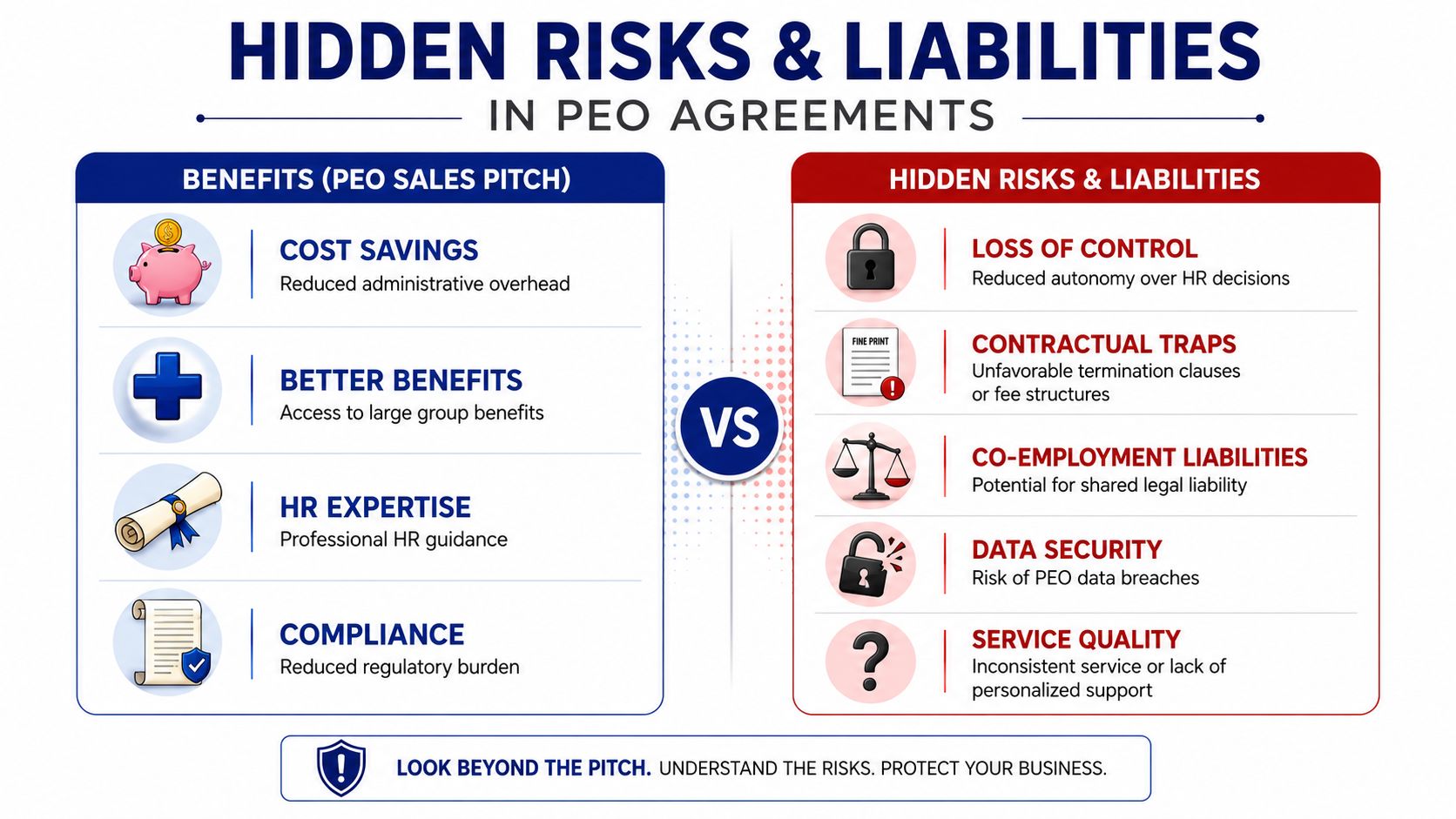
PEO agreements often help with administrative compliance and tax handling. That's useful. But the riskiest moments in employment law usually don't come from routine administration. They come from human judgment.
Common examples include:
A PEO is usually an administrative partner. It is not your litigation shield, and it is not your executive decision partner when a manager wants to terminate an employee on Friday afternoon.
Many PEOs are built for scale. That means standardized workflows, centralized service teams, and queue-based support. That model is efficient for payroll tickets and benefits questions. It's less effective when the issue is fact-sensitive, emotional, and legally loaded.
Watch for these pressure points:
Don't ask only, “What does the PEO handle?”
Ask, “Who advises us when the facts are messy, the manager is emotional, the employee is protected, and the documentation is incomplete?”
If the answer is vague, your company still owns a serious risk gap.
For growing employers, multi-state hiring is where the small business PEO conversation gets serious. A single-state business can often limp through compliance issues with a payroll provider and a decent accountant. That stops working once you hire across state lines.
As of 2026, small businesses in the United States employ 46.5% of all private-sector employees, representing approximately 59 million workers. With businesses expanding remotely, managing compliance across multiple states has become a significant challenge for this massive sector, according to these small business statistics.
A PEO can be useful in the administrative mechanics of multi-state employment. That often includes setting up payroll processes that account for state-specific withholding, unemployment tax administration, and workers' compensation coordination.
It can also help centralize records so your team isn't maintaining fragmented employee files across different systems. That's valuable because inconsistency is what creates downstream trouble during audits, disputes, and employee separations.
The hard part of multi-state compliance isn't just filing and processing. It's policy judgment.
You still need to decide how your company will handle:
For businesses wrestling with these issues, this resource on wage and hour compliance is a useful reminder that payroll execution and policy defensibility are not the same thing.
The PEO can help carry the paperwork. Your leadership team still has to own the judgment.
That's why multi-state growth often exposes the main weakness in a standard PEO model. The provider can administer a process. It may not help you think through a risky one.
If you're deciding on a small business PEO, don't compare it only to doing nothing. Compare it to the actual alternatives. Most executive teams are choosing among three structures: a PEO, an ASO, or in-house HR.
A PEO uses co-employment. An ASO typically provides administrative services without that co-employment structure. In-house HR keeps the function inside your business, whether through one HR leader or a broader team.
| Criterion | PEO (Co-Employment) | ASO (Administrative Services) | In-House HR |
|---|---|---|---|
| Employer structure | Shared through co-employment | No co-employment | Fully internal |
| Administrative relief | High | Moderate to high | Depends on team size |
| Control over HR process | Moderate | Higher than PEO | Highest |
| Benefits administration | Usually bundled | Often available, varies by provider | Self-managed or broker-supported |
| Tax handling | Strong administrative support | Support varies | Fully internal responsibility |
| Strategic advisory depth | Often limited in high-risk situations | Usually depends on the advisor | Depends on internal capability |
| Fit for complex employee relations | Often uneven | Can be stronger if paired with advisory support | Strong if experienced HR leadership is in place |
| Standardization | High | Moderate | Fully customizable |
| Scalability | Good for growing SMBs | Good if systems are well designed | Good if you invest early |
The right answer depends on your core problem.
Choose a PEO if:
Choose an ASO if:
Choose in-house HR if:
Most PEO decisions are made too quickly. Leadership gets frustrated with admin, hears a simplified pitch, and signs before anyone pressure-tests the risk model. That's backwards.
The right question isn't whether outsourcing sounds efficient. The right question is whether the structure matches the kind of problems your company has. While most PEO content focuses on payroll and benefits, it largely ignores the need for advisory guidance on terminations and internal investigations. With multi-state regulatory complexity surging by 35% in the last year, that gap in high-stakes decision support has become a major unmet need for SMB leadership teams, as discussed in this article on why small business owners consider PEOs.
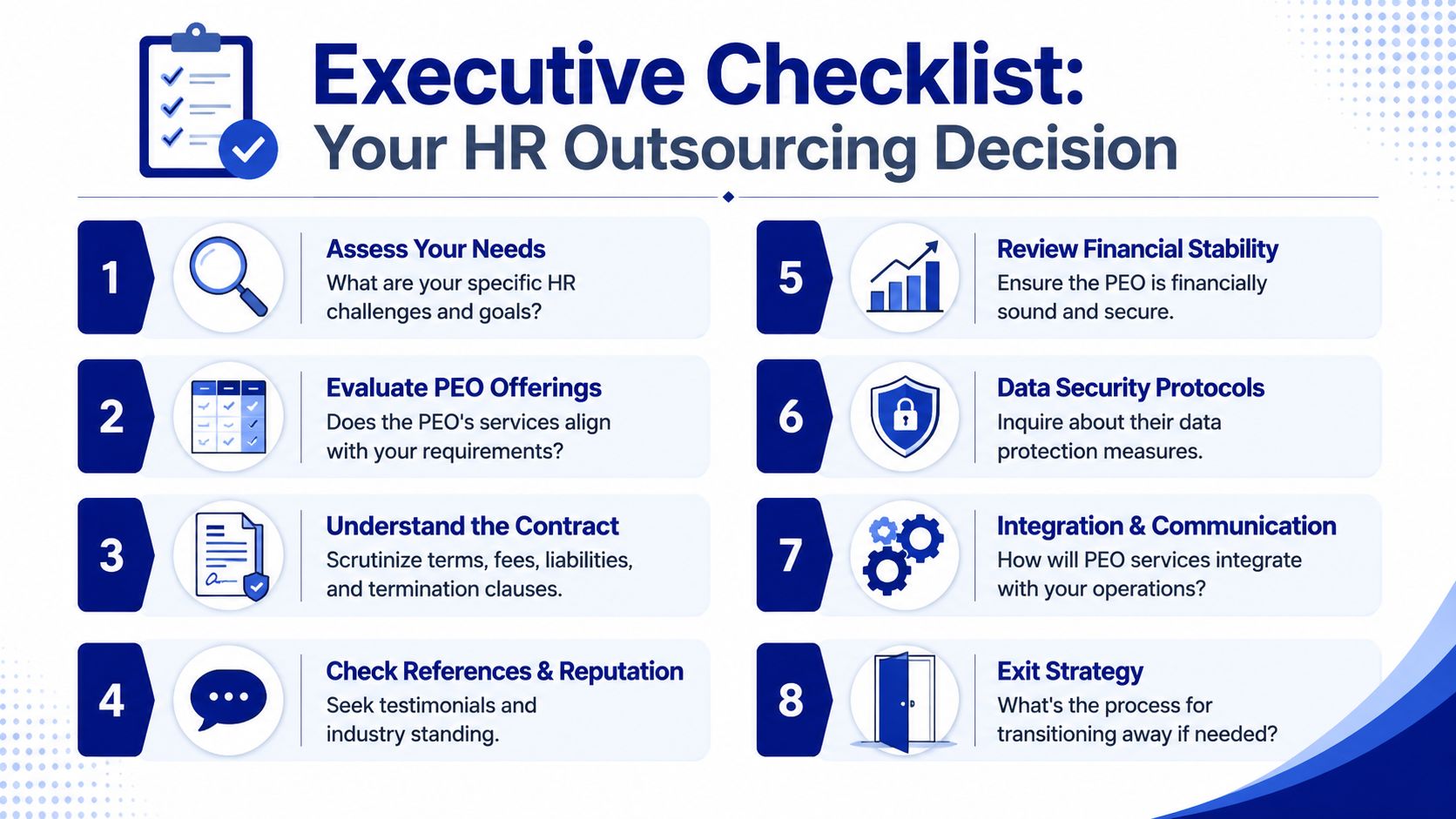
Use these in diligence meetings:
| Decision area | What to ask |
|---|---|
| Certification | Are you actively certified, and how do you handle tax liability boundaries? |
| Insurance | What EPLI coverage applies, and where are the limits and exclusions? |
| Escalation | Who advises us on terminations, investigations, and retaliation concerns? |
| Documentation | How do you support defensible records, warnings, and policy consistency? |
| Multi-state support | What is administrative support, and what remains our responsibility? |
| Exit planning | How hard is it to leave, transition data, and rebuild processes? |
Board-level question: If a manager creates a legal problem tomorrow, who is helping us think, document, and respond in real time?
If your company is small, growing, and buried in back-office HR work, a PEO is often a reasonable operational choice.
If your company is managing multi-state teams, sensitive employee relations, or repeated manager judgment issues, don't rely on a PEO alone. Pair administrative support with direct advisory capability, or choose a model built around strategic guidance. For example, a specialized strategic guidance provider works with SMB leadership teams on terminations, investigations, manager conduct, documentation standards, and multi-state risk decisions. That's a different function from routine HR administration, and many businesses need both.
A manager calls at 4:45 p.m. An employee has accused a supervisor of retaliation, morale is falling, and leadership wants someone terminated before the end of the day. Your PEO can process payroll tomorrow. It usually is not built to tell you whether that termination is defensible tonight.
That distinction matters more than the admin pitch.
The hardest HR problems are judgment problems. They involve credibility, timing, documentation, consistency, manager behavior, and legal exposure across states. An administrative PEO supports the infrastructure around employment. It does not replace an experienced advisor who can assess facts, pressure-test options, and guide leadership through a decision that may end up in a demand letter or agency charge.
Small businesses often discover this gap too late. They assume outsourced HR includes strategic counsel, then hit a termination, complaint, or internal investigation and find themselves translating a vendor's general guidance into a business-critical decision with real liability attached.
If your risk is mostly transactional, a PEO can be a good fit. If your risk comes from people managers making inconsistent calls under pressure, add direct advisory support or choose a partner built for that work. Such a partner serves that role for SMB leadership teams that need help with investigations, terminations, documentation standards, and manager-risk decisions, not just HR administration.
If your leadership team is weighing whether a PEO is the right fit, or whether you need deeper advisory support for high-stakes employment decisions, this firm is a practical next conversation. You can learn more about how the firm supports SMB owners, COOs, and HR leaders facing complex people risk through the contact page.