
You post a job. Applications come in fast, but most are weak, misaligned, or clearly sent to every employer in the market. Your hiring manager gets frustrated, your internal team wastes hours screening, and the role stays open longer than it should. For many SMBs, that cycle becomes normal.
It shouldn't. If you're growing, hiring across states, or operating in a regulated environment, relying on whoever happens to apply is a poor staffing strategy and a poor risk strategy. Sourcing in recruitment gives you a more controlled way to identify, approach, assess, and document talent before the process turns chaotic.
A business owner usually notices the problem before HR labels it. The issue isn't just that roles take too long to fill. It's that the process feels random. One opening gets a flood of low-quality applicants. Another gets almost none. Managers start making exceptions, changing standards midstream, or pushing for shortcuts because the pipeline is weak.
That's where sourcing changes the game. Instead of waiting for interest, your team goes into the market with a defined target, consistent screening criteria, and a deliberate outreach plan. You stop treating hiring like inbox management and start treating it like a business process.
Most hiring advice talks about sourcing as a speed tool. That's incomplete. For SMBs, especially those with multiple locations or compliance obligations, the bigger value is control. A sourced process can be structured. It can be documented. It can be reviewed for consistency.
Practical rule: If your hiring team can't explain why one candidate was contacted, screened, advanced, or rejected using the same criteria across the requisition, your sourcing process isn't defensible.
The governance gap matters. Public recruiting content tends to focus on access to passive talent and faster pipelines. It spends far less time on what multi-state employers need: consistent documentation, quality controls, and process discipline that reduce the risk of bias claims or sloppy decision-making. That gap is real, and it's one reason many SMB hiring systems break under pressure.
Healthcare leaders often understand this sooner than others because talent shortages and credential-sensitive hiring force tighter discipline. If you want a useful example of how proactive outreach can be organized around real staffing constraints, WeekdayDoc's physician playbook is worth reviewing. The format is specialized, but the operating lesson applies broadly: define the target clearly, build outreach around role reality, and don't confuse activity with hiring quality.
Sourcing in recruitment means proactively identifying and engaging people who match a role before they enter your applicant flow. It is not the same thing as posting a job and reviewing whoever shows up.
A simple way to explain it is this. Recruiting is the full trip. Sourcing is the first critical leg. Sourcing finds and attracts the right people. Recruiting then manages screening, interviewing, selection, offer, and close.
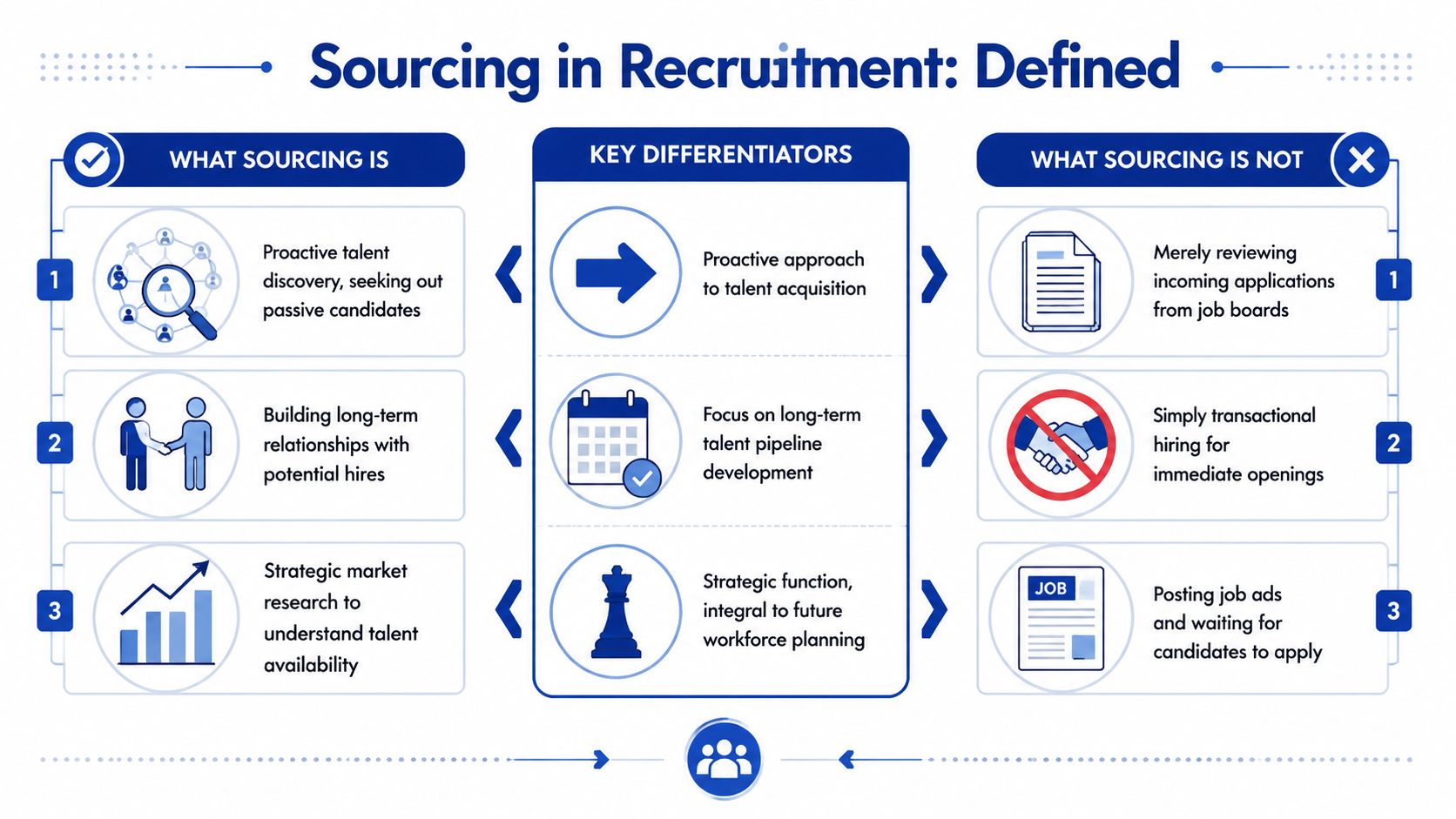
Sourcing is targeted search plus disciplined outreach. It includes market mapping, identifying passive candidates, building talent pools, and starting conversations before a requisition turns urgent.
That matters because most talent isn't actively applying. Recruitee notes that 70% of the global workforce is not actively seeking new jobs in its overview of talent sourcing strategy, which means waiting for applications leaves a large share of qualified talent untouched (Recruitee talent sourcing strategy guide).
A good sourcer doesn't just hunt names. They build a pipeline around role requirements, location constraints, compensation realities, and likely response behavior.
It is not just resume review. It is not a blast-email exercise. It is not a vanity project built around how many profiles your team touched this week.
It also isn't a substitute for recruiting discipline. If your intake is weak, your outreach is inconsistent, or your screening notes are incomplete, sourcing moves disorder earlier in the process.
Sourcing should narrow uncertainty, not multiply it.
That distinction matters for resource planning. If you think sourcing is just “finding candidates,” you'll underinvest in process design. If you understand it as the front-end control point for candidate quality, hiring consistency, and market access, you'll build it differently.
Owners and COOs should separate sourcing from recruiting because each function solves a different business problem.
If one person handles all three in a smaller company, that's fine. But don't blur the work. When responsibilities are blurred, standards drift. When standards drift, hiring gets slower, less consistent, and harder to defend.
The biggest mistake SMBs make is over-relying on the same public channels everyone else uses. That creates noise, not advantage. In narrow fields, it becomes self-defeating because employers end up “fishing in the same pond as everyone else,” which is why stronger teams build segmented talent pools instead of chasing the same visible profiles over and over (discussion on direct sourcing and talent communities).

This is the closest thing to precision work in sourcing. Your team uses search tools and search logic to find people who match specific criteria, then contacts them directly.
Common examples include:
This channel works best when the role has clear technical, credential, or industry markers. It is less effective when the job itself is vague.
Social sourcing is no longer optional. It's where many professionals signal expertise, network activity, and career interests long before they apply anywhere. That doesn't mean every platform matters equally for every role.
Use social sourcing with discipline:
If you want a broader read on where tech hiring tactics are heading, tech recruiting strategies for 2026 from Talantrix gives a practical look at channel diversification. Use that kind of material as a prompt, not a script. Your channel mix should follow your role profile, not trend content.
The highest-value sourcing function isn't built on one-off searches. It's built on reusable talent relationships.
That usually looks like:
For a practical framework on tightening the broader recruiting process around these efforts, our guidance on recruiting best practices is a useful companion. Sourcing works better when intake, screening, and interview discipline are already in place.
Don't reward your team for finding the most candidates. Reward them for building the most usable pipeline.
A sourcing function only works when the process is repeatable. You need clear intake, channel discipline, consistent outreach, screening notes that mean something, and records that can be reviewed later. Without that structure, your team is just improvising in public.
Start with a real intake, not a rushed handoff. Effective sourcing is a data segmentation problem. iCIMS recommends segmenting candidate data by function, skills, location, experience, and availability so teams can identify which channels work best for which roles, rather than pretending there is one universal best source (iCIMS on data-driven talent sourcing strategy).
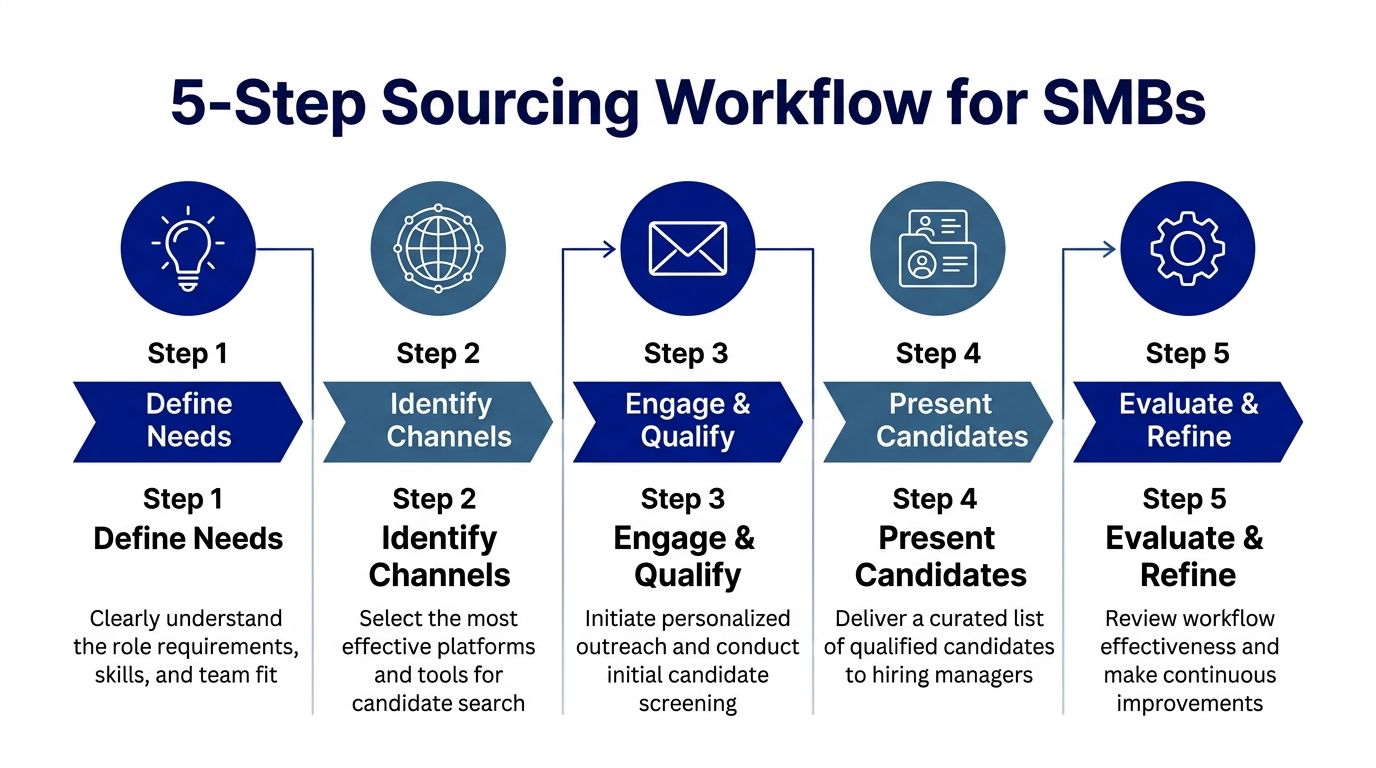
Use this workflow:
Define the role before you search Establish the fixed criteria. Title inflation, vague “culture fit” language, and shifting requirements destroy sourcing quality. Agree on core duties, must-have credentials, location rules, compensation boundaries, and what evidence will count as qualified.
Choose channels based on the role segment
A field operations role, a physician recruiter, and a controller should not be sourced the same way. Match channels to the actual labor pool and document why those channels were chosen.
Send structured outreach
Personalize enough to show relevance, but keep core language standardized. That protects consistency and reduces ad hoc messaging that can create uneven candidate treatment.
Run a first-pass qualification screen
Screen against the intake criteria, not manager instinct. Capture notes tied to job-related factors only.
Document and refine
Keep a tracker, review response patterns, and adjust by role family, geography, and experience level.
A basic initial message can be short and still professional:
Hello [Name], I'm reaching out regarding a [Role Title] opportunity with a company operating in [Location/Region]. Your background in [relevant skill or function] stood out based on [specific public detail]. If you're open to a brief conversation, I'd be glad to share the role scope, location requirements, and next steps. If not, I appreciate your time.
The point isn't to sound clever. The point is to be clear, role-specific, and consistent.
Use a shared tracker for every sourced candidate. If your ATS can do this well, use it. If not, a controlled spreadsheet is better than scattered notes.
| Candidate Name | Source/Channel | Outreach Date | Response Status | Screening Notes | Next Step |
|---|---|---|---|---|---|
| [Name] | [Channel] | [Date] | [No reply/Interested/Declined] | [Job-related notes] | [Action] |
| [Name] | [Channel] | [Date] | [No reply/Interested/Declined] | [Job-related notes] | [Action] |
One practical option for SMBs that need structured support is to assign ownership clearly, whether that sits with internal recruiting, an HR leader, or an external advisor. The point isn't the model. The point is that someone must own standards, documentation, and review.
Many companies measure the wrong things. They count how many profiles were viewed, how many messages were sent, or how many names were added to a spreadsheet. None of that tells you whether sourcing is helping the business make better hires.
A stronger measurement model uses three categories: speed, quality, and efficiency.
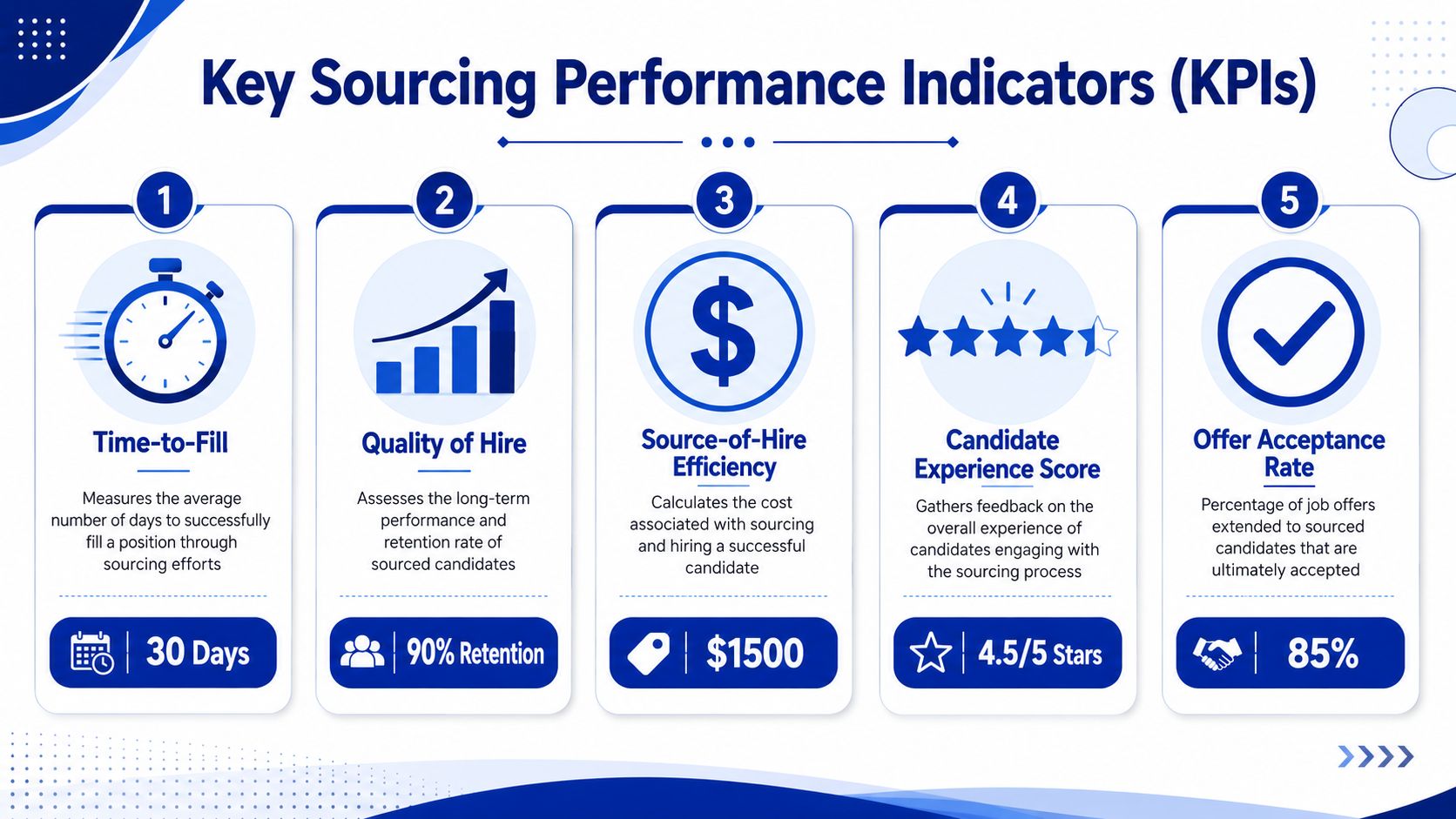
Juicebox identifies time-to-shortlist as the most important speed measure because it tracks the days from search kickoff to the first slate of qualified candidates. It's a better sourcing metric than general time-to-hire because it isolates the front-end performance of your sourcing engine (Juicebox on sourcing KPIs).
If time-to-shortlist is dragging, your problem is usually one of these:
Quality should be assessed downstream. Did sourced candidates perform well? Did they stay? Did they meet the actual success profile of the role after hire?
Many SMBs tend to get lazy. They celebrate pipeline volume and ignore whether the people sourced were better matched than inbound applicants. That creates motion without progress.
A fast shortlist is only useful if the people on it prove to be strong hires later.
Juicebox also points to outreach-to-reply rate and cost-per-hire as useful efficiency measures. Those numbers tell you whether your targeting and messaging are producing a viable return, or whether your team is merely doing more work to get the same result.
Use efficiency metrics to answer practical questions:
The right scorecard isn't complicated. It just needs to be tied to business decisions.
Once you accept that sourcing matters, the next decision is staffing the function. Build it in-house, or bring in outside help. There isn't one correct answer. There is only the right answer for your hiring pattern, internal maturity, and risk profile.
The case for sourcing at all is strong. Gem's recruiting benchmarks report states that a sourced outbound applicant is 5× more likely to be hired than an inbound applicant, which is why sourcing deserves real operating attention rather than side-of-desk effort (Gem 2025 recruiting benchmarks takeaways).
Choose in-house when hiring is steady, role families repeat, and managers can support a disciplined process. In that model, the sourcer becomes part of your institutional memory. They learn your workforce, your manager preferences, your market realities, and your documentation expectations.
In-house sourcing works best when you need:
Use a partner when hiring demand is uneven, the roles are specialized, or your internal team lacks process maturity. An outside expert can bring search discipline, market reach, and workflow structure without requiring a permanent headcount decision.
That option is often better when you need:
If you're weighing broader people-function resourcing, our comparison of outsourced HR vs in-house helps frame the decision beyond recruiting alone.
Don't ask, “Can someone find candidates?” Ask these three questions instead:
If the answer to any of those is no, don't force an in-house model too early.
Most sourcing failures don't look dramatic at first. They show up as inconsistent outreach, manager-specific screening shortcuts, undocumented rejection reasons, and candidate records spread across inboxes, texts, spreadsheets, and memory. That's how a hiring function creates legal exposure without realizing it.
For SMBs in multi-state or regulated environments, compliance in sourcing is not administrative overhead. It is process control. If two candidates with similar backgrounds receive different treatment because one manager likes a certain school, one recruiter uses a different screen, or one location keeps weaker records, you've created avoidable risk.
Use a few essential standards:
If you're reviewing your recordkeeping standards, our guide to employment records retention requirements is a practical place to start. For founders and lean teams trying to sort through recruiting support models without a lot of fluff, no-fluff RPO advice for startups also gives useful context on process ownership.
Good sourcing doesn't just improve access to talent. It creates a hiring record you can explain.
That is the standard worth building toward.
If your team needs help building a sourcing process that is structured, documented, and workable across complex employment settings, Paradigm International Inc. can help you design a more defensible approach. The goal isn't more recruiting activity. It's better hiring decisions, cleaner documentation, and a process you can trust as your business grows.