An employee requests leave, another has moved across state lines, and payroll needs an answer before the next processing deadline. The owner handling HR may have a national handbook and a payroll platform, but neither confirms which state's leave rules apply. For state paid family leave 2026 planning, work location comes before benefit duration. Assigning an employee to the wrong program can affect deductions, notices, eligibility decisions, and leave documentation.
The U.S. Department of Labor's paid-leave overview reports that 13 states and the District of Columbia have enacted paid family and medical leave programs. There's still no national guarantee of paid family and medical leave. A multi-state employer therefore needs a jurisdiction-by-jurisdiction operating plan, not a single paid-leave paragraph in the handbook.
The National Partnership for Women & Families' 2026 analysis identifies Virginia as the 15th state and the first Southern state in its analysis to enact a program. That count and the DOL count reflect different reporting and implementation bases. Neither count establishes when an employer must register, start deductions, or accept benefit applications.
The status table separates operating programs from implementation-stage programs. The DOL overview supports the jurisdiction list and implementation milestones; the additional program details come from the statutory and policy summaries identified below. An enacted law isn't the same as benefits being available.
2026 paid family leave status by state
| State | 2026 status | Key date or detail |
|---|---|---|
| California | Operating | Confirm current benefit formula and qualifying reasons |
| New Jersey | Operating | Check benefit eligibility separately from reinstatement rights |
| Rhode Island | Operating | Confirm family-leave eligibility and job protection separately |
| New York | Operating | Current-employer tenure affects eligibility |
| District of Columbia | Operating | Confirm registration, contributions, and benefit rules |
| Washington | Operating; technical change to employer contribution split | Confirm medical and family contribution allocation |
| Massachusetts | Benefits since 2021 | Up to 12 weeks to bond with a new child |
| Connecticut | Operating | Check employment eligibility and applicable safe-leave rules |
| Oregon | Operating | Check employment eligibility and applicable safe-leave rules |
| Colorado | Operating | Check qualifying reasons and reinstatement requirements |
| Maryland | Implementation for 2026 | Confirm contribution, registration, and benefit rules with the agency |
| Delaware | Benefits begin January 1, 2026 | Employers under 10 employees excluded from contributions and benefits |
| Minnesota | Benefits begin January 1, 2026 | Up to 20 combined weeks; employer and employee contributions |
| Maine | Contributions since January 1, 2025 | Claims processing begins May 1, 2026 |
| Virginia | Enacted; first Southern state in the cited policy analysis | Effective date not confirmed by the cited analysis |
The Congressional Research Service's paid-family-leave report states that Massachusetts began paying benefits in 2021, including up to 12 weeks for bonding with a new child. The table's Delaware, Minnesota, and Washington details are addressed through the implementation and payroll sources later in this guide. Those details require agency verification before payroll changes.
Maryland deserves particular caution. The DOL material identifies implementation activity, but it doesn't establish a sufficiently reliable operational deadline for an employer to configure payroll without checking the administering agency. The same discipline applies when any state changes its schedule after enactment.
The employer's working calendar should distinguish:
The immediate assignment is straightforward: mark every jurisdiction where employees work, including home offices and planned hires. Attach an agency-confirmation date and a responsible person to each entry. An unverified effective date should remain an open implementation item, not become a payroll assumption.
State paid family and medical leave programs operate like insurance systems. Employers need to distinguish the covered event, the benefit duration, and the wage-replacement formula. Knowing an employee's potential leave allowance doesn't establish the amount payable or whether the employee qualifies.
For planning under state laws applicable in 2026, the Congressional Research Service's program comparison describes wage replacement generally ranging from 50% to 100% of average weekly earnings, subject to a statutory weekly maximum. It also describes family-leave durations commonly ranging from 8 to 12 weeks, with medical-leave allowances ranging from 6 to 52 weeks annually. These are cross-program ranges, not promises to an individual employee.
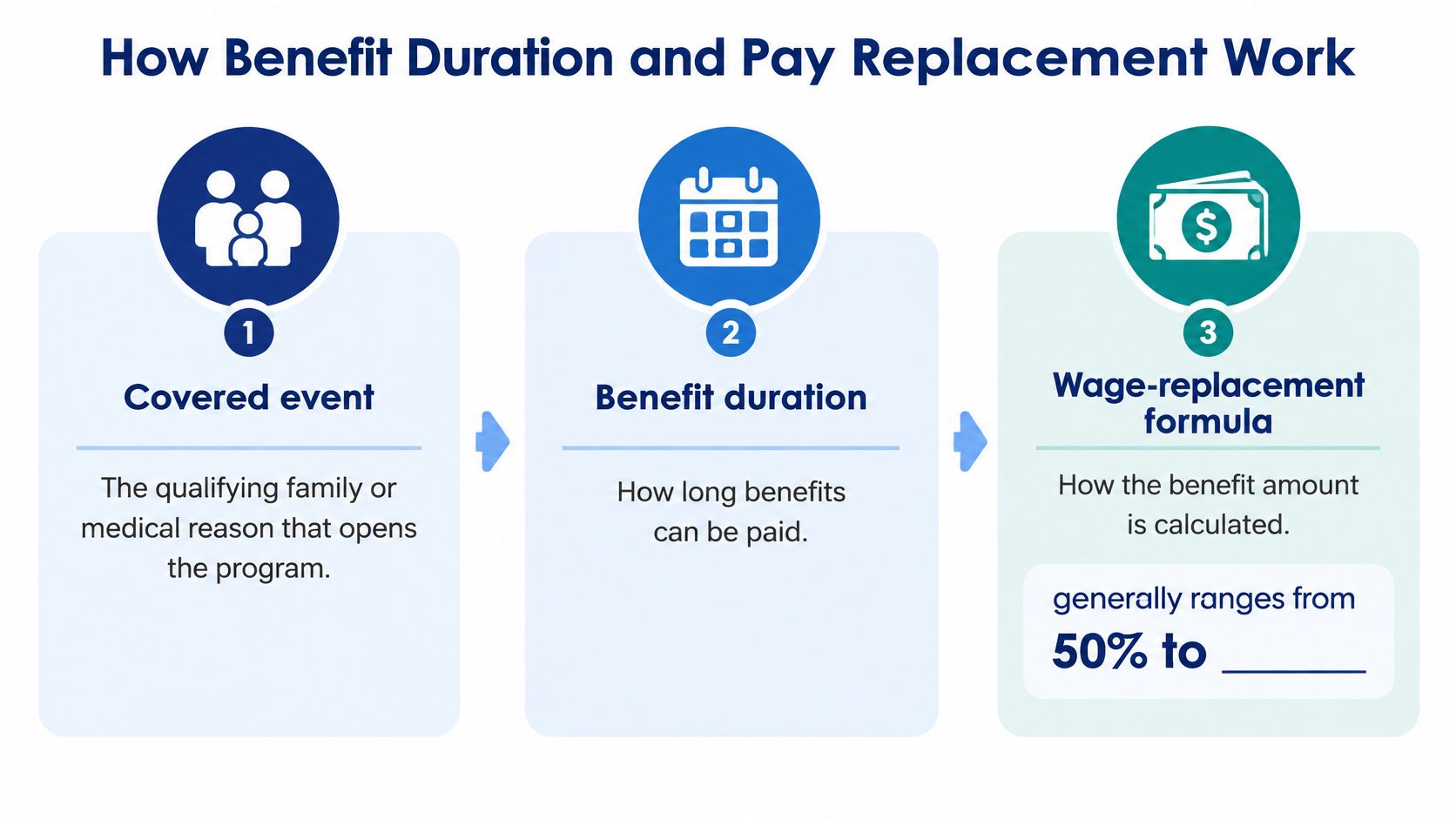
The employer's benefit worksheet should answer distinct questions rather than produce a single approved-or-denied result.
The CRS comparison also identifies earnings, employment duration, and in-state work as potential eligibility conditions. New York and Delaware also make eligibility dependent on tenure with the current employer. For an actual determination, the applicable state statute and agency guidance in effect for the claim must control.
A recent pay increase illustrates the administrative problem. An employee's current salary may be higher than the historical earnings used by the state formula. A payroll administrator who starts with current salary can produce a benefit estimate that doesn't match the agency's calculation.
The worksheet should preserve the earnings history used, the applicable look-back rule, and the calculation date. If the employer offers salary continuation, that arrangement needs a separate coordination review. The company shouldn't assume that its payment automatically supplements, replaces, or offsets the state benefit.
Calculation control: Keep the wage-history calculation separate from the decision about whether the employee's job is protected.
For each work state, the record should identify the qualifying event, available duration, formula, base period, and governing rule. Where the employer hasn't confirmed a state-specific provision, the entry should say what still needs verification. An incomplete field is more useful than an unsupported benefit promise.
Benefit eligibility and job protection are separate tests. Approval for wage replacement doesn't, by itself, answer whether the employer must restore the employee to a position. An employer also shouldn't treat the absence of protection under a particular benefit program as permission to terminate employment.
The U.S. Department of Labor's safe-leave and state-program comparison identifies family-leave protections in Rhode Island and New York and conditional family-and-medical-leave protections in the other jurisdictions shown below. For 2026 administration, the agency's comparison describes Washington criteria as similar to FMLA and generally identifies a 90-day employment standard in Connecticut and Oregon, with exceptions for some safe-leave situations. The table distinguishes those confirmed descriptions from details that still require a current agency check.
| State | Job-protection trigger | Eligibility or safe-leave note |
|---|---|---|
| Rhode Island | Certain family-leave users identified by DOL | Exact eligibility threshold requires agency confirmation |
| New York | Certain family-leave users identified by DOL | Current-employer tenure applies to benefit eligibility |
| Washington | Applicable tenure or hours requirements met | DOL describes criteria as similar to FMLA |
| Massachusetts | Applicable tenure or hours requirements met | Exact trigger requires current agency confirmation |
| Connecticut | Applicable employment requirements met | Employment-duration standard; safe-leave exceptions; survivor leave |
| Oregon | Applicable employment requirements met | Employment-duration standard; safe-leave exceptions; survivor leave |
| Colorado | Applicable tenure or hours requirements met | Survivor leave addressed |
| Maryland | Applicable tenure or hours requirements met | Confirm implementation and operative protection requirements |
| Delaware | Applicable tenure or hours requirements met | FMLA-style eligibility; employer-size coverage test also applies |
| Minnesota | Applicable tenure or hours requirements met | Survivor leave addressed; work-location analysis also required |
| Maine | Applicable tenure or hours requirements met | Survivor leave addressed |
| New Jersey | Not established by the cited DOL comparison | Survivor leave addressed |
The DOL document identifies six state paid-leave laws addressing leave for survivors of domestic violence, sexual assault, or stalking: Colorado, Connecticut, New Jersey, Oregon, Maine, and Minnesota. Implementation timing differs. Employers should verify the operative state provision before determining eligibility or requesting sensitive documentation.
A handbook entry saying job protected is insufficient. The decision record should identify the applicable state law, the administering agency, the rule's effective year, and the employee facts satisfying the rule. If tenure or hours matter, the file should show the supporting employment and time records.
The work-location matrix should contain:
This distinction matters when employees with similar needs work in different states. Their benefit approvals may look alike while their employment protections or notice obligations differ. Consistency means using the same disciplined review process, not forcing identical outcomes under different laws.
Before a denial, disciplinary action, or position change during leave, the employer should obtain expert review. Sensitive complaints, survivor-leave requests, and proposed terminations deserve particular care. A benefit administrator's determination is an input to that review, not the employer's entire analysis.
For distributed employers, which state applies can be a higher-risk question than how many weeks are available. Minnesota's official Paid Leave guidance for 2026 generally covers an employee working at least 50% of the time in Minnesota, including a Minnesota home office, while an employee working more than 50% in another state may be excluded, according to Minnesota Paid Leave's common questions. Employees dividing work among several states require a different analysis.
Minnesota's program launched January 1, 2026, as new programs also expanded the administrative demands associated with Delaware and Maine. Their calendars aren't interchangeable. Nor should Minnesota's work-location test be applied as a nationwide rule.
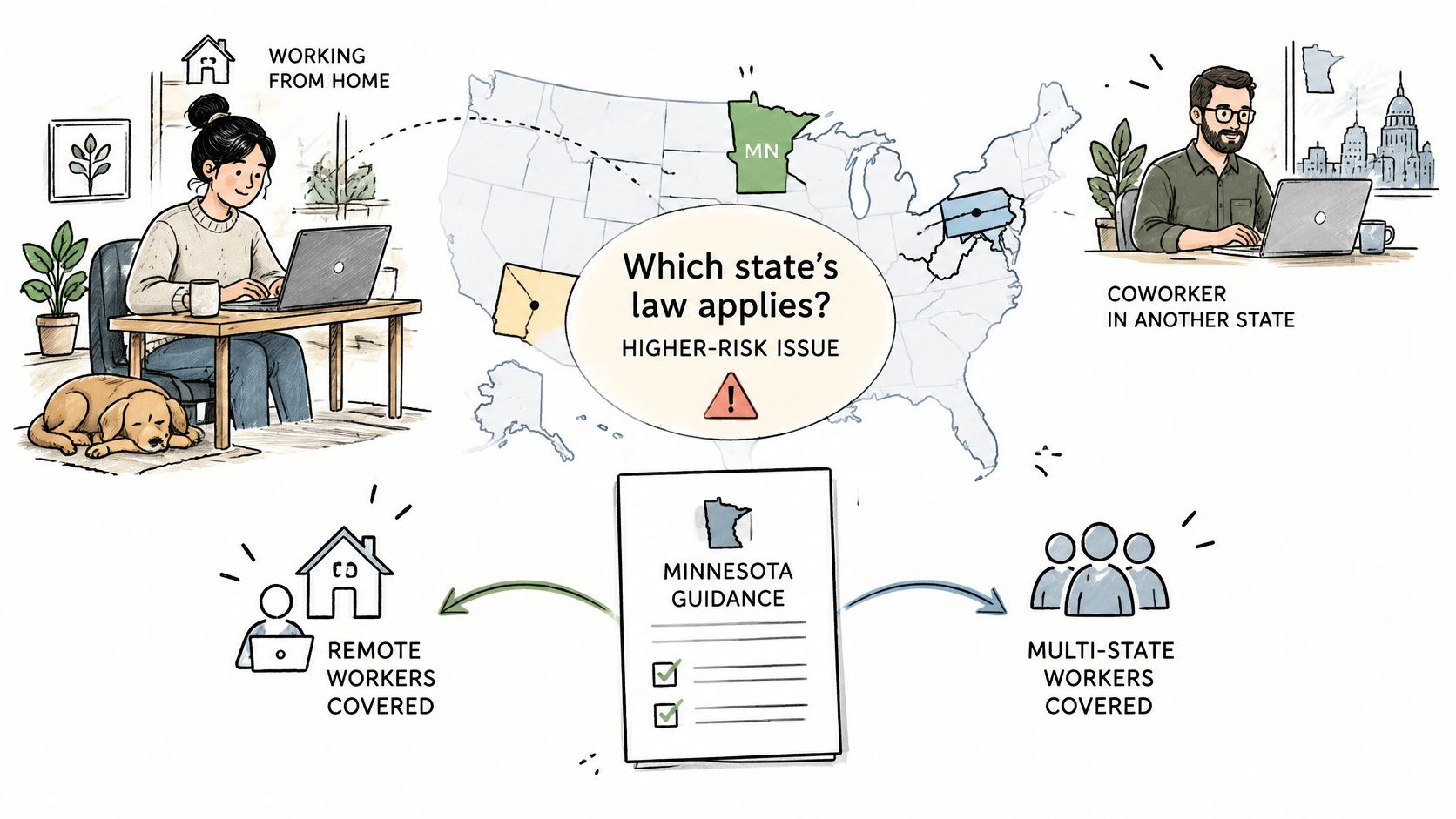
A mailing address alone isn't a sufficient work-location record. An employee may live in one state, regularly work in another, and travel through others. The employer needs an account of the actual pattern before deciding how the state program applies.
Say an employee begins working from a different home office while the payroll record retains the previous state. The company may continue administering the old arrangement without anyone making a deliberate coverage decision. A relocation workflow should connect manager approval, employee records, payroll, and leave administration.
Guidance on an employee moving to another state provides context for reviewing that broader employment change. For employers considering administrative support, KeenVerdict's resource to evaluate Justworks for your business can support platform due diligence. That evaluation should include who owns coverage decisions, rather than assuming the platform resolves them.
International Inc.’s Multi-State Compliance covers handbooks, leave, sick-time, and policies that hold together across every state where the client has people. That scope matters when a relocation affects more than a payroll field. Outside support is most useful when it connects the employee's work pattern to the company's actual policies and decision records.
Paid family and medical leave isn't the same as federal FMLA leave. For 2026, the U.S. Department of Labor's FMLA guidance describes the Family and Medical Leave Act, 29 U.S.C. § 2601 and 29 C.F.R. Part 825, as providing unpaid, job-protected leave for covered employers and eligible employees. State programs may provide wage replacement and additional employment protections.
Some employees can use federal FMLA and state paid leave concurrently. Receiving a state benefit doesn't automatically establish or eliminate federal eligibility. The employer needs a separate conclusion under each applicable law.
| Feature | Federal FMLA | State paid family and medical leave |
|---|---|---|
| Pay | Unpaid statutory leave | Wage replacement calculated under the applicable state formula and weekly cap |
| Employer coverage | Federal covered-employer requirements apply | State-specific employer thresholds and coverage rules apply |
| Employee eligibility | Federal service, hours, and other eligibility requirements | State tenure, hours, earnings, or in-state work requirements |
| Duration | Federal entitlement and applicable leave-year rules | Separate family and medical allowances under state law |
| Job protection | Restoration rights for eligible employees | Separate state reinstatement tests |
| Governing rules | Family and Medical Leave Act and DOL regulations | Each state statute and administering agency's rules |
The comparison deliberately separates the systems rather than treating paid leave as an extension of FMLA. An employee's state benefit claim, federal leave designation, and company payment arrangements should be documented distinctly. A single payroll code can't capture those decisions reliably.
Before denying leave, imposing discipline, or changing a position during an absence, the employer should follow a written review sequence.
A state benefit approval answers a benefit question. It doesn't replace the employer's federal leave, accommodation, or policy review.
The FMLA and ADA overlap guide addresses the practical need to coordinate these reviews. Medical restrictions and return-to-work questions should go to the person responsible for leave administration, rather than remaining solely with a line manager.
A specialist firm manages FMLA requirements and administration for clients, including consistent state-by-state handling of eligibility, accommodations, and return-to-work. Expert help is worth getting before acting on a termination, complaint, investigation, or leave-and-disability overlap. Those decisions require judgment about the complete employment situation, not merely the status of a benefit application.
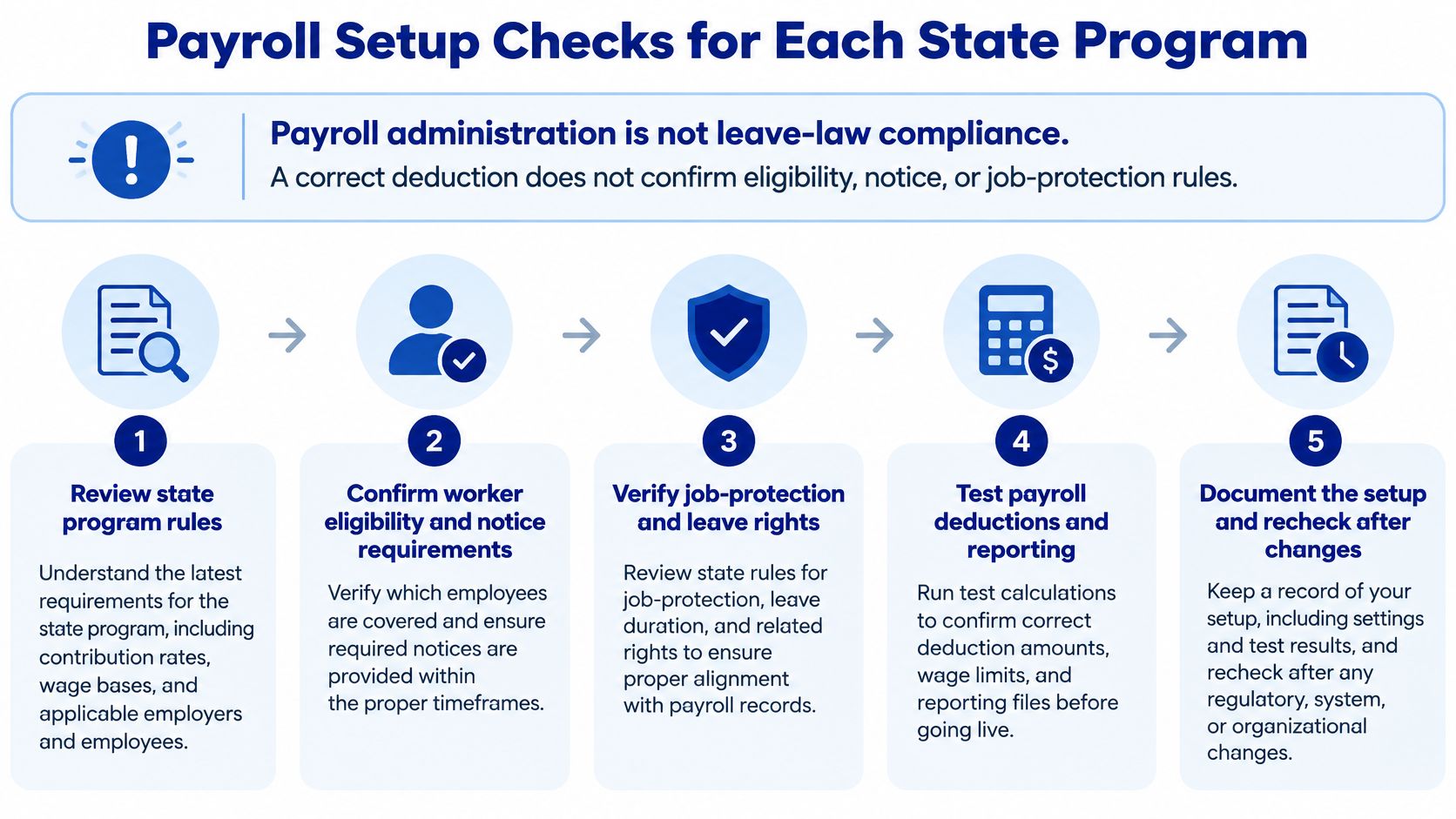
Payroll administration is not leave-law compliance. A correct deduction doesn't establish that the employer has issued the right notice, applied the right eligibility test, or evaluated job protection. Payroll and leave administration need connected records and separate accountability.
Delaware illustrates the importance of coverage thresholds. For 2026 planning, the Prenatal-to-3 Policy Impact Center's state-policy roadmap describes employers with fewer than 10 employees as outside contribution and worker-benefit coverage, while employers with 11–24 employees generally contribute only for parental leave. That summary leaves the exact boundary case requiring direct agency confirmation; employers shouldn't fill the gap by assumption.
Washington's 2026 technical change reallocating employer contributions between medical and family portions to address IRS tax treatment is described in Bradley's employment-law implementation update. That update also reports an additional year of IRS transition relief for administering states. Employers should confirm current IRS guidance and their own withholding and reporting treatment with a tax adviser.
Transition relief isn't permission to leave the process undocumented. The reconciliation owner should retain configuration approvals, exception reports, corrections, and communications with administrators. Tax treatment and leave eligibility should remain separate entries in the control record.
A managed payroll service review can help leadership define administrative responsibilities. The important question isn't just whether deductions occur. It's whether someone can explain the deduction, the governing setup, the reporting treatment, and the unresolved exceptions.
The most common operating mistake is treating a functioning payroll deduction as evidence that the entire leave process works. An owner may receive no warning until an employee asks about pay, reinstatement, or a return date. By then, different people may already have given inconsistent answers.
A useful internal test follows a hypothetical request from intake through return-to-work. Leadership should identify who receives the request, who checks coverage, who communicates with the employee, and who updates payroll. Any unanswered handoff becomes an assigned corrective task.
Management check: Every unresolved leave issue should have an owner, a next action, and a written decision record.
A compliance risk assessment can organize those corrections by consequence and urgency. A missing reinstatement review deserves faster attention than an editorial improvement to a handbook. An open coverage question should be resolved before a manager promises an outcome.
These controls reduce exposure and improve consistency; they don't guarantee an outcome. Investigations, complaints, and employment decisions during or after leave still need fact-specific judgment. Administrative completeness shouldn't be mistaken for a legal conclusion.
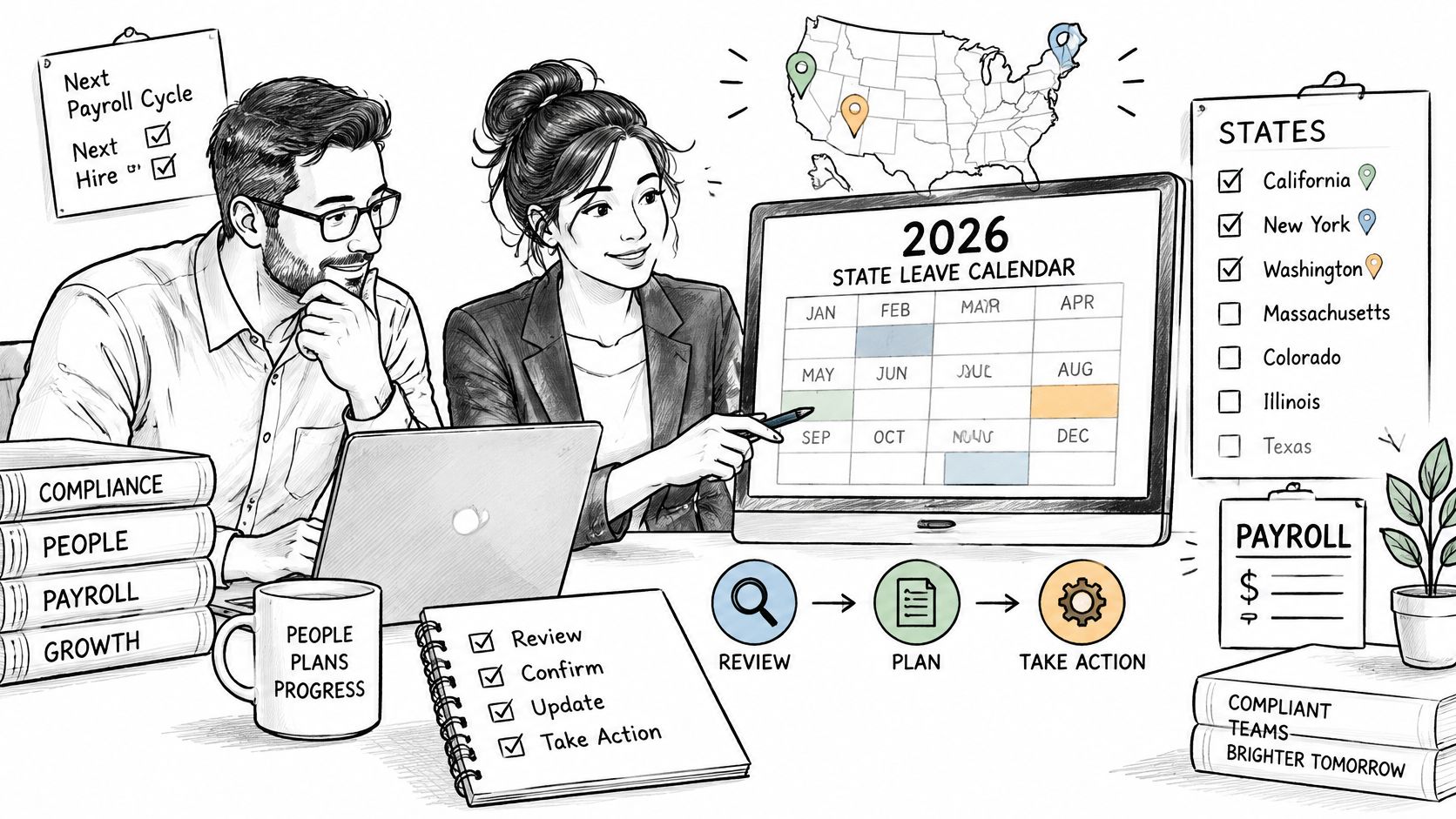
The employer should build the leave calendar before the next payroll cycle and before approving the next out-of-state hire. Waiting for an employee's request turns a manageable implementation task into a deadline-driven decision. The calendar should identify owners and evidence of completion, not just dates.
A shared spreadsheet is sufficient if the entries are controlled and maintained. It should connect employee work locations, agency milestones, payroll changes, required communications, and policy approvals. Access to sensitive medical or complaint information should remain separate from the general implementation calendar.
A time-off policy sample can support document planning, but the employer still needs work-state-specific decisions. The final policy should match what payroll, managers, and the leave administrator do. A document that promises one process while staff follow another creates avoidable confusion.
Leadership should receive a concise list of unresolved items rather than the entire administrative file. Each item should explain the decision needed, its operational consequence, and the person handling it. Expert help is worth getting before any termination, complaint response, investigation, or leave-and-disability decision.
Teams that want help building the matrix can learn about Paradigm's multi-state HR support. The useful starting point is a clear account of where employees work and which leave decisions remain unresolved.
This article is general information, not legal advice. Employment laws change and vary by state; consult qualified employment counsel about your situation.
International Inc. provides multi-state HR advisory, handbook alignment, and FMLA administration support for employers managing employees across state lines. Leadership teams can visit Paradigm International Inc. to learn how that support connects work-location decisions, leave documentation, and payroll responsibilities.