Your payroll platform shows a sick time balance for a supervisor in one state, and your handbook still promises everyone a single PTO bank of 15 days, use it or lose it. An employee three states away asks whether she can take a day to care for her father, and her manager wants to know if a doctor's note is required. Nobody in the building owns that question, so it lands on the owner or the COO who already handles HR on top of everything else.
The instinct is to answer with one policy. That instinct is where multi-state employers get into trouble, because the rules that decide accrual, carryover and permitted use are set state by state and, in places, city by city.
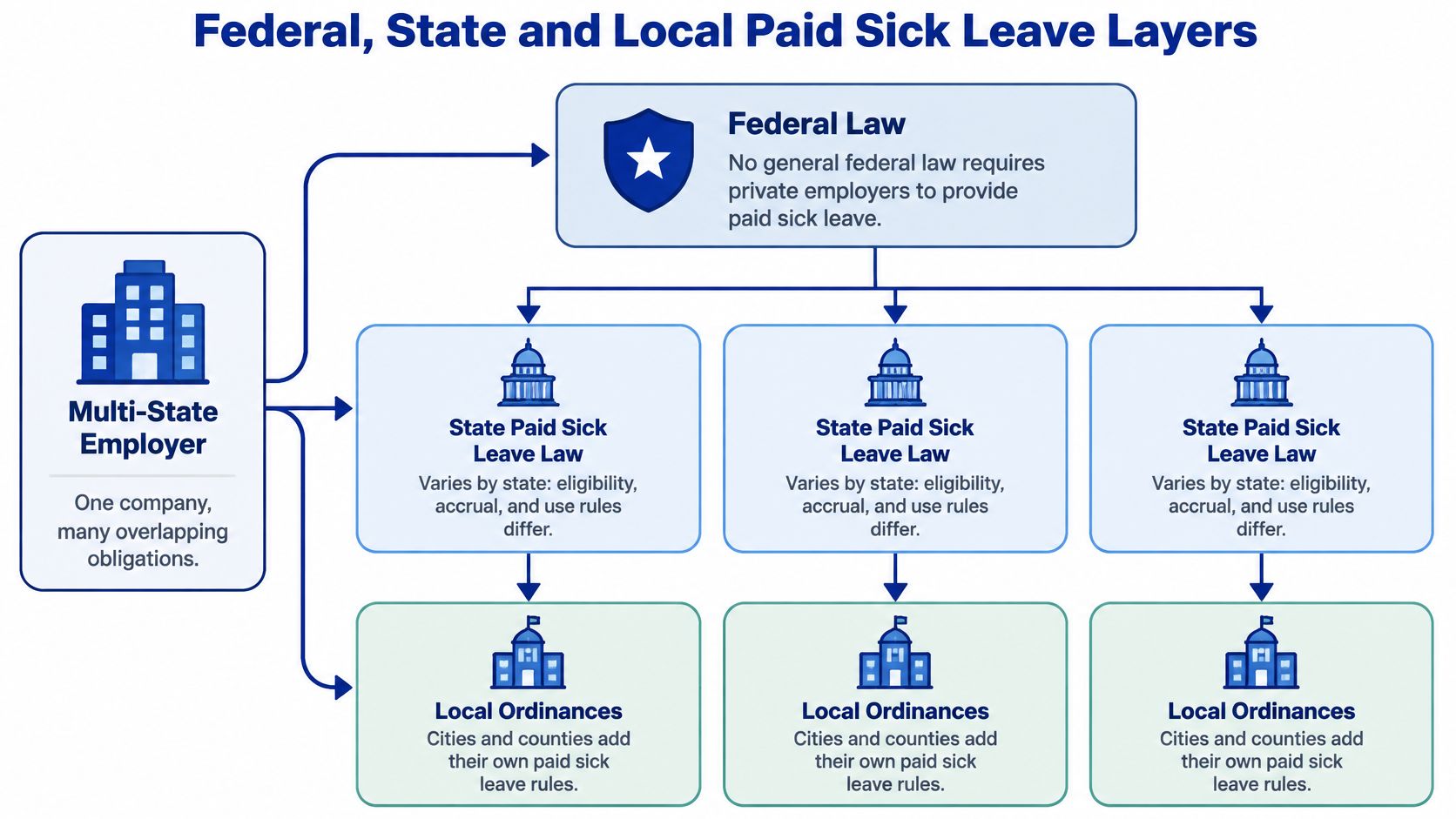
A single PTO bank can satisfy a state's paid sick leave rules and still fail a local ordinance. Federal law generally does not require private employers to provide paid sick leave, according to the U.S. Department of Labor's sick leave overview. State and local rules set the requirements that determine how leave accrues, carries over, and may be used.
The Family and Medical Leave Act (FMLA), enacted in 1993, can provide up to 12 weeks of unpaid, job-protected leave for qualifying medical and family reasons. It protects the employee's job, but does not require paid leave.
Paid sick leave requirements vary by jurisdiction, and local ordinances can add rules beyond state law. A compliance review that checks only state requirements may miss obligations where employees work.
The Bureau of Labor Statistics reported that 80 percent of private-industry workers had access to paid sick leave in 2025. That figure measures access, not whether a particular employer's plan meets the legal requirements where an employee works.
The rules come from several layers:
| Level | What it requires | Source |
|---|---|---|
| Federal | No general requirement for private employers to provide paid sick leave | U.S. Department of Labor |
| Federal leave (FMLA) | Up to 12 weeks of unpaid, job-protected leave for qualifying reasons | FMLA, 29 U.S.C. § 2601; 29 C.F.R. Part 825 |
| State | Paid sick leave laws in 18 states and the District of Columbia | Congressional Research Service, 2026 |
| Local | Requirements vary by city and county | U.S. Department of Labor |
| Federal contractors | Accrual, carryover, and notice rules on covered federal contracts | Executive Order 13706; 29 C.F.R. Part 13 |
Start with a location list. Record every state and city where an employee works, including remote staff, traveling sales representatives, and employees who moved during the year. That inventory defines which rules to check before adopting or applying a company-wide PTO policy.
Leave questions can also overlap. When an employee has a serious health condition, FMLA, state sick leave, and disability accommodation requirements may all be relevant. Review the relationship between FMLA and ADA obligations before responding to a manager's question about an individual case.
Two states can require paid sick leave yet impose different rules on accrual, carryover, and permitted uses. A company-wide PTO bank may meet one state's requirements and fall short in another. Before adopting a policy, build a location-by-location comparison using each state's current statute and labor agency guidance.
| State | Accrual rate | Annual or total cap |
|---|---|---|
| California | 1 hour per 30 hours worked; alternative of 24 hours by day 120 and 40 hours by day 200 | 10 days or 80 hours, whichever is greater, subject to exceptions |
| Washington | 1 hour per 40 hours worked | Carryover limited to 40 hours, with the next year's accrual added on top |
| Connecticut (2012 law) | 1 hour per 40 hours worked | 40 hours per year |
| Massachusetts | 1 hour per 30 hours worked | Up to 40 hours of paid sick time per year; employees may accrue up to 40 hours of unpaid sick time |
| Oregon | 1 hour per 30 hours worked | Employers may limit annual use to 40 hours; accrued, unused time carries over, subject to a 40-hour carryover limit |
| Vermont | 1 hour per 52 hours worked | Employers may limit annual use to 40 hours; accrued, unused time carries over, subject to a 40-hour carryover limit |
Treat accrual, use limits, and carryover as separate tests. A policy can meet an accrual rule and still fail because it restricts permitted uses or discards a balance that must carry over.
California generally requires accrual of at least 1 hour per 30 hours worked. Employers may use the alternative schedule shown in the table, and the law permits a cap of 10 days or 80 hours, whichever is greater, subject to exceptions. Washington's baseline is 1 hour per 40 hours worked, with up to 40 unused hours carried into the following year and new accrual added on top. The Congressional Research Service's comparison of state paid leave laws summarizes these differences.
Connecticut's 2012 law applied to employers with at least 50 employees, provided accrual at 1 hour per 40 hours worked, and capped annual use at 40 hours. Treat those figures as historical: the current Connecticut statute has since changed the law.
Use the table as a starting point, not a finished policy. For each state, confirm the current text on accrual, permitted uses, caps, carryover, and any front-loading option before aligning a shared PTO bank. A single bank is simpler to administer, but only if its rules meet or exceed each applicable state requirement.
The office address is the wrong starting point. A company headquartered in Texas with a controller working from home in Colorado, a field technician who drives through three states, and a part-time bookkeeper in Philadelphia has obligations that have nothing to do with where the lease was signed. The unit that matters is the employee's work location, and for a mobile worker it's the place where most of the work is performed.
Build the map once, in a spreadsheet, and treat it as the single source of truth. The sequence below is the one that holds up when someone asks how a balance was calculated.
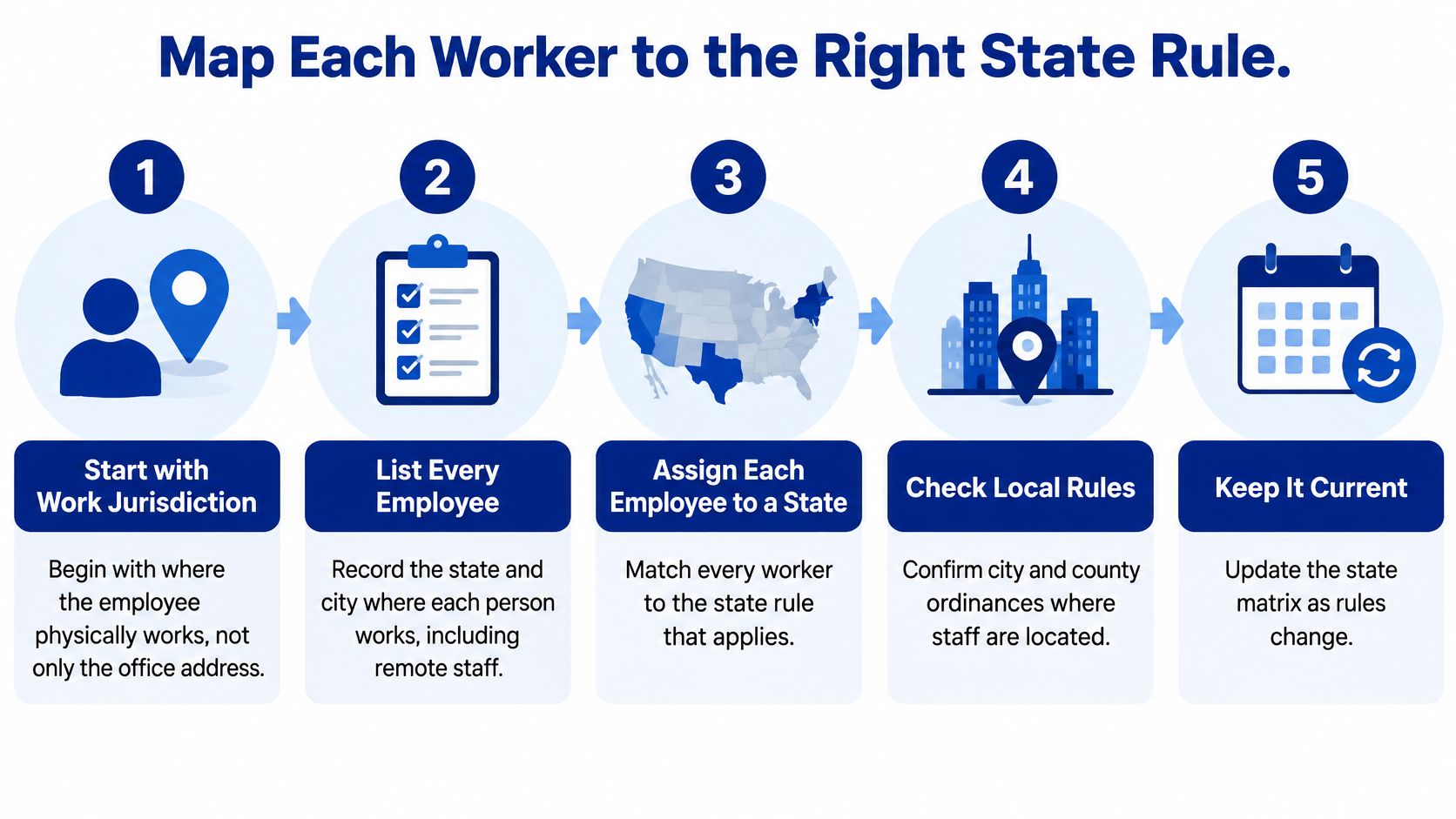
Two columns make the matrix useful rather than decorative: the rule as the statute states it, and what your policy does today. Any row where those diverge is a defect with a payroll consequence, and the fix belongs before the next pay run rather than after the next complaint.
Remote work is what makes step two hard, because the answer changes when someone relocates. The guide to which state law applies to remote employees covers the fact patterns that come up most often.
A matrix in a shared drive proves nothing. Payroll and timekeeping should hold jurisdiction-specific balances rather than one company-wide number, with an audit trail showing accruals, usage, notices and policy acknowledgments. Then run a quarterly reconciliation across payroll, timekeeping and the handbook language.
Sample the employees most likely to fall through: new hires, transfers, remote staff, exempt managers, temporary workers and recent separations. Confirm that balances weren't forfeited improperly, that carryover was applied, and that supervisors aren't imposing approval barriers nobody wrote down.
The test that matters: for any employee in any state, you should be able to show where each hour came from and how the balance was calculated.
A single PTO bank is the most common design at companies this size, and it's chosen for good reasons. One policy, one balance, one handbook line, fewer arguments at the front desk. The design fails when the bank is asked to satisfy statutes it was never built against.
Accrual is the first fracture. A single grant amount can't satisfy two states with different clocks unless it's set at the higher of the two, and a mid-year hire changes the math because timing matters as well as total hours. Carryover is the second. A year-end reset that zeroes balances conflicts with any state that requires unused time to carry into the next year.
Setting one number higher doesn't solve it either. A plan satisfies a state mandate only when it provides at least the required amount, permits the required uses, and imposes no more restrictive conditions than the statute allows. Generosity in total days doesn't compensate for a rule that blocks the reason the employee needed the time.
The 2025 legislative changes show how granular this gets. Nebraska's law was modified to exclude certain minors, temporary or seasonal agricultural workers, and businesses with 10 or fewer employees, while Maine's reported change raised allowable carryover to 80 hours but kept annual accrual and usage limits at 40 hours, according to the National Partnership's tracking of current paid sick days laws. Both belong on a verification list against the statutes themselves.
Choosing among them comes down to two questions. How many states do you operate in, and how much administration can your team sustain without dropping it every quarter?
A larger number in the handbook doesn't fix a rule difference. Carryover, permitted reasons and notice are separate tests from the size of the bank.
The guide to building a paid time off policy is a reasonable next read if you're deciding between a single bank and a separate sick accrual.
Start with one question. Does anyone on payroll perform work on or in connection with a covered federal contract? If the answer is no, this layer doesn't apply. If it's yes for even a handful of people, Executive Order 13706, issued in 2015, and the Department of Labor's implementing rule at 29 C.F.R. Part 13 apply to those employees, and the DOL fact sheet on paid sick leave for federal contractors lays out the terms.
| Requirement | Federal contract rule |
|---|---|
| Accrual | 1 hour for every 30 hours worked, or at least 56 hours at the start of each accrual year |
| Annual accrual cap | 56 hours |
| Balance cap | 56 hours |
| Carryover | Unused accrued leave must carry over from one year to the next |
| Notice | Written notice of available leave at the end of each pay period or each month, whichever interval is shorter |
| Conflicting state or local rule | The more protective requirement applies |
Three points matter more than the table. First, satisfying a state rule does not satisfy the federal contractor obligation, so a contractor working in a state with a compliant plan still has to check the contract rule separately. Second, where a state or local law provides greater protection, the contractor must follow the more protective requirement. Third, the written notice duty runs on a fixed interval and can't be satisfied by a handbook nobody reads.
Decide who works on covered contracts before you decide anything else, because that list drives which of your employees are in scope.
Contracting shops already read terms closely before committing, and the same discipline applies to judging contestability and cash flow before bidding on work that might carry these obligations. A company with mixed contracts, several states and a pending handbook revision should take the completed matrix to counsel before the policy changes.
A supervisor approves paid sick time for an employee recovering from surgery, but the absence may also qualify for FMLA. If the employer treats it only as sick leave, it can miss required FMLA steps. If it treats every sick day as FMLA, it may designate leave that does not qualify. Review each obligation separately, then coordinate them.
Start by assessing the reason for the absence and the employee's FMLA eligibility. Follow the applicable notice and designation process. Then use the employee's work location to check which state or local sick leave rule applies.
Next, determine whether accrued paid leave will run alongside unpaid FMLA leave. Substitution rules can depend on the circumstances and applicable requirements, so set out the decision clearly rather than leaving it to a supervisor's discretion.
Keep the records distinct. Track FMLA designation separately from the sick leave balance, and debit the balance tied to the employee's applicable location. That makes it easier to reconstruct which leave was used and why without mixing state balances.
When an absence also involves a possible disability accommodation, assess that issue alongside the leave rules before responding. The overview of state paid family leave rules provides related context for requests involving sick time, family leave, and accommodation.
An employee asks payroll for an available sick-leave balance, but the system can show only the company-wide PTO total. That gap can make it hard to demonstrate whether the employee received the notice and balance information required for their work location.
For each jurisdiction, check how the rules apply to these records and processes:
A single company-wide PTO bank can make these records harder to produce if the system cannot separate balances by location or show the required information on pay statements. Set up payroll and policy records to preserve the balance and notice details each employee's jurisdiction requires.
If a termination follows protected leave or a complaint, review the facts and policy before sending notice. The Leave and FMLA service handles eligibility, accommodations and return-to-work consistently, state by state.
Before revising a handbook, check each state's current statute or enforcing agency guidance. Then check the cities and counties where employees work. Local rules may set different accrual, carryover, and notice requirements.

Keep the matrix as a dated working document. A company-wide PTO bank may meet one state's requirements and fall short in another because accrual, carryover, and permitted uses differ. Map each employee's work location to the applicable rules before adopting a shared policy.
Get counsel or an experienced HR advisor's input before a termination following leave or a complaint, discipline tied to sick leave use, a leave request that overlaps with a disability accommodation, or a workplace investigation. The sequence of decisions, questions, and documentation can affect the response.
Bring the location matrix and relevant policy language to the discussion. That gives the reviewer a clear view of which jurisdictions and rules apply.
If your company is newer or its counsel relationship is limited, a founder legal checklist for South Florida can help you frame a specific request for legal review.
The firm provides multi-state HR compliance support, including aligning handbooks, leave, sick-time, and policies across states. Request a review of your location list and policy matrix before the next handbook revision.
This article is general information, not legal advice. Employment laws change and vary by jurisdiction. Consult qualified employment counsel about your situation.