
Building a team that can carry your business into the future requires a strategic approach, not a reactive one. While filling empty seats provides a short-term fix, sustainable growth is driven by a forward-thinking hiring strategy. This is where a dedicated talent acquisition team becomes essential, acting as a strategic partner to build the workforce your company needs to thrive. A strong talent acquisition function moves beyond simply filling jobs and focuses on creating a competitive advantage through people.

Many business leaders use "recruiting" and "talent acquisition" interchangeably, but they represent two different approaches. Recruiting is transactional; it focuses on filling an immediate, open role as quickly as possible. A talent acquisition team, on the other hand, develops a long-term strategy to ensure the right people are always within reach.
Think of it as building a sales funnel for your workforce. Instead of scrambling to find candidates only when a position opens, a talent acquisition team is constantly building relationships and identifying great people. It is a strategic function focused on anticipating your future business needs and ensuring the right talent is in your orbit when you need it.
The goal is to shift from a reactive hiring process to a deliberate, strategic one. This prevents wasting time and money on candidates who were never the right fit. It ensures that you, your hiring managers, and your interview teams are aligned on what a great hire looks like before the search even begins.
A well-run talent acquisition function delivers several key benefits:
By investing time upfront to align on the target, a talent acquisition team avoids the costly cycle of misaligned hires and high turnover. This strategic pause is what separates effective workforce planning from simple order-taking.
Ultimately, establishing a talent acquisition team is an investment in your company’s future. It provides the structure needed to build a real competitive advantage and secure the talent that will drive your growth for years to come.
Ready to build a more strategic hiring process? Our team can help you design a talent acquisition framework that aligns with your business goals. Learn more by contacting our team for a personalized consultation.
A modern talent acquisition team does much more than post job ads and review resumes. Its purpose is to build a strategic, repeatable, and legally defensible hiring process that supports your company’s long-term goals. Instead of just plugging holes, a great TA team focuses on building a resilient workforce through a series of connected activities.
These functions work together to lower hiring risks, improve the quality of new hires, and create a talent pipeline that gives your business a competitive advantage. Each function has a clear purpose, contributing to a system that is proactive rather than reactive.
To better understand their role, let's break down the core responsibilities that define a high-performing talent acquisition team.
| Responsibility | Description | Strategic Business Value |
|---|---|---|
| Strategic Sourcing | Actively identifying and engaging potential candidates, including passive talent not currently seeking a new job. | Reduces time-to-hire by building a pre-vetted talent pool and provides access to top performers not found on job boards. |
| Talent Pipelining | Building and nurturing long-term relationships with potential candidates for future roles. | Creates a "bench" of warm candidates, turning frantic searches into deliberate selections and reducing hiring costs. |
| Employer Branding | Crafting and promoting the company's story, culture, and values to attract top talent. | Improves the quality and quantity of inbound applicants and helps the company stand out in a competitive talent market. |
| Candidate Experience | Managing every touchpoint a candidate has with the company, from application to offer or rejection. | Builds a positive reputation, generates referrals, and ensures even unsuccessful candidates can become brand advocates. |
| Data & Analytics | Tracking, analyzing, and reporting on key hiring metrics to measure effectiveness and identify improvements. | Enables data-driven decisions, optimizes the hiring process, and provides leadership with clear ROI on recruiting efforts. |
| Process Management | Ensuring a consistent, fair, and legally compliant evaluation process for every candidate. | Mitigates legal and compliance risks, improves hiring consistency, and supports diversity and inclusion goals. |
These functions show that talent acquisition is not just an administrative task—it is a strategic driver of business growth, risk management, and long-term success.
The foundation of any strong talent acquisition team is strategic sourcing. This goes far beyond reviewing applicants on traditional job boards. It is the ongoing, active process of identifying and connecting with potential candidates, especially "passive candidates" who are not actively looking for a new job. Effective sourcers map the talent market to understand where top performers work and what skills they possess.
This work feeds directly into talent pipelining, which is about building and nurturing relationships with these potential candidates over time. This creates a "bench" of pre-qualified individuals for roles you anticipate needing in the future. When a critical position opens, the team is not starting from zero; they already have a warm pool of talent to engage, which significantly reduces hiring time.
A well-maintained talent pipeline transforms hiring from a frantic search into a deliberate selection process. It ensures you are not starting from scratch every time, giving you immediate access to qualified individuals who are already familiar with your company.
How your company is perceived in the job market directly impacts your ability to attract top-tier professionals. A key function of a talent acquisition team is to manage and promote the employer brand. This involves crafting a compelling story about your company culture, values, and what makes it a great place to work, then sharing it across your career page, social media, and through employee testimonials.
Tied directly to your brand is the candidate experience. Every interaction a candidate has with your company during the hiring process shapes their opinion of your business. A positive experience, even for those you do not hire, builds goodwill and can lead to future referrals. Conversely, a poor experience can damage your reputation and deter the very people you want to attract. For more on this, you can explore our resources on recruiting best practices.
Modern talent acquisition is driven by data, not guesswork. A core function is to track, analyze, and report on key hiring metrics. This provides leadership with a clear view of hiring effectiveness and identifies areas for improvement. Solid process management also ensures every candidate is evaluated fairly and consistently, which is critical for avoiding legal risks.
The need for data-driven hiring is more urgent than ever, as 77% of recruitment professionals report skills shortages as their top challenge. This pressure makes it essential to use analytics to make smarter decisions, as vacancies can inflate costs to 1.5 to 2 times the annual salary for each unfilled role. You can discover more insights on global talent trends and see how they are impacting hiring today.
By focusing on these core functions, a talent acquisition team evolves beyond simple recruiting. It becomes a strategic partner that builds the human capital your business needs for long-term success. If you are ready to formalize your hiring process, our experts can guide you. Learn how we can help by contacting our team.
Deciding how to structure your hiring function is a pivotal choice for a growing company. The right structure provides a pipeline of talent to fuel expansion. The wrong one can create hiring bottlenecks, increase costs, and slow down growth.
There is no one-size-fits-all solution; the best approach depends on your company's hiring volume, budget, and long-term goals. The choice typically comes down to three models: building an in-house team, outsourcing to a partner, or creating a hybrid of the two.
Think of it like deciding between an in-house marketing team and a full-service agency. If your marketing needs are consistent and you want total brand control, an internal team is the best choice. However, if you need specialized skills for a short-term campaign, an agency offers immediate expertise without long-term overhead. Your approach to talent acquisition deserves the same strategic consideration.
Building an in-house team means hiring your own full-time sourcers, recruiters, and leaders. This model is ideal for companies with steady, predictable hiring needs, typically those bringing on more than 20-30 people per year. An internal team lives and breathes your company’s mission and values, making them powerful brand ambassadors.
Alternatively, you can outsource the entire function to a Recruitment Process Outsourcing (RPO) provider. An RPO partner acts as your recruiting department, managing the end-to-end process as an extension of your company. This model is highly effective for businesses that need to scale quickly or lack the resources to build a team from scratch. RPOs bring proven processes, specialized expertise, and access to powerful recruiting technologies that are often too expensive for small or mid-sized businesses.
Outsourcing to an RPO provides immediate access to a mature recruiting infrastructure. This allows you to tap into best practices, advanced tools, and broad talent networks without the significant upfront investment and time required to build them from scratch.
A hybrid model offers a practical middle ground, blending the stability of an in-house team with the flexibility of external partners. In this setup, an in-house Talent Acquisition Manager might own the overall strategy while using contract recruiters for specific, hard-to-fill roles or to manage sudden spikes in hiring. This approach allows you to balance cost, control, and expertise.
The right structure for your talent acquisition team depends on your unique circumstances. Consider your hiring volume, role complexity, budget, and speed-to-scale. A thoughtful decision here will set the foundation for building a workforce that can drive sustainable growth.
If you are weighing these options and need guidance, our team can provide expert advice. You can get in touch with our experts here to discuss a structure that aligns with your goals.
Great hiring does not happen by chance; it is the result of a deliberate, well-managed process. To build a team that drives your business forward, your talent acquisition team must guide both candidates and hiring managers through a consistent journey. This approach turns hiring from a reactive scramble into a strategic advantage that protects your company while securing top talent.
Think of it as a four-stage lifecycle that takes you from the initial search to a new hire's first day. Following this path ensures every decision is intentional and every action is documented. This creates a process that is both effective and legally defensible.
This first stage, sourcing and attraction, is where you proactively find candidates instead of waiting for them to come to you. It involves more than just posting a job and hoping for the best. A smart talent acquisition team actively seeks top performers, including "passive" candidates who are not looking for a new job but are open to the right opportunity. A key part of this today is knowing where to find remote jobs and tapping into platforms built for a distributed workforce.
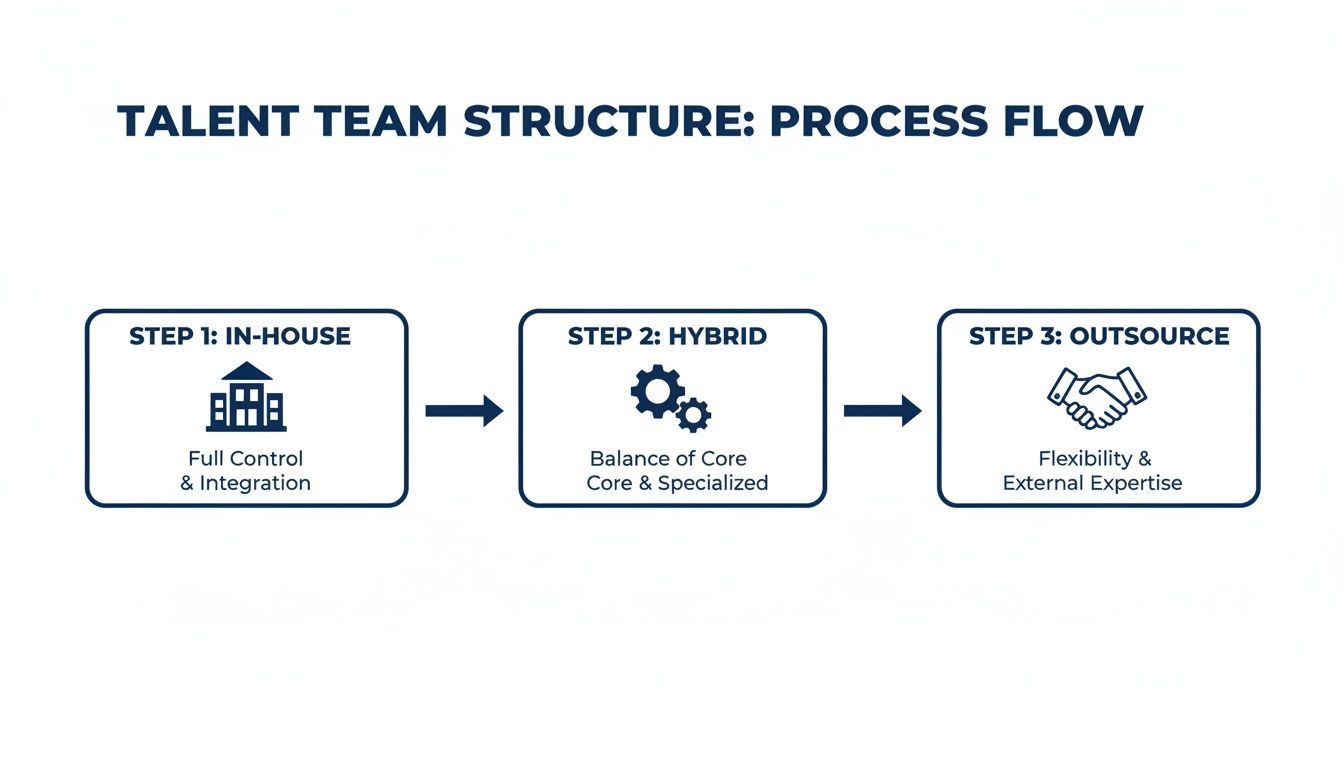
Attraction is the other side of this coin, where your employer brand makes talented people see your company as a place they want to work. The goal is to build a steady pipeline of qualified, interested individuals before you even have an open role to fill. As shown in the diagram, how you structure your team—whether in-house, outsourced, or hybrid—directly shapes your approach to sourcing and the entire hiring process.
Once you have built a pool of candidates, you move into the screening and assessment stage. The objective is to fairly and efficiently narrow the field to a shortlist of the most promising individuals. This phase is critical for risk management, as it establishes a foundation for consistent, unbiased evaluation.
During this stage, your team will:
A common pitfall is inconsistent screening, where different candidates are asked different questions. A structured process ensures every applicant is evaluated against the same objective criteria, creating a defensible record and reducing the risk of bias claims.
The interviewing and selection stage is your opportunity to get to know the top candidates on a deeper level. To keep the process fair and effective, it is essential to use a structured interview process. This means every candidate for a given role is asked the same core set of job-related questions by a prepared interview panel.
This structured approach helps neutralize unconscious bias and allows for a true "apples-to-apples" comparison between candidates. Your talent acquisition team is responsible for creating these interview guides and training hiring managers on how to use them. This includes coaching on legally compliant questions and proper note-taking.
The final stage, offer and onboarding, is where you secure your chosen candidate and set them up for success. The offer itself should be handled with care and transparency. Your talent acquisition team will extend the formal offer, manage any negotiations, and ensure all necessary paperwork, from background checks to employment agreements, is completed correctly.
Once the offer is accepted, the focus shifts to onboarding. A great onboarding experience is about more than just filling out HR forms; it is about integrating the new hire into your company culture and preparing them to be productive. A well-organized process can improve employee retention and engagement from day one. You can use our sample new hire checklist to help structure this critical handoff.
You cannot prove the value of your talent acquisition team without the right data. To move from a cost center to a strategic business partner, your team must demonstrate a clear return on investment. Focusing on key performance indicators (KPIs) turns hiring data into actionable intelligence, allowing you to refine your process and make smarter decisions.
This shift from simple activity tracking to strategic measurement is what separates an administrative recruiting function from a real value driver. It’s about answering the big questions: are we hiring the right people, are we doing it efficiently, and is our process strong enough to stand up to scrutiny?
While you could track dozens of metrics, a few core KPIs provide the clearest picture of your team’s effectiveness. Instead of getting lost in a sea of data, focus on a handful of high-impact indicators that tell a compelling story about your hiring outcomes.
Here are essential metrics every business leader should watch:
Beyond metrics, a successful talent acquisition team must build a process that is repeatable and defensible. Governance and controls are the guardrails that ensure your hiring activities are fair, consistent, and compliant with regulations like those from the Equal Employment Opportunity Commission (EEOC). Without these guardrails, even a well-intentioned team can expose the business to significant legal risk.
Strong governance isn’t about adding bureaucracy; it’s about creating a predictable and fair system that protects the organization. It ensures every hiring decision is based on objective criteria and supported by consistent, defensible documentation.
Data-driven decision-making is central to both performance measurement and governance. Today, 73% of professionals use analytics to guide their hiring strategies, and modern firms have shown that advanced analytics can slash time-to-fill by 22%. For multi-state operators, these tools can also flag compliance gaps. You can explore more statistics on talent acquisition trends on Jobylon.com to see the full picture.
Implementing oversight does not have to be complicated. Here is a starter checklist to help you build a more defensible hiring process:
If you need help establishing KPIs and governance for your hiring process, our team can provide expert guidance. Let us build a system that delivers results and peace of mind by scheduling a consultation today.

Expanding your hiring footprint across state lines opens up a world of talent, but it also introduces a maze of complex regulations. What is perfectly legal in your home state could be a compliance violation just one border away. For a growing business, this patchwork of rules is a serious challenge.
When your talent acquisition team recruits nationally, a deep understanding of legal and regulatory compliance is not just a good idea—it is your best defense against preventable pitfalls. A small misstep in one location can create significant legal and financial exposure for the entire organization.
The compliance landscape is not uniform. It is a collection of state- and city-specific rules that are constantly changing, and your talent acquisition team must stay vigilant to protect the business.
Key areas where laws frequently differ include:
Think of multi-state compliance like navigating different traffic laws in every state you drive through. You cannot assume the rules of the road are the same. A defensible hiring process acts as your guide, ensuring you follow local rules no matter where you recruit.
The most effective way to manage multi-state risk is to build a standardized hiring framework that complies with the strictest applicable laws. This "high-water mark" approach simplifies your process and creates a consistent, fair experience for all candidates, regardless of location. This requires a disciplined effort from your talent acquisition team to establish and enforce clear guardrails. For a deeper look, check out our guide on remote worker compliance challenges.
To create a process that holds up across jurisdictions, your team should focus on three critical areas. First, create and mandate the use of standardized interview guides with pre-approved, job-related questions to prevent hiring managers from accidentally asking non-compliant questions. Second, provide ongoing manager training on compliant interviewing and documentation.
Finally, maintain consistent documentation for every candidate. This creates a defensible record showing that your evaluation was fair, objective, and based entirely on job-related criteria. A proactive and well-informed talent acquisition team is your greatest asset in managing these complexities and confidently hiring the best talent from anywhere.
As leaders begin to think more strategically about hiring, a handful of practical questions often arise. Below, we address some of the most common questions from business leaders, with clear, actionable answers.
Think of a recruiter as a short-term problem-solver. Their job is to fill open seats as quickly and efficiently as possible. It is a reactive role driven by the immediate, tactical need to get someone hired. A talent acquisition specialist, on the other hand, plays the long game. They focus on strategic goals like building talent pipelines, strengthening the employer brand, and forecasting future skill needs.
There is no single magic number, but a good rule of thumb is to formalize the function when you consistently hire more than 15-20 new roles per year. At this stage, the volume of work and growing compliance risks usually justify the investment in a dedicated strategic team. This is the move that takes your company from reactive hiring to proactive workforce planning.
Ensuring every interview is compliant is a critical risk management function. The best way to achieve this is with a structured approach that removes guesswork for your managers. A compliant process is built, not assumed; it requires providing hiring managers with the right tools and training.
To get there, you need to:
Your first hire should be the person who can solve your biggest hiring headache right now. If your main challenge is finding enough qualified candidates for hard-to-fill roles, start with a Talent Sourcer. This person can dedicate their entire focus to building crucial talent pipelines. However, if your biggest need is someone to design the hiring process and create the strategy, hiring a Talent Acquisition Lead or Manager is a more effective first step.
If you have more specific questions about navigating hiring complexities or ensuring your processes are defensible, our team is here to help. To learn more about how we can support your business, Contact our team for a personalized consultation.