


A Tampa owner can run a capable business, know every customer by name, and still be unprepared for the next employee complaint. A supervisor leaves after a confrontation, a team member requests an accommodation, or an unemployment notice arrives, and suddenly an ordinary morning becomes a legal and operational problem. That's where Tampa HR consulting for small business should earn its value, through judgment, documentation, and calm decision support.
Florida's small-business market makes this need difficult to ignore. The U.S. Small Business Administration's 2025 Florida profile reports 3.5 million small businesses, representing 99.8% of all businesses in the state, and 3.8 million small-business employees, or 39.6% of Florida employees. Tampa owners don't need more generic paperwork. They need an HR partner who can help them make defensible decisions before a people issue becomes a claim.
At 8:10 on a Tuesday morning, the owner of a 22-person Tampa service company receives three messages.
A field supervisor walked off a job after a heated exchange with a technician. A pregnant employee wants to discuss workplace accommodations. Then an unemployment claim lands in the company inbox. None of these events can wait for a convenient afternoon, and each one requires a different response.
The owner's next 90 minutes become a sequence of risk decisions:
An owner acting alone often sends the wrong text, asks a leading question, or allows a manager to discuss confidential medical information. Those choices can later become evidence. A casual message can conflict with the termination reason. An undocumented coaching conversation can make consistent discipline impossible to prove.
Practical rule: Treat every high-stakes employee conversation as if someone outside the company may review the words, timing, and records later.
The owner's instinct may be to “handle it internally.” That usually means assigning legal-risk decisions to people who lack the training, distance, or documentation discipline to manage them. The cost isn't just the consultant's fee. It includes disrupted operations, inconsistent treatment, weak unemployment responses, and decisions that become harder to defend.
HR isn't paperwork. It's decision support when the company's legal exposure and workplace culture are being defined.
Advisory-first HR consulting is a decision-partner model. It's different from buying payroll processing, outsourcing benefits administration, or joining a PEO.
| Model | What it primarily delivers | Who retains employer control |
|---|---|---|
| PEO | Co-employment structure with bundled payroll, benefits, and workers' compensation administration | Shared employer model |
| Payroll service | Payroll processing, tax filings, and related administration | The business |
| Advisory-first HR consulting | Independent guidance, compliant infrastructure, and support during complex people decisions | The business, supported by an advisor |
A PEO can be useful when an owner wants bundled administration and benefits access. A payroll service can solve payroll execution without addressing why a manager's disciplinary practice is inconsistent. Neither automatically provides the judgment required for a termination, investigation, accommodation, or multi-state expansion.
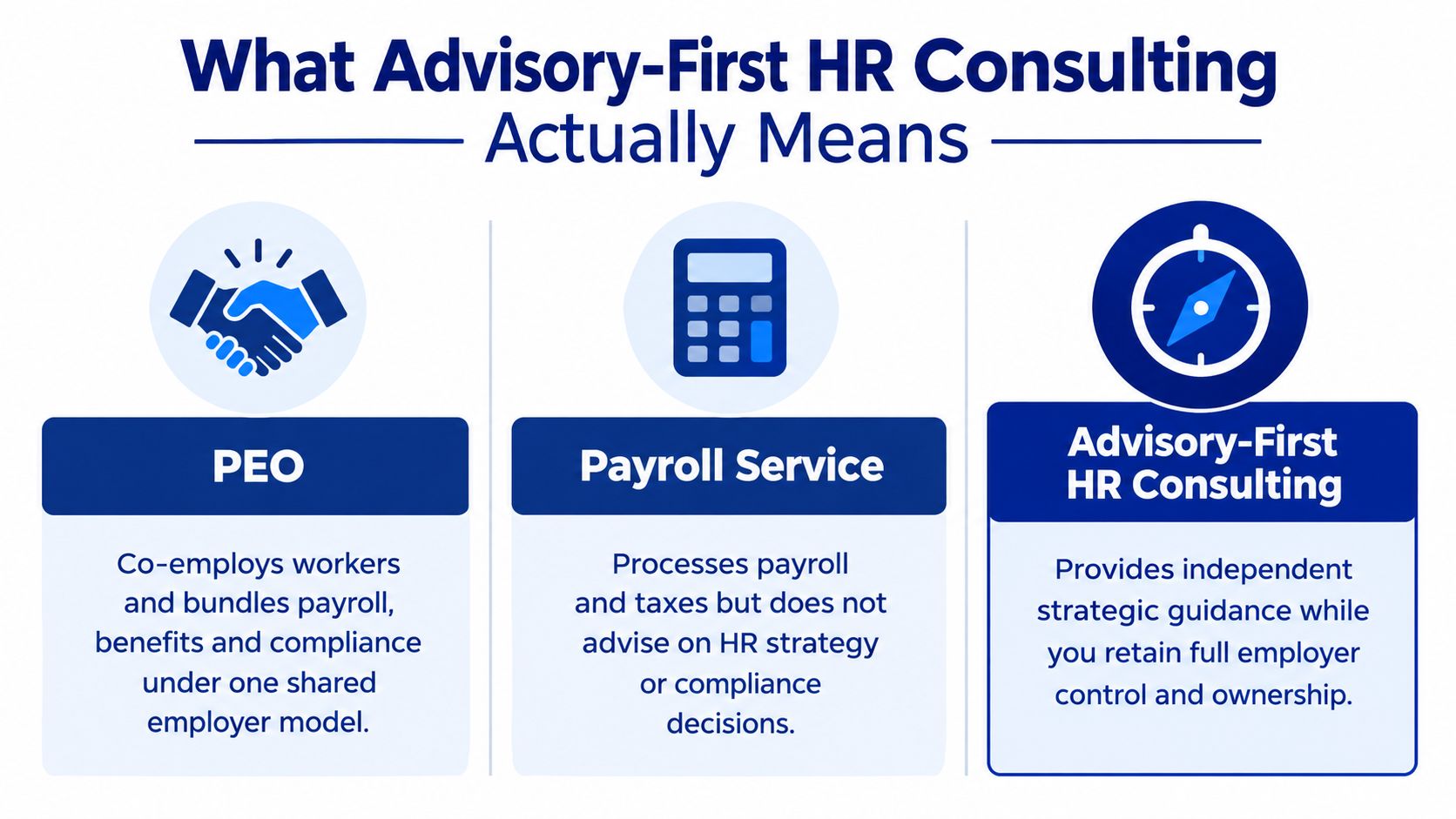
A strong advisor doesn't measure value by the number of forms completed. The deliverable is a recommendation the owner can act on, supported by a clear record of the facts considered, the policy applied, the alternatives rejected, and the follow-up required.
In practice, an advisory engagement may include:
The employer still owns the decision. That matters. An advisor can identify risk, recommend a process, draft documentation, and prepare the manager, but the company must decide how it will operate and whom it will employ.
Owners evaluating long-term resilience can also review this resource on future proof HR management. For a more focused purchasing perspective, this SMB HR service buying advice can help distinguish ongoing advisory support from administrative outsourcing.
A Tampa-focused firm should provide more than a help desk. It should connect daily HR execution to the decisions that create legal and operational exposure.
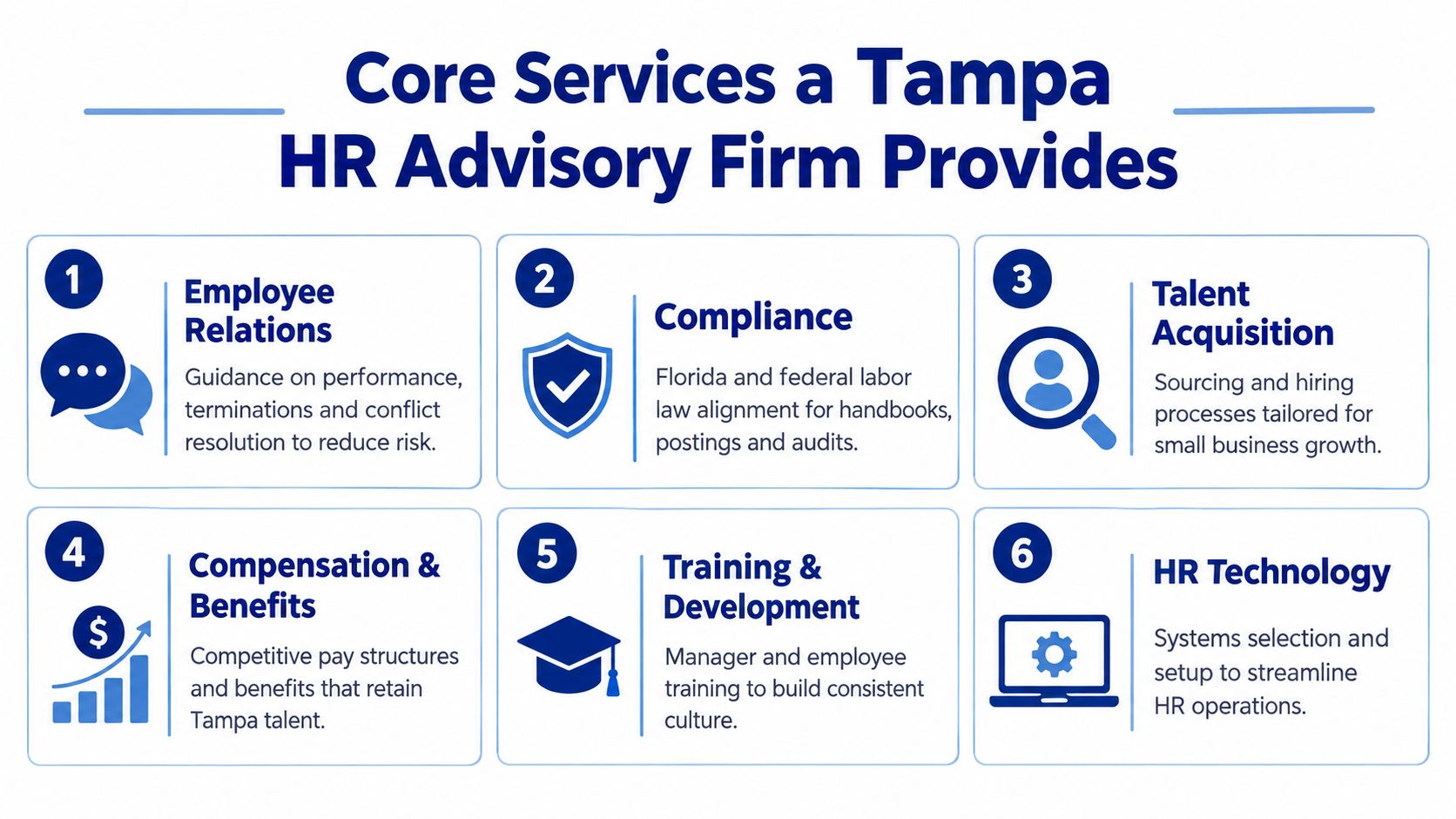
A handbook only protects the company when managers follow it. An advisor should test the policy against real manager behavior, then train the people who apply it.
These services should combine ongoing advisory access with defined project work. A handbook rebuild may be a project. A termination, complaint, or manager escalation requires responsive judgment in the moment.
A termination meeting can expose a weak HR system quickly. The owner may have a policy, but the file lacks consistent coaching notes, the payroll team used an outdated wage rate, or the I-9 process assigned no clear owner. Florida may have fewer employment mandates than some states, yet Tampa employers still need reliable controls for pay, hiring verification, classification, records, leave, complaints, and separations.
Florida's minimum wage is $14.00 per hour through September 29, 2026, and is scheduled to rise to $15.00 per hour on September 30, 2026, according to the Florida Restaurant and Lodging Association's minimum wage guidance. The required cash wage for tipped employees is $10.98 during that period and is scheduled to increase to $11.98 on September 30, 2026, under the same guidance. An advisor should convert the schedule into payroll checks, offer-letter updates, manager instructions, and pricing decisions.
Florida's new-employer reemployment tax rate is 2.7% on the first $7,000 of each employee's wages, creating a maximum first-year state unemployment tax of about $189 per employee before experience rating changes the rate, as described in Florida unemployment tax guidance. Owners should confirm who monitors rate notices, filings, and worker classification decisions.
Florida employers must retain I-9 forms for three years from hire or one year after termination, whichever is later, according to this Florida HR compliance checklist. Use version-controlled onboarding files, restricted access, and a named retention owner. A defensible process makes it clear who completes verification, who reviews exceptions, and where records are stored.
Florida's SB 1718 requires private employers with 25 or more employees to use E-Verify. A 2025 legislative analysis also described a proposal to expand that requirement to all private employers beginning July 1, 2025. Verify the current rule before changing the hiring process, and retain the Florida Senate analysis as legislative context rather than treating a proposal as settled law.
| Compliance Area | Common Trap | Defensible Practice |
|---|---|---|
| Wage and hour | Applying an outdated wage rate or mishandling tipped pay | Maintain dated wage controls and review payroll before effective changes |
| I-9 and E-Verify | Storing forms inconsistently or missing verification steps | Use a controlled onboarding workflow with assigned ownership |
| Employee relations | Relying on verbal coaching or inconsistent discipline | Record the facts, policy, expectations, response, and follow-up |
| Terminations | Giving shifting reasons or incomplete exit records | Align the decision, documentation, final communication, and unemployment response |
| Handbook controls | Issuing a template that managers do not follow | Obtain acknowledgments, train managers, and audit actual practice |
Owners can use this Florida HR compliance guide for broader coverage. The advisor's value is judgment: turn each rule into a documented decision, assign control ownership, and test whether the process works before an agency, former employee, or attorney requests the file.
A Tampa company doesn't become multi-state when it opens a second office. It becomes multi-state when an employee starts working from another jurisdiction, even if payroll and leadership remain in Florida.
A salesperson working in Georgia, a remote engineer working in Colorado, or a contractor performing services in California can trigger new registration, wage, leave, posting, workers' compensation, withholding, unemployment, and classification questions. The headquarters address doesn't answer where the employee works.
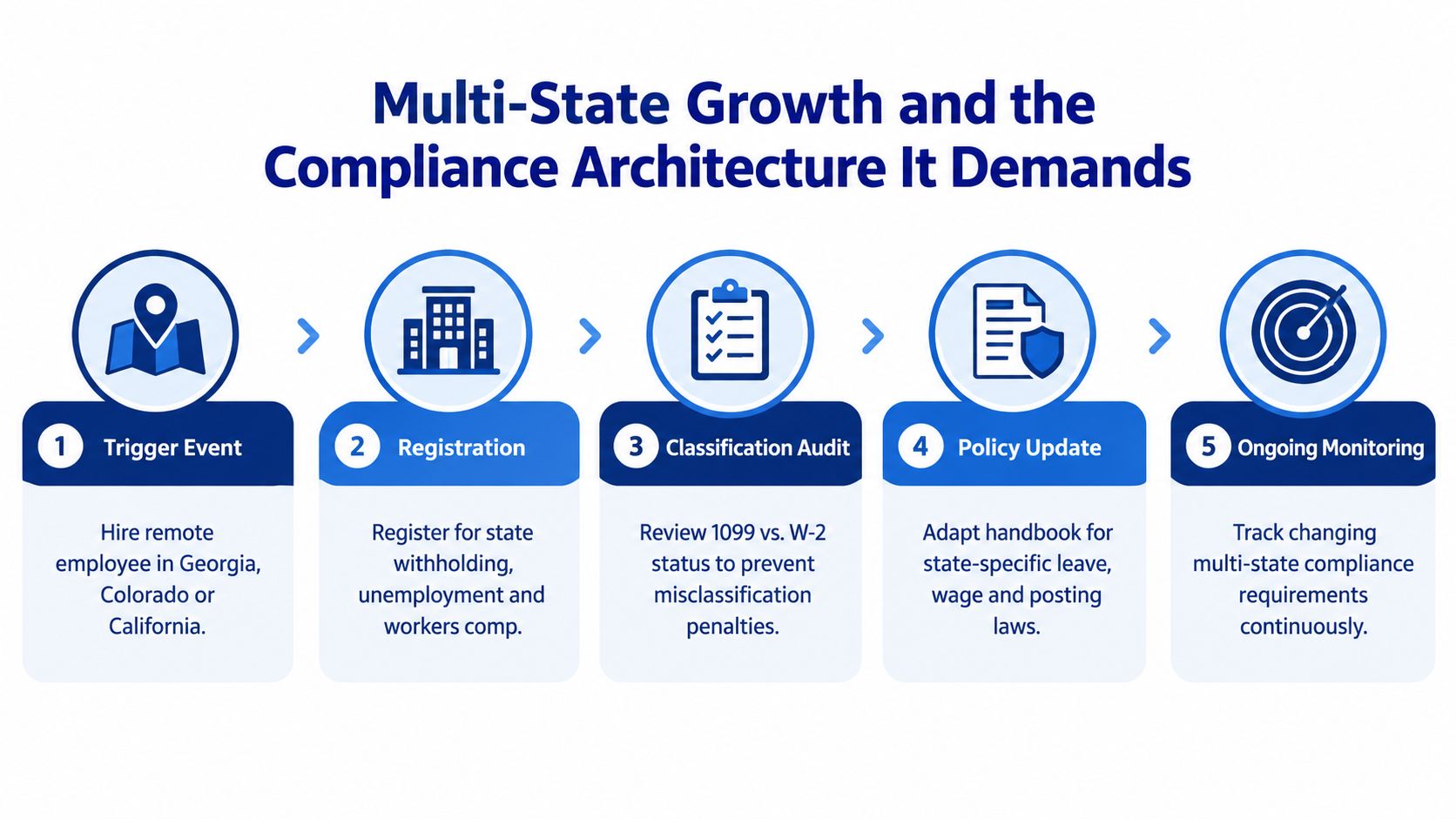
A sound architecture starts with an employee-work-location register. It should identify where each employee performs work, not the address listed in the HRIS.
The advisor should then connect that register to:
The company also needs a classification review. A 1099 label doesn't settle whether the relationship is independent contracting. The review should examine economic substance, control, independence, and the actual work arrangement. A contractor who functions like an employee can create a different risk profile than the contract language suggests.
The architecture should activate when a company hires in a new state, moves an employee, receives a complaint, changes payroll, or sees a legislative update. That trigger creates a review task, assigns an owner, updates the relevant policy or registration, and records completion.
Advisors outperform form processors. The difficult work is designing the logic that connects an event to the right action. Once built, the system needs maintenance, but it shouldn't depend on someone rediscovering the same problem every pay period.
Owners often underbuy HR support before a complaint and overpay after one arrives. The better approach is to match the engagement structure to the risk pattern.
A small employer with stable operations may need a recurring advisory retainer for policy questions, manager coaching, and scheduled reviews. A company rebuilding its handbook or preparing for multi-state hiring may need a defined project. An investigation or termination may call for episodic work with a clear response expectation.
| Engagement Type | Typical Structure | Best Fit For |
|---|---|---|
| Monthly advisory retainer | Recurring access, scheduled reviews, and defined support boundaries | Owners who need consistent decision support |
| Project engagement | Fixed scope for a handbook, audit, classification review, or expansion build | Businesses addressing a known risk |
| Hourly or episodic support | Time-based assistance for investigations, terminations, or urgent matters | Employers with occasional high-stakes events |
| Fractional HR leadership | Ongoing strategic partnership with operating cadence and leadership access | Growing firms without an internal HR executive |
The quote should state what's included. Ask whether phone counsel is unlimited or capped, whether difficult meetings can occur onsite or only virtually, and whether urgent after-hours separations receive a different response standard.
Don't accept a low monthly fee that hides aggressive overage charges. Ask whether manager training is included in a handbook project, and require a quarterly review cadence for any retainer. A consulting relationship without scheduled review is often just reactive administration.
Before comparing proposals, review this guide to HR consulting rates 2026. The right question isn't “What's the cheapest option?” It's “What decision support will be available when waiting creates more exposure?”
Treat the selection process as a judgment test. A polished presentation doesn't show how a firm handles a manager who must be terminated, a complaint involving a company founder, or a remote employee whose work location changed.

Use questions that force the firm to explain its operating method:
A serious firm should explain how it handles conflicting information. It should distinguish HR guidance from legal advice and identify when employment counsel needs to participate. It should also explain how it preserves confidentiality without promising secrecy it can't legally provide.
Ask for redacted deliverables, not a slide deck. Defensibility appears in the artifacts.
Ask how the firm has handled a contested unemployment claim or an EEOC charge in the past 12 months. You don't need confidential details. You need to understand whether the team can organize facts, preserve records, maintain consistency, and communicate with leadership under pressure.
The best interview answer may be a clarifying question. Advisors who immediately promise a standard solution haven't learned enough about the company's workforce, managers, policies, or operational realities.
The right HR partner earns trust before a termination call, investigation, or multi-state launch forces a decision under pressure. Evaluate the firm on timing, fit, and scope, then test whether its advice produces consistent, defensible documentation.
Bring in an advisor when legal exposure is rising, headcount is outgrowing informal practices, or the company is preparing to hire its first employee in another state. Waiting for a complaint often exposes inconsistent manager decisions that could have been corrected earlier.
Choose advisory judgment over administrative volume. Payroll accuracy matters, but processing payroll will not determine whether a termination reason is consistent, an investigation record is sufficient, or an accommodation discussion was handled appropriately.
Match the engagement to the decision:
The cheapest option is rarely the safest. Confidential conversations require chemistry, direct communication, and an advisor willing to challenge an owner's preferred course when it creates avoidable risk. Before recommending scope, the firm should review the employee map, pending decisions, policies, documentation habits, and Florida compliance posture.
Paradigm International Inc. provides HR risk and advisory support for owners, COOs, and executive teams handling terminations, investigations, manager conduct, documentation standards, and multi-state compliance considerations. For a Tampa business seeking a decision partner rather than reactive administration, start with a focused review of current people risks and controls.


