
You're probably dealing with a version of the same problem many growing employers face. A reliable employee starts slipping by a few minutes. A manager lets it go for one person, writes up another, and gives a third employee a warning only after the pattern becomes impossible to ignore. Then someone raises a medical issue, a remote employee disputes a late start, or a supervisor in another state applies the rule differently. At that point, a tardiness issue becomes a policy, documentation, and legal exposure issue.
That's why tardiness policies matter most when the organization is busy, distributed, and trying to stay fair. For multi-state SMBs, the primary challenge isn't writing a rule that sounds strict. It's building one that managers can apply consistently without tripping over protected leave, wage-and-hour rules, or state-specific requirements.
At 8:03 a.m., one location opens short-staffed, a supervisor pulls a higher-paid employee into coverage, and the front desk starts the day behind. By 8:20, the issue is no longer one employee arriving late. It is overtime risk, service delay, manager time off task, and a documentation decision that may matter later if the same employee claims a medical limitation or protected leave.
Chronic employee lateness annually costs employers approximately $2,945 per employee due to lost productivity and coverage issues, and a 1% increase in lateness and absenteeism correlates with a 2.3% decline in daily sales, according to TimeTrex's attendance statistics roundup. For a multi-state SMB, the harder problem is not measuring the drag. It is controlling it without creating inconsistent enforcement or sweeping protected absences into a no-fault attendance record.
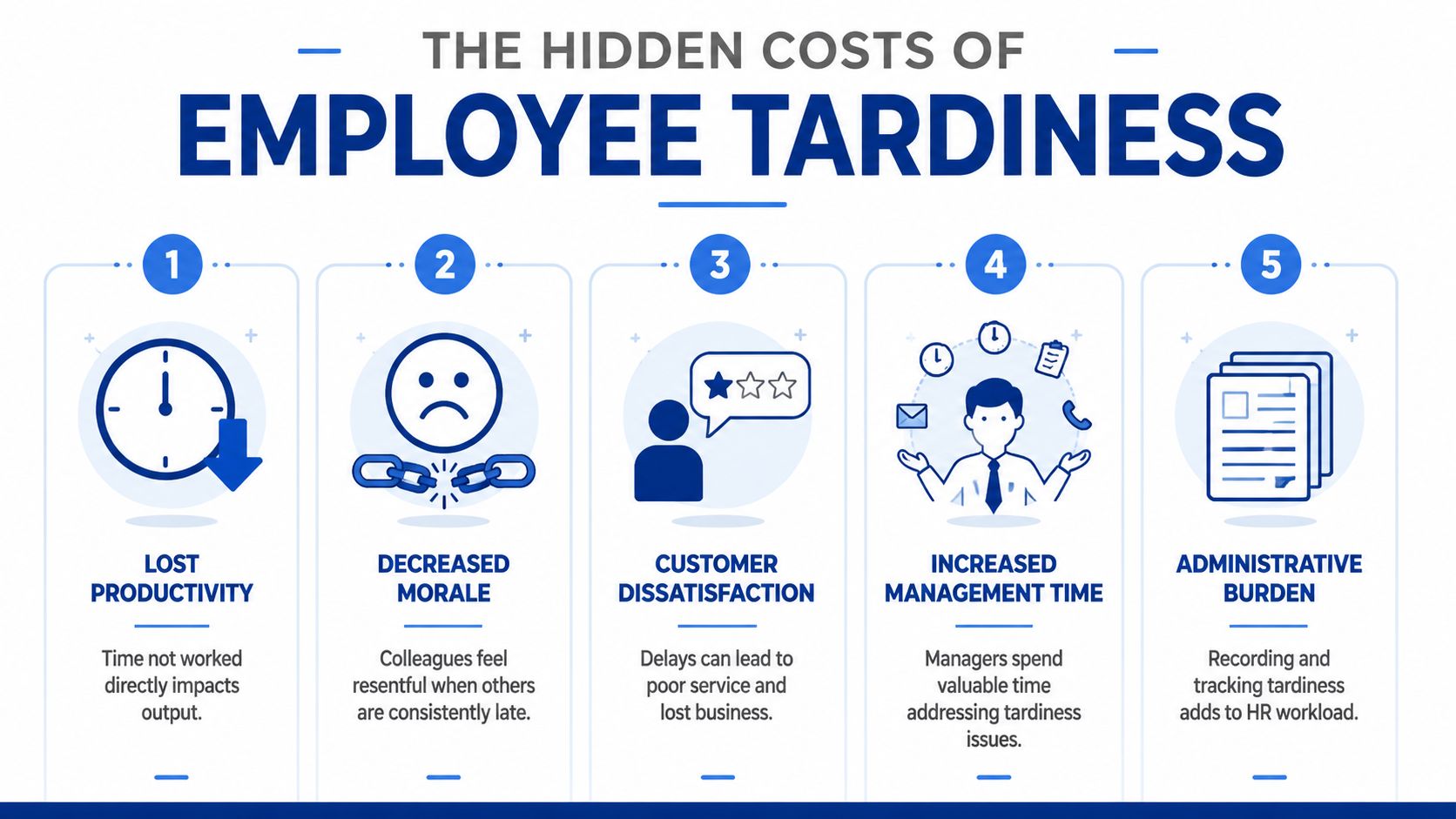
Late arrival costs rarely stay confined to the missed minutes.
The financial impact also varies by site. One office can absorb a 10-minute delay. Another triggers overtime, missed appointments, meal-break compression, or delayed opening procedures. Multi-state employers feel this more sharply because local practices drift fast when one branch treats lateness as minor and another treats it as a write-up.
Attendance problems often show up in revenue and labor spend before leadership treats them as a policy issue. Harvard Business School Working Knowledge highlights research showing that a 1 percent increase in lateness correlates with a 2.3 percent decline in daily sales, and employees who are late average 21 minutes late per incident.
That matters in retail, healthcare, hospitality, field service, and any operation built around scheduled handoffs. For leaders trying to optimize healthcare workflows, attendance control affects staffing continuity, throughput, and patient experience.
Overtime is usually the next place the cost appears. The U.S. Bureau of Labor Statistics tracks overtime as a meaningful labor input across industries. In practice, repeated lateness pushes employers to extend another employee's shift, call in backup coverage, or ask a supervisor to absorb nonexempt work. That may look manageable at one location. Across several states, it becomes a recurring labor-cost pattern with wage-and-hour implications if timekeeping and exception handling are sloppy.
A related risk is policy design. Owners often adopt a clean no-fault point system because it seems easier to administer across locations. The trade-off is legal exposure if managers treat every late arrival as equal. An attendance point tied to an FMLA-protected absence, an ADA-related schedule modification, or state sick leave use can turn an operations policy into an avoidable claim. If your attendance rules sit beside leave rules, they need to fit together. A practical starting point is reviewing your broader time-off policy sample and leave coordination framework before you finalize point-based discipline.
Informal enforcement usually creates two problems at once. The business absorbs the disruption, and HR inherits a weak record.
| Common approach | What goes wrong |
|---|---|
| Manager-by-manager judgment | Similar conduct gets different outcomes, which creates fairness complaints and weakens the employer's position later |
| Verbal reminders only | No reliable record exists when the pattern continues or termination is challenged |
| Strict point system with broad exceptions handled ad hoc | Supervisors make inconsistent calls, and employees read that as favoritism |
| Automatic discipline with no review step | Protected leave, disability-related delays, and state law exceptions get coded as attendance violations |
The operational cost of tardiness is real. The legal cost usually comes from how the employer responds. A business that treats lateness as a small annoyance often ends up with a larger problem: inconsistent enforcement, inflated labor spend, and documentation that does not hold up when the decision is questioned.
A supervisor marks an employee late three times in a month. On paper, the rule looks neutral. In practice, one incident involved intermittent FMLA leave, another involved a disability-related medication delay, and the third happened in a city with predictive scheduling or paid sick leave rules that affect how attendance events should be coded. That is how a basic attendance policy becomes a legal exposure for a multi-state business.
A defensible tardiness policy does three jobs at once. It gives employees clear notice, gives managers a usable process, and gives HR a review point before protected time is treated as misconduct. OnPay's tardy policy guide identifies five policy elements that belong in most drafts: a defined lateness threshold, the number of occurrences that trigger action, progressive consequences, a documentation and appeal process, and a reset period. Those components matter because each one closes a gap that plaintiffs' counsel often tests later.
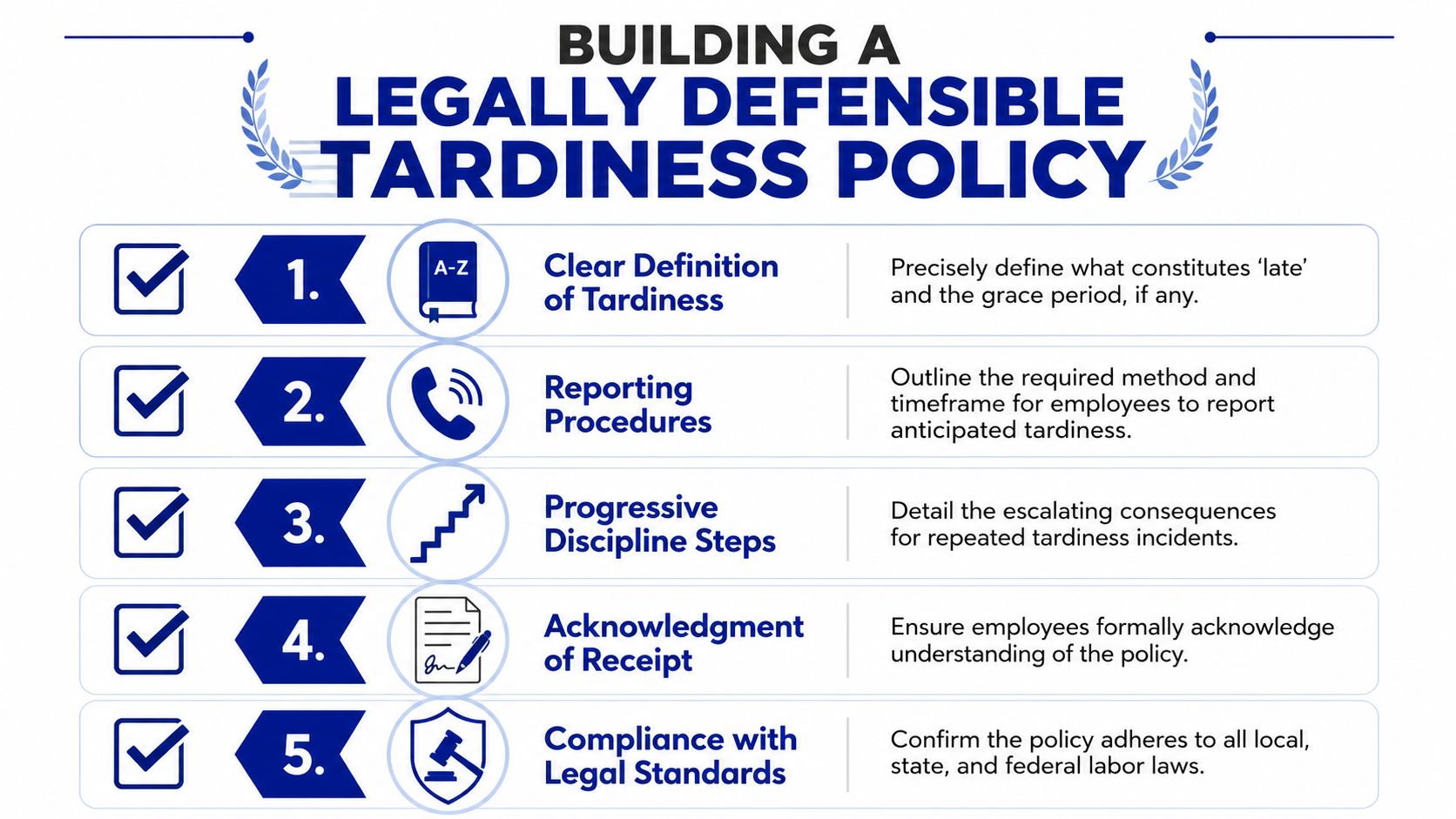
Start with the threshold. If one manager treats a six-minute delay as late and another ignores anything under ten minutes, the company does not have a rule. It has a pattern of individual judgment.
Many employers use a short grace period. The main issue is not whether the cutoff is five minutes, seven minutes, or another number. The issue is whether the rule is written, tied to your timekeeping system, and applied the same way across locations and job types. The Indeed guide to attendance policies notes that employers often include a grace period in attendance rules, which makes written definitions and consistent administration especially important.
For multi-state SMBs, the definition also needs to address remote and hybrid work. If the workday begins when an employee logs into a call center platform, opens a ticketing system, joins a scheduled video call, or reports to a client site, the policy should say what "ready to work" means. Ambiguity creates disputes. It also creates wage and hour problems when start-of-shift expectations are implied but not documented.
Strong policies are easier to enforce because leadership answers the practical questions before the first dispute shows up. Put these answers in writing:
A draft is easier to control when the format is standardized. If your team is building from scratch, a practical policies and procedures template can help organize the language before HR, operations, and counsel review the details.
This is the part many smaller employers underwrite. A no-fault point system can look fair because it removes manager discretion. It also creates risk if points are assigned automatically to absences or late arrivals that should have been excluded or reviewed first.
The policy should say that protected leave, approved accommodations, and other legally required exceptions are not counted under the attendance system where the law requires exclusion. It should also require a review step before points are finalized. That review does not need to be complicated. It does need to exist.
In multi-state operations, the exception language has to work across overlapping rules. Federal FMLA standards, ADA accommodation duties, state paid sick leave laws, pregnancy accommodation statutes, and city scheduling rules do not line up neatly. If your attendance language is stricter than your leave administration process, managers will follow the simpler rule and create the record you later have to defend.
Documentation decides many attendance disputes. A good record captures the scheduled start time, actual arrival time, how the employee reported the delay, who reviewed it, and whether any protected-leave or accommodation issue was raised. A weak record says only "late again."
Appeal language matters for the same reason. Employees need a defined way to challenge an entry, and managers need to know they are not the final authority on close calls involving medical issues or leave rights. Calm process language often prevents the emotional email chain that turns a routine correction into a retaliation allegation.
Handbook alignment matters here too. Employers revising attendance rules alongside leave and corrective action documents should review a time-off policy sample and leave coordination framework so definitions, notice rules, and exceptions match across policies.
A policy is only as defensible as its use in the field. Employees should acknowledge receipt. Managers should be told, in writing, that they cannot create side deals, waive reporting rules for favored employees, or assess points without following the review process.
Smaller businesses sometimes resist that level of formality. I usually advise the opposite. In a single-state office with one manager, informal fixes may survive for a while. In a multi-state business with different supervisors, timekeeping practices, and leave laws, informal enforcement is where inconsistency starts, and inconsistency is what usually makes the policy hard to defend.
A supervisor in Texas gives a verbal warning for three late arrivals. A supervisor in Illinois skips straight to a final warning for the same pattern. By the time the issue reaches HR, the attendance problem is no longer the only risk. The business now has an inconsistency problem, and inconsistency is what employees' lawyers examine first.
A progressive discipline framework should do two things at once. It should give managers a repeatable path, and it should slow them down enough to check whether the lateness is ordinary misconduct, a scheduling problem, or something that may connect to Family and medical leave compliance. Multi-state employers need that pause built into the process, not left to judgment in the moment.
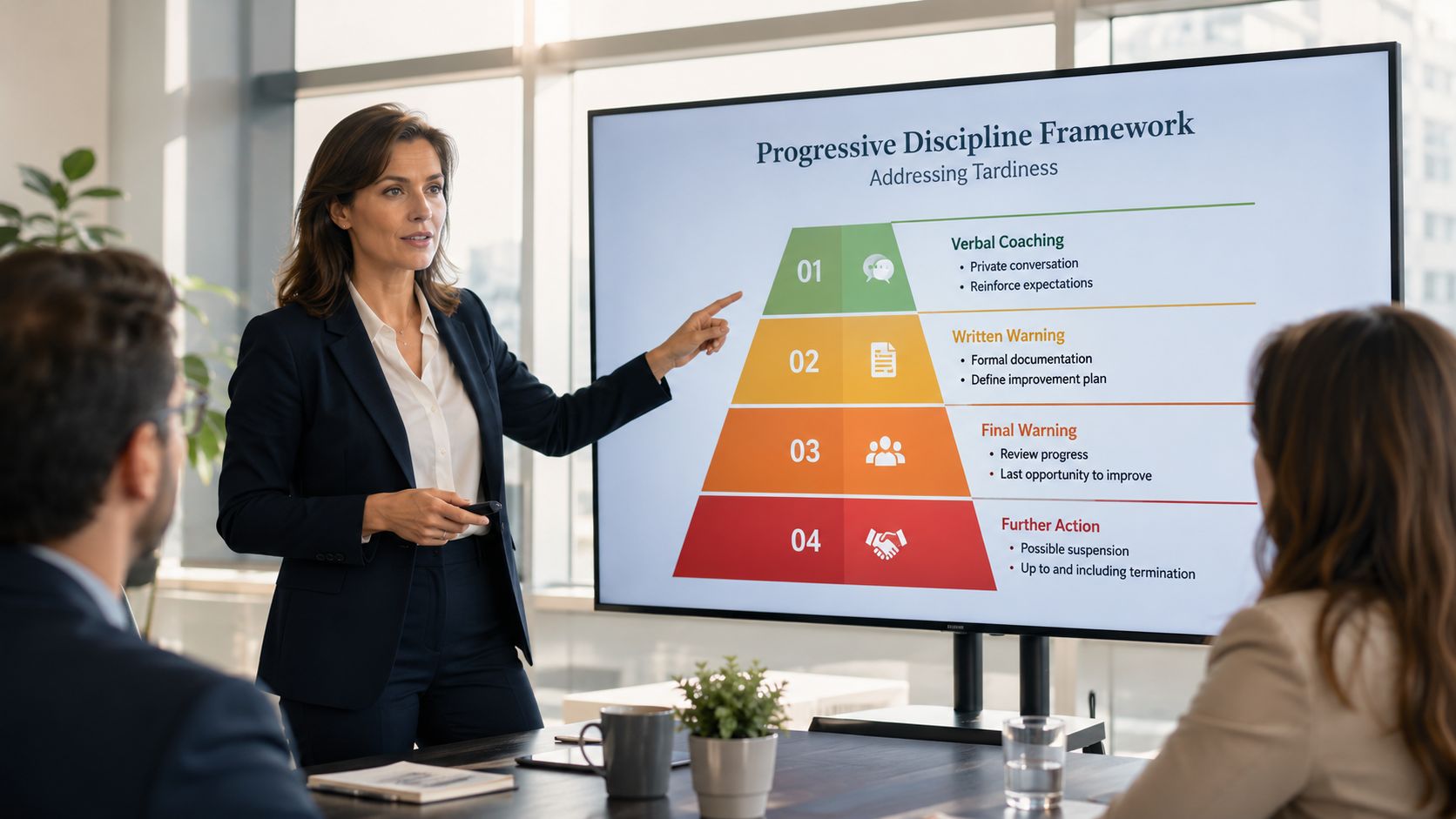
The familiar five-step structure still works if each step is defined clearly and applied the same way across locations.
Verbal coaching
Address the issue early. Confirm the start-time expectation, ask whether anything is affecting attendance, and make a note of the discussion even if the conversation is informal.
Written warning
List the dates, length of each tardy, prior coaching, and the improvement expected. Avoid vague language such as "attendance needs work."
Final warning
State that immediate improvement is required and explain the consequence of another unexcused tardy within the review period. This is also a sensible point to review whether the schedule still fits the role and the employee's actual availability.
Suspension or probation
Use this only if the handbook allows it and prior steps were documented. In wage and hour terms, suspension rules can create separate issues for exempt employees, so this step needs review before managers apply it.
Termination
Reserve termination for repeated, documented failure to meet expectations after the earlier steps were used correctly.
The point is not to create ceremony. The point is to create consistency.
Most employers choose either an occurrence-based system or a point system. The choice is less about style than administrative capacity.
| Model | Strength | Weak point |
|---|---|---|
| Occurrence-based | Easier to explain and adjust to context | More supervisor discretion, which can lead to uneven treatment |
| Point-based | Easier to standardize across sites and shifts | More compliance risk if protected absences or late arrivals are coded incorrectly |
A point system can be useful for a distributed workforce because it reduces improvisation. It also creates a common threshold for action when different managers oversee similar roles. But the cleaner the system looks on paper, the more dangerous sloppy exception handling becomes. If managers do not know when to stop and escalate a tardy for HR review, the system can convert a protected absence issue into a discipline problem.
That trade-off matters for small and midsize employers operating in more than one state. A simple occurrence model may produce more judgment calls, but a point model demands stronger leave administration, cleaner payroll coding, and tighter manager training.
The framework itself doesn't protect the business; the records do.
If a supervisor says an employee was coached, there should be a dated note showing what happened, what expectation was restated, and whether the employee mentioned a medical, caregiving, transportation, or schedule-related issue. If the company uses a rolling review period, the file should also show when older incidents dropped off. Those details often decide whether later action looks measured or arbitrary.
Standard forms help. Standard review rules help more. I advise clients to require the same core fields across every location: date, minutes late, policy category, prior step level, employee explanation, manager response, and HR sign-off when the stated reason could trigger leave or accommodation review. A practical guide to documenting employee discipline can help tighten that process before managers start issuing warnings.
A discipline framework fails when one manager treats it as a checklist and another treats it as a suggestion. The safest version is specific enough to limit improvisation, but flexible enough to pause the process when the facts do not fit a standard tardy.
Generic tardiness policies often fail. They assume every late arrival is a conduct issue and every attendance rule can be applied mechanically. For multi-state SMBs, that assumption is dangerous.
A no-fault attendance or point system can inadvertently penalize FMLA-protected tardiness, and the U.S. Department of Labor has clarified that these policies are permissible only when applied non-discriminatorily, as summarized by Ogletree Deakins on no-fault attendance policies and FMLA leave. The risk isn't in having the policy. The risk is in treating every late clock-in as interchangeable when the underlying reason may be legally protected.
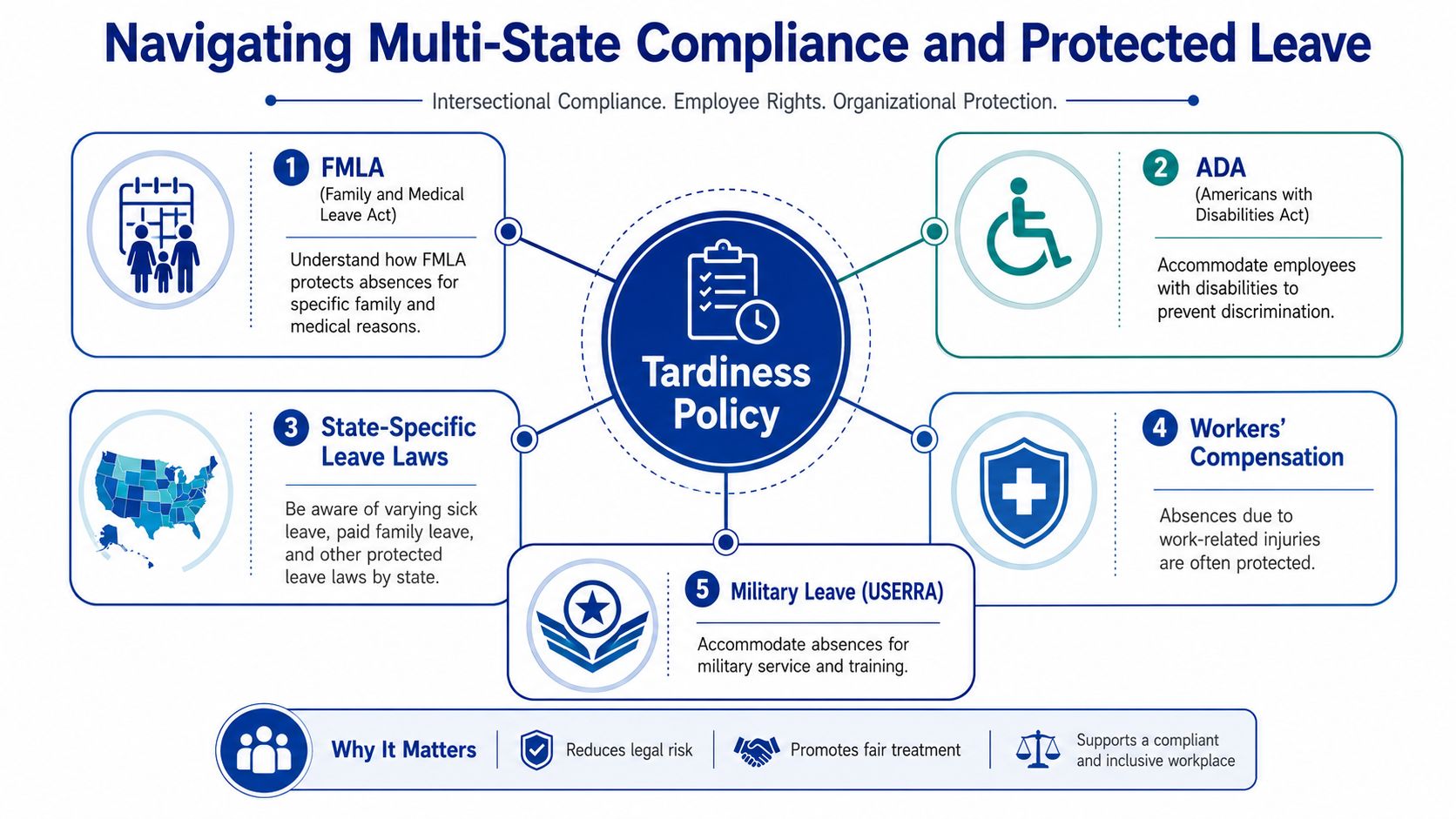
A no-fault system sounds clean. One point for a tardy. More points for a longer delay. Consequences at preset thresholds. Managers like it because it appears neutral.
The problem is that neutral design doesn't guarantee lawful application. An employee may be late because of intermittent FMLA leave, a disability-related limitation that may require accommodation under the ADA, state-protected sick leave, a workers' compensation issue, or another protected circumstance. If the system counts that event automatically and no one reviews the reason, the employer can create exposure while believing it is being consistent.
Here's the practical mistake I see most often. The company trains managers to count incidents, but not to pause and ask whether an attendance event should be excluded from discipline pending HR review.
Assume an employee in one state has approved intermittent FMLA leave tied to ongoing treatment. On two occasions, that employee arrives late after a morning flare-up connected to the certified condition. The supervisor assigns attendance points automatically because “the policy applies to everyone.”
That is exactly the sort of situation where a lawful policy can be applied unlawfully. The issue isn't favoritism. It's failure to separate protected time from ordinary misconduct before discipline is imposed.
Protected leave issues rarely announce themselves in perfect legal language. Supervisors need a trigger to stop, document, and escalate.
Even when federal leave issues aren't present, multi-state employers face a practical drafting problem. A single attendance policy has to work across different leave rules, documentation expectations, payroll practices, and employee handbook requirements.
That doesn't always mean writing separate tardiness policies for every state. It often means writing one core policy with clear state-specific addenda and a defined exception review process. Employers that operate across jurisdictions should make sure the handbook framework supports that structure. A useful starting point is reviewing employee handbook requirements by state so attendance language doesn't conflict with required notices or protected leave provisions.
A better model is straightforward:
This is one reason broad manager override authority tends to backfire. It creates inconsistent exceptions, uneven records, and later credibility problems.
For employers that need a stronger baseline on Family and medical leave compliance, the key is not just understanding the leave categories. It's integrating leave review into attendance administration so discipline doesn't run ahead of legal analysis.
A written policy can still fail on day one if managers don't know how to use it. Implementation is where many tardiness policies become either credible or meaningless. Employees watch for consistency immediately. Managers test the edges just as quickly.
The first step is communication. Announce the policy in plain language. Explain what changed, when it takes effect, how tardiness is defined, how employees report delays, and how the company reviews exceptions. If employees don't understand the process, they'll fill in the gaps with past practice.
Manager training should focus less on theory and more on moments of decision. A supervisor needs to know what to say when an employee calls late, what to document after a shift starts short, and when not to assign a point or warning without HR review.
Use short scenarios during training:
The strongest policy is the one a frontline manager can apply correctly at 7:55 a.m. without improvising.
This is a modern gap in many policies. Arcoro's employee lateness analysis reports that 70% of SMBs enforce strict tardiness rules for on-site staff, while fewer than 15% have updated policies to define tardiness for virtual start times. That mismatch creates ambiguity, uneven enforcement, and weak documentation when disputes arise.
Remote work doesn't remove attendance expectations. It changes how employers need to define them. For some roles, “on time” means logged into a phone platform and available for calls. For others, it means present in a scheduled meeting, active in a case management system, or ready to begin client work at the scheduled hour.
A practical rollout should include:
After launch, review actual usage. Pull a sample of attendance incidents from multiple managers and sites. Check whether the same event is being coded the same way. Look for unauthorized exceptions, missing notes, and places where a manager skipped review steps because they were trying to be helpful.
The goal isn't strictness for its own sake. It's predictability. Tardiness policies work when employees know the rule, supervisors follow the process, and the organization can show that discipline was based on documented facts rather than personal preference.
Sometimes, but this is a wage-and-hour issue first and a discipline issue second.
For nonexempt employees, employers generally must pay for all time worked. Deducting pay as a penalty, shaving time from a timesheet, or handling lateness in a way that drops pay below minimum wage can create Fair Labor Standards Act problems. The U.S. Department of Labor's guidance on hours worked and recordkeeping is the safer reference point here: https://www.dol.gov/agencies/whd/flsa
For exempt employees, improper deductions raise a different risk. Salary basis rules are stricter, and a poorly handled deduction can trigger classification disputes. The cleaner approach is usually to address tardiness through documented attendance discipline, not ad hoc payroll reductions.
A reasonable grace period depends on the job and the cost of delay.
Five minutes may be workable in an office with staggered starts. It may be too loose for a front desk, manufacturing line, healthcare setting, or customer support team that relies on shift handoffs. The policy should match the operational reality, your timekeeping system, and your rounding practices, if any.
The legal risk is inconsistency. If one manager treats three minutes as late and another ignores ten, the problem is no longer just attendance. It becomes uneven enforcement.
Use a defined review period and stick to it.
Many employers choose a rolling period such as 90 days, six months, or 12 months. The right answer is the one you can administer consistently across locations and managers. If your policy says warnings reset after a stated period, records should show that reset happened the same way for employees in similar roles.
In multi-state operations, discipline timelines also need to line up with record retention, final pay rules, and any state-law limits on how attendance records are used in later employment decisions.
They should follow the same attendance principles, but the rule itself usually needs role-specific definitions.
For a remote employee, “on time” may mean logged in and available in the required system, present for a scheduled handoff, or ready to take the first customer interaction at the start of the shift. If the policy does not define that point clearly, supervisors fill the gap with personal judgment. That is where documentation starts to break down.
Apply one framework. Define punctuality by job function.
Pause as soon as the reason for lateness may be legally protected.
That includes references to a medical condition, treatment, pregnancy-related limitations, intermittent FMLA leave, disability accommodation, domestic violence leave where state law applies, or another protected absence category. Multi-state employers get into trouble when a no-fault point system keeps running after the issue should have been routed through leave or accommodation review.
I see this mistake often in smaller employers with locations in several states. A supervisor treats every late arrival as an attendance event because the policy says points are automatic. Then HR learns the employee was dealing with approved intermittent leave or a recurring condition that should have triggered the ADA process. By then, the documentation has already framed the issue the wrong way.
If the facts may involve protected leave or accommodation, stop the attendance track and review the reason before adding points or issuing the next warning.
If your leadership team is revising tardiness policies across locations, dealing with leave-related attendance issues, or trying to make manager enforcement more defensible, Paradigm International Inc. can help you evaluate the policy, the documentation process, and the multi-state compliance risks before a routine attendance problem turns into a larger employment matter.