Your leadership team is probably asking a fair question right now. Is a team building retreat a strategic investment, or just an expensive break from work? If you run a multi-state SMB, that question matters more than most retreat guides admit.
A retreat can strengthen alignment, improve retention, and sharpen execution. It can also create wage and hour problems, ADA concerns, misconduct complaints, and a stack of vague action items nobody owns. The difference comes down to design. If you treat the retreat like a business initiative with HR controls, it can pay off. If you treat it like a reward trip, it can become a liability.
The biggest mistake executives make is approving a team building retreat before deciding what problem it’s supposed to solve. “Improve morale” is not a business case. It’s a hope.
Start with a hard question. What decision, behavior, or operational breakdown needs to improve because of this retreat? For multi-state organizations, the answer is usually more concrete than leaders first think. Cross-location friction. Inconsistent manager judgment. Weak documentation habits. Lack of trust between operations and HR. Slow alignment on performance issues.

If you want executive buy-in, frame the retreat as a retention and execution tool. That argument is defensible because the data supports it. Research compiled by High5 team building statistics found that team-building reduces turnover by up to 36% in high-engagement organizations, and companies report an average return of $4 to $6 for every $1 spent.
That changes the conversation. You’re no longer defending a line item based on culture language alone. You’re connecting the retreat to talent stability, stronger collaboration, and lower replacement risk.
Practical rule: If you can’t explain the retreat in terms a COO would use, you’re not ready to budget for it.
A useful starting point is to align three groups before any venue search begins:
CEO or owner priorities
Clarify what leadership wants fixed. That might be decision speed, accountability, or stronger manager consistency across locations.
Operational leaders’ pain points
Ask department heads where work breaks down. Retreat agendas should address actual friction, not generic bonding.
HR and compliance concerns
Confirm whether the retreat should support cleaner investigations, more consistent documentation, or better manager judgment in employee relations.
Vague retreat objectives create vague outcomes. Strong objectives force discipline. Use S.M.A.R.T. goals, but don’t stop at the acronym. Tie each goal to a business process or people risk.
Examples of useful retreat goals include:
Those are retreat-worthy outcomes because they influence cost, legal exposure, and execution quality.
A strategic planning lens helps here. If your leadership team already uses a formal planning process, this kind of retreat should connect directly to it rather than sit beside it. A useful reference point is this guide to strategic HR planning for growing organizations, especially if your retreat needs to support growth without increasing people risk.
Most retreat ROI gets lost because leaders measure only whether people enjoyed themselves. Satisfaction matters, but it’s not enough. Track outcomes that reflect the original business problem.
Use a short scorecard with measures such as:
| Goal area | Pre-retreat question | Post-retreat evidence |
|---|---|---|
| Retention risk | Are key teams showing signs of disengagement or manager inconsistency? | Voluntary turnover trends and stay-risk feedback |
| Cross-state alignment | Do managers handle similar issues differently by location? | More consistent escalation and documentation patterns |
| Communication quality | Are teams escalating issues too late or with missing context? | Faster, cleaner cross-functional handoffs |
| Productivity | Are delays caused by mistrust, rework, or unclear ownership? | Better decision speed and fewer breakdowns |
Leaders often say they want the retreat to improve culture. Fine. But culture isn’t a retreat activity. It’s the repeated pattern of how your managers act, communicate, document, and decide under pressure.
So define the culture outcome in operational language. If you want a more accountable culture, decide what that means. Better follow-through? Cleaner manager notes? More consistent treatment across states? Less tolerance for informal side deals? Once culture is translated into behavior, a team building retreat becomes measurable.
A retreat earns its budget when it changes how leaders work together after they fly home.
The strongest business case is simple. Better connection can support stronger retention. Better alignment can improve execution. Better structure can reduce preventable HR mistakes. If the retreat is built around those three outcomes, the spend is easier to justify and much harder to dismiss.
A good retreat agenda doesn’t entertain people into alignment. It moves them through a sequence that builds trust, surfaces friction, and ends with decisions. That requires structure.
The data gives a useful benchmark. According to corporate retreat statistics from Retreats and Venues, the average corporate retreat lasts 3.78 days, with peak participation in September and October, and team building is selected by 50% of organizations as a preferred engagement activity. That tells you two things. Companies are using retreats regularly, and team building is central. But frequency does not equal effectiveness.
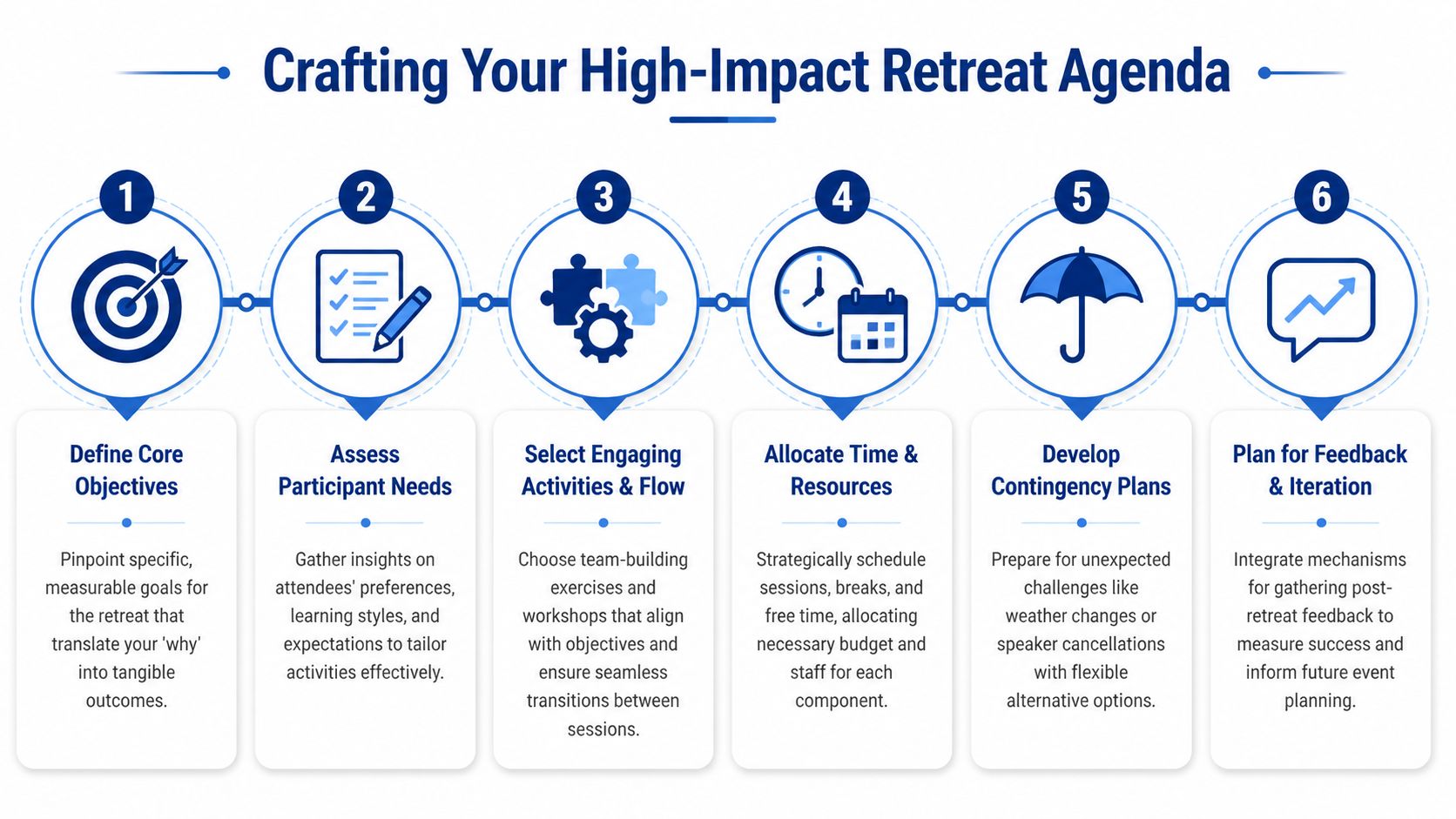
A retreat needs breathing room, but it also needs a backbone. The best planning rule here is simple. Keep 60% of the agenda structured and 40% organic.
Structured time should cover the work that justified the retreat in the first place. That might include strategy sessions, process redesign, role-play scenarios for difficult conversations, cross-functional planning, or manager calibration. Organic time gives people room to process, connect, and continue useful conversations without being managed every minute.
If you over-schedule, people shut down. If you under-structure, the event turns into expensive drift.
Many retreats fail when leaders choose activities based on novelty, venue brochures, or whatever sounds fun in a planning meeting. That’s backwards.
Use a simple filter. Ask what each agenda item is supposed to produce.
A scavenger hunt or outdoor challenge isn’t automatically bad. It’s bad when it has no connection to the reason you gathered people.
If you need inspiration for activities that can work in a real team setting, this list of unforgettable Perth team building ideas is useful because it shows how experiences can be varied without all feeling like forced icebreakers.
Don’t ask whether an activity is engaging. Ask whether it helps your team make better decisions together.
Day one should not open with the hardest conversation in the room. A team needs a ramp, not a collision. Start with lower-risk interaction, move into heavier strategic work once energy and trust rise, and avoid placing your most critical session at the point people are mentally spent.
A strong narrative flow usually looks like this:
Arrival and reset
Get people out of day-to-day mode. Keep the first session focused and limited.
Shared context
Put the business reality on the table. What’s working, what isn’t, and where alignment is weak.
Structured team work
Move into workshops, breakouts, and scenario-based sessions tied to actual operating issues.
Unstructured relationship time
Give people room for real conversation without more slides.
Decision and commitment sessions
Convert discussion into ownership, timelines, and documented next steps.
Here’s a practical template. It’s not universal, but it’s far more useful than filling every slot with generic activities.
| Day | Morning (9am-12pm) | Afternoon (1pm-5pm) | Evening (7pm+) |
|---|---|---|---|
| Day 1 | Leadership context, retreat objectives, business realities | Cross-functional workshop on core friction points | Hosted team dinner with guided conversation prompts |
| Day 2 | Manager calibration, role-play scenarios, strategic planning | Breakout groups to solve operational and people challenges | Free time or optional low-pressure networking |
| Day 3 | Action planning, ownership assignments, commitment review | Final debrief, documentation of decisions, departure | Travel |
Retreats produce good conversations all the time. That’s not rare. What’s rare is coming home with clean records of what was decided, who owns what, and how the work will be followed.
Use one live capture system during the retreat. Keep it simple. Shared notes, a structured action tracker, or a project board. What matters is consistency. Every session that asks for input should end with written next steps.
A few essentials:
Assign owners by name
“Leadership team” owns nothing.
Set decision dates
If the next review has no date, the commitment is soft.
Separate ideas from approved actions
Don’t let brainstorm notes get mistaken for policy.
A productive retreat respects human limits. Don’t bury the strongest session after a heavy lunch. Don’t stack five consecutive workshops and call it momentum. Alternate between collaboration, discussion, and quieter reflection.
The point of the agenda isn’t to keep people busy. It’s to make sure the right work happens while people are together.
The highest-impact retreat agenda feels intentional from start to finish. Every session has a reason. Every break has value. Every activity supports the larger business objective. That’s how a team building retreat stops being performative and starts becoming useful.
Many retreat plans fall apart when leaders spend weeks debating activities and almost no time reviewing employment risk. That’s backwards, especially for multi-state employers.
A retreat changes the setting, not your obligations. Employees are still employees. Managers are still managers. Conduct standards still apply. Travel time, accessibility, alcohol, overnight lodging, reporting lines, and documentation all get harder off-site, not easier.

Most retreat content ignores this entirely, which is a serious planning failure. A 2025 SHRM survey cited in this risk-focused retreat analysis found that 28% of HR professionals reported post-retreat complaints related to misconduct, and 15% escalated to formal investigations. That same source notes that most retreat planning resources fail to address issues like ADA accommodations, conduct policies, or multi-state wage laws.
That should change your planning posture immediately. If your retreat includes travel, optional social events, alcohol, mixed reporting relationships, or physically demanding activities, you have exposure points that need active controls.
A clean way to handle this is to run a pre-event risk review. Not a vague planning call. An actual review.
Focus on these areas:
Wage and hour treatment
Review travel time, required attendance, after-hours expectations, and non-exempt employee participation. Multi-state rules complicate this quickly, especially when employees cross state lines.
ADA and accessibility
Confirm whether activities, transportation, lodging, meals, and meeting spaces are accessible. Don’t assume a scenic venue is an inclusive one.
Conduct expectations
Reissue standards on harassment, discrimination, retaliation, and professional behavior. A retreat is not an exception zone.
Alcohol management
If alcohol will be present, set limits, define host responsibilities, and make reporting channels clear before the event starts.
Incident handling
Decide in advance who receives complaints, where issues are documented, and how concerns are escalated discreetly.
Risk check: If your retreat plan includes alcohol but no written conduct reminder, your controls are weak.
Common sense doesn’t solve state law differences. Travel pay rules, meal and rest expectations, reimbursement issues, and local employment protections can create inconsistent treatment fast. Executive teams that already manage hybrid and distributed work should treat the retreat as an extension of that compliance environment.
This is especially important if some attendees are remote workers crossing into another state for the event. That scenario can raise practical compliance questions that many teams miss until after payroll or an employee complaint. A useful background reference is this guide on remote worker compliance across multiple states, because many of the same risk patterns show up during retreat travel and attendance.
Your retreat communication should do more than share the schedule. It should establish standards. Keep it plain and direct.
Send a short pre-event document that covers:
This doesn’t need to read like a legal memo. It needs to remove ambiguity.
Some retreat activities look harmless on paper and become problematic in practice. Anything highly physical, competitive, late-night, or centered on alcohol deserves extra scrutiny. The same applies to events that pressure attendance outside normal working expectations.
Use a simple test. Could a reasonable employee feel excluded, unsafe, disadvantaged, or unable to participate fully? If yes, redesign it. You don’t need to eliminate all social activity. You need to offer inclusive options and avoid building team status around participation in one narrow kind of event.
The retreat should strengthen belonging, not quietly sort employees into insiders and outsiders.
Most leaders understand they should document complaints. Fewer think to document planning decisions that reduce risk before a problem happens. You should.
Keep records of venue accessibility confirmations, attendee communications, accommodation handling, facilitator instructions, and your conduct reminder. If an issue later arises, those records show the company acted deliberately rather than casually.
That’s the core point. A team building retreat can absolutely support culture and alignment. But in a multi-state environment, it also needs legal guardrails. Smart leadership teams don’t bolt those on at the end. They build them into the event from the start.
The venue is not just a backdrop. It’s part of your control environment. The facilitator is not just there to keep energy up. That person shapes what gets surfaced, what gets ignored, and whether the room stays productive when tension rises.
Too many leadership teams choose both based on appearance. Nice property. Good food. Confident presenter. That’s not enough. A team building retreat should be supported by partners who can handle business objectives, privacy expectations, and operational discipline.

The practical standards matter. Guidance from expert retreat planning benchmarks recommends venues with high-speed WiFi of 500Mbps+, multiple breakout rooms, and integrated AV, along with 30-day cancellation clauses to preserve flexibility and reduce financial risk.
That advice is more strategic than it sounds. Strong connectivity supports working sessions and secure communication. Breakout rooms allow sensitive conversations to happen without chaos. AV matters when you need to present clearly, document decisions, or connect remote contributors if necessary. Cancellation terms matter because leadership priorities change, weather happens, and business conditions shift.
A good facilitator can move a hard conversation forward without turning it into theater. A weak one fills time with exercises and leaves the leadership team with nothing durable.
Ask direct questions before hiring anyone:
If the answers sound like event marketing copy, keep looking.
Some teams also benefit from reviewing examples of effective strategy away days because they show the difference between a well-facilitated working session and a loosely organized offsite.
A proper venue review should include more than rates and room photos. At minimum, check the following:
| Area | What to verify | Why it matters |
|---|---|---|
| Accessibility | Guest rooms, meeting spaces, routes, restrooms, dining access | Supports inclusion and lowers accommodation risk |
| Privacy | Ability to hold confidential sessions without interruption | Critical for leadership and HR discussions |
| Connectivity | WiFi strength and reliability, AV support | Necessary for productive work sessions |
| Layout | Enough breakout space and quiet areas | Prevents bottlenecks and supports focused discussion |
| Safety | Emergency procedures, after-hours access, transportation logistics | Reduces incident risk |
| Contract terms | Cancellation rights, indemnity, insurance expectations | Protects budget and legal position |
Venue contracts often look routine until something goes wrong. Read them with the same discipline you’d use for any other operational vendor.
Pay close attention to:
Cancellation and rescheduling language
You need flexibility if business needs shift.
Liability and insurance provisions
Make sure responsibilities are clear, especially for third-party activities.
Data and confidentiality terms
Important if work sessions involve sensitive personnel or business information.
Food, transportation, and subcontractor arrangements
If the venue outsources key services, understand who is actually responsible.
A beautiful property can still be a bad business decision if the contract is rigid and the operations are loose.
The right venue and facilitator should reinforce the purpose of the retreat. They should make it easier to run productive sessions, maintain standards, and keep attendees supported. They should not force your leadership team to choose between a good experience and a controlled environment.
That’s the test. If a partner can support both business outcomes and risk management, keep them in the process. If they can only sell atmosphere, move on.
A retreat without follow-up is a short-term mood boost. That’s all. Leaders may leave feeling aligned, but if nobody tracks outcomes, assigns ownership, or checks whether commitments held, the value fades fast.
That gap is common. A 2025 Gartner report cited in this analysis of post-retreat measurement for SMBs found that only 12% of SMBs measured retreat success beyond satisfaction scores. The same report found that organizations linking the retreat to performance KPIs saw 18% lower voluntary attrition.
Start with two kinds of evidence. First, collect immediate feedback on whether the retreat felt useful, relevant, and well-run. Second, track whether the behaviors and outcomes tied to your original goals moved.
Those two measures do different jobs. Satisfaction tells you whether the format worked. KPI tracking tells you whether the retreat mattered.
Use a scorecard built around questions like these:
If your only success metric is “people enjoyed it,” you measured hospitality, not impact.
The most useful structure is a simple 30, 60, and 90-day review rhythm. Keep it tied to the retreat’s original business goals and assign a real owner to each checkpoint.
At 30 days, check early execution. Were action items assigned? Were key decisions communicated? Did leaders begin using the tools, standards, or agreements created at the retreat?
At 60 days, review behavior change. Are managers handling situations more consistently? Are cross-state teams escalating issues with less confusion? Has collaboration improved in ways that operators can observe?
At 90 days, assess business effect by comparing the retreat’s original problem statement against what changed. Some gains will be quantitative. Others will be qualitative but still meaningful if they are documented clearly.
A simple follow-up model works best:
| Timeframe | Leadership action | Evidence to collect |
|---|---|---|
| 30 days | Review commitments and owner progress | Completion status, meeting notes, unresolved blockers |
| 60 days | Evaluate behavior shifts in managers and teams | Leader observations, workflow improvements, issue patterns |
| 90 days | Judge business value against original goals | Retention indicators, process consistency, execution outcomes |
You’ll also want one consolidated debrief. Not a casual recap. A documented discussion on what the retreat produced, what stalled, and what needs reinforcement.
Not every important outcome will show up immediately in a dashboard. Some of the strongest early indicators are qualitative. Fewer side conversations. Faster escalation. Less confusion in meetings. Better judgment from frontline managers. Cleaner coordination between operations and HR.
These signals matter, but they shouldn’t float around as anecdotes. Write them down, compare notes across leaders, and connect them to the retreat goals. If you already use engagement tracking, this article on how to measure employee engagement in a practical way can help sharpen how you gather and interpret those signals.
A strong team building retreat doesn’t live in memory. It shows up in how leaders run meetings, manage conflict, document issues, and make people decisions after the event ends.
That’s why the follow-up process matters so much. It turns a one-time gathering into a management tool. If you don’t close that loop, the retreat becomes a story people tell about a good few days away from the office. If you do close it, the retreat becomes part of how the company gets better.
If your leadership team is weighing a team building retreat and needs a sharper framework for ROI, compliance, and defensible execution, Paradigm International Inc. can help you think through the decision before small planning gaps turn into larger people risks.