A manager tells you an employee filed a harassment complaint on Monday. By Wednesday, the manager wants to terminate that employee for performance problems that supposedly existed before the complaint. The file contains a few critical emails, but the warnings are inconsistent, the complaint investigator reports to the same manager, and nobody can say exactly when termination first became an option.
That's the situation where a routine performance decision becomes a retaliation exposure decision. Terminating an employee who just filed a complaint requires proof, process, and disciplined timing, not just a plausible explanation.
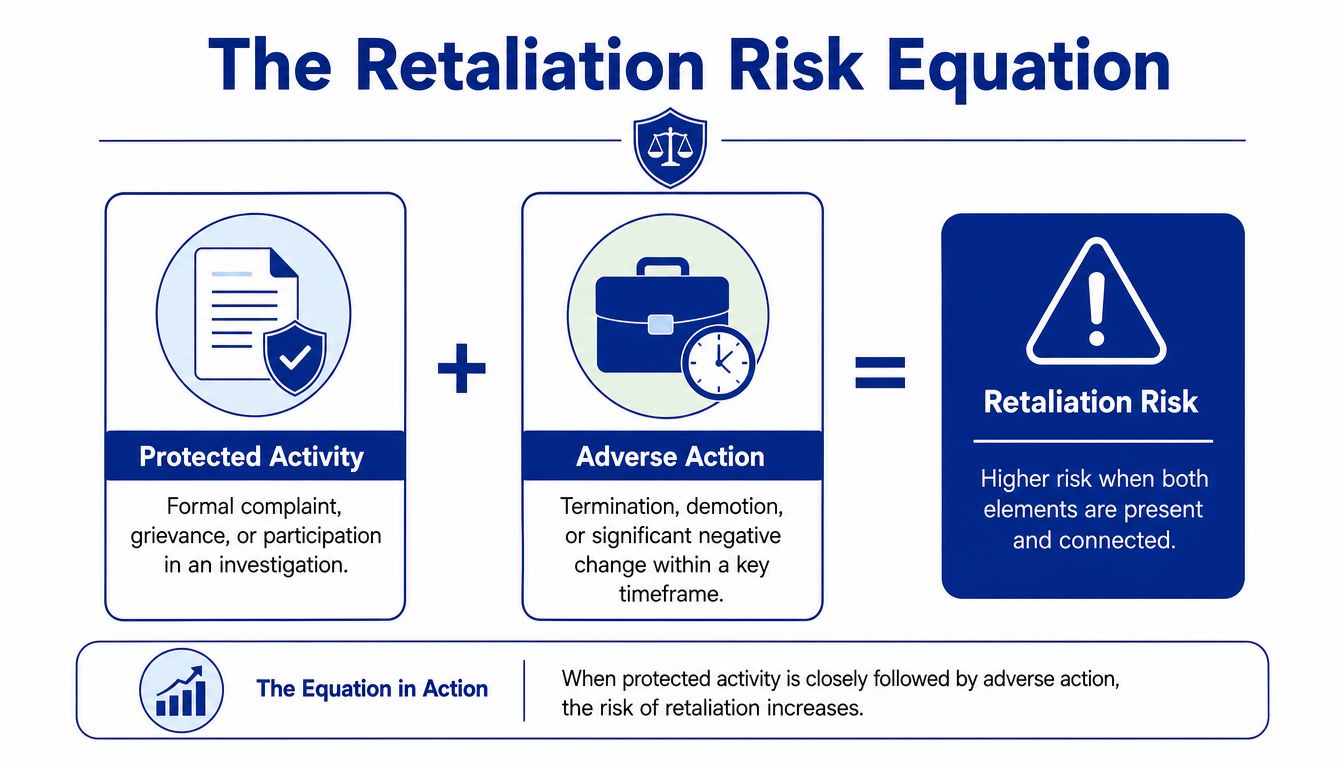
The employee's complaint may involve discrimination, harassment, wage concerns, safety, leave, accommodation, or another workplace issue. The legal label can vary, but the operational question is the same: did the employee engage in protected activity, and did the company then take an adverse action?
A termination is an adverse action. So can be a demotion, suspension, significant reduction in duties, or another action that could discourage a reasonable employee from raising a concern. The EEOC's retaliation guidance explains that firing or other adverse action can create retaliation risk when it would dissuade a reasonable employee from complaining.
Close timing doesn't automatically make a termination unlawful. It does, however, make the timeline one of the first things an investigator, agency, judge, or opposing lawyer will examine. If the complaint arrives Monday and termination follows Friday, the company needs more than a manager's statement that “the employee was already on thin ice.”
The enforcement pattern makes this exposure especially important. Retaliation was the most prevalent EEOC filing category in FY 2024, with 42,301 charges representing 47.8% of all charges, according to the EEOC's enforcement and litigation statistics. Retaliation has also been the EEOC's most frequently alleged basis of discrimination in the federal sector since FY 2008, and nearly half of federal-sector complaints in FY 2013 were retaliation complaints, as reported in the agency's federal-sector retaliation materials.
That changes how leaders should frame the decision. The question isn't "Can we terminate this person?" The better question is, "Can we demonstrate that the same decision would have occurred without the complaint, using evidence that existed before the complaint and standards the company applies consistently?"
Executive rule: A post-complaint termination is defensible only when the business reason survives independent review without relying on the complaint itself.
For owners and COOs, the risk extends beyond federal enforcement. A multi-state employer may face different rules for final pay, protected activity, leave, accommodation, and agency procedures. Use a structured process, and consider Managing retaliation risk with Paradigm International Inc. when the facts involve a recent complaint and an immediate employment decision.
A termination decision made days after a complaint will be judged through the complaint record. If that record is incomplete, slanted, or controlled by the manager who wants the employee gone, legitimate performance concerns can look like punishment for speaking up.
Create a formal intake record immediately. Capture the date received, the allegations in the employee's own words, the people involved, potentially relevant policies, and any immediate safety or operational concerns. Describe the facts without labels such as “malicious,” “disloyal,” or “overly sensitive.” Those labels weaken the record and suggest that the company judged the complainant before reviewing the evidence.
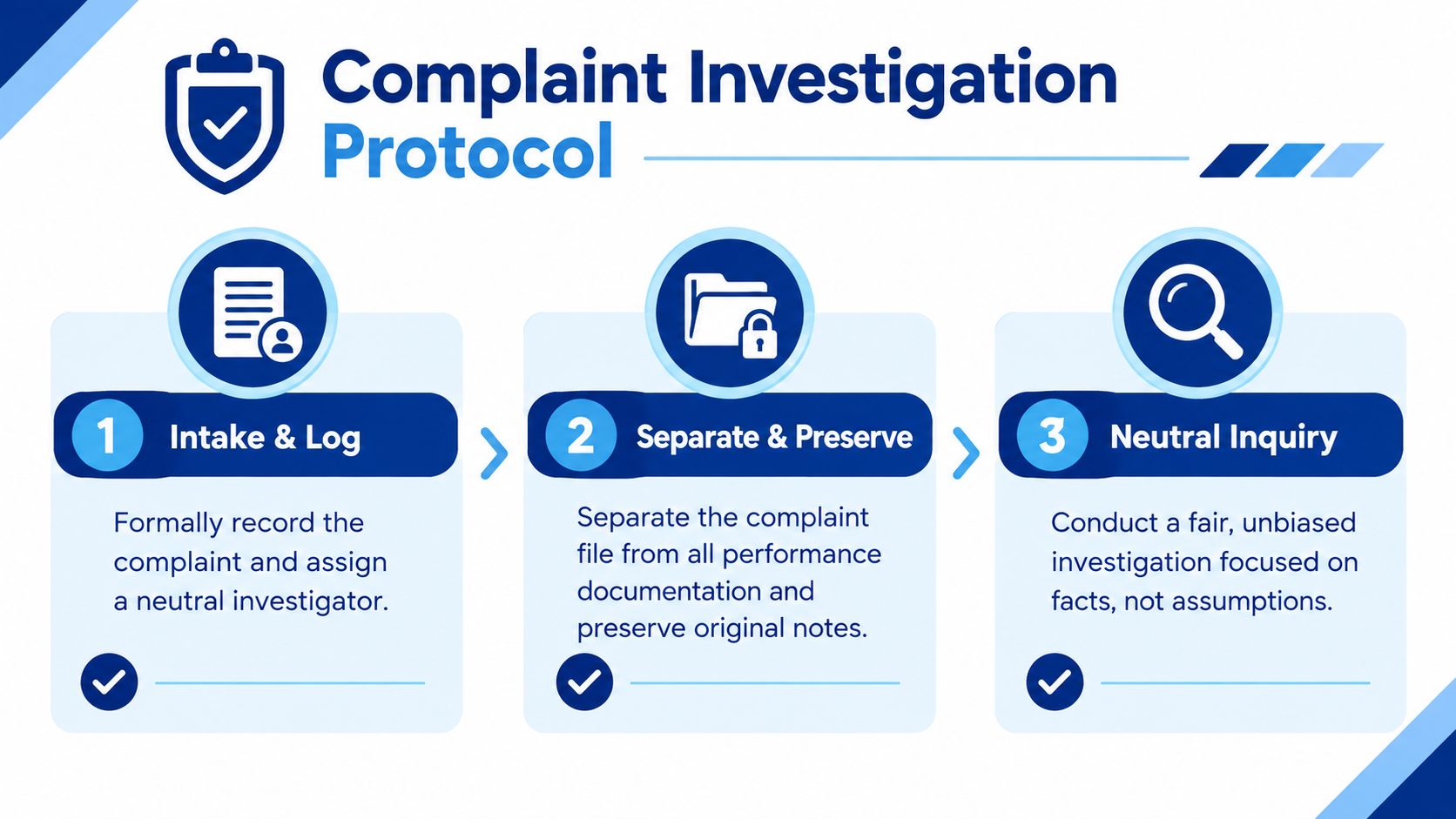
The person deciding whether to terminate should not control the complaint investigation. If the accused supervisor investigates the complaint and then recommends termination, the sequence creates an obvious inference problem. Assign a neutral investigator, such as an internal HR leader, an outside investigator, or employment counsel.
Use two clearly maintained records:
An authorized reviewer may examine both files, but employees should not casually mix them. The separation helps establish that the company investigated the complaint on its own terms instead of using it to accelerate discipline.
Prepare a short investigation plan. State the questions to answer, witnesses to interview, documents to collect, and standard for reaching findings. If new allegations arise, record why the scope changed and who approved the change.
Preserve original emails, messages, performance reviews, calendar entries, and relevant system records. Do not rewrite earlier notes to make them cleaner. If a manager prepares a new summary after the complaint, label it as a later-created summary and retain the underlying records. Multi-state employers should preserve records under a consistent hold process while accounting for different agency and employment requirements.
The investigator should document the outcome and communicate that the matter was reviewed and addressed appropriately. The company does not need to disclose every personnel detail. It should not promise a particular result or imply that the employee must stop raising concerns.
Before any termination discussion, confirm the investigation file contains the intake record, interview summaries, an evidence log, and a written findings memo signed and dated by the investigator. Also record who reviewed the proposed action, what comparator information was checked, and when the decision-maker received the employment records. This timeline is the clearest defense against an inference that the complaint drove the termination.
A legitimate reason must exist independently of the complaint and must be supported by records that predate it. “Performance issues” isn't a reason by itself. A defensible record identifies the expected standard, the actual conduct, the date, the response provided, and the consequence that followed.
Test the proposed reason with a counterfactual question: If this employee had never complained, would the company take the same action on the same record? If the answer is uncertain, stop the process and identify what changed. A sudden shift from coaching to termination after the complaint requires a clear explanation grounded in facts, not manager frustration.
Independent reporting on EEOC data found that at least 63% of workers who filed an EEOC discrimination complaint eventually lost their job, and about 40% reported some form of employer retaliation. The reported findings don't establish that every termination was retaliatory, but they reinforce why post-complaint separations receive close scrutiny.
Review similarly situated employees. Compare the seriousness of the conduct, the applicable policy, the employee's role, the manager's prior practice, and the discipline imposed. A comparator doesn't need to be identical, but the company should be able to explain meaningful differences.
Also examine whether the stated standard was applied consistently. If other employees missed deadlines and received coaching, an immediate termination for the complaining employee needs a documented distinction. If the company changed the performance standard after the complaint, the file will invite a pretext argument.
| Checkpoint | What Good Looks Like | Red Flag |
|---|---|---|
| Reason | Specific conduct tied to an existing policy or expectation | Vague language such as “bad attitude” or “not a fit” |
| Timing | Records show the issue and response existed before the complaint | New criticism appears immediately afterward |
| Comparators | Similar conduct received similar treatment, or differences are documented | Managers can't explain inconsistent discipline |
| Decision-maker | Reviewer had no role in receiving or handling the complaint | The accused supervisor controls the outcome |
| Evidence | Original records, messages, notes, and approvals are preserved | Documents were created or edited after the complaint |
Use factual language. “Missed the required deadline and did not complete the corrective step” is more useful than “doesn't care about the job.” Managers should document observable conduct, business impact, prior notice, and the employee's response.
For formal governance records, a board minutes template for Mac can help leadership teams create a consistent record of approvals and meeting decisions. It isn't a substitute for employment counsel or a termination checklist, but a disciplined approval record can clarify who reviewed the decision and what business rationale was considered.
Maintain the core file using principles from Paradigm International on HR records. The objective is simple: someone outside the original decision chain should be able to understand the reason without relying on undocumented memory.
Timing doesn't determine the outcome by itself, but careless timing creates avoidable inference risk. The company should build a chronology before approving termination, beginning with when the performance issue arose and ending with the proposed separation date.
Write down when the company first considered the issue, when the manager raised it with HR, when corrective action occurred, when the complaint was received, and when termination became a serious option. Don't backdate a decision. If leadership had not considered termination before the complaint, say so and explain what independently led to the later decision.
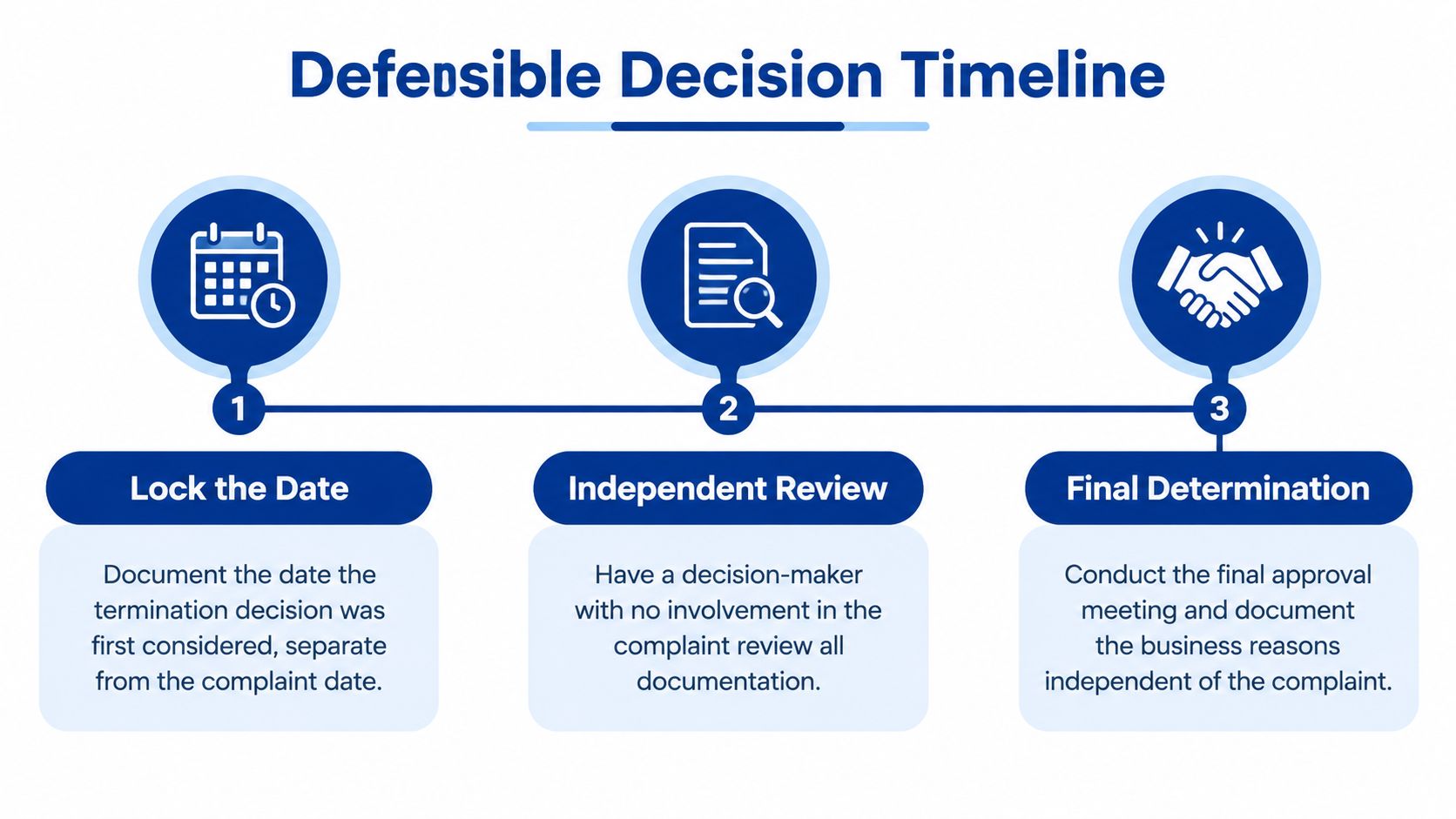
The complaint handler should provide facts, not make the final termination decision. Select a reviewer who wasn't accused, isn't a material witness, and hasn't expressed hostility toward the employee. That reviewer should examine the employment record, comparator information, investigation status, and applicable state requirements.
Use a written approval memo with concise answers:
The EEOC generally gives an employee 180 calendar days from the alleged unlawful act to file a charge, with the period extending to 300 calendar days when a qualifying state or local agency enforces a law on the same basis, according to the EEOC filing deadline guidance. The exposure therefore doesn't end when the meeting ends.
A short pause for review often protects the company better than an immediate reaction. That pause should not become indefinite delay or punishment through changed working conditions. It should create time to verify the record, consult counsel where appropriate, and check multi-state obligations.
Decision discipline: Pause the action, not the employee's rights. Keep conditions consistent while the company verifies the decision.
For broader operational preparation, leaders may also need a plan for protecting your brand during a trust crisis, especially where a complaint could become public or affect customer confidence. Before acting, review state-by-state termination rules alongside federal protections and the company's policies.
Once the decision is approved, execution matters. A poorly handled meeting can create new evidence of retaliation even when the original business reason was sound.
Prepare a short script. State that employment is ending, identify the approved business reason in consistent terms, explain the effective date, and provide the required written materials. Don't debate the complaint, accuse the employee of bad faith, or suggest that raising concerns caused the decision.
Have an HR representative or neutral company witness attend. The witness should document who participated, what was said, how the employee responded, and whether any new allegation emerged. If the employee raises a new concern during the meeting, record it and route it through the complaint process rather than treating it as an argument to dismiss.
The National Labor Relations Board says employers cannot discharge, discipline, or threaten employees for protected concerted activity, including activity involving group concerns about wages, hours, or working conditions, as described in the NLRB's employee rights guidance. A complaint involving coworkers or shared workplace conditions may require a separate labor-law analysis.
Complete final pay, benefits, access, property return, and required notices according to applicable law and policy. Don't improvise severance or release language. Have counsel review any release, particularly where the employee raised discrimination, wage, leave, safety, or concerted-activity concerns.
Preserve the evidence that existed before, during, and after the decision. That includes email, messaging platforms, HRIS entries, calendars, performance systems, investigation notes, approval documents, and meeting records. A practical evidence preservation guide for reporters offers useful general principles for protecting original records and documenting chain of custody, which leadership teams can adapt to workplace disputes.
Issue a litigation hold when appropriate. Tell relevant custodians not to delete or alter potentially relevant information, and suspend routine deletion practices where feasible. Keep the termination letter, decision memo, comparator review, investigation record, and approval trail together in a controlled location with access limited to those who need it.
The safest approach isn't to prohibit termination after every complaint. That would let an employee's protected activity prevent legitimate management action. The safer approach is to make the process independent, evidence-based, and consistent.
Use a repeatable leadership protocol:
This framework helps leadership distinguish a lawful decision from a retaliatory-looking one. It also creates a record that remains understandable after the original managers have moved on or the company has expanded into another state.
Don't let the complaint and performance process bleed into each other. Investigate the complaint fairly, manage performance under established standards, and document the reason for each action. If the records show that the company changed its position only after the complaint, the risk is already high.
International Inc. can serve as an advisory resource for owners and operating teams handling workplace investigations, retaliation concerns, manager conduct, termination decisions, and multi-state HR practices. The value of structured support is judgment at the decision point, before an avoidable process mistake becomes the central fact in a charge.
If a recent complaint and a proposed termination are colliding, Paradigm International Inc. offers advisory support for investigation structure, decision timelines, documentation review, and multi-state HR risk. Visit the firm to discuss the facts before your team takes an irreversible step.