
If you discharge an employee in Texas, final wages must be paid no later than the sixth calendar day after discharge. If the employee quits, pay is due by the next regularly scheduled payday.
That distinction matters the moment a COO approves a termination. Payroll can't wait for the next normal run, and HR can't hold wages until a laptop comes back, paperwork is signed, or a commission dispute is resolved. Texas termination pay laws look simple at first glance, but the exposure sits in policy language, incentive plans, deductions, and the limited time available to challenge unpaid wages.
Texas uses the reason for separation to start the final-pay clock. An employee who is discharged, terminated, or laid off must receive all final wages within six calendar days after the separation date. The Texas Workforce Commission confirms that these are calendar days, so weekends and holidays count toward the deadline. See the Texas Workforce Commission final pay guidance.
An employee who quits follows a different rule. Final wages are due by the next regularly scheduled payday. The separation date should be recorded accurately because it determines which rule applies and when payroll must complete its work.
Operational rule: Build the payroll service-level deadline around the separation date, not the next convenient payroll cycle.
Start with a written separation record showing:
Don't let an unresolved property return or incomplete exit form change the payment date. Texas guidance indicates that administrative disputes don't extend the final-pay deadline. Asset recovery and payroll should run as separate workflows, with the company pursuing property through another documented process.
| Separation Type | Statutory Deadline | Trigger Date | Common Mistake |
|---|---|---|---|
| Discharge, termination, or layoff | No later than the sixth calendar day after separation | The discharge date | Waiting for the next regular payroll run |
| Voluntary quit | Next regularly scheduled payday | The employee's separation date | Applying the six-day rule to every departure |
The safest internal control is a termination alert that reaches payroll as soon as the decision is approved. The alert should identify the legal separation category and launch an off-cycle calculation when the regular payroll calendar won't meet the deadline. Your broader wage and hour compliance guide can support that control by giving managers and HR a consistent compliance reference.
The final check isn't limited to the employee's last hourly punch or salary payment. Texas requires final wages to include amounts that are earned under the applicable agreement, policy, or compensation plan. That means payroll must review the employee's actual compensation documents instead of relying on a standard termination template.
Base wages through the final day worked belong in the calculation. Salaried pay may need to be prorated according to the employer's established payroll method and applicable rules. Earned commissions and bonuses require a closer review because the plan may define when compensation becomes payable.
Texas doesn't independently require employers to pay accrued vacation or PTO because an employee leaves. A written policy or contract can change that result. If the policy promises payment for accrued vacation, the employer must follow its own language. If the policy excludes payout, distinguishes earned from front-loaded leave, or places conditions on eligibility, those terms need careful review.
The same document-first approach applies to incentives:
A final check issued before incentive calculations are complete can create conflict. If a commission is already earned under a written plan, the employer shouldn't erase it merely because the normal commission statement hasn't been finalized. If the commission remains contingent, payroll should document the condition, calculation method, and expected payment process.
Multi-state businesses often need better payroll coordination. Teams responsible for a distributed workforce can use resources on how to manage mobile workforce payroll, then adapt the process to each employee's compensation documents and work location.
The practical recommendation is direct: attach the handbook, PTO policy, commission plan, bonus plan, and expense record to the final-pay worksheet. The check should be supported by documents that explain both what was paid and why a disputed item was excluded.
A final paycheck can include lawful deductions, but a termination is not an invitation to recover every amount the company believes an employee owes. Payroll must distinguish between a deduction from wages and a separate debt or property claim.
Ordinary authorized deductions may include benefit contributions, retirement plan deductions under the plan documents, garnishments, and other deductions required or properly authorized for a lawful purpose. The authorization should be in writing and should identify what the deduction covers.
The critical control is to test each deduction before it reduces gross pay:
Withholding final pay until a laptop, key, tool, or vehicle is returned is a particularly poor control. The company can request return, document the condition of the property, and pursue an appropriate recovery route. It shouldn't make payment of earned wages conditional on that recovery.
Keep the employee's wage statement and the company's asset claim in different files, with different owners and different approval paths.
Equity compensation also deserves its own review. If the separation involves restricted stock units or other equity awards, payroll and HR should coordinate with the plan administrator rather than guessing at the tax result. A resource on understanding RSU tax withholding can help frame the questions for that review, but the governing award documents control the outcome.
Consider a fictional salaried account manager who is discharged on a Wednesday. The employee earns $72,000 annually, has five working days remaining in the pay period, has 38 hours of unused PTO listed under the company handbook, and has a $4,500 commission that appears earned but hasn't been paid.
The first calculation is base salary. The annual salary must be converted using the employer's established payroll convention, then applied to the portion of the pay period through the separation date. Because the available facts don't establish the employer's pay-period length or salary-proration method, payroll shouldn't invent a daily rate. It should use the same documented method applied to comparable separations.
The PTO line depends on the handbook. If the policy promises payout of accrued PTO and the 38 hours are earned, the worksheet should include 38 hours multiplied by the employee's applicable regular rate. If the policy treats the leave as front-loaded, excludes payout, or states that the hours aren't earned until another condition occurs, the result may differ.
The commission requires a separate determination. If the written plan says the employee earned the commission after satisfying completed sales or other defined conditions, include $4,500 in the gross calculation. If payment remains contingent on an unresolved condition, document that condition and the plan's payment process rather than labeling the amount unpaid without analysis.
| Pay Component | Calculation | Amount |
|---|---|---|
| Base salary | $72,000 annual salary, prorated under the employer's documented payroll method | Determined by payroll records |
| Accrued PTO | 38 hours multiplied by the applicable rate, if the handbook promises payout | Determined by policy and rate |
| Commission | Earned amount under the written plan, if conditions are satisfied | $4,500 if earned |
| Gross final pay | Base salary plus payable PTO plus earned commission | Sum of payable lines |
| Withholding | Applicable payroll withholdings and authorized deductions | Determined by payroll |
| Net final pay | Gross final pay less lawful withholdings and deductions | Determined by payroll |
The check must be delivered no later than the sixth calendar day after the Wednesday discharge date. The exact gross and net amounts depend on records that must be verified before approval. A defensible calculation is better than a fast guess, but the review must happen quickly enough to meet the statutory deadline.
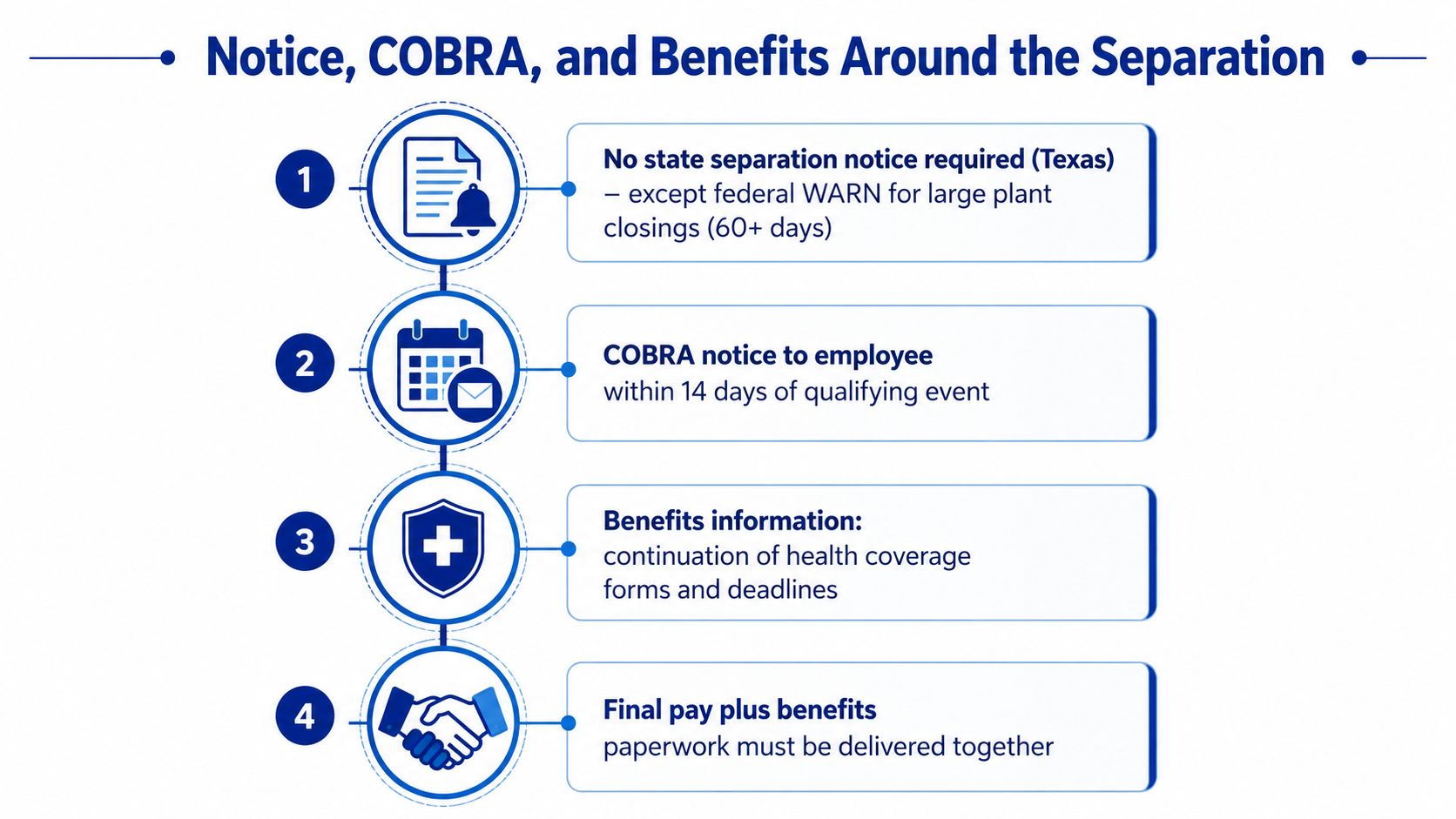
Final pay is only one part of the exit process. HR must coordinate benefits notices, insurance administration, unemployment information, and any applicable separation communications without allowing those tasks to delay earned wages.
Texas doesn't generally impose a broad state separation-notice requirement for every termination. Federal obligations may apply in specific circumstances, including covered plant closings or mass layoffs under the WARN framework. The responsible team should assess that issue separately rather than treating a routine termination form as a complete notice process.
COBRA administration begins with the qualifying event and the loss of group health coverage. The plan administrator must send the election notice within the applicable federal timeline, and qualified beneficiaries receive the applicable election period established by COBRA. Benefits staff should confirm the coverage-end date, identify each qualified beneficiary, and preserve proof of delivery.
A smaller employer may also need to evaluate continuation requirements under Texas insurance law if federal COBRA doesn't apply. The correct answer depends on the plan, employer size, coverage structure, and facts of the separation.
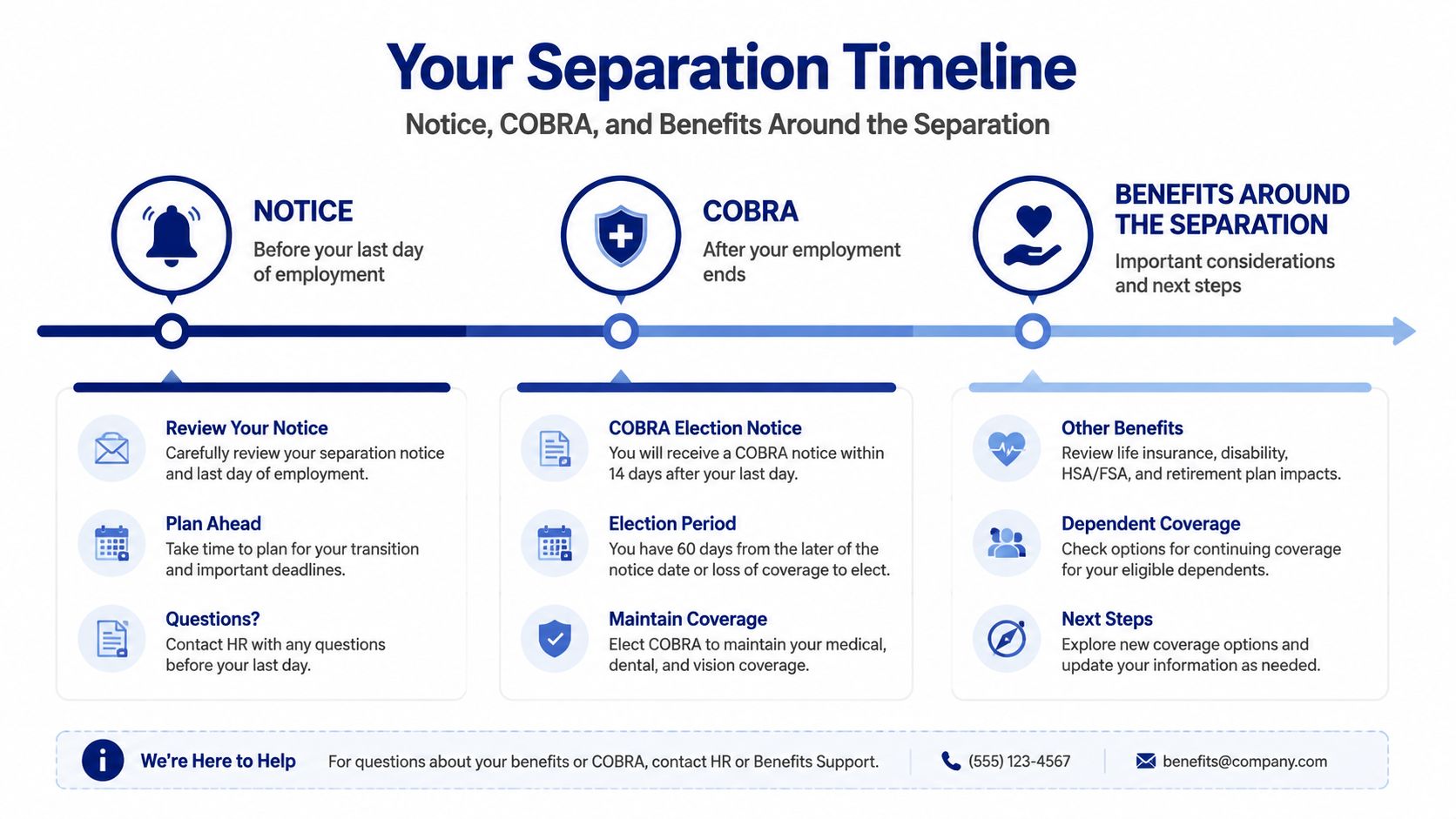
A practical sequence is:
Benefits cost planning also affects termination decisions, particularly for employers reviewing budgeting for employee benefits 2026. For an operational explanation of notice administration, use this guide on COBRA for SMB leaders. Benefits paperwork can travel with the exit packet, but its deadlines shouldn't be confused with the final-pay deadline.
The most important enforcement fact is the 180-day claim deadline. An employee must file a Texas wage claim no later than the 180th day after the wages became due. The Texas Workforce Commission describes that deadline as jurisdictional, so a late filing can be barred rather than merely processed later. Review the agency's Texas Payday Law information when a dispute arises.
That window creates two risks at once. The employee may have a short period to receive final wages, then a finite period to challenge a missing or incomplete payment. The employer shouldn't assume that silence means the issue is closed, especially when the employee has disputed PTO, commissions, deductions, or expense reimbursement in writing.
When a complaint arrives, preserve the full record:
The Texas Workforce Commission may request records and evaluate whether wages were due under the applicable agreement and facts. A prompt internal review gives the company options. It can correct a clear error, explain a defensible exclusion, or seek counsel before the dispute develops into a formal proceeding.
Don't make unsupported assumptions about penalties or private litigation remedies. The available exposure depends on the claim, the governing law, the evidence, and the forum. The practical recommendation remains firm: escalate a disputed final check early, especially when the employee alleges retaliation, discrimination, contractual commission rights, or a policy promise.
A Texas headquarters doesn't make every employee a Texas-pay employee. The employee's work location and the laws governing the employment relationship can change the final-pay analysis, particularly for remote workers and people who work across state lines.
Use one workflow with a jurisdiction check at the front:
Texas, California, New York, Colorado, and Illinois can create materially different termination workflows. A remote employee may trigger rules from the state where the employee worked even when payroll, management, and corporate records are located in Texas. Don't use a Texas template across all locations without a state-by-state review.
Your handbook should also match actual payroll practice. A focused HR risk advisory on handbooks can help identify policy language that creates payout obligations or conflicts with state requirements.
The cleanest handoff has three signatures or approvals: HR confirms the separation facts, payroll confirms the calculation, and a responsible leader confirms the payment method and delivery record. That small amount of discipline prevents a rushed termination from becoming an avoidable wage dispute.
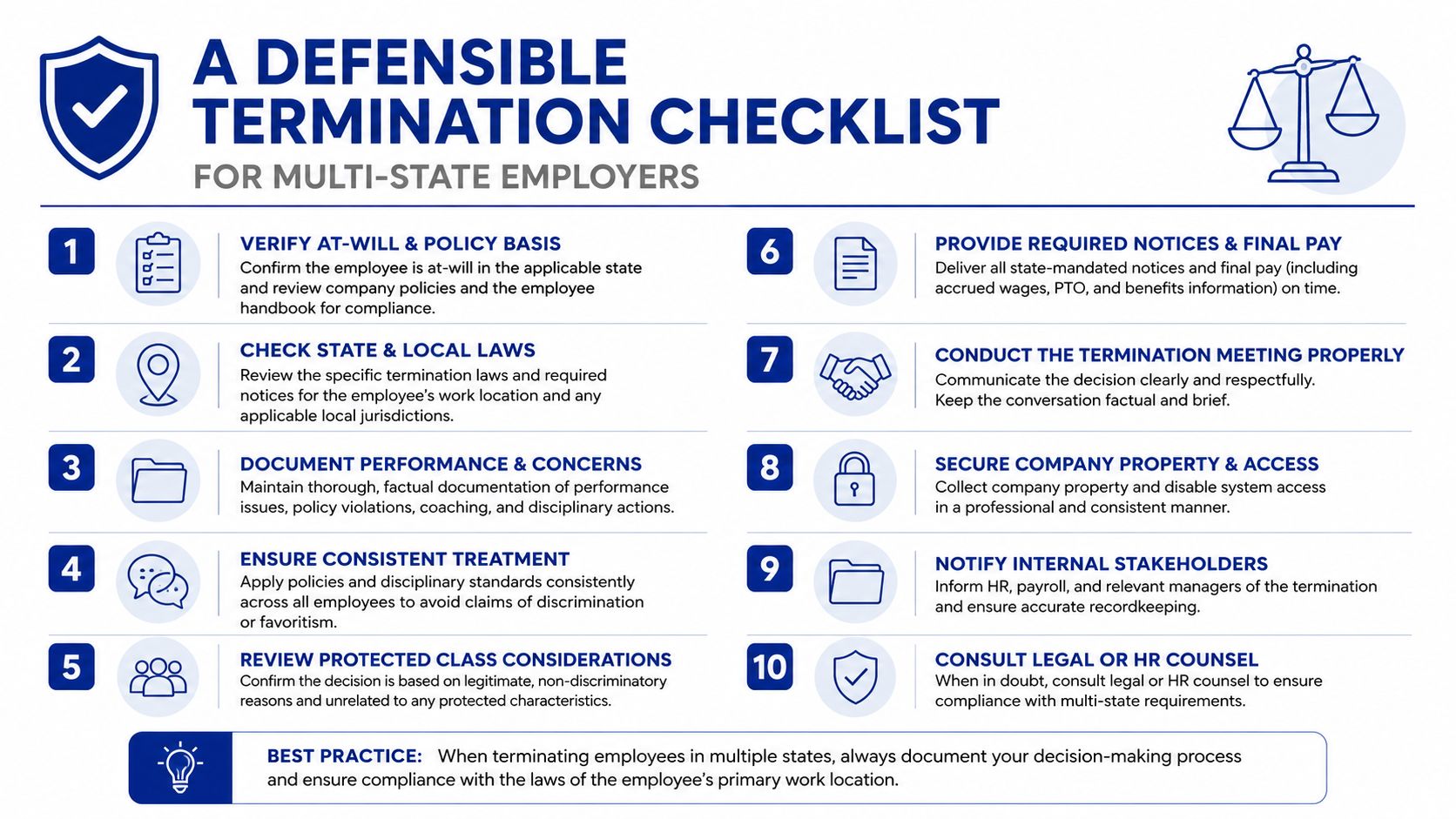
Texas termination pay works best as a controlled payroll process. Confirm the separation type, identify the applicable deadline, and calculate wages from the employee's actual PTO, commission, and deduction terms. The six-day rule is only the starting point. Policy language and commission timing can change the result.
Use these controls:
If a wage issue has surfaced, review the Texas Workforce Commission wage claim resources promptly. The 180-day claim window makes delay a poor compliance strategy. Obtain jurisdiction-specific advice for contested commissions, retaliation concerns, unusual deductions, or overlapping state rules.
Paradigm International Inc. helps owners, COOs, and HR leaders review termination pay controls, documentation, and multi-state workflows. For a practical review of a Texas separation or active wage issue, visit Paradigm International Inc. to start a focused conversation.