


Discovering that a trusted employee might be stealing from your business is a difficult and stressful experience. This quiet threat goes far beyond a hand in the cash register; it could be inventory vanishing from a warehouse, intellectual property downloaded to a personal drive, or company time spent on personal projects. For any business, this isn't just a minor loss—it's a significant financial drain and an operational risk that can damage your company culture and shatter trust. Understanding its true scope is the first step toward building an effective defense.
The impact of employee theft extends far beyond the initial dollar amount. When a team member betrays your trust, the consequences can seep into the very fabric of your company, undermining morale and creating serious legal and reputational risks. It's a scenario no leader wants to face, but it happens more often than many business owners realize.

This isn’t about a few isolated incidents. Statistics show that a significant percentage of employees have stolen from an employer at least once, highlighting just how widespread this challenge is. For example, in the retail sector alone, dishonest employees were responsible for nearly 30% of the industry's inventory losses in a single year, amounting to tens of billions of dollars stolen by insiders.
The direct cost of a stolen item or missing cash is just the beginning. The real financial burden grows when you add the resources spent investigating the incident, the legal fees for consultation or prosecution, and the costs of hiring and training a replacement. Often, these secondary expenses can easily exceed the value of what was stolen, leaving a much deeper financial impact than initially realized.
Beyond the balance sheet, employee theft introduces a destructive element into your workplace. Once trust is broken, it affects the entire team. Collaboration can give way to suspicion, and morale may plummet as honest employees feel their own integrity is being questioned or that their hard work is being devalued. This erosion of trust is a critical blind spot in many HR risk management strategies.
The operational consequences are just as damaging. Internal theft can create chaos in your systems, leading to:
A proactive, structured approach to preventing and addressing theft is essential. This is not about creating a culture of distrust. It is about implementing clear, consistent systems that protect the company’s assets, its people, and its integrity—a foundation every business needs to thrive.
To protect your business, you first need to understand what you're looking for. Employee theft is not a single act but a range of behaviors, some obvious and others nearly invisible. Identifying these different types helps you see where your business might be exposed so you can build smarter, more targeted safeguards.
Think of employee theft as falling into three main categories: directly taking company assets, creating fraudulent payments to siphon funds, and stealing intangible resources that give your business its competitive advantage. Each type poses a distinct threat, from draining your cash reserves to compromising your most valuable secrets.
This is the most straightforward kind of theft, where an employee simply takes physical company assets. While it sounds simple, the methods can be surprisingly creative and often occur where money or inventory is constantly changing hands.
Common examples include:
Unlike a direct grab, fraudulent disbursements involve tricking the company into making a payment it should not. The employee isn't taking cash out of the register; they are creating a fake transaction that sends company money where it doesn’t belong. These schemes are harder to spot because they are often disguised as normal business operations.
These schemes often exploit weak spots in accounts payable or payroll systems, making the payments appear legitimate on the surface.
Here are a few common ways this plays out:
Not all theft involves cash or physical items. Some of the most damaging schemes involve stealing intangible assets—the kind of theft that can have devastating long-term consequences for a company's competitive advantage and market position.
This category includes:
By familiarizing yourself with these common schemes, you can start to identify potential weaknesses in your own organization. Each one highlights a vulnerability that, once identified, can be strengthened with the right internal controls and a clear investigative plan.
Discovering employee theft often feels like a sudden crisis, but the warning signs are usually present long before the damage is done. Your best defense is learning to spot the subtle behavioral and operational signals that something is wrong. Recognizing these red flags helps you shift from reacting to problems to proactively building a culture of accountability.
These warning signs generally fall into two categories: the human element, involving changes in an employee's behavior, and the operational element, which appears as anomalies in your data and daily processes. Both are equally important for catching problems early.
Often, the first clues are behavioral. You may notice changes in an employee's conduct or personal life that seem out of character or inconsistent with their known circumstances. While these signs are not definitive proof of wrongdoing, they are strong indicators that warrant a closer, discreet look.
Common behavioral red flags include:
It is crucial to remember that perpetrators do not always fit a specific profile. While red flags like living beyond their means or experiencing financial difficulties are common, a high percentage of offenders have no prior criminal record, highlighting the need for fair and consistent investigation processes.
While behavioral signs can be subjective, operational red flags are grounded in hard data. These are the tangible discrepancies that appear in your financial records, inventory counts, and other business systems. Regularly monitoring your key operational metrics is one of the most effective ways to detect employee theft.
An unusual pattern in your data is a clear signal that something needs immediate investigation.
Look for these key data-driven indicators:
Recognizing these signs is the first step toward protecting your business. If you have identified potential red flags and need guidance on how to proceed with a defensible and compliant investigation, our team is here to help.
When you suspect an employee of theft, every step you take is critical. A poorly handled investigation can fail to solve the problem and may expose your company to legal risks, damage employee morale, and harm your workplace culture. The key to avoiding this fallout is to follow a structured, objective process that is fair, thorough, and legally sound.
A well-run investigation is about building a case on credible evidence, not assumptions. It protects both the company and its employees by demanding fairness and consistency. More than just addressing the immediate issue, it sends a clear message that your company takes misconduct seriously and handles it with professionalism.
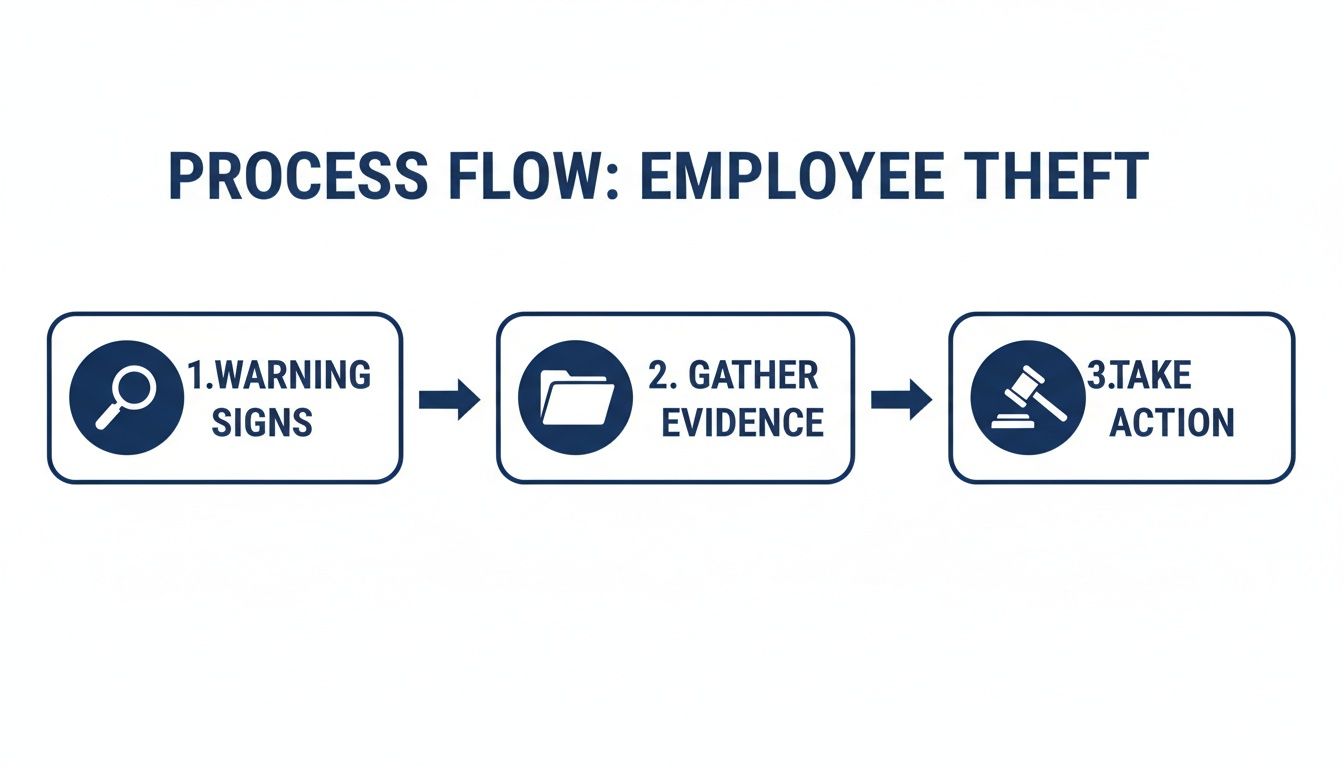
This workflow highlights the importance of moving systematically from suspicion to facts before making any final decisions.
Before you do anything else, assemble a small, trusted team to lead the investigation. This group must be impartial and capable of handling sensitive information with complete confidentiality. Rushing in without the right people can compromise the entire effort from the start.
The ideal team usually includes:
This core group's first task is to create a clear investigation plan. The plan should define the scope of the inquiry, outline the specific allegations, and detail the methods you will use to gather evidence. A solid plan keeps the investigation focused and prevents it from becoming aimless.
With a team and a plan in place, the next priority is to discreetly secure and collect all relevant evidence. This must be done carefully to avoid alerting the suspected employee, which could give them a chance to destroy key information. The goal here is to build a foundation of tangible proof.
Gathering evidence is a meticulous process that requires compiling a body of proof that tells a clear story. For a deeper look at this process, review our guide on how to conduct an HR investigation.
Key sources of evidence often include:
Every piece of evidence must be documented, noting where and when it was found. This creates a clean chain of custody, which is essential if you need to defend your actions later.
Once you have preliminary evidence, it is time to start talking to people. Interviews must be handled with extreme care to maintain confidentiality and avoid making accusations. Your objective is to gather facts, not to interrogate or intimidate.
Start by interviewing individuals who may have useful information but are not the subject of the investigation. When you are ready to interview the employee in question, it is best to have two investigators present—one to ask questions and the other to take detailed notes.
During an interview, stick to open-ended, non-leading questions. Instead of asking, "Did you steal the inventory?" try, "Can you help us understand the discrepancy in last month's inventory report?" This approach encourages factual answers rather than defensive denials. Throughout this process, documentation is non-negotiable, as meticulous records are your best defense if your decisions are ever challenged.
While a solid investigation process is crucial for reacting to theft, the best strategy is to create an environment where it is unlikely to happen in the first place. This means shifting your focus from reactive to proactive—from catching theft to building a culture of integrity. Such a culture not only protects your assets but also builds trust and reinforces the shared values that unite your team.

This proactive stance is built on two pillars: strong internal controls and clear, consistently enforced policies. When these safeguards are woven into your daily operations, they make theft much harder to commit and far easier to detect. They serve as both a practical barrier and a powerful psychological deterrent.
Internal controls are the specific systems and procedures you put in place to eliminate opportunities for theft. They primarily work by creating checks and balances so that no single person has unchecked power over sensitive assets.
Some of the most effective controls include:
A core principle here is to remove temptation. When strong processes are in place, it becomes extremely difficult for an employee to commit fraud without being caught, which often deters them from trying in the first place.
Controls are a framework; they need clear, well-documented policies to be effective. Your policies set the standard for behavior and outline the consequences for breaking the rules. They are the backbone of a workplace where integrity is the norm.
Your prevention framework should be built on these key policies:
Prevention also extends to physical and digital security. This includes managing old company equipment that may still contain sensitive data. For example, having a secure IT asset destruction plan for retired computers is a critical step in preventing data theft.
Ultimately, preventing theft is as much about your culture as it is about your controls. A positive work environment where people feel valued, respected, and fairly compensated is your most powerful deterrent. This requires consistent, genuine effort from leadership.
When employees feel a sense of ownership and loyalty, they are far more likely to act as guardians of the company’s assets. For leaders ready to build this foundation, understanding the link between leadership and trust is the perfect starting point. The effort pays for itself by creating a workplace where integrity is simply how things are done.
If you need help developing preventative policies or strengthening your internal controls, our team is here to guide you. Contact us to discuss how we can build a more secure framework for your business.
Once an investigation confirms misconduct, you have reached a critical crossroads. The focus now shifts from uncovering facts to making a series of difficult decisions. Navigating this stage requires a clear-headed strategy that balances your legal duties, company policies, and the morale of your entire team.
How you respond sends a powerful message to everyone in the organization about your commitment to integrity. Rushing this step or acting inconsistently can undermine all your hard work and damage the credibility of your process.
The right response is not one-size-fits-all. It depends on several factors, including the severity of the theft, the strength of your evidence, and your existing disciplinary procedures.
Your primary options generally fall into three categories:
The decision to involve law enforcement should be strategic, not emotional. You need to consider if the evidence is strong enough to support a criminal case and how a public filing might affect your business and other employees.
Before making any decision, it is essential to consult with legal counsel. An expert can review your investigation file and advise you on a path that minimizes legal risk while ensuring your response is fair, consistent, and well-documented.
Taking the right action not only resolves the immediate problem but also reinforces the standards of conduct you expect from every person on your team. If you are facing this difficult stage and need help ensuring your response is legally defensible, we can help you make these critical decisions with confidence. Contact us to learn how we can support you.
When dealing with the complexities of employee theft, many questions arise. It is a sensitive situation, and business owners and HR leaders often find themselves facing similar concerns. Getting straightforward, practical answers is the first step toward responding effectively and protecting your organization.
Here, we cover some of the most common questions, providing a reliable starting point for your response strategy.
The moment you suspect theft, your first move is to start gathering preliminary information discreetly, without alerting the employee in question. Start a confidential file and document what raised your suspicion, noting any specific discrepancies, dates, and potential evidence.
Avoid confronting the employee directly, as an accusation can compromise the investigation and create legal risks. Instead, your next step should be to consult with your HR advisor or legal counsel to develop a formal investigation plan. A structured approach is crucial.
This is a common misconception. Generally, there is no legal requirement for a private company to report theft by employees to law enforcement. The decision to involve the police is a strategic one for the business.
This decision depends on several factors: the severity of the theft, the strength of your evidence, your company policy, and whether you wish to pursue criminal prosecution. It is a business decision that should be made after consulting with legal counsel, as your choice can have significant implications.
Recovering stolen money or property can be pursued through a few different channels. Each path has its own costs and benefits, so the best route should be determined with your legal and risk management advisors.
Your main recovery options include:
Navigating the aftermath of employee theft requires a careful balance of legal duties and strategic business goals. If you need guidance on conducting a defensible investigation or determining the right course of action in a high-stakes situation, we can help.
To learn more about how we can support your leadership team, contact us to discuss your specific needs.


