You may be running a Virginia location with the same handbook you use in other states. That’s where break compliance starts to drift. Owners assume every state requires lunch breaks for adults, managers improvise, payroll applies automatic deductions, and nobody notices the mismatch until there’s a complaint.
Virginia is simpler than many employers think. It’s also easier to get wrong if you rely on assumptions instead of a clean operating rule. The state gives employers broad discretion for adults, but it draws a hard line for younger workers, and federal wage-and-hour rules still control how optional breaks must be paid.
A Virginia store manager borrows the break schedule from your Maryland or Pennsylvania location, payroll auto-deducts 30 minutes for every long shift, and nobody checks whether Virginia law requires that setup. That is how clean intentions turn into wage-and-hour risk.
Virginia’s rule is narrower than many employers expect. For employees age 16 and older, Virginia does not require meal breaks or rest breaks under state law. For employers, that means one thing. You need a deliberate operating rule, not assumptions copied from another state.
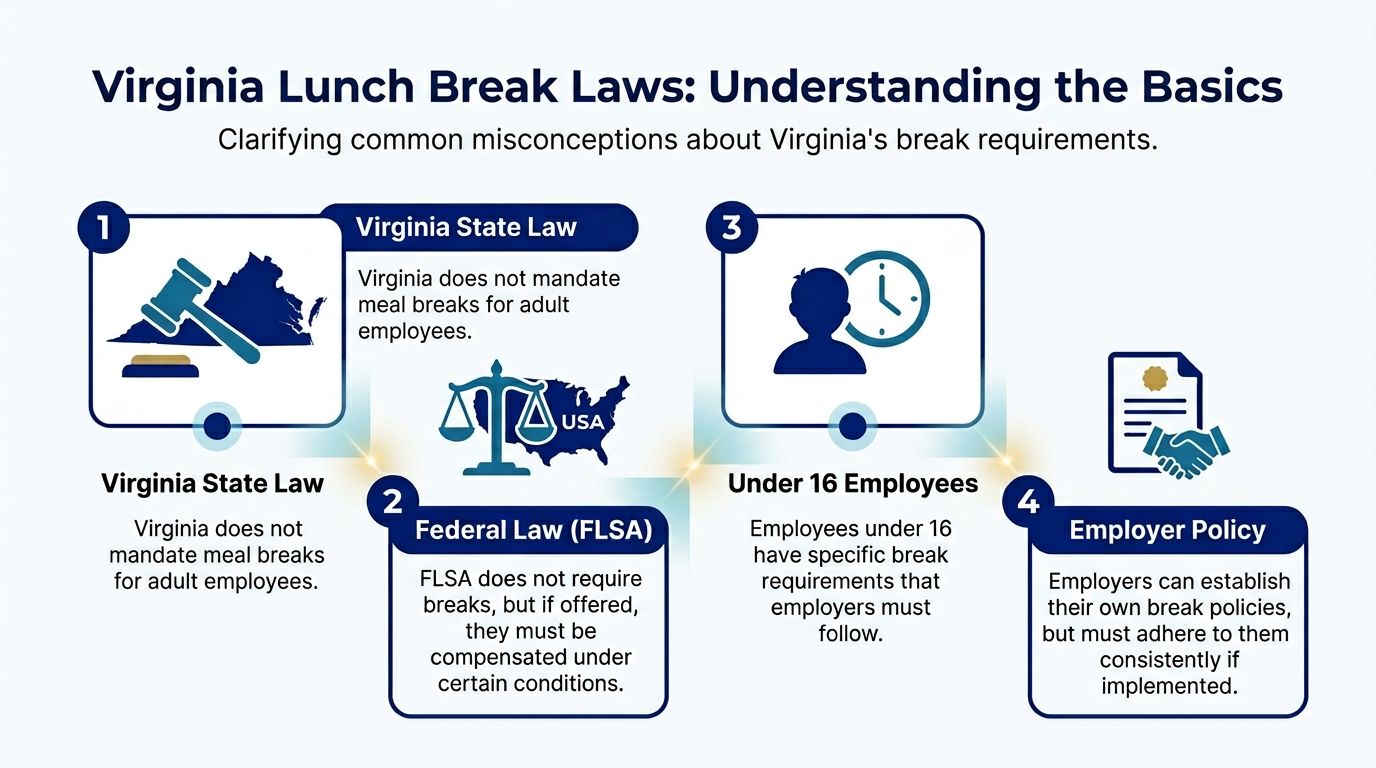
Virginia’s state break requirement applies to a specific group. Employees under 16 must receive a minimum 30-minute unpaid lunch period for every five consecutive hours worked (timeero.com/resources-page/virginia-break-laws).
That should drive your setup. If your Virginia workforce is entirely 16 or older, state law leaves the adult break decision to the employer. If you employ younger teens, your scheduling rules, supervisor training, and timekeeping controls need to reflect that requirement.
Virginia is the kind of state that exposes lazy policy rollouts. A one-size-fits-all handbook creates friction in two directions. You either overbuild your Virginia process with rules the state does not require, or you underbuild another state’s process by copying Virginia’s flexibility where it does not belong.
If you need a comparison point, Pennsylvania break law requirements show how quickly break obligations can shift across state lines.
Use a state supplement or manager guide if you operate in several states. Do not rely on a generic “employees receive meal periods as required by law” sentence and hope local managers get it right. They will not.
Break rules should be assigned by work location, employee age, and whether the employee is fully relieved from duty. Anything less creates avoidable payroll and supervision errors.
Small and mid-sized employers do not need a complicated Virginia break program for adults. They need a clear choice and a policy they can enforce.
Pick one model and document it:
The risk is inconsistency, not complexity. If one supervisor gives paid breaks, another auto-deducts lunches, and a third lets employees eat while answering calls, you have created a wage issue even without a Virginia adult break mandate.
Use language your managers can apply on the floor. For example:
Virginia break rule: Employees age 16 and older may be provided meal or rest breaks based on business needs and company policy. Employees under age 16 must receive an unpaid 30-minute meal period for each five consecutive hours worked. Unpaid meal periods must be duty-free. Employees must report any missed, short, or interrupted unpaid meal period.
Pair that with a short recordkeeping checklist:
Use this rule set:
That is the practical answer for business owners. Virginia gives you flexibility on adult breaks. Your job is to turn that flexibility into a policy, payroll rule, and scheduling practice that managers can follow without improvising.
If you employ anyone under 16 in Virginia, stop treating break administration as a casual scheduling issue. It’s a compliance issue.
The rule is straightforward. Virginia requires an unpaid lunch period of specific duration for younger employees working for a set number of consecutive hours. Your responsibility isn’t just to write that in a handbook. Your responsibility is to make sure supervisors schedule it and the employee receives it.

“Consecutive hours” should be treated operationally as continuous working time before the required meal period. If a minor is on the clock and performing work, those hours are counting toward the threshold.
Don’t let managers get cute with this. A brief pause at the register, standing idle while waiting for customers, or checking a phone while remaining responsible for the work area is not the same as a genuine lunch period.
Use a simple scheduling rule. If a worker under 16 is scheduled for a shift that could run into five continuous hours, place the meal break in the schedule before that threshold is reached.
An unpaid meal break must be real. If the employee remains responsible for answering questions, monitoring customers, covering a counter, or handling cleanup during the break, you’ve undermined the whole arrangement.
For younger workers, I recommend that managers follow a stricter internal standard than they might use for adults. Don’t interrupt the break unless there is a true emergency. If the break is interrupted, fix the time record and reschedule the meal period when needed.
Here’s the operating checklist I’d require for any Virginia location employing younger teens:
Practical rule: If a manager can’t prove the break happened, assume the business will struggle to defend it.
A practical way to manage this is to use a scheduling note for under-16 workers. Mark the employee in your scheduling system and require a meal period before the shift reaches five consecutive working hours.
This is not the place for manager discretion. Minor break compliance should be system-driven.
The most common problem isn’t legal complexity. It’s operational sloppiness.
Managers often believe they can delay the break because the store is busy, the employee is willing to wait, or the shift is almost over. That thinking creates preventable risk. The break requirement for younger workers is mandatory, and your system should treat it that way.
A manager in Richmond schedules a 30 minute unpaid lunch for the front desk team. By Friday, employees have answered phones through most of those lunches, payroll still deducts the time, and the company has created a wage claim out of a routine staffing problem.
That is the main compliance issue for adult employees in Virginia. State law does not require meal or rest breaks for most workers age 16 and older, but the Fair Labor Standards Act still controls whether break time must be paid. For multi-state employers and growing SMBs, the practical rule is simple. Standardize your pay treatment around what your operation can enforce, not what looks efficient in the handbook.

Use this line in manager training because it prevents expensive mistakes:
Policy labels do not control pay treatment. Working conditions do. If an employee keeps answering calls, watching a lobby, monitoring a chat queue, staying on radio, or responding to messages, the business should pay for that time.
This matters even more in organizations with mixed on-site and remote teams. A break policy that works in one state or one department often fails when copied across locations without adjusting for how the job is performed.
The risk points are operational, not theoretical.
Do not build your adult break policy state by state unless you have the HR infrastructure to support that complexity. Build a default rule for adult employees, then apply state-specific exceptions where required.
Here is the approach I recommend:
1. Choose one of two operating models for adult employees.
Use paid breaks for roles that cannot disconnect cleanly. Use unpaid meal periods only for roles where managers can fully release employees from duty every time.
2. Match the model to the job, not to manager preference.
Front desk staff, dispatch, healthcare support, retail coverage roles, and lean admin teams usually fit better under a paid-break structure. Field staff, warehouse teams, and employees who can leave the work area often fit better under a true unpaid meal period.
3. Write the exception process before rollout.
If an unpaid meal period is interrupted, require the employee to report it the same day and require the supervisor to confirm the correction in payroll.
4. Train supervisors on one test.
Ask one question: was the employee fully relieved from duty? If the answer is no, pay the time.
That is the standard managers remember.
Use plain language. Ambiguous wording creates arguments.
For paid short breaks:
“Authorized rest breaks of 20 minutes or less are counted as hours worked and will be paid.”
For unpaid meal periods:
“Meal periods are unpaid only when the employee is completely relieved of all work duties. Employees must immediately report any interrupted or missed meal period to their supervisor and record the time accurately.”
For remote employees:
“Employees taking an unpaid meal period must stop performing all work, including responding to messages, emails, calls, or chat platforms. Any work performed during the meal period must be recorded and will be paid.”
If you are hiring remote staff across states, align break instructions with your broader onboarding process so supervisors are not improvising the rules on day one. Remote Onboarding Best practices can help you build that into the first-week workflow.
A receptionist eats at the desk and continues greeting visitors. Pay the time.
A technician clocks out, leaves the work area, and receives no work requests during lunch. That meal period is much easier to treat as unpaid.
A remote coordinator marks lunch on the calendar but continues replying to messages from a phone. Pay the time.
Do not overcomplicate this. If the business continues to get labor during the break, the time is usually compensable.
For adult employees in Virginia, your best defense is a clean timekeeping process tied to working conditions. If you use unpaid meal periods, require three things: accurate start and stop times, a simple way to report interrupted lunches, and supervisor review before payroll closes.
A neat handbook does not fix sloppy execution. A break model your managers can enforce does.
A supervisor in Richmond auto-deducts 30 minutes for lunch because that is how your payroll system is set up. A 15-year-old cashier works straight through a busy shift. An adult employee answers customer messages while "on lunch." Now you have three different compliance problems, and your handbook helped create all of them because it was too generic.
A defensible break policy does more than describe the law. It tells managers what to do, tells employees what to report, and gives payroll a clear rule set to follow. For Virginia employers, that means writing for operations, not for a legal file cabinet.
Start with the operating rules your business needs:
If your retention process is weak, the policy will still fail under scrutiny. Build this section of the handbook to match your broader employment records retention requirements, especially if you run multiple locations or share HR support across states.
| Employee Group | Virginia State Requirement | Federal (FLSA) Rule If Break is Offered |
|---|---|---|
| Employees under 16 | Minimum 30-minute unpaid lunch period for every five consecutive hours worked | If a break is offered, pay treatment depends on whether the employee is fully relieved from duty |
| Employees age 16 and older | No statewide meal or rest break mandate | Short breaks are generally paid; bona fide meal periods may be unpaid if the employee is fully relieved from duty |
Use language your managers can enforce on a busy day.
Sample policy language
The Company administers meal and rest breaks based on applicable law, job duties, and business needs. In Virginia, employees age 16 and older do not receive meal or rest breaks under state law unless provided by Company policy or scheduling practice.
Employees under 16 who work in Virginia must receive a 30-minute unpaid meal period for every five consecutive hours worked. Supervisors must schedule these meal periods and must not allow minor employees to work through them.
An unpaid meal period is allowed only when the employee is fully relieved of all work duties. Employees may not perform work during an unpaid meal period, including answering calls, responding to messages, assisting customers, monitoring equipment, or completing setup or cleanup tasks.
If any work is performed during an unpaid meal period, the employee must report the time immediately, and the supervisor must ensure the time record is corrected.
Employees must record time accurately. Supervisors may not direct off-the-clock work, apply unpaid meal periods that did not occur, or ignore missed or interrupted breaks.
Many small and mid-sized employers often make errors here. The handbook says one thing, the scheduler does another, and payroll applies a blanket deduction to everyone. That model creates wage risk fast.
Use a simple framework:
That four-part structure works well for multi-state employers because you can keep the core rules company-wide and add Virginia-specific language as a state supplement. It also keeps your handbook from becoming a bloated 50-state memo that no frontline manager will read.
If you operate in more than one state, stop trying to force one break paragraph to cover every location. That approach creates confusion for managers and inconsistent treatment for employees. Use a national policy for pay principles and timekeeping, then attach state-specific addenda for rules like Virginia's under-16 meal-break requirement.
That same discipline should carry into hiring and onboarding. If your business is updating location-specific policies for remote staff, these Remote Onboarding Best practices are a useful operational reference for how policy communication breaks down when teams scale quickly.
Your managers should not have to interpret your intent. Give them direct instructions they can apply without calling HR every time:
One clear page beats a polished but vague policy every time.
Write for the person running the shift.
If a store manager, office lead, or department supervisor cannot answer five questions after reading your policy, revise it: Who gets a break, when it happens, whether it is paid, what counts as work during lunch, and how to report an exception. That is what makes the policy defensible.
A wage complaint usually starts the same way. A manager says the employee always took lunch, payroll says the deduction was automatic, and the time records say nothing useful. That is how a routine break issue turns into an expensive credibility problem.
Your policy matters. Your records decide whether anyone believes it.
Keep records that prove what happened, not what the schedule assumed would happen. For multi-state employers and growing SMBs, that means using one documentation standard across locations, then adding state-specific checks where needed, especially for Virginia minors.
Maintain:
If you’re reviewing broader retention practices, this guide to employment records retention requirements helps frame how break records fit into a larger documentation strategy.
The biggest compliance failures are operational, not legal.
If your system deducts 30 minutes every day unless someone complains, you have a weak process. Require employees to confirm the meal period was taken and fully duty-free, or require managers to review exception prompts before payroll closes.
A standing deduction is not proof of a real break.
An employee answers the phone, watches the front desk, responds to a manager question, or stays available for customers. That time is work. Pay it, record it, and train supervisors to stop treating interrupted lunches as unpaid by default.
Small businesses often face issues here. Informal coverage rules create formal wage exposure.
One manager fixes missed punches correctly. Another edits timecards to match the schedule. A third tells employees to clock out and finish a task. That inconsistency creates exactly the records a lawyer wants to see.
Set one approval rule for time edits across every location. Then audit who is using it.
Break compliance falls apart faster when employees work across sites, from home, or in field roles. You need visible workflows in scheduling, payroll, and attendance tools so employees can report interrupted meals and managers can approve corrections fast. If you are reviewing better controls, this overview of effective clock-in systems and time tracking is a useful starting point for tightening break and hour documentation.
Do not leave this to interpretation. Put the instruction in writing:
Employees must record all time worked and all meal periods taken. If a meal period is missed, shortened, interrupted, or performed while on duty, the employee must report it the same day or as soon as practical so payroll can pay for all compensable time. Managers may not instruct employees to work off the clock or edit time records to match scheduled breaks.
That language works because it tells employees what to report, tells managers what they cannot do, and gives payroll a basis to correct errors.
Run a short audit on a set schedule. Monthly is better than waiting for a complaint.
Good records do more than support a defense. They show you where supervisors are creating risk before the issue becomes a claim.
Virginia is manageable if you stop overcomplicating the law and start tightening operations.
For most employers, the core points are clear. Virginia does not impose a statewide break mandate for adult employees. The serious state-law issue is the required meal period for employees under 16. Once you choose to offer breaks to adults, federal pay rules drive whether that time must be paid.
Focus on execution:
The lowest-risk break policy is the one your supervisors can follow on a busy day, not the one that looks polished in a handbook.
Multi-state employers need more discipline than single-state operators. The problem usually isn’t understanding one rule. It’s applying the wrong rule to the wrong workforce, location, or age group.
If your team is revising policies, cleaning up manager practices, or aligning multi-state compliance standards, the experts at this contact link can help you build a more defensible approach.
No statewide Virginia rule requires meal or rest breaks for employees age 16 and older. The primary compliance issue for adults is how optional breaks are handled for pay purposes under federal law.
Not for the core statewide rule discussed here. Employers may assume healthcare, retail, hospitality, or office settings each have their own Virginia lunch mandate for adults. That assumption creates unnecessary policy confusion.
Don’t operate as if the answer is yes. Treat the required meal period as mandatory and schedule it accordingly. A manager should not rely on employee preference, parental permission, or workload demands to skip a required break.
Yes. If the employee works in Virginia, location still matters. Remote work doesn’t erase wage-and-hour obligations or child labor rules.
For adults, the issue is accurate pay treatment if breaks are offered. For under-16 workers, the issue is whether the required meal period is scheduled, taken, and documented.
You can, but it’s risky if you don’t also verify that the break happened and was uninterrupted. Automatic deductions are one of the fastest ways to create a wage dispute when practice and payroll don’t match.
Yes, especially if you employ younger workers. You can’t comply with the under-16 rule if you don’t know who falls under it.
Treat that as a recordkeeping and pay issue immediately. If an employee performs work during an unpaid meal period, the time may need to be paid and the break record may need correction.
Not without state-specific supplements. That approach is too blunt. Virginia’s narrow rule set can look simple, but it doesn’t match the requirements in many other states.