


A lot of businesses don't realize they have a wage and hour problem until growth exposes it. The company adds a second state, opens another location, hires a remote employee, or promotes a strong individual contributor into management. Payroll still runs on time, nobody is complaining, and leadership assumes the basics are covered. Then a departure, attorney letter, or agency inquiry forces the business to answer a harder question: can you prove every employee was paid correctly?
That's where multi-state employers get into trouble. Wage and hour compliance rarely breaks down because someone intended to ignore the rules. It usually breaks down because small operating decisions, how time is recorded, how bonuses are paid, who approves edits, what managers say at closing time, don't stay small as headcount and geography expand.
The exposure is real. In the Economic Policy Institute's review of minimum wage violations in the 10 most populous U.S. states, an estimated 2.4 million workers were affected, losing $8 billion per year. The same research says that equals about $3,300 annually for year-round workers and nearly a quarter of their earned wages, with 17% of low-wage workers experiencing this form of wage theft and nonwhite workers collectively losing about $4 billion each year. For a growing employer, that's the practical lesson: pay errors compound gradually across a workforce.
Many leaders are dealing with exactly this now. They're running a healthy business, but the payroll process was designed for one location and one rule set. Once remote work, multi-state hiring, and local wage standards enter the picture, the old process stops being reliable. If your team is already managing cross-border work arrangements, this related guide on remote worker compliance in multiple states fits naturally alongside wage and hour review.
A common pattern looks like this. A business expands into a new state because demand is strong, recruiting gets easier, or a client wants local coverage. The owner assumes payroll can absorb the change with a few settings updates, but soon the questions pile up. Is this salaried employee really exempt? Does travel time count? What happens when a manager asks staff to finish paperwork after clocking out?
Those questions matter because wage and hour compliance is an operating system issue, not just a legal one. If the business doesn't have a consistent method for classifying roles, capturing time, approving exceptions, and documenting pay decisions, the risk sits in everyday behavior. It often stays hidden until someone leaves, compares pay, or challenges a deduction or final paycheck.
What worked when everyone sat in one office often fails once teams spread out. Different locations create different habits. One manager rounds time one way, another edits punches informally, and a third tells employees to handle opening or closing tasks outside scheduled hours because “it only takes a minute.”
That's how otherwise well-intended businesses create patterns they can't defend later.
Practical rule: If a pay practice depends on manager judgment without a documented rule, it will drift across locations.
A defensible wage and hour framework isn't just a handbook statement saying employees must follow policy. It means the business can reconstruct what happened in a specific workweek for a specific employee. You can show the classification decision, time entry, pay calculation, approvals, corrections, and supporting records.
That standard changes how you think about compliance. Instead of asking, “Do we have a policy?” you start asking:
Businesses that scale well treat wage and hour compliance as a control environment. That's the difference between hoping your process is compliant and being able to prove it.
A multi-state employer can follow a sensible payroll process in one location and still create wage and hour risk in another. The reason is simple. Wage and hour law works in layers, and the rule that controls is often the one that gives employees more protection.
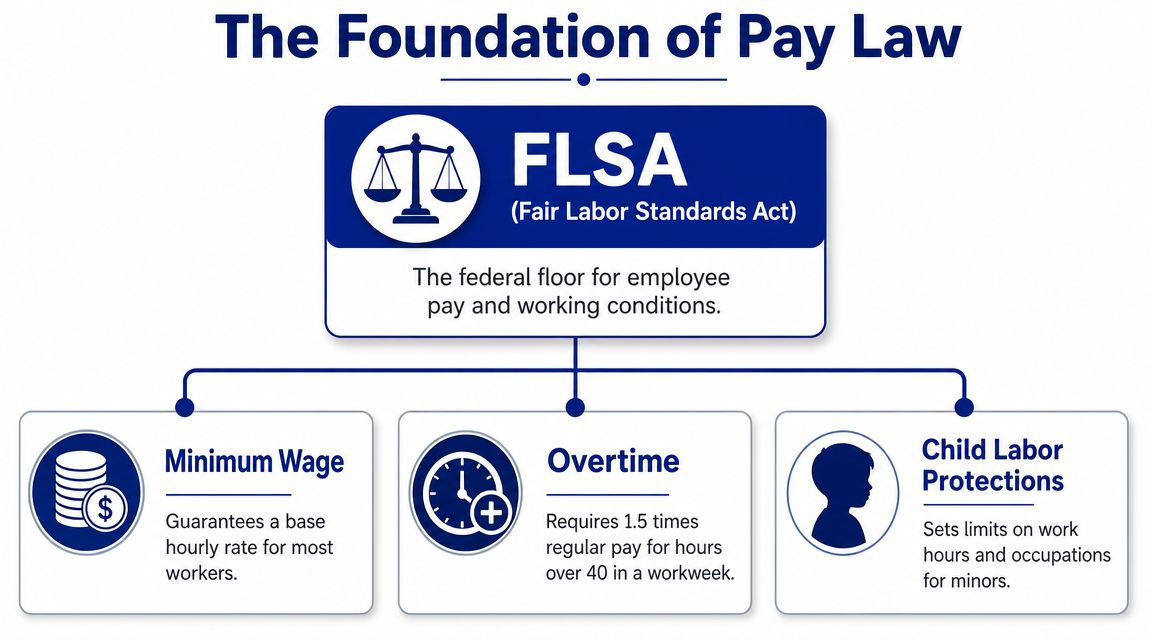
At the center is the Fair Labor Standards Act, or FLSA. It sets the federal baseline for minimum wage, overtime, and recordkeeping. That baseline matters, but it is only the starting point. State law may add stricter overtime rules, meal and rest period requirements, wage notice obligations, or timing rules for final pay. Some cities and counties add another layer.
The first question is rarely, “What does federal law require?” The better question is, “What rules apply to this employee in this location, and which standard gives the employee more protection?” That shift matters because wage claims are often driven by local practice, not abstract legal theory.
For a practical review, use this order:
| Level | What to check | Why it matters |
|---|---|---|
| Federal | FLSA baseline | Sets the national floor for pay practices |
| State | Wage and hour rules in the state where the work is performed | Common source of stricter standards |
| Local | City or county requirements, if any | May add another compliance layer |
| Policy | Your handbook, payroll settings, and manager practices | Internal inconsistency creates claims you could have prevented |
In small and midsize businesses, the actual failure point is not usually lack of effort. It is drift. Payroll follows one rule. Operations follows another. Managers fill gaps with informal instructions. Then a complaint arrives months later, after nobody has preserved the details of what happened.
Most wage and hour disputes trace back to four operating questions:
Those questions sound basic. They are also where manager liability and company liability start to overlap. A supervisor who edits time casually, tells employees to finish tasks after clocking out, or ignores missed meal periods can create exposure well before HR hears about it. In many businesses, employees do not report those issues right away because they assume the practice is normal or they do not want conflict with a direct manager.
That is why defensibility matters. A policy statement alone does not help much if local leaders are trained poorly, exceptions are undocumented, and payroll cannot trace how a paycheck was built.
Even in stricter states, the FLSA shapes how employers set up pay practices. It defines the federal framework for hours worked, overtime eligibility, and recordkeeping. If that foundation is weak, the business usually struggles more as state and local rules stack on top. The U.S. Department of Labor provides a general overview of these federal requirements on its FLSA compliance assistance page.
For business owners, the practical takeaway is straightforward. Wage and hour compliance is a control framework. It requires clear rules, payroll settings that match those rules, and manager behavior that does not undercut them. If you are reviewing roles next, a solid understanding of exempt vs. nonexempt classification standards then becomes important because the legal structure only works when each role is set up correctly from the start.
The most expensive classification mistake is also one of the most common: assuming salary equals exempt status. It doesn't. Paying someone on a salary basis may be part of the analysis, but it is not the full answer. The actual work performed still drives the decision.
That's where many multi-state businesses drift. A role gets promoted, the title becomes “manager” or “administrator,” payroll flips the person to salary, and nobody revisits whether the day-to-day duties support exemption.
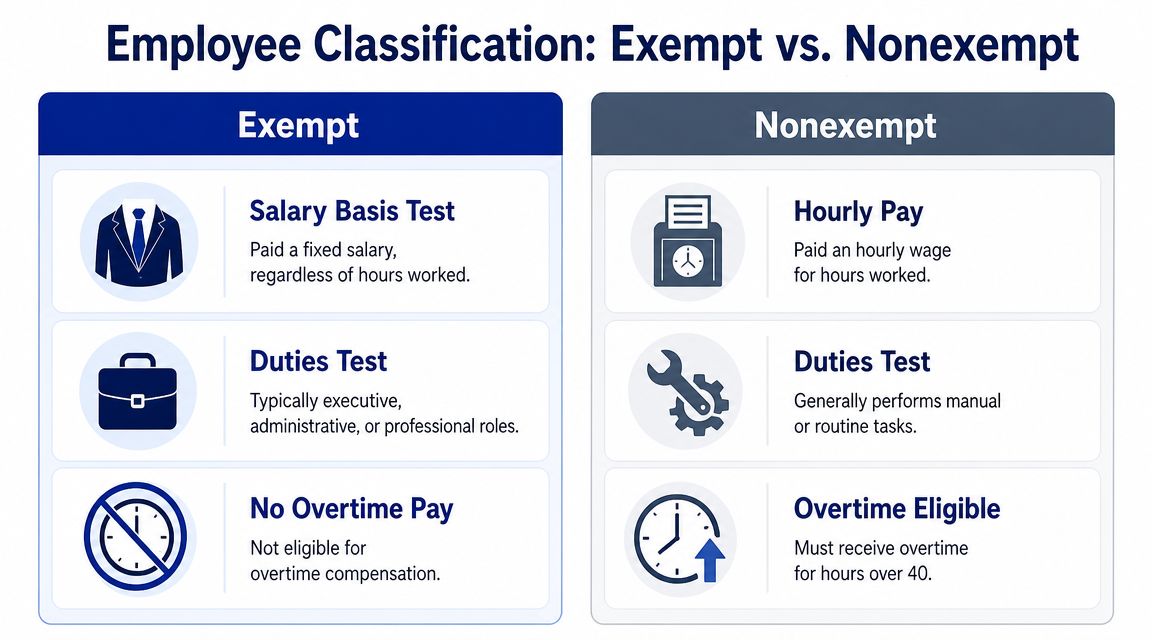
A sound classification review asks what the employee does most weeks. Job titles don't decide the issue. Neither does how valuable the employee is to the business.
Here's the practical distinction:
For business owners, the duties piece is usually where the risk sits. A person can supervise a shift occasionally and still be nonexempt. A salaried coordinator can handle important tasks and still be nonexempt. The label is not the analysis.
An executive-type role usually involves real management authority. Think hiring input, supervision, scheduling control, and accountability for directing work, not just being the most senior person on site.
An administrative-type role is often misunderstood. It does not mean “works in the office.” The closer question is whether the employee performs higher-level work tied to business operations and exercises meaningful judgment, rather than following a set process.
A professional-type role generally turns on specialized work requiring advanced knowledge. Again, the title alone won't answer it.
For teams that need a more focused breakdown, this guide on exempt vs nonexempt classification is a useful companion when reviewing role structures.
Some warning signs show up repeatedly in audits and internal reviews:
A good classification review compares three things side by side: the job description, the manager's description of the role, and a sample week of actual work. If those three don't align, don't trust the label.
The safest approach is disciplined skepticism. If a role is close, changing, or inconsistently managed across states, review it before a complaint forces the issue.
A common failure pattern looks like this. Payroll closes on time, overtime is paid, and leadership assumes the process is working. Months later, a complaint reveals that supervisors routinely trimmed early log-ins, ignored small after-hours tasks, or left bonuses out of the regular-rate calculation. The problem was not effort. It was a weak control system.

For nonexempt employees, overtime usually turns on more than hours over 40 in a workweek. The legal and practical question is whether payroll used the correct regular rate before applying the overtime premium. If the business leaves out nondiscretionary bonuses, shift differentials, commissions, or a flawed salary-to-hourly conversion, the math is off even when overtime hours appear on the check.
That distinction matters in audits and lawsuits. “We paid overtime” is not a strong defense if the underlying rate was understated.
Multi-state employers face an added complication. Payroll systems tend to standardize rules for efficiency, while wage and hour risk often shows up in local operating habits, manager edits, and state-specific pay practices. A defensible framework accounts for both. It gives payroll a clear calculation method and gives managers very little room to improvise.
An effective overtime review starts with the full workweek record, not just the final timecard total.
Check these elements together:
For owners building or refreshing payroll workflows, a practical outside reference is this guide to 2026 payroll requirements for SMEs, especially if your team is trying to align payroll setup with broader business controls.
The breakdown is usually operational, not technical. A location manager asks someone to sign in early for a handoff. A closing employee finishes cash-out after clocking out. An incentive payment hits payroll, but no one checks whether it changes the regular rate for that week. Each decision looks minor. Repeated across locations or managers, it becomes a pattern that is hard to defend.
Manager liability is part of the risk analysis here. In many cases, the person directing the work created the pay exposure, even if payroll processed exactly what it received. That is why training cannot stop at “approve timecards carefully.” Managers need a rule they can apply under pressure.
Manager rule: If you know the work happened, directed it, or accepted the benefit of it, send it for pay review.
That standard protects the business for a reason. Wage and hour issues often go unreported until an employee leaves, a new manager asks questions, or one location gets treated differently than another. By then, the dispute is no longer about one timesheet. It is about whether the company had controls strong enough to catch a predictable problem before it spread.
The practical goal is defensibility. HR sets the rule, payroll applies the pay logic, and operations follows a process that records all working time before payroll closes. If one of those functions works in isolation, overtime compliance becomes a trust-based system. Trust is not a control.
Most wage and hour problems come from ordinary habits that a business stopped noticing. The manager wants the store ready before opening. The clinic wants charting done before the next patient arrives. The office wants “quick cleanup” after clock-out. None of that sounds like a legal event in the moment. In aggregate, it becomes one.
Enforcement has remained active for years. Federal data summarized by CEPR shows more than 16,000 minimum-wage underpayment cases and more than 76,000 overtime underpayment cases from 2005 to 2020, involving nearly $570 million in back wages. The same analysis notes that the Wage and Hour Division reported recovering more than $259 million in back wages for nearly 176,957 employees in fiscal year 2025, averaging about $1,465 per worker. You can review those figures in CEPR's discussion of minimum wage compliance and enforcement incentives.
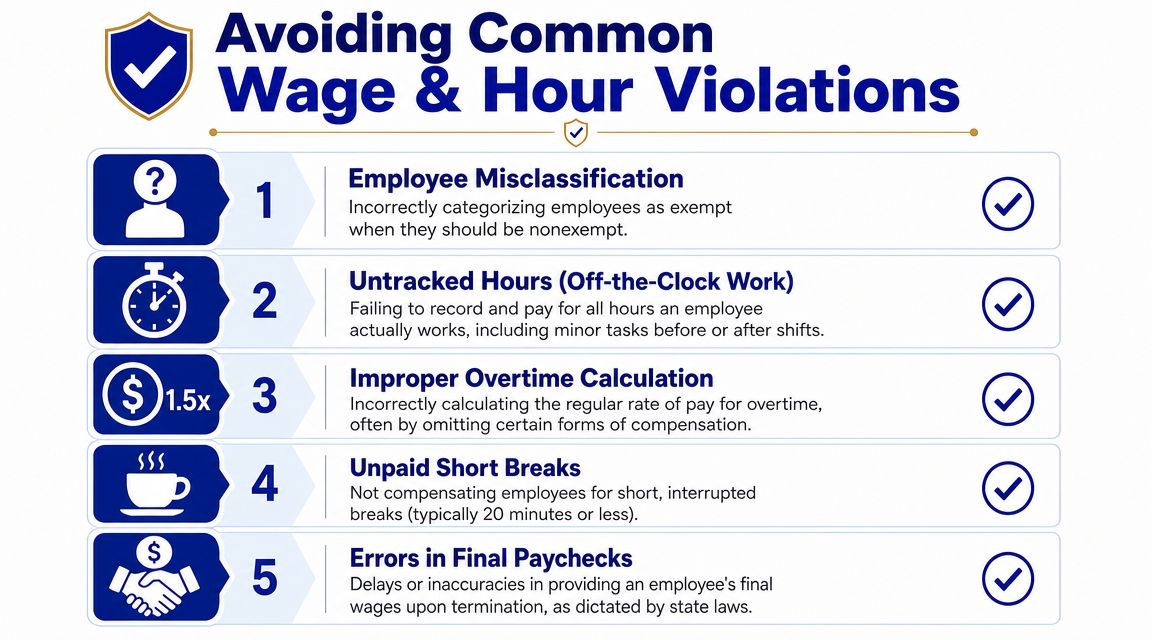
Ask whether any of these scenarios sound familiar:
Off-the-clock work after clock-out: Employees finish cleaning, respond to messages, or complete paperwork after the shift ends.
Fix: Require managers to record all time worked, then address policy violations separately. Never solve unauthorized work by refusing to pay for it.
Misclassification drift: Longtime salaried employees take on routine execution work while keeping exempt status.
Fix: Recheck classification when roles change, not only when jobs are created.
Improper overtime inputs: Payroll uses the base hourly rate and ignores other compensation that affects overtime.
Fix: Map each type of pay code to whether it should flow into the regular rate analysis.
Unpaid small tasks: Opening procedures, system logins, end-of-day reconciliation, and mandatory meetings fall outside scheduled hours.
Fix: Build those tasks into the paid schedule and make managers accountable for compliance.
Final pay mistakes: Terminations happen fast, payroll doesn't have complete hours, and the final check is inaccurate or delayed.
Fix: Use a termination checklist that routes time approval and payroll review before separation is finalized.
A surprising amount of risk comes from weak manager messaging. Telling employees to “be efficient,” “handle it quickly,” or “don't put down overtime unless approved” often produces underreported time. The business may not intend underpayment, but those instructions shape behavior.
What works better is operational clarity. Pay for all hours worked. Correct process issues through coaching and discipline, not through wage suppression.
Good records are not administrative clutter. They are evidence. When an employee questions pay, the business needs more than confidence that payroll was probably right. It needs documentation that can recreate what happened.
That is why recordkeeping should be treated like an internal control, not a filing exercise.
According to the Department of Labor guidance summarized in this discussion of effective wage and hour recordkeeping strategies, employers must keep payroll records for at least three years and wage-computation records for two years. The more practical point is just as important: the employer must be able to preserve and reconstruct the underlying time and pay data used to show hours worked and how wages were calculated.
If your records can't show the path from recorded time to actual pay, they are weaker than they look.
A defensible recordkeeping system should answer five questions quickly:
| Question | What record should answer it |
|---|---|
| Who was the employee and how were they classified? | Job description, classification review, compensation record |
| What time did they work? | Time entries, edits, approvals, attestation records |
| How was pay calculated? | Payroll register, pay code detail, wage computation support |
| Who changed anything? | Audit trail, manager approval, correction notes |
| Can this be reconstructed later? | Retention process and accessible archive |
That last point is where many businesses fall short. They retain pay stubs but lose the approvals, edit history, or source data behind the calculation.
The strongest systems usually include a few straightforward controls:
If your operation already thinks seriously about controls in other areas, the logic is similar to financial and billing environments. For example, the same mindset used to prevent fraud in medical practice applies here: preserve source data, limit unchecked edits, and make the audit trail visible.
For employers tightening documentation standards, this related resource on employment records retention requirements helps align wage and hour files with broader HR recordkeeping.
Missing records don't just create inconvenience. They weaken your credibility at the exact moment you need it most.
A business can survive an isolated payroll mistake more easily than it can survive a pattern it cannot explain.
A payroll manager finds a time-rounding problem on Tuesday. By Friday, leadership is discussing whether to terminate the employee who complained first. That is the point where a routine compliance issue becomes a business risk with legal, financial, and management consequences.
The trigger for escalation is not just the size of the wage error. It is the combination of pay practices, manager behavior, timing, and how many employees may be affected. In multi-state businesses, those factors can turn one complaint into a broader review of supervision, payroll controls, and decision-making.
Leadership should slow down when any of these facts show up at the same time:
Some state laws raise the pressure fast. In Colorado, for example, recent changes can expose certain owners with at least a 25% interest to personal liability, and adverse action within 90 days of protected activity can support an inference of retaliation, as explained in Fox Rothschild's analysis of Colorado wage act compliance risks. For an SMB, that changes the trade-off. Speed feels efficient, but a rushed response can create a record that is harder to defend than the original payroll mistake.
Escalation should follow a controlled process.
This is also where many employers make avoidable mistakes. They issue off-cycle payments without documenting why. They let the involved manager interview witnesses. They treat the complaint as an employee relations problem instead of a wage and hour problem with retaliation exposure. Those choices weaken credibility later.
A defensible framework protects more than payroll accuracy. It helps owners control manager liability, preserve decision quality under pressure, and surface problems early, before employees, agencies, or plaintiffs' counsel define the story first. International Inc. advises SMB leadership teams on that kind of structured escalation, especially where terminations, documentation, manager conduct, and multi-state compliance intersect.
If you are dealing with a pay issue that no longer looks isolated, or you want a wage and hour framework that holds up as your company grows, contact Paradigm International Inc. to continue the conversation.


