


A manager gives notice on Monday. By Tuesday, your leadership team is asking the same question every owner asks in that moment: what can they take with them, who can they call, and what can you stop? If you operate in more than one state, the answer usually isn't sitting in the contract template your company has used for years.
That's why business owners keep asking what is a non compete agreement. They're not asking for a textbook definition. They're asking whether the clause they already have will hold up, whether it's still worth using, and what to do instead when it won't.
The stakes are not small. Non-competes affect a large part of the workforce. Estimates place the number of covered American workers between 36 million and 60 million according to the U.S. Treasury's analysis of non-compete use. That alone should end the myth that non-competes are only for executives. They are common, heavily scrutinized, and risky when handled casually.
A departing employee creates two separate problems. The first is operational. You need coverage, client communication, and a clean handoff. The second is strategic. You need to know whether the person leaving can walk into a competitor, call on your customers, and use what they learned inside your business against you.
Many employers react by reaching for a non-compete because it feels broad and decisive. That instinct is understandable, but it's often sloppy. A non-compete can help protect real business interests. It can also become an expensive distraction if it was copied from a template, signed at the wrong time, or written too broadly to survive review.
The mistake usually starts with overestimating what a non-compete does. It does not give you ownership over a former employee's career. It does not let you block ordinary competition just because the departure is inconvenient. Courts generally look for a narrower rationale: protection of trade secrets, client relationships, proprietary know-how, or a similar legitimate business interest.
Practical rule: If your real concern is confidential information or customer poaching, a broad non-compete is often the wrong first tool.
Multi-state employers get burned fastest. A clause that looks standard in one state may be weak, void, or aggressively challenged in another. That's why this topic has shifted from routine hiring paperwork to a board-level risk issue for growing companies.
If you're leading an SMB in healthcare, professional services, tech, or another knowledge-driven business, the important question isn't whether non-competes exist. It's whether your agreements are targeted enough to protect what matters without creating legal exposure you didn't intend.
That means treating restrictive covenants as part of risk management, not paperwork. The strongest employers don't rely on one clause. They build a structure that matches the role, the jurisdiction, and the actual business threat.
A non-compete agreement is a contract that restricts an employee's ability to compete with the employer after the employment relationship ends. That's the simple definition. The legal reality is tougher. For the restriction to have a realistic chance of enforcement, it has to be reasonable.
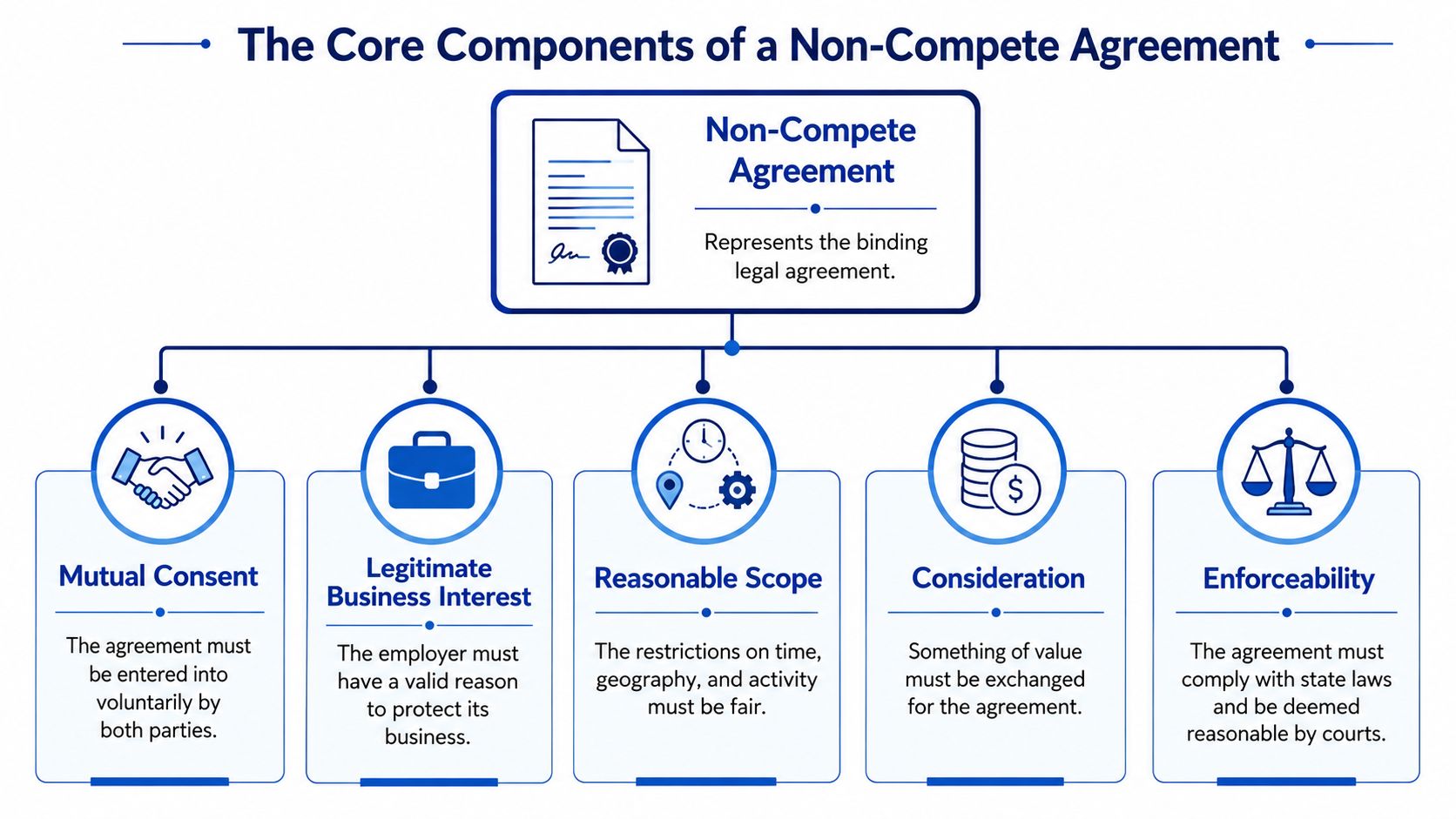
The reasonableness test usually turns on three core limits: time, geography, and activity. Cornell's overview notes that enforceability depends on reasonable restrictions, typically with duration in the 6 to 24 month range, a defined geographic scope such as a 50-mile radius, and a clear activity restriction. It also notes that California's Business and Professions Code §16600 makes most non-competes statutorily void. That baseline is summarized in Cornell's noncompetition agreement reference.
A non-compete needs boundaries. Without them, it starts to look like a restraint on working, not a protection of business interests.
Here's how to think about the three pillars:
| Component | Defensible approach | High-risk approach |
|---|---|---|
| Duration | Tie the restriction to the period you actually need to protect relationships or sensitive information | Picking an arbitrary long term because it feels safer |
| Geographic scope | Match the restriction to where the business actually operates or where the employee worked | Using nationwide or worldwide language without a real business basis |
| Activity scope | Limit the clause to the work that creates competitive risk | Barring work in any role, in any capacity, in any related industry |
A good non-compete says what the employee can't do with precision. A bad one says they can't work in anything remotely similar, anywhere, for too long. Courts tend to punish lazy drafting.
Specificity matters because judges don't like vague restrictions. “Cannot work for a competitor” is weak if you never define competitor, market, or prohibited conduct. “Cannot provide AI chip development services to direct competitors serving the same customer segment in states where the employee managed accounts” is at least aimed at a real risk.
The same issue applies to business interest. You need to know what you're protecting.
Narrow tailoring isn't a drafting preference. It's the difference between a usable agreement and a symbolic one.
A non-compete also needs valid consideration. In plain terms, the employee must receive something of value in exchange for the restriction. At hire, the job offer itself may serve that role in some jurisdictions. Mid-employment, you usually need something more concrete, such as a bonus, raise, promotion, or special training.
That is where many employers fail. They hand an existing employee a new agreement and assume a signature fixes everything. It doesn't.
Most employers use the term “non-compete” as a catch-all. That's a mistake. A non-compete is only one type of restrictive covenant, and in many cases it's not the best one.
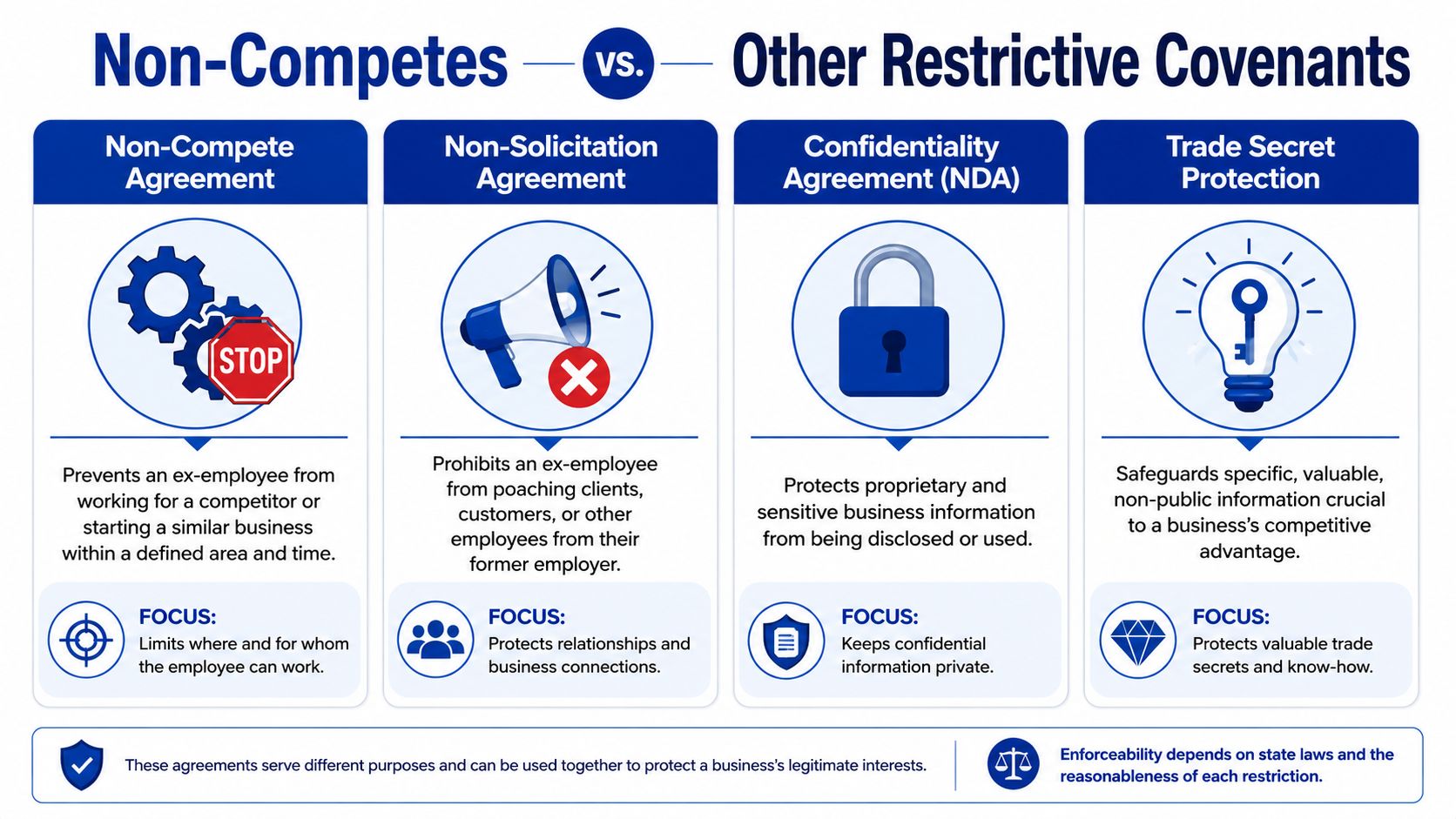
If you choose the wrong tool, you either overreach or leave a gap. The cleaner approach is to match the covenant to the actual threat.
Use this framework:
| Tool | What it protects | Best use |
|---|---|---|
| Non-compete | The competitive activity itself | Reserve for roles with real strategic exposure |
| Non-solicitation | Your customers, prospects, or employees | Strong option when poaching is the main concern |
| NDA or confidentiality agreement | Confidential information | Essential for nearly every sensitive role |
| Trade secret controls | High-value non-public information | Critical when your advantage depends on proprietary information |
An NDA protects your what. A non-solicitation clause protects your who. A non-compete tries to restrict the where and how of future competition.
For many SMBs, the strongest legal position comes from a layered combination of narrower restrictions. If your salesperson leaves, your main risk may be client solicitation. If your engineer leaves, the concern may be confidential information and product knowledge. Neither situation always justifies a broad post-employment ban on working.
That's why stronger employers often focus on:
A related strategy is protecting your business with garden leave, especially for senior employees with access to sensitive relationships or live strategic information. Garden leave can create breathing room without relying entirely on a post-employment non-compete.
If a narrower covenant solves the problem, use the narrower covenant. Broad restrictions attract attention. Focused restrictions are easier to defend.
Be careful not to write an NDA or non-solicitation clause so broadly that it effectively blocks someone from working at all. Once that happens, you may trigger the same scrutiny that makes non-competes difficult in the first place. The label on the clause won't save you. The practical effect matters.
There is no single national standard that makes non-competes simple. Employers still face a patchwork of state rules, and that patchwork is getting more fragmented, not less.
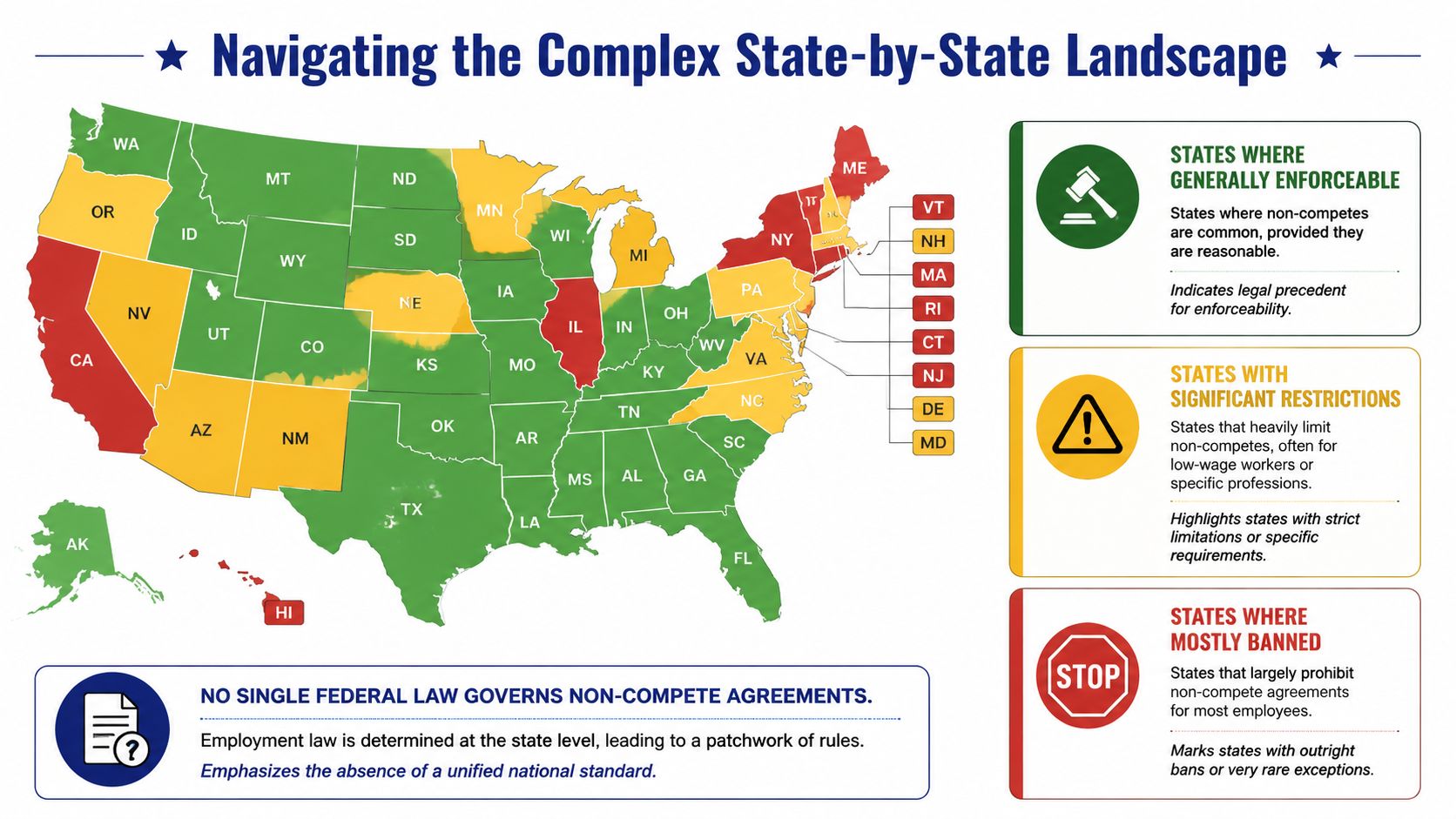
By 2024, four states had banned non-competes entirely, and 34 states plus D.C. had imposed some restrictions, according to the National Employment Law Project's FAQ on non-compete agreements. The policy shift accelerated after President Biden's July 5, 2021 Executive Order encouraging the FTC to ban or limit non-competes.
If you operate in one state, this is already important. If you operate across state lines, it's a contract governance issue.
A few examples make the point:
Companies often get trapped by “uniform” contracts. The same agreement sent to employees in several states can be partly enforceable for one worker, void for another, and affirmatively risky for a third.
Even with ongoing legal uncertainty around federal action, the FTC's 2024 rule changed employer behavior by forcing a hard question: if a broad class of non-competes may not survive scrutiny, what protections are still worth investing in?
That question matters more than the headline itself. The compliance impact is immediate. Legal review now has to account for federal pressure, state statutes, court treatment, and whether the clause could be viewed as overreaching.
For employers trying to track the broader shift, this overview on the nationwide ban on noncompete agreements is a useful starting point.
If you have employees in multiple states, stop thinking in terms of “our non-compete.” Start thinking in terms of role-based, state-aware restrictions.
Use this checklist:
The biggest non-compete risk for a multi-state SMB isn't employee departure. It's assuming one document can cover every jurisdiction.
Geography now shapes enforceability more than employer preference. If your contracts don't reflect that, they're not disciplined. They're outdated.
If you decide a non-compete is necessary, draft it like you expect a court to read every line. Because if enforcement becomes necessary, that's exactly what happens. Boilerplate is the enemy here.
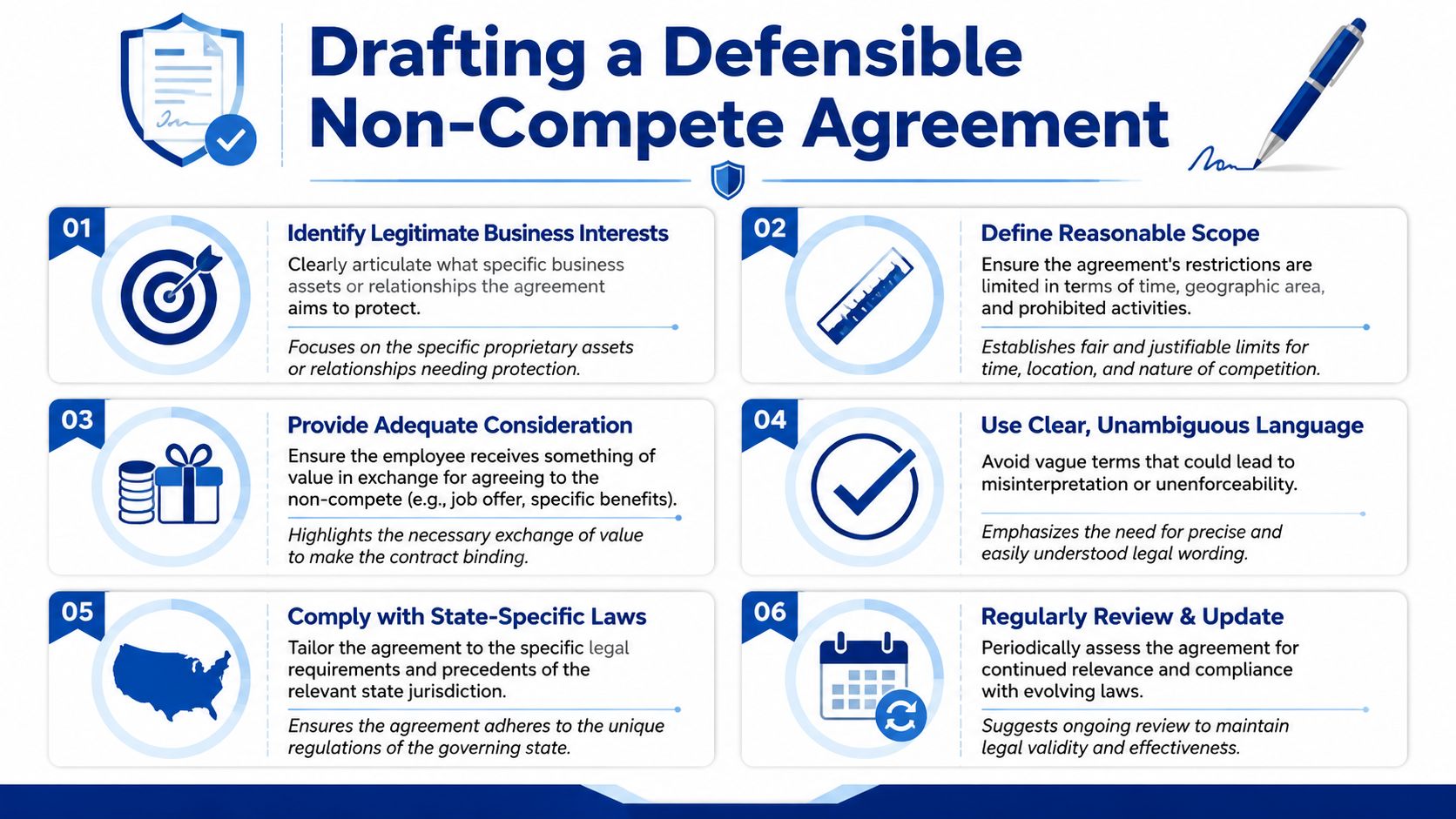
The strongest agreements are narrow, role-specific, and tied to a documented business need. The weakest ones are written as if every employee poses the same threat. They don't.
Before drafting any clause, answer one question plainly: what are you protecting?
If the answer is vague, stop. “We don't want people leaving” is not a protectable interest. “This executive has access to acquisition strategy, pricing models, and key customer relationships in states where we actively compete” is much closer to a defensible position.
Use a written internal rationale that identifies:
This is where discipline matters. A non-compete should reflect the employee's real work, not a generic fear of competition.
A stronger approach looks like this:
A weaker approach bans work “in any similar business” or “in any capacity” for an overly broad area. That language invites challenge.
Broad language makes management feel protected. Precise language is what gives you a chance in enforcement.
Consideration should be documented clearly. If the non-compete is signed at hire, make the offer contingent on signing where allowed. If it's introduced later, identify the extra value being provided.
Examples of consideration may include:
Don't bury this point. If you gave something of value, say so in the agreement and in the related employment records.
The contract should be readable by a manager, an employee, and a judge. Avoid bloated definitions and avoid trying to capture every imaginable threat in one sentence.
A practical process helps just as much as legal wording:
| Drafting issue | Better practice |
|---|---|
| Timing | Present the agreement before employment starts or pair later signing with clear consideration |
| Scope | Restrict only what creates actual competitive risk |
| Definitions | Define competitor, confidential information, and prohibited activity carefully |
| Process | Keep signed copies, offer records, and any consideration records together |
| Updates | Revisit restrictions after major promotions or changes in territory |
A defensible clause often sounds more like this in concept: the employee may not perform specified competitive functions for a direct competitor serving a defined market in a defined geography for a limited period, because the employee had access to identified confidential information and customer relationships.
That approach is surgical. It isn't dramatic. That's the point.
In the current environment, relying on non-competes as your primary defense is often the wrong strategy. The better model is layered protection. Use the narrowest effective tools first, then reserve non-competes for the small group of roles where they are justified.
The key shift is practical. Enforcement depends heavily on jurisdiction and reasonableness, and with the FTC's 2024 rule aiming to ban most new agreements, employers need to focus on safer alternatives. The question now is what restrictive covenants survive scrutiny and still protect the business.
A durable framework usually includes several controls working together:
Many employers obsess over contract language and ignore the basic controls that matter in a departure.
Do you disable access immediately when appropriate?
Do you know which employees downloaded sensitive files before resigning?
Do managers know how to transition customer relationships before a top producer leaves?
Those questions matter because a weak process can ruin a strong agreement. A restrictive covenant should support your controls, not substitute for them.
Good risk management starts before the resignation. If your only protection activates after the employee leaves, you're already late.
Use non-competes sparingly. They make the most sense where the employee has unusual access to strategy, trade secrets, or highly sensitive market relationships. For much of the workforce, narrower restrictions create less friction and usually hold up better.
That isn't a soft approach. It's a smarter one.
A non-compete should never be your default setting. It should be a deliberate decision tied to a real risk. If you use them broadly, you increase the odds of weak drafting, uneven enforcement, and unnecessary legal exposure.
The better approach is selective use. Reserve non-competes for sensitive roles. Pair them with consideration, solid NDAs, non-solicitation terms, and state-specific review. In some industries, that remains common practice. In healthcare, for example, non-competes are still standard in many settings, and 70% of physician employment contracts include them. Even there, viability depends on jurisdiction-specific review and a layered defense structure.
Use this decision test before putting a non-compete in front of any employee:
If the answer to any of those is no, revise the strategy before you circulate the agreement.
For leaders reviewing the broader compliance framework around hiring, contracts, and workplace obligations, this overview of employment law basics is a practical next step.
The employers who handle this well don't chase the broadest restriction. They choose the most defensible one.
If your leadership team is sorting through non-competes, multi-state contract issues, or broader employment risk decisions, Paradigm International Inc. can help you evaluate the exposure, tighten your approach, and put more defensible protections in place.


