
Receiving a formal write-up is often seen as a negative event, but for business owners and HR leaders, it's a critical tool for clear communication and risk management. A write-up officially documents an employee's performance issue or misconduct, moving the conversation from informal feedback to a structured, formal record. Understanding what a write-up at work is, when to use one, and how to do it correctly is a fundamental part of leading a fair and compliant organization. This guide breaks down the process into simple, actionable steps.
A workplace write-up is a formal document that records an employee’s performance issue or misconduct. It’s typically used after verbal warnings haven’t led to the necessary improvements. Think of it as a critical tool for both performance management and legal protection for your business. For leaders, especially those running businesses across multiple states, understanding exactly what a write-up at work means is a fundamental part of managing risk.

A properly handled write-up is much more than a disciplinary note—it’s a strategic asset. It creates a clear, factual record of an issue, spells out concrete expectations for improvement, and proves you have a fair and consistent process. This paper trail is essential for defending your organization against potential legal challenges, like wrongful termination claims.
Instead of seeing it as just a punitive step, consider the write-up a powerful tool for:
A strong write-up contains several key elements that make it both effective and legally defensible. Each component serves a specific purpose in creating a clear and objective record.
Getting these components right transforms a simple form into robust documentation that protects your business and gives your employees a fair chance to succeed. If you want to strengthen your company’s approach to employee documentation, we can help. Learn more by contacting us today.
Deciding to move from a conversation to a formal write-up is a key judgment call for any manager. A write-up should never be a surprise. It is the logical next step after you’ve already provided verbal coaching and informal feedback, but the problem persists or is too severe to ignore.
The shift from conversation to paper signals that the issue is serious enough to require an official response. It is necessary when you see a pattern of poor performance or behavior, or when a single incident is so significant it demands immediate documentation. The goal is to officially outline the problem, clarify expectations, and protect the company by showing you’ve followed a fair process.
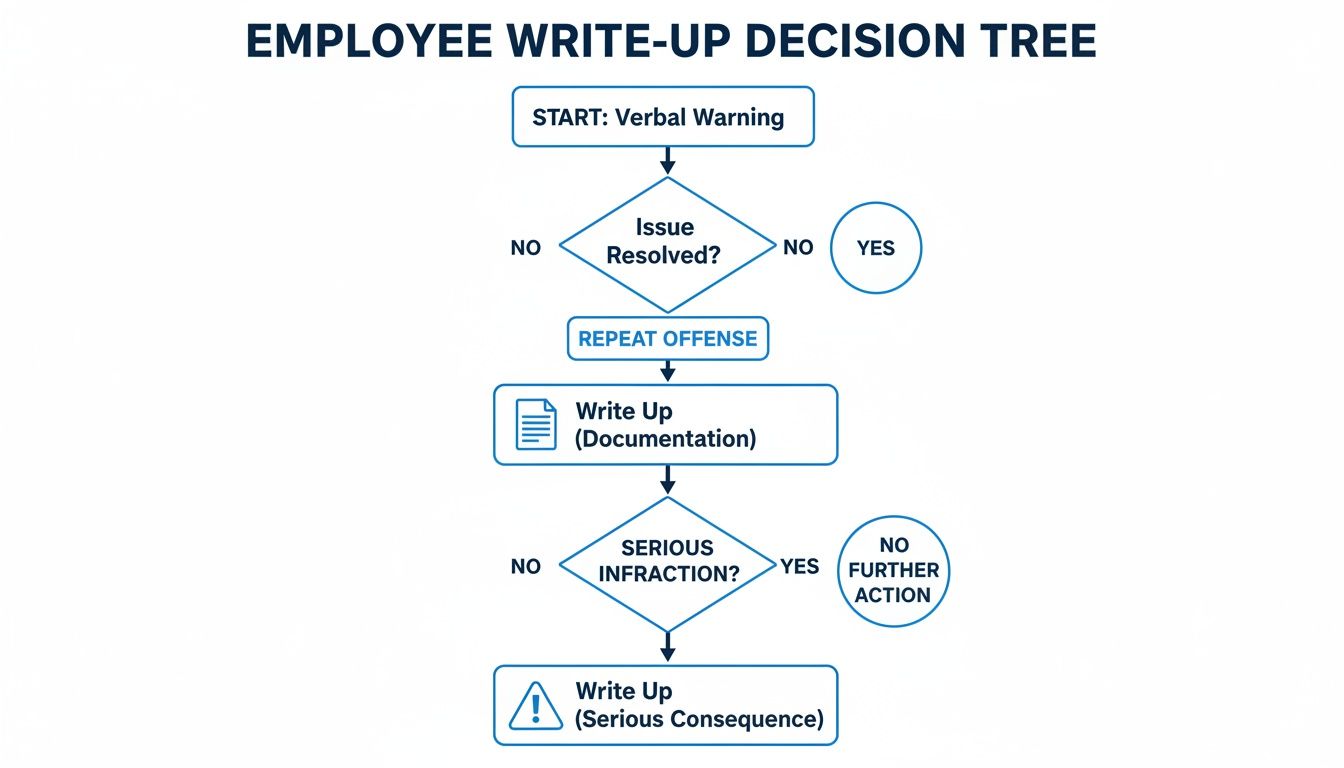
Most issues start with a conversation. But when those conversations don’t lead to change, or when the misconduct is serious, you need to escalate to a formal document. This establishes a clear record and signals the gravity of the situation. For a deeper look into this process, explore our guide on disciplinary action in the workplace.
Not every mistake needs a paper trail. Effective management involves knowing the difference between a coaching moment and an infraction that requires formal discipline. A minor error that an employee acknowledges and quickly corrects is a perfect opportunity for coaching, not a write-up.
However, some actions almost always require a more formal response. These are the situations where you need to start documenting immediately.
The severity and repetition of the behavior dictate the response. While a first-time minor issue warrants a conversation, repeated offenses or serious misconduct demand formal, written action to protect your business and ensure fairness.
Once you’ve decided a write-up is necessary, act promptly. Issuing the document as soon as possible after the incident is critical. If you wait, the facts can become unclear, the feedback loses its impact, and it may send a message that the issue wasn’t that serious. Acting quickly ensures the details are fresh and reinforces that company standards matter.
This proactive approach turns abstract rules into concrete expectations. If you need help creating defensible and effective documentation, our HR advisory team is here to help. Contact us to see how we partner with leaders to build consistent and compliant HR practices.
A write-up is your most critical tool during disciplinary action. For it to be effective and legally sound, it must be more than just a quick note. Think of it as building a case for improvement. Every piece of information you include adds to its strength and clarity, protecting your business while giving the employee a fair path forward.
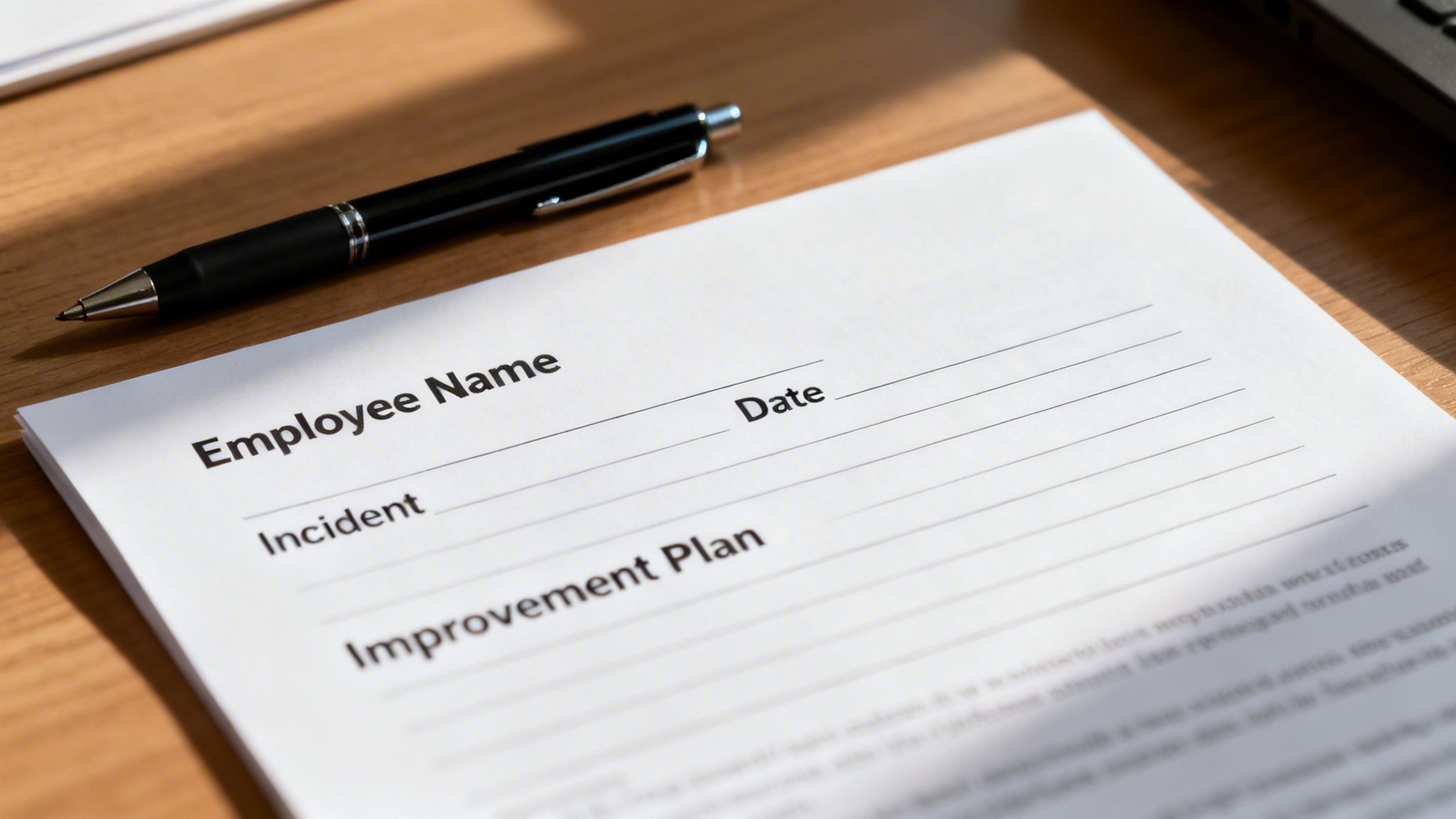
The foundation of a strong write-up is a consistent disciplinary process. This starts with understanding how to make a disciplinary action policy that guides your actions and ensures fair treatment. Once you have a solid policy, you can focus on getting the write-up itself right.
To build a form that is both corrective and defensible, make sure it covers these key areas. Leaving any of them out weakens the document's credibility and its power to correct behavior.
By including all these elements, you turn a simple form into robust documentation. A 2026 SHRM analysis confirmed that write-ups with a clear action plan were twice as likely to result in sustained performance improvement. For more detailed phrasing, see our guide on employee write-up examples.
Delivering a write-up is more than just handing over a document. It’s a critical conversation that, if handled poorly, can leave an employee feeling defensive. When done right, it provides clarity and a path toward improvement. How you manage this meeting determines whether it’s a constructive turning point or a damaging confrontation.

This conversation is where the facts of the write-up meet the human side of management. Getting it right shows your company is committed to fairness and process, which is essential for both morale and legal protection. Think of it as a structured dialogue, not a one-way lecture.
The environment you create is as important as what you say. Rushing the process or picking the wrong location can immediately set an adversarial tone. To ensure the meeting stays professional and focused, follow these steps:
The purpose of a witness is not to intimidate the employee. It is to ensure the conversation remains professional, fact-based, and accurately documented, which is a safeguard for both the employee and the organization.
Your tone and approach are everything. Staying calm, objective, and focused on the facts in the document is essential. Start by calmly stating the purpose of the meeting and walk the employee through each section of the write-up. Stick to the documented facts and avoid emotional language or personal opinions.
After you have explained the document, give the employee a chance to share their side of the story without interruption. This two-way dialogue is critical. It shows respect and can sometimes bring new information to light. Strengthening your internal processes starts with clear, defensible practices. If you need help refining your approach, Connect with our team today.
For businesses operating across state lines, HR compliance can be a significant challenge. What constitutes a legally sound disciplinary process in one state might be inadequate in another. Your approach to workplace write-ups must account for this patchwork of laws to avoid legal exposure.
Inconsistent disciplinary actions are a major red flag for regulatory bodies like the Equal Employment Opportunity Commission (EEOC). If you fire an employee in one state for an offense that only earned a verbal warning in another, it can create the appearance of discrimination or unfair treatment, even if it was unintentional.
While most states operate under at-will employment—meaning you can terminate an employee for almost any reason—this doctrine has its limits. Relying on it without a solid paper trail is a high-stakes gamble. States like California have strict requirements for documenting performance issues, while others like Texas are more employer-friendly.
Even in at-will states, a well-documented write-up is your best defense against a wrongful termination lawsuit. It serves as crucial proof that your decision was based on legitimate, non-discriminatory business reasons. A standardized yet flexible write-up process is the cornerstone of a multi-state risk management strategy.
Inconsistency is a magnet for legal trouble. If a manager in one office documents every minor issue while a manager in another office only gives verbal warnings, it suggests your company applies its own rules unfairly. This creates a major weak point in your legal defense. To head off these risks, ensure your write-up process is uniform in its core elements.
A few key legal areas to watch for include:
Effectively managing employee discipline across state lines is about precision and creating defensible practices. If you need help building a compliant framework, reach out to our team.
Even with a solid understanding of the process, workplace write-ups bring up many practical questions for managers. Here are answers to some of the most common concerns.
An employee’s signature is not an admission of guilt; it is simply an acknowledgment that they received the document. If an employee refuses to sign, it does not invalidate the write-up. Simply make a note on the signature line, such as "Employee declined to sign," and have your witness sign and date your note. The document remains a valid part of the employee's personnel file.
In most U.S. states with at-will employment, you can legally terminate an employee without prior warnings. However, doing so creates significant legal risk. Without a documented history of performance issues, a termination can appear arbitrary or discriminatory, opening the door to a wrongful termination lawsuit. Write-ups provide the critical evidence that you acted fairly and had a legitimate business reason for the separation.
Company policy usually dictates how long a write-up remains "active" for progressive discipline, which is typically 12 months. If the employee shows sustained improvement, the write-up may no longer be a factor in future decisions. However, the physical document itself should be kept in the employee's personnel file for several years to comply with federal and state record-keeping laws.
Yes, using a standardized template is a recommended best practice. It drives consistency and ensures every manager gathers the same information. The critical step is to have your template reviewed by legal counsel to ensure it is compliant with employment laws in every state where you operate. While the form is standardized, the content must always be customized with the specific, objective facts of the situation. You can discover more insights about defensible write-ups here.
In many cases, a write-up is the first formal step before a more structured intervention like a Performance Improvement Plan (PIP). To understand how these documents work together, check out our guide on how to write a performance improvement plan.
Navigating complex employee issues requires precision and defensible documentation. If you’re ready to strengthen your company’s HR practices and reduce employment risk, our team is here to help. Learn more about how we partner with leaders like you by contacting us.